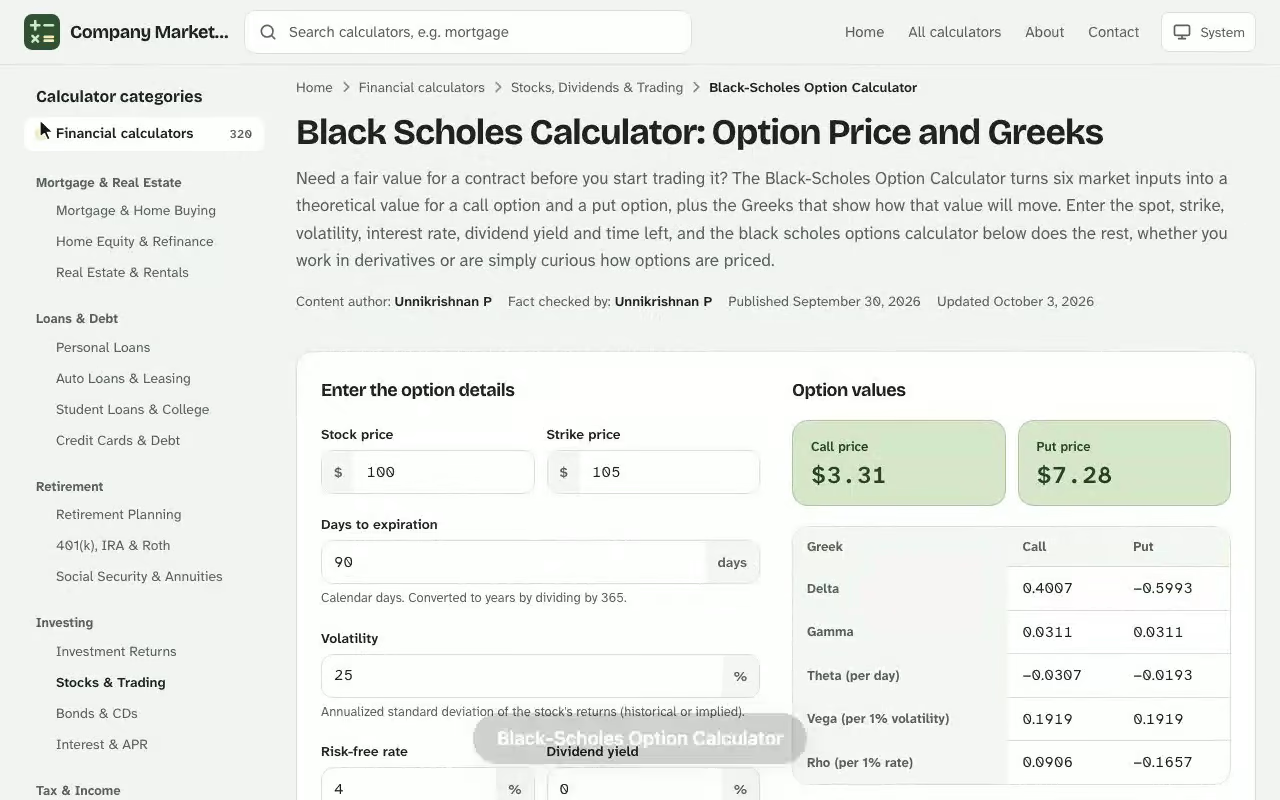
Black-Scholes Option Calculator. Need a fair value for a contract before you start trading it? The Black-Scholes Option Calculator turns six market inputs into a theoretical value for a call option and a put option, plus the Greeks that show how that value will move. Enter the spot, strike, volatility, interest rate, dividend yield and time left, and the black scholes options calculator below does the rest, whether you work in derivatives or are simply curious how options are priced. Next, open the pivot point calculator and enter your own details to see an estimate in seconds.
Option values
Call price
–
Put price
–
Option Greeks for the call and the put
Greek
Call
Put
Time to expiration–
d1 / N(d1)– / –
d2 / N(d2)– / –
Call intrinsic / time value– / –
Put intrinsic / time value– / –
Put-call parity: call − put = Se−qT − Ke−rT–
Prices are per share; a standard US equity option contract covers 100 shares. The model assumes European exercise and constant volatility, interest rate and dividend yield, so it is a theoretical value, not a market quote. American options can be worth more than these values when early exercise pays off.
Results are estimates for educational purposes and are not financial, tax or legal advice.
How the Black-Scholes Option Calculator Prices a Contract
The Black-Scholes model, also written Black-Scholes-Merton or BSM, is an options pricing model published in 1973 by Fisher Black and Myron Scholes, with Robert Merton extending the mathematical framework. It estimates what a European contract is worth today by building a risk-free portfolio from the underlying asset and a bond, so that no arbitrage profit is left on the table. Options traders and quantitative desks use the output as a valuation yardstick for securities with option features: a quote well below the model value looks cheap, one well above it looks expensive. Next, open the position sizing calculator and enter your own details to see an estimate in seconds.
A stock option gives its owner the right, not the obligation, to buy or sell shares at a fixed strike on or before the expiration date. A call option is the right to buy, and a put option is the right to sell. The calculator prices both at once, so you can compare the premium for each side of the same strike. Options let you hedge an existing investment or speculate on a move in stocks and other assets, and the expected return profile differs from simply owning the underlying asset. The calculator returns the call and put premium for the same strike in one step.
The Black Scholes Formula for Call and Put Values
The Black Scholes formula for a call is shown first, followed by the put:
Here \(S_0\) is the stock price, \(K\) the strike price, \(T\) the time to expiration in years, \(r\) the risk-free rate, \(q\) the dividend yield and \(\sigma\) the annualized volatility. \(N(x)\) is the cumulative standard normal distribution, which turns \(d_1\) and \(d_2\) into probability-like weights. This mathematical Black Scholes equation is the closed-form answer to a partial differential equation describing how the underlying asset price drifts, and every tool on this page follows it.
Inputs the Black Scholes Model Calculator Needs
Every field maps to one symbol in the formula, so a single wrong entry changes the whole result. The table lists what to enter and where to find it. If you want to see how the figures change, the stock valuation confidence interval calculator gives you an instant result you can adjust as you go.
Input
Symbol
What to enter
Stock price
\(S_0\)
The current price of the underlying stock, also called the spot price
Strike price
\(K\)
The exercise price written into the option contract
Time to expiration
\(T\)
Years remaining until the expiration date (days divided by 365)
Volatility
\(\sigma\)
The annualized volatility of the stock, as a percentage
Risk-free interest rate
\(r\)
A Treasury yield matching the option's life
Dividend yield
\(q\)
Expected annual dividend as a percentage of the stock price
Choosing a Risk-Free Rate and Dividend Yield
Risk-free rate: use the Treasury bill or note yield closest to the option's remaining life; the rate is assumed constant until expiry.
Dividend yield: enter the forecast annual dividend divided by the stock price; use 0 for a stock that pays no dividend.
Strike and spot: take both straight from your broker's option chain so the strike matches the contract you are valuing.
Estimating Volatility and Time to Expiration
Volatility is the standard deviation of the stock's returns, scaled to a year. You can enter historical volatility from past prices, or the implied volatility backed out of a market quote; the second reflects what the market expects. Time to maturity must be expressed in years, so 120 days to expiration becomes 120 / 365, or 0.329; maturity here is simply the contract's final date. Because volatility feeds both \(d_1\) and \(d_2\), it is the input to double-check first.
Worked Example: Pricing a Six-Month Contract
Pick the option type, call or put, and suppose a stock trades at $62.40 and you are valuing a contract with a $65.00 strike price, six months (0.5 years) to expiry, 31% volatility, a 4.35% risk-free interest rate and a 1.2% dividend yield. First the intermediate terms:
The normal distribution gives \(N(d_1) = 0.4981\) and \(N(d_2) = 0.4114\), and the formula returns a call option price of $4.73 and a put option price of $6.31.
Result
Call
Put
Theoretical value
$4.73
$6.31
Intrinsic value
$0.00
$2.60
Time value
$4.73
$3.71
Delta
0.495
-0.499
Rho (per 1%)
0.131
-0.187
Theta (per day)
-0.017
-0.011
Check the answer with put-call parity: the call minus the put is -1.57, which equals the discounted stock price minus the discounted strike, so the two values are consistent.
Why Put-Call Parity Is a Useful Cross-Check
After you run the calculator, put-call parity ties its two outputs together: the call minus the put must equal the discounted spot minus the discounted strike. In the example the gap is -1.57, which matches the stock price, strike price, rate and yield you entered. If a rerun stops matching that identity, a field has been mistyped, most often a percentage typed as a decimal or days typed where years belong.
Reading the Output: Intrinsic Value, Time Value and Fair Value
The theoretical value of an option splits into two pieces. Intrinsic value is what exercising would pay today: for the put in the example, $65.00 minus $62.40 gives $2.60. Time value is the rest, the price of the chance that the stock moves further before expiry. The call is out of the money, so its whole $4.73 is time value, and the Black Scholes model's output of $6.31 for the put reflects the same split. This split tells you how much of a quote you are paying for protection against what has already happened versus what might still happen.
The put's $6.31 theoretical value split into intrinsic value and time value.See how the Black-Scholes Option Calculator works: change the inputs and the call price updates instantly. Enter your own numbers in the calculator above.
Compare the figure to the fair market price you see on screen. A listed premium well under the fair value may be a bargain; one well above it implies traders expect more volatility than you entered. Reading that gap in terms of implied volatility is often more useful than comparing prices alone.
Option Greeks Explained: Delta, Gamma, Vega, Theta and Rho
The Greeks measure the risk sensitivity of a position, so they answer how the value moves when one input shifts. Many calculators, including those aimed at advanced traders, also show lambda, psi, vanna and volga.
Delta is the change in option price for a one-unit move in the underlying asset; a call delta of 0.495 means about $0.50 per $1.00.
Gamma is the rate of change of delta as the underlying price moves, and peaks at-the-money.
Vega is the change per one-point move in volatility; here, 0.175 per 1%.
Theta is time decay, the value lost each day as expiration approaches.
Rho is sensitivity to the rate on the risk-free asset.
Using Greeks for Hedging and Position Risk
A delta neutral position offsets directional exposure, so traders add or remove units of the underlying asset until net delta is near zero. Because gamma changes delta as the price moves, dynamic hedging has to be repeated, and the cost of rebalancing is highest where gamma peaks. Vega matters around earnings releases, when volatility tends to expand.
Call value against stock price for the worked example: $4.73 at $62.40, delta 0.495.
How Volatility, Time and Spot Price Move the Result
Volatility is the most powerful lever in the calculator. Holding the other worked-example inputs fixed, the call value climbs from $2.98 at 21% volatility to $4.73 at 31% and $6.48 at 41%. Time works the same way: the call is worth $2.95 with three months left, $4.73 with six and $7.34 with a full year.
Call value across volatility and time, with the six-month, 31% worked-example cell outlined.
Volatility
3 months
6 months
12 months
21%
$1.74
$2.98
$4.90
31%
$2.95
$4.73
$7.34
41%
$4.19
$6.48
$9.78
Checking a Protective Put Quote with the Black Scholes Calculator
A fund manager holds 600 shares of a stock trading at $148.35 and wants downside cover through a 91-day, $140.00 put. The broker quotes $5.60. Before paying, the manager opens the calculator to see whether that quote matches the model's theoretical value.
The entries come from three places: a spot of $148.35 from the screen, a strike of $140.00 from the option chain, and 91 / 365 = 0.2493 years to expiry. The 3-month Treasury bill yield of 4.12% goes in as the risk-free rate, the stock pays no dividend so the yield is 0%, and 38.4% volatility comes from the stock's trailing one-year price history.
Theoretical put value: $6.75
Put delta: -0.326
Vega: 0.267 per volatility point
Theta: -$0.050 per day
The quote of $5.60 sits $1.15 below the model's theoretical value, which looks like a bargain until the manager reverses the question. Solving for the volatility that returns $5.60 gives 34.1%, so the market is pricing 4.3 points less volatility than the stock's own history. A rerun at 34.1% confirms $5.60, so the difference is a volatility view, not an arithmetic error.
The delta turns the result into a decision. Six contracts cover 600 shares and cost $3,360 (6 x 100 x $5.60). At -0.326 per share, they offset about 196 shares of price movement, leaving the position with a net delta near 404 shares, enough protection against a gap below $140.00 that the manager buys all six and schedules a recheck of delta in two weeks, when theta will have removed about $0.70 per contract.
Model Assumptions and Limits of the Option Pricing Model
No option pricing model is a crystal ball. The Black-Scholes model assumes the stock follows geometric Brownian motion, that volatility and the interest rate stay constant, and that trading happens in an efficient market with no transaction costs. Real markets show a volatility smile, where different strikes imply different volatility, so the calculator's single volatility input is a simplification.
It is built for European options: a European option can only be exercised on the expiration date.
An American option can be exercised early, so a binomial tree or Monte Carlo simulation may suit that asset better.
Exotic options with path-dependent payoffs need other methods too.
Treat the output of any black scholes calculator as a guide for decisions, not an exact forecast.
Black Scholes Option Pricing Calculator Versus Quoted Premiums
Why does an exchange quote differ from the model? The quote reflects supply, demand and the bid-ask spread, while the model value reflects only your six inputs. Quants in options trading often turn the question around and solve for implied volatility using a numerical routine such as Newton-Raphson. The calculator values one contract at a time, which suits a single quote check.
The Black-Scholes calculator is also handy for sanity checks on a trade. Change one input at a time and watch the premium respond; that simple scenario analysis shows which assumption your view really depends on.
Use this black scholes option calculator, or any options calculator, as a starting point: confirm the strike, spot and expiry, then compare its theoretical price with the market before you trade.
Black-Scholes Option Calculator questions
What does the Black-Scholes model calculate?
It estimates the theoretical fair value of a European call or put option from the stock price, strike price, time to maturity, volatility, risk-free interest rate and dividend yield.
Which interest rate should I use?
Use a Treasury bill or note yield whose term is close to the option's remaining life, entered as an annual percentage. The model assumes it stays constant until expiry.
How do I choose the volatility input?
Enter annualized volatility as a percentage. You can use historical volatility from past stock returns, or the implied volatility derived from a market option quote.
Why does the result differ from the market quote?
Market quotes reflect supply, demand and the bid-ask spread, and imply their own volatility. The model value only reflects the six inputs you enter, so a gap is normal.
Can I use it for American options?
The Black-Scholes model is built for European options that can only be exercised at expiry. For American options, which can be exercised early, the result is only an approximation.
What if the stock pays no dividend?
Set the dividend yield to 0. The formula then reduces to the original Black-Scholes version without a dividend adjustment.
What are the main limits of the model?
It assumes constant volatility and interest rates, efficient markets and no transaction costs, while real volatility varies by strike and expiry (the volatility smile).