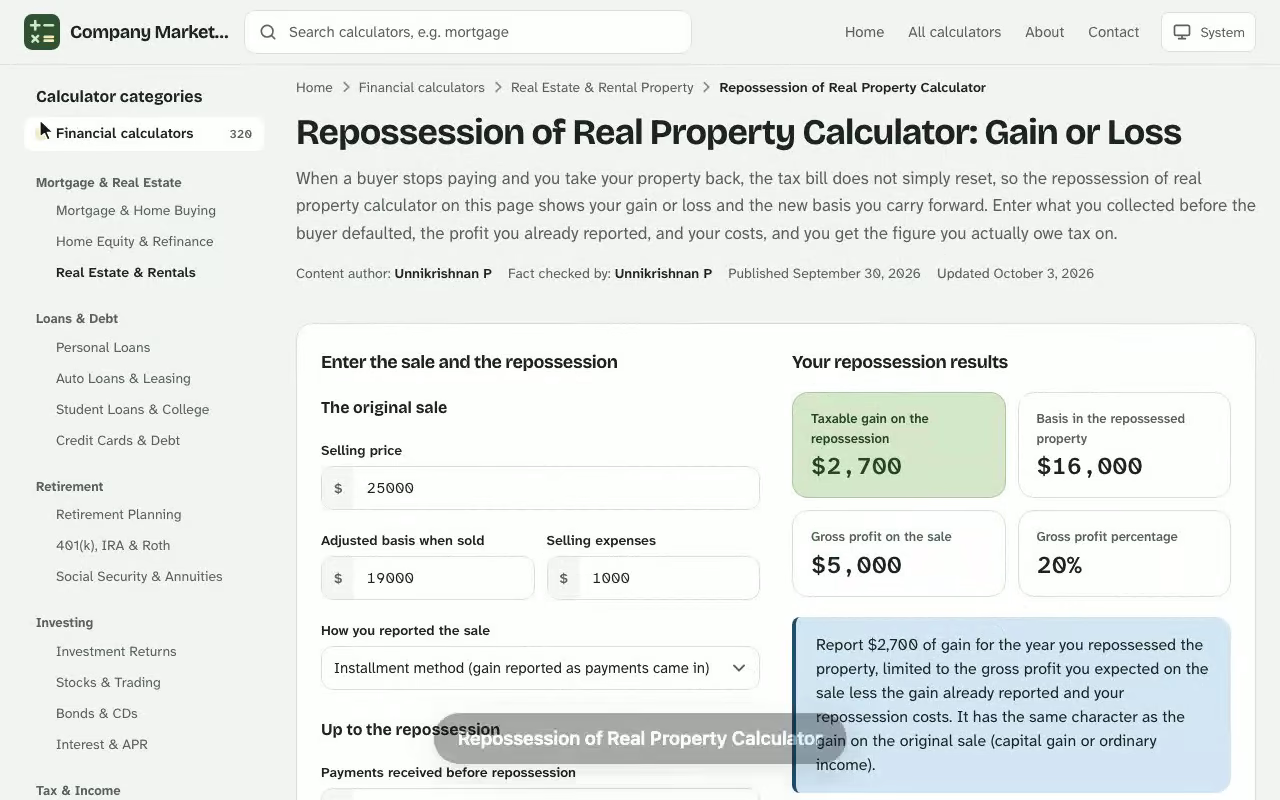
Repossession of Real Property Calculator. When a buyer stops paying and you take your property back, the tax bill does not simply reset, so the repossession of real property calculator on this page shows your gain or loss and the new basis you carry forward. Enter what you collected before the buyer defaulted, the profit you already reported, and your costs, and you get the figure you actually owe tax on. The rent calculator online uses the same plain-English approach, so you can compare results side by side.
Your repossession results
Taxable gain on the repossession
–
Basis in the repossessed property
–
Gross profit on the sale
–
Gross profit percentage
–
–
Contract price–
Gain you would have reported so far–
Bad debt recovery taxed this year–
Taxable gain worksheet
The line-by-line calculation of the gain on taking the property back, as laid out in IRS Publication 537.
Line
What it holds
Amount
Basis worksheet
Your new basis is the untaxed part of the note plus the gain you report now and your repossession costs, which roughly restores the basis you had before the sale.
Line
What it holds
Amount
If you later resell the property, your holding period includes the time you owned it before the original sale plus the time since the repossession, but not the time the buyer held it.
Results are estimates for educational purposes and are not financial, tax or legal advice.
Repossession of Real Property Calculator Definitions
Every number you type into the calculator maps to one line of the IRS repossession rules for installment sales. Getting each input right matters more than the arithmetic, because the same five values drive both the taxable gain and your basis in the repossessed land or building. Here is what each field means. If you want to see how the figures change, the real estate calculator online gives you an instant result you can adjust as you go.
Total amount received
This is every dollar of cash and the fair market value of any other property the buyer handed over before the default: the down payment, the regular monthly payments, and any extra principal they paid down. Interest is not part of this figure, since interest is taxed as ordinary income in the year you receive it.
Gain previously reported
Under installment reporting you pay tax on a slice of each payment, so part of the profit has already been taxed. Enter that slice here, including any gain that was deferred or excluded from tax, such as the home sale exclusion explained in IRS topic 701. The calculator subtracts it so you never pay taxes on the same profit twice.
Original basis
Your original basis is what you paid for the property plus qualifying improvements, less depreciation you claimed, and including the sales expenses from the first sale. A building you bought for $190,000 and upgraded with $57,300 of home improvements carries a basis of $247,300. If you inherited it, your stepped-up basis is the value on the date of death, and a swap through a 1031 exchange carries the old basis forward.
Gain on original sale
This is the full profit you were going to earn when you sold: sale price minus your cost basis. It acts as a ceiling, because repossession can never create more taxable gain than the original deal promised.
Repossession costs
Legal fees, court filing charges, and other expenses you pay to retake the property go here. They shrink the capped gain and they are added to your new basis, so a larger entry never hurts you.
Gain or Loss Formula for Repossessed Real Estate
Two tests decide how much gain you recognize, and the calculator applies the smaller result. The first test measures what you collected beyond the profit already taxed. The second caps the answer at the original deal's remaining profit after costs. Next, open the rent vs buy calculator and enter your own details to see an estimate in seconds.
A result below zero is treated as zero. Under section 1038 of the Internal Revenue Code, you do not recognize a loss when you reclaim real property that you sold on the installment plan, so the lowest your reportable figure can reach is $0.
Reportable gain after costs
The cap in the formula is where costs matter. Subtracting them lowers the ceiling, so when the second test is the smaller one, each dollar of costs lowers your taxable amount by a dollar. When the first test is smaller, the costs do not change the gain and only raise your new basis.
Input or result
Where it comes from
Effect
Total amount received
Payments before default
Raises gain, lowers basis
Gain previously reported
Earlier tax returns
Lowers gain
Gain on original sale
Price minus basis
Sets the ceiling
Repossession costs
Legal and recovery expenses
Lowers ceiling, raises basis
Worked Example of an Installment Sale Taken Back
Suppose you sold land with a small building for a sale price of $418,000, and your original basis was $247,300. The gain on original sale is therefore $170,700, which is 40.84% of the price. The buyer paid $171,000 before defaulting, so you reported $69,832 of gain over the years. Reclaiming the property cost you $6,850.
Received minus reported: $171,000 − $69,832 = $101,168.
Ceiling after costs: $170,700 − $69,832 − $6,850 = $94,018.
Reportable gain is the smaller figure: $94,018.
In this case the second test governs, so the full $6,850 of costs reduces your tax liability base. Without costs, the gain would have been $100,868.
The smaller of the two tests, $94,018, is the gain reported in the worked example.
Original Basis and New Basis After Taking Property Back
Your new basis is what you use later to compute depreciation or a future sale. It begins with the adjusted basis of the unpaid note, adds the gain you just recognized, and then adds your costs.
With the example above: $247,300 − $171,000 + $69,832 + $94,018 + $6,850 = $247,000. That is the amount you can later subtract from a future sale when you work out the capital gain.
How the new basis of $247,000 is built from the worked example's figures.
Capital gains rates after you resell
The new basis is the number your next buyer's price is measured against: on a later resale you subtract $247,000 from the selling price, and only the remainder is taxed under the capital gains schedule. Your filing status and taxable income decide whether those capital gain rates are 0%, 15% or 20%, and they apply on top of the repossession gain you already reported, so check your tax bracket before choosing a listing price. A former home may still qualify for the primary residencededuction described earlier, which a tax professional can confirm against your basis.
Checking a Repossessed Duplex: Gain or Loss and New Basis
Marguerite Oyelaran sold a duplex in 2021 for $286,400 on a ten-year note, and in March the buyer stopped paying after 31 months. Her closing statement shows an adjusted basis of $201,950, so the original deal promised $84,450 of profit. Before she calls her accountant, she opens the repossession calculator and enters what she has in her folder.
Total amount received: $98,300, taken from her payment ledger (down payment plus principal).
Gain previously reported: $28,985, the installment slice on her 2021 to 2023 Form 6252 schedules.
Original basis: $201,950.
Gain on original sale: $84,450.
Repossession costs: $4,175, covering the attorney's retainer and the court filing.
The first test returns $98,300 − $28,985 = $69,315. The second subtracts her reported gain and costs from the $84,450 ceiling and returns $51,290. Because the second is smaller, her reportable gain after costs is $51,290, and the repossession calculator shows a new basis of $188,100 ($201,950 − $98,300 + $28,985 + $51,290 + $4,175).
She compares the result with the section 1038 ceiling, which her tax software also lists, and the figures agree. Then she makes two decisions. She reports $51,290 on the year of repossession rather than splitting it across years. She also reruns the inputs with her attorney's final invoice of $5,020 in place of $4,175, and watches the reportable gain fall to $50,445, which tells her to wait for the final bill before filing.
Seller Financing, Balloon Payments and Repossession
Most repossessions of land and buildings start with a note you wrote yourself rather than a bank mortgage, which is why the deal's structure matters.
See how the Repossession of Real Property Calculator works: change the inputs and the taxable gain on the repossession updates instantly. Enter your own numbers in the calculator above.
Seller financing and owner financing
With seller financing, also called owner financing, you act as the lender and the buyer pays you directly. The interest rate must at least match the Applicable Federal Rate, or the IRS can impute interest. Installment reporting under Section 453 spreads your tax savings across years, which is the very reason the repossession rules exist: they undo that deferral fairly when the sale fails.
Balloon payment and loan term
A balloon payment is a lump-sum payment due at the end of a short loan term even though the amortization schedule runs longer. Buyers who cannot refinance that lump often default. Payments you received count toward the total, but the unpaid remaining balance does not.
Mortgage payoff and loan balance
If the buyer's own mortgage or a senior lien survives, you must pay that loan balance to keep the property, and the payoff goes into the repossession costs field, which also raises your new basis. Weigh it against the home equity you regain, since a heavy lien can swallow the net proceeds of a later sale after its closing costs.
Taxes on Repossessed Real Estate: What the IRS Expects
Treat the figures from the calculator as estimates that feed your return, not a substitute for it. Report the recognized amount on the year of repossession, keep the documentation (the original contract, payment ledger and legal invoices), and file the installment sale schedule that tracked installment receipts.
Keep a payment ledger showing each installment and the portion that was principal or interest.
Save every invoice for repossession costs.
Confirm that no risk of a second claim remains on the asset.
Personal property follows different rules, so a repossession of personal property such as equipment or a vehicle needs its own worksheet. This page offers general information rather than tax advice, so a licensed adviser should review your financial and finance records, and the repossession gain and new basis, before you file.
What Your New Basis Means for the Next Sale or Rental of Repossessed Real Estate
Once the title is back in your name, the figures from the calculator keep working: the new basis sets your depreciation if you rent the property and your gain if you resell it.
Rent the property and depreciate from the new basis
If you rent the building, rental income is taxable, and depreciation is figured from the new basis rather than the old one, so a precise basis protects those yearly deductions. Land is not depreciated, so split the $247,000 between land and building using your property tax assessment.
Capital gains tax on the next resale
Your holding period for the next sale generally includes the time you owned the property before the first sale, which often moves a quick resale into long-term treatment. The capital gains tax on that second sale depends on the difference between the new selling price and your new basis, so a precise basis keeps you from overpaying. If you finance that sale again, any down payment you collect is a first payment under a fresh installment calculation, which starts from the new basis.
Improvements that raise the new basis again
Repairs that add value, such as a new roof or code fixes, increase the basis again and can reduce the taxable amount on the next sale, so treat each as an investment in the property's basis and keep every receipt. Ordinary upkeep does not raise it. A second investment of this kind also builds equity you can borrow against or recover at resale. Recovery fees already entered as repossession costs should not be counted twice.
Keep receipts for every improvement made after you retake the property.
Record the date you regained possession, since it starts the new basis.
Separate repairs from upkeep, because only repairs that add value raise your basis.
with Repossessed Real Estate
Most errors come from mixing up the deal you made with the deal you finished.
Counting interest payments as part of the amount received.
Forgetting the profit that was excluded or deferred on earlier returns.
Adding costs to the gain instead of subtracting them from the ceiling.
Expecting to recoup a deductible loss, when the rules disallow it.
Treating the repossessed property as brand new, with a basis equal to the old price.
Once your numbers are right, you know the exact loan shortfall you absorbed, the taxable amount for this year, and the basis you will use on the next sale.
Repossession of Real Property Calculator questions
What does the repossession of real property calculator tell me?
It shows the gain you recognize when you take back real property you sold on the installment plan, the same gain after repossession costs, and the new basis you carry in the property.
Can I claim a loss when I repossess real property?
Generally no. Under section 1038 of the Internal Revenue Code you do not recognize a loss when you reclaim real property sold on installments, so the lowest reportable gain is zero.
How do repossession costs change the result?
Costs lower the ceiling on your gain and are added to your new basis. When the ceiling is the smaller of the two tests, each dollar of cost reduces your reportable gain by a dollar.
What counts as the total amount received?
Cash and the fair market value of other property you received before the repossession, including the down payment and principal payments. Interest is not included because it is taxed as ordinary income when received.
How is the new basis calculated?
Your original basis, minus what you received, plus the gain previously reported, plus the gain recognized on repossession, plus repossession costs.
Does this work for personal property?
No. Repossession of personal property sold on installments follows different rules and has its own worksheet.
What if I already excluded or deferred part of the gain?
Enter that amount as gain previously reported, deferred or excluded. It reduces the new gain so the same profit is not taxed twice.
Is this tax advice?
No. The results are estimates for planning, so have a tax professional review your figures before you file.