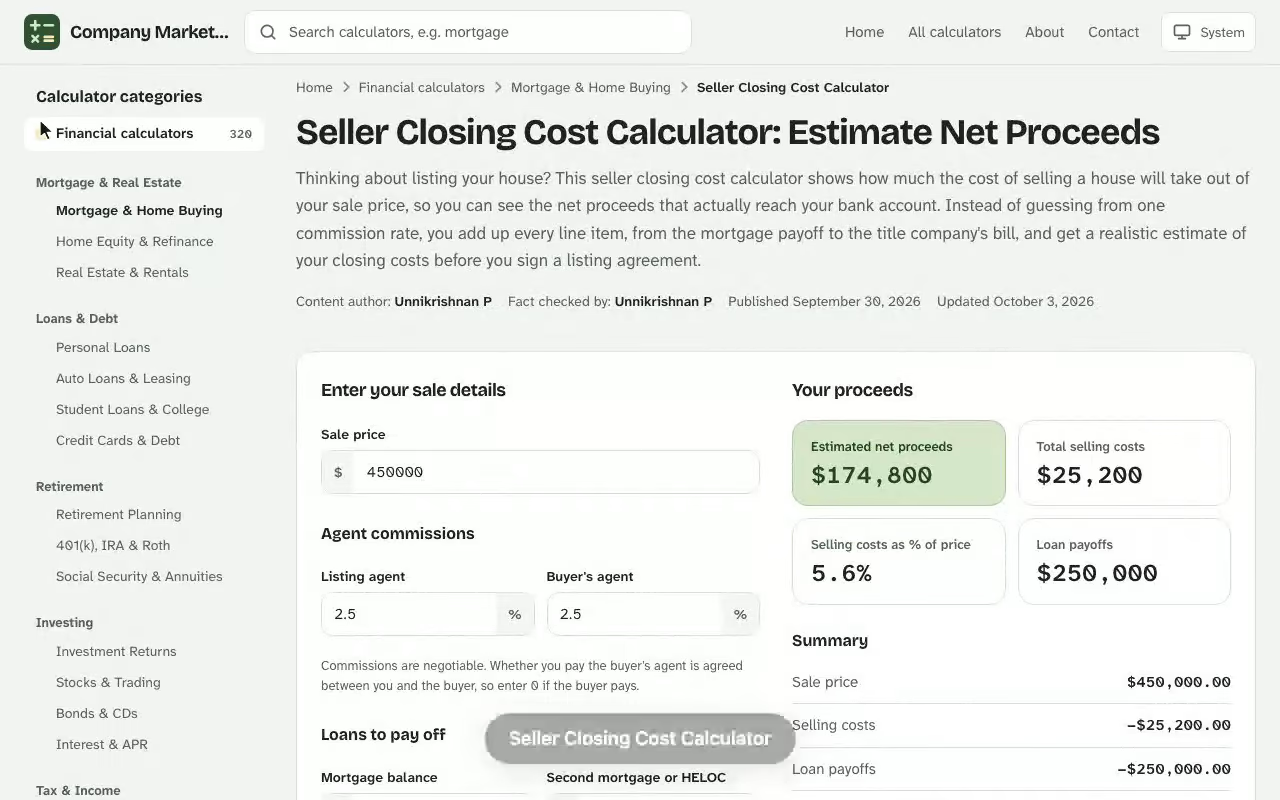
Seller Closing Cost Calculator. Thinking about listing your house? This seller closing cost calculator shows how much the cost of selling a house will take out of your sale price, so you can see the net proceeds that actually reach your bank account. Instead of guessing from one commission rate, you add up every line item, from the mortgage payoff to the title company's bill, and get a realistic estimate of your closing costs before you sign a listing agreement. The free house affordability calculator is free to use with no sign-up, and works on desktop and mobile.
Your proceeds
Estimated net proceeds
–
Total selling costs
–
Selling costs as % of price
–
Loan payoffs
–
Summary
Sale price–
Selling costs–
Loan payoffs–
Net proceeds to you–
Itemized costs and payoffs
Every cost you entered, largest first. These are estimates: your settlement statement will show the final figures.
Item
Amount
% of sale price
Results are estimates for educational purposes and are not financial, tax or legal advice.
How the Seller Closing Cost Calculator Works
A home sale calculator answers one question: after every bill at the closing table is paid, how much of the buyer's money is left for you? You enter the price, the balance you still owe, and each cost you expect to pay as the seller. The tool subtracts the total from the price and returns your net sale proceeds. Run it more than once, because the first number is only a starting point and every input you tighten makes the estimate more useful. Next, open the va mortgage calculator and enter your own details to see an estimate in seconds.
Sale price and selling price
Start with the sale price you realistically expect, not the asking number you hope for. A recent comparable sale, a pre-listing appraisal or a broker's market analysis gives you a defensible selling price. If you already hold an offer, use the offer. Most of the percentage-based costs below scale from this single figure, so an error here ripples through every line.
Mortgage payoff and remaining mortgage
Your lender's mortgage payoff is usually the largest deduction after the sale price itself. It is not the same as the remaining mortgage balance on last month's statement, because the payoff includes interest accrued up to the closing date and sometimes a prepayment fee. Ask your lender for a written loan payoff figure for the closing date you expect, and enter that. If you have a second loan, a home equity line or any recorded lien, add each one, since the title company must clear every lien before the deed can transfer.
Agent commission and the listing agent
Real estate commission is negotiable, and it is often the biggest of the seller closing costs. Sellers have traditionally paid a listing agent and a buyer's agent, commonly 2% to 3% of the sale price for each. Since the industry settlement, buyers negotiate their own agent's pay, so you may offer a smaller buyer agent fee or none at all. Enter whichever split is written in your listing agreement. A flat fee MLS listing or a sale by owner (FSBO) removes the listing agent line, but you still carry the marketing work yourself.
Seller Closing Costs Itemized: Where Your Sale Price Goes
Beyond the commission and the loan payoff, a handful of smaller charges decide whether your estimate holds up. Local custom matters here: in some states the seller buys the title policy, in others the buyer does, and a few require a closing attorney while others never use one. Review each item below against your own county before you rely on a number. The down payment calculator uses the same plain-English approach, so you can compare results side by side.
Transfer tax and excise tax
A transfer tax is charged by a state, county or city when the deed moves to the buyer, and the seller customarily pays it. It may be called an excise tax, a documentary transfer tax or a real property transfer tax depending on where you live, and some states charge nothing. Rates range from a few hundredths of a percent to well over 1% of the price. A few cities add a separate "mansion tax" at the top of the market, and in New York co-ops a building may also collect a flip tax. Look up your jurisdiction's rate rather than borrowing a national average.
Title insurance and escrow fee
The seller often pays for the owner's title insurance policy that protects the buyer from ownership disputes and old claims. Premiums rise with the price and vary widely by state. The escrow fee pays the neutral party who holds the earnest money and final funds, then distributes them to your lender, agents and you. Many escrow companies charge a flat fee, while others split it with the buyer. Your title company can quote both before you list.
Attorney fee and recording fees
If your state requires a closing attorney, expect an attorney fee of roughly $800 to $1,200 in many markets, and several times that in the most expensive cities. Even without a lawyer, a small recording fee applies for each document, and recording fees are charged when the release of your old mortgage is filed with the county. Wire transfer charges, courier or overnight delivery fees and document copies show up on a settlement statement as well; they look minor but can total a few hundred dollars.
Prorated property tax and HOA fees
At closing, escrow splits the year's prorated property tax so you pay only for the days you owned the home. If your tax bill is paid in arrears, you owe the buyer a credit, which appears as a tax proration charge. Likewise, HOA fees are prorated to the closing date, and some associations bill a separate HOA transfer fee or a move-out deposit. Add all of these under the property and association lines.
Seller concessions and home warranty
In a slower market you might agree to seller concessions, a credit toward the buyer's own closing costs, discount points or repairs raised during the home inspection. A one-year home warranty, typically a few hundred dollars, is another optional incentive. Neither is mandatory, but both come directly out of your proceeds, so include them if you have promised them in writing.
Net Proceeds Calculator Formula and Worked Example
The math is simple subtraction. Everything else is deciding which numbers belong in it:
Percentage items are calculated as \(\text{Sale price} \times \text{rate}\), while title, escrow, attorney and recording charges are entered as flat dollar amounts. Here is one complete example, entered in the calculator exactly as it would appear on a settlement statement.
Net proceeds equal the sale price less the payoff and seller costs.
Example inputs for a $412,900 home sale
Suppose you sell a three-bedroom house for $412,900 and still owe $236,480 on the loan. You agree to pay a 2.6% listing fee and a 2.4% buyer agent fee, a 0.35% transfer tax, and $4,000 in concessions. The remaining charges are listed in the table.
Cost line
Basis
Amount
Listing agent commission
2.6% of sale price
$10,735.40
Buyer's agent commission
2.4% of sale price
$9,909.60
Transfer tax
0.35% of sale price
$1,445.15
Owner's title insurance
Flat quote
$1,985.00
Escrow fee
Flat fee
$1,150.00
Closing attorney fee
Flat fee
$975.00
Recording fees
County schedule
$148.00
Prorated property tax
Days owned this year
$1,742.30
HOA transfer fee
Association charge
$325.00
Seller concession
Negotiated credit
$4,000.00
Home warranty
One-year plan
$515.00
Pre-listing repairs
Contractor invoice
$2,300.00
Total seller costs
8.53% of sale price
$35,230.45
Reading the result
Subtract the payoff and the costs from the price: $412,900 − $236,480 − $35,230.45 leaves $141,189.55 in net proceeds, about 34.2% of the sale price. Commissions alone account for $20,645.00, which is 58.6% of the total costs, so negotiating that one line moves your result more than all the flat fees put together. Compare the result with the down payment you need on the next home before you commit to a listing date.
See how the Seller Closing Cost Calculator works: change the inputs and the estimated net proceeds updates instantly. Enter your own numbers in the calculator above.Where a $412,900 sale price goes: payoff and $35,230.45 of seller costs leave $141,189.55.
Checking a Down Payment With a Home Sale Calculator Before Listing a Texas House
Dana owns a house in Round Rock, Texas, and wants to buy a $585,000 home nearby. A 20% down payment, $117,000, avoids private mortgage insurance on the new loan, so the question is whether the old house can fund it. The lender's payoff letter says $189,615.42 is owed, and the listing agent has suggested pricing at $338,750.
Dana opens the calculator to estimate the cost of selling this house and enters the price, the payoff and a total commission of 5.25%, or $17,784.38. Texas has no state transfer tax, so that line stays at zero, and the HOA charge is zero too. The owner's title policy quote is $2,214, the escrow fee $925, recording fees $126, and the prorated property tax from the title company's draft is $1,386.40. Dana adds a $3,000 credit toward the buyer's costs and $1,250 for caulking and paint.
Seller costs total $26,685.78, or 7.88% of the price.
The calculator returns $122,448.80 in net sale proceeds.
The down payment target of $117,000 is cleared by $5,448.80.
That margin looks comfortable until Dana remembers the $2,800 moving quote, which is not deducted at closing but still comes out of the same account. The real cushion is $2,648.80, thinner than a typical one-month reserve, so the number does not yet justify a firm offer on the new home. Dana reruns the estimate with a 4.5% total commission, the rate a second agent proposed, and every other input unchanged. The result is $124,989.43, which is $2,540.63 higher. Dana asks the first agent to match 4.5% in writing before signing the listing agreement, and keeps the new offer contingent on the sale.
Capital Gains and Your Home Sale Proceeds
This estimate stops at the closing table, so the figure it returns is before any income tax on your profit. Many owners owe nothing on a primary residence thanks to the federal exclusion, but you should check where you stand before you spend the money.
Capital gains tax and the primary residence exclusion
Under IRS rules, you can usually exclude up to $250,000 of capital gains ($500,000 if married filing jointly) when you sell a primary residence you owned and lived in for at least two of the last five years. Your gain is the sale price less selling costs less your cost basis, which is the purchase price plus major improvements. The total of seller costs from the calculator is the selling-costs term, so a more complete cost list also lowers the gain you report. Gains above the exclusion are taxed as capital gains tax at 0%, 15% or 20% depending on income. The exclusion does not cover investment property, where a 1031 exchange is the usual deferral route.
Estimated Closing Costs When Selling a Home in Different Markets
Your home does not sell in a national average, it sells in a county with its own customs. Two homes with the same price can produce estimated closing costs that differ by several thousand dollars, so treat the percentages you read online as a range and replace them with local quotes as soon as you have them.
Why a home's price band changes the percentages
Flat charges weigh heavily on a low-priced home and lightly on an expensive one. A $975 attorney fee is a quarter of a percent on a $400,000 house but a fraction of that on a $1.2 million property, while a percentage-based broker commission and transfer tax grow in step with the price. As a rule of thumb, sellers should expect total costs between 8% and 10% of the price once the commission is included, and closer to 1% to 3% without it. Your home's price band also decides whether a luxury surcharge or a higher tax tier applies.
Condo, co-op and townhouse costs
Selling a condo or co-op adds charges that a detached house never sees. The managing agent may bill a closing fee, the building can require a move-out deposit, and a co-op may collect a flip tax calculated as a percentage of the price, a share of your profit or a flat amount per share. Each of these is a real flip tax or association cost that has to be on your list. Townhouse owners should also ask the association about HOA transfer fees, because a transfer fee can be assessed to the seller even when the buyer receives the benefit of the paperwork.
State rules for taxes, recording and who pays
States disagree on who pays what. Some home sellers pay the whole transfer tax, some split it, and some states have none at all. A county may also charge a flat recording fee for each document filed, such as the satisfaction of your mortgage, and a per-page fee for any extra pages. Tax prorations follow the local billing calendar: in states where bills are paid in advance the buyer reimburses you, and where they are paid in arrears you credit the buyer. Your closing statement shows tax prorations as a separate line, so ask the title company to send a draft early.
Home improvements as a seller cost line
Home improvements deserve their own cost line in the estimate because the money leaves your account before the sale even happens, and the amount you enter reduces your net sale proceeds dollar for dollar. Fresh paint, a landscaping refresh or new flooring usually cost less than the price reduction an unprepared house attracts, but a kitchen remodel rarely pays itself back. Enter only the work you will actually do, then compare that cost against the price you expect, and remember that a buyer's inspection can still turn up items you did not plan for in your home budget.
Broker commission and its effect on your estimate
The broker commission is the largest single input in the calculator. It is quoted as a percentage but paid in dollars, which is why a half-point difference is worth about $2,000 on a $412,900 home. Ask for the rate in writing, ask what the buyer's side will receive, and ask which marketing costs are included. If an agent's fee is higher than the market rate, the extra service should be easy to name.
Each point of commission changes the worked example's net proceeds by about $4,129.
How to Lower the Cost of Selling a House
You cannot remove every fee, but several of them are controllable. Plan these steps before listing rather than after an offer arrives.
Home staging, cleaning and pre-inspection
Spending a little before listing often protects the price, and each amount belongs in the estimate as a seller expense, so rerun the calculator after you get quotes. Home staging and staging advice from your agent can cost a median of about $1,800, while a thorough deep cleaning is far cheaper and lifts curb appeal and first impressions at once. A pre-inspection of around $250 to $700 reveals problems early, so you can fix them or price around them instead of renegotiating later. Repairs, from patched walls to termite treatment, are cheaper on your schedule than on a buyer's.
Declutter and clean every room before photos are taken.
Book a pre-inspection, and a termite inspection where relevant.
Order a survey or appraisal only if your market or lender requires one.
Compare two or three quotes from a title company and an escrow provider.
Negotiating commission and timing the sale
Timing matters too. Selling when you hold enough home equity, usually at least 10% to 15% after payoff, means closing costs and moving expenses, including any temporary housing, come out of the sale rather than your savings, and a higher figure after payoff means more equity carried into the next purchase. Your real estate agent, lender and settlement attorney can each confirm items on this list before the closing date.
Common mistakes with a closing cost estimate
Most errors are omissions. Sellers forget the prorated tax, leave out HOA charges, or use a rate from another state. Others treat the buyer's closing costs as theirs, even though only seller-paid credits belong in this tool. Finally, remember that moving costs are not deducted at closing but still reduce your real profit, so keep them in a separate line next to your net proceeds calculator result.
Seller Closing Cost Calculator questions
What are seller closing costs?
Seller closing costs are the fees and credits a seller pays at the closing table when a home sells. They usually include agent commissions, transfer tax, title and escrow charges, attorney and recording fees, prorated property tax, HOA charges and any concessions you agreed to.
How much are closing costs for a seller?
Seller costs depend heavily on the commission and local taxes. Many sellers see roughly 6% to 10% of the sale price once commissions are included, and a lower share when no agent is used. Local quotes always beat a national average.
What is the difference between closing costs and net proceeds?
Closing costs are what you pay. Net proceeds are what is left after you subtract those costs and your mortgage payoff from the sale price. The calculator shows both so you can plan your next purchase.
Does the calculator include capital gains tax?
No. It stops at the closing table. Many owners can exclude up to $250,000 of gain ($500,000 if married filing jointly) on a primary residence they owned and lived in for two of the last five years, but income tax depends on your cost basis and filing status.
Who pays the transfer tax when selling a house?
The seller customarily pays it, though the cost can be negotiated and some states have no transfer tax. Rates vary by state, county and city, so look up your own jurisdiction.
Are moving costs part of seller closing costs?
Not at closing. Moving and temporary housing are paid separately, so the calculator subtracts them in a separate line to show the cash you actually keep.
Why is my mortgage payoff different from my balance?
The payoff includes interest accrued up to the closing date and sometimes a prepayment fee. Ask your lender for a written payoff statement for your expected closing date.
Can I lower my seller closing costs?
Yes. Negotiating the commission, comparing title and escrow quotes, skipping unneeded concessions and pre-inspecting the home all reduce the total. Run the calculator again after each change to see its effect.