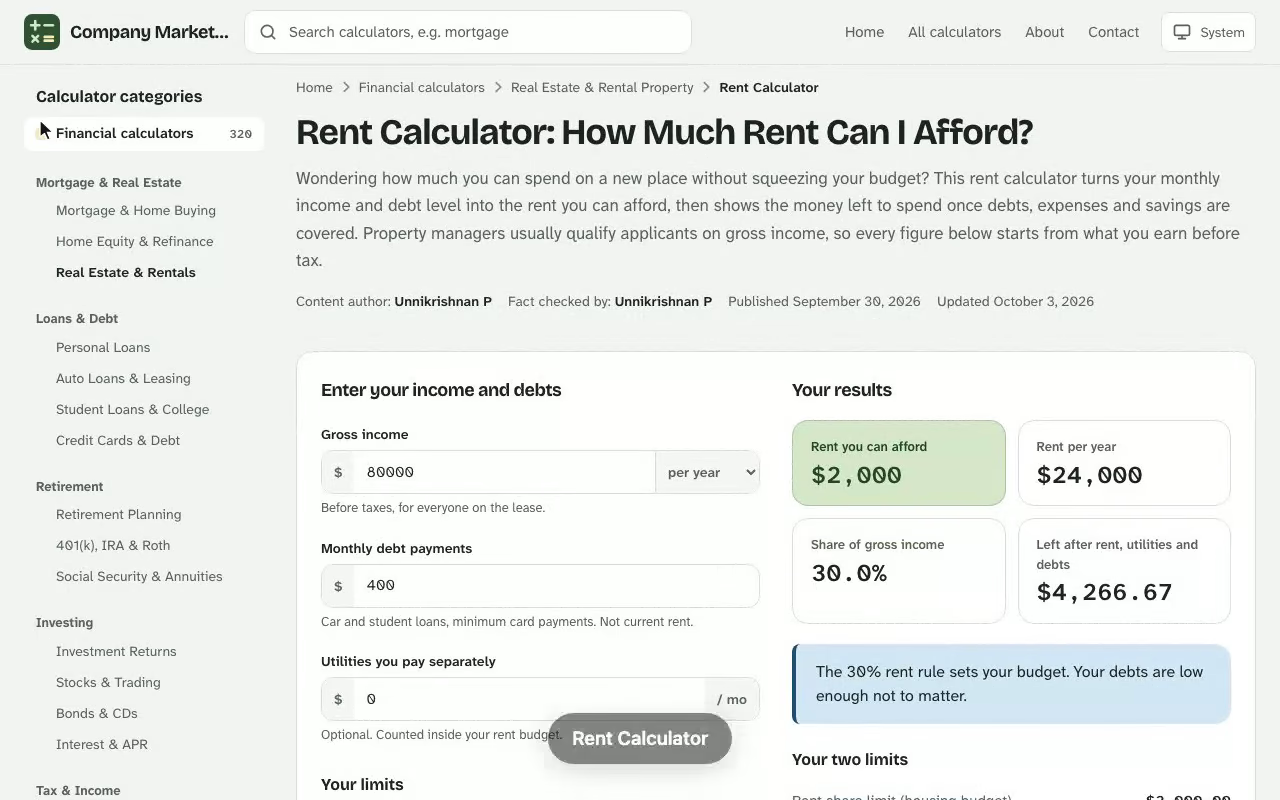
Rent Calculator. Wondering how much you can spend on a new place without squeezing your budget? This rent calculator turns your monthly income and debt level into the rent you can afford, then shows the money left to spend once debts, expenses and savings are covered. Property managers usually qualify applicants on gross income, so every figure below starts from what you earn before tax. The mortgage calculator uses the same plain-English approach, so you can compare results side by side.
Your results
Rent you can afford
–
Rent per year
–
Share of gross income
–
Left after rent, utilities and debts
–
–
Your two limits
Rent share limit (housing budget)–
Rent plus debts limit, after debts–
The rent you are considering
Share of gross income–
Income the landlord rule asks for–
Result–
Rent at different shares of income
Rent, your debt-to-income ratio with that rent, and what is left of your gross pay each month after rent, utilities and debts.
Share of income
Rent / mo
Rent / yr
Rent + debts
Left / mo
Results are estimates for educational purposes and are not financial, tax or legal advice.
Rent Calculator How Much Rent Can I Afford: The Core Formula
Most affordability tools rely on one simple rule: multiply your pay by the share you are willing to hand to a landlord. The rent affordability calculator approach then subtracts everything else you owe each month so you can see whether that number really works.
Moving the percentage slider from 20% up to 40% shows how quickly the cushion shrinks. Any rental calculator built on this rule gives a starting point rather than a verdict, because every household carries different obligations.
Gross Monthly Income
Start with your gross monthly income: salary, hourly pay, side work and any other regular deposits before anything is withheld. If you only know the yearly figure, divide it by 12. A yearly pay of $67,380 becomes $5,615 per month, and that is the number you enter first.
Net Income vs Gross Income
Your net income is what lands in your bank account after withholding, while gross income is the figure on your contract. Landlords check the second one, which is why a calculator that assumes a flat tax on take-home pay can be off by a few hundred dollars. Gross income is the safer base, since it matches how you will be screened.
Your Affordable Rent at 20%, 25%, 30% and 40% of Income
There is no single correct share. The table below uses the $5,615 example to show how each popular guideline changes the monthly rent and the money that remains after $1,940 of fixed costs. Try the house affordability calculator to run your own numbers — everything is calculated in your browser and nothing you enter is stored or sent anywhere.
Share of gross income
Monthly rent
Left to spend
Style
20%
$1,123.00
$2,552.00
Thrifty
25%
$1,403.75
$2,271.25
Cautious
30%
$1,684.50
$1,990.50
Balanced
40%
$2,246.00
$1,429.00
Stretch
A thrifty 20% leaves room for saving and for non-essentials, though you may have to skip the sleekest apartments in pricier cities. The sweet spot sits near 30%, often called the golden rule because it balances comfort with a healthy cushion. A splurge at 40% can buy a better location or extra space, but a rise of 10% in housing cost leaves much less margin when something unexpected happens.
Worked Example: The Rent You Can Afford on $5,615 a Month
Take a single renter who earns $5,615 per month before tax and wants to compare apartments in a mid-sized city. The inputs are: Next, open the free real estate calculator and enter your own details to see an estimate in seconds.
Gross income: $5,615 per month
Monthly debts: $410 for a car loan and a student loan
Monthly expenses: $1,180 for groceries, phone and insurance
Monthly savings: $350 moved to an emergency fund
At a 30% share, the answer is $5,615 × 0.30 = $1,684.50 of monthly rent. Subtract that and the $1,940 of debts, expenses and savings, and the result is $1,990.50 left to spend. That rent should fit comfortably within your budget, so apartments listed at up to roughly $1,685 deserve a viewing. If a favorite listing asks $1,850, that is 32.9% of your pay and leaves $1,825.00 each month, so you would negotiate the price or keep looking.
Monthly Debts, Monthly Expenses and Monthly Savings
Enter monthly debts such as credit cards and loans, monthly expenses such as food, insurance and phone plans, and monthly savings such as retirement or emergency contributions. Leave a field at zero if it does not apply. Rent is deducted first, then these three, and what remains is the amount you can truly spend.
Front-End Debt-to-Income Ratio and Rental Application Checks
Lenders and landlords turn your pay into ratios, and knowing them in advance prevents surprises when you submit paperwork for a rental.
Front-End Debt-to-Income Ratio
Your front-end debt-to-income ratio is housing cost divided by gross income, so $1,684.50 against $5,615 gives 30%. Some people consider 25% affordable, others accept 33%. The broader debt-to-income ratio adds your loans: ($1,684.50 + $410) ÷ $5,615 = 37.3%. Keeping your debt level low before applying makes approval easier.
Rental Application
A rental application asks for your name, address, references and often your income and debt. The landlord then reviews credit reports, a criminal background check and your eviction history. Many owners also compare your gross income with the rent, often asking for three times the monthly figure, so the result this calculator produces is the number to check before you apply. Once both sides agree, the lease is drafted and becomes a legal contract.
Security Deposit and Other Upfront Costs
A security deposit is rarely the only upfront charge. Expect an application fee, a pet deposit and renter insurance, and remember that a real estate agent's fee, often one month's rent, may apply in competitive metropolitan areas, while rural areas often skip it. These costs sit outside the monthly result, so plan to cover them from savings rather than from your monthly allowance.
Checking a $1,595 Listing with the Rent Affordability Calculator
Priya, a dental hygienist relocating for a new clinic, has a one-bedroom listing at $1,595 a month and a viewing on Saturday. Before she goes, she wants to know whether the monthly rent she can afford actually covers it.
Her offer letter says $59,112 a year, so she divides by 12 and enters $4,926 as gross income. She adds $287 for her student loan, $1,043 for groceries, phone, insurance and gas, and $412 for the retirement and emergency transfers she refuses to pause. The slider starts at 30%.
The result card shows $1,477.80 in rent and $1,706.20 left over each month. Her listing sits $117.20 above that figure, so the 30% guideline says it is a stretch.
See how the Rent Calculator works: change the inputs and the rent you can afford updates instantly. Enter your own numbers in the calculator above.
She then checks the screening rule this property manager publishes: gross income must be at least three times the rent. Dividing $4,926 by three gives a ceiling of $1,642, and $1,595 clears it by $47. Moving the slider to 32.4% reproduces the listing's price and shows $1,589.00 remaining, still a comfortable margin after her fixed costs.
30% guideline: $1,477.80 rent, $1,706.20 left
Listing at 32.4% of income: $1,595.00 rent, $1,589.00 left
Three-times-rent screening ceiling: $1,642
Her next step is concrete. She keeps the viewing, asks whether water and trash are included, and reruns the numbers with $90 of utilities added to her expenses. If the remaining amount drops below $1,500, she will counter at $1,525.
Rental Spending Beyond the Monthly Rent
The listed price is only part of what a home costs. Before you commit, add the recurring and personal factors that never show up in a percentage.
Utility costs: internet, water, gas and electricity, some of which may be included in the rent
Furniture: most renters need to furnish a new place
Location: commute, school district, public transport and daily routines
Quality: age of the building, working appliances and amenities such as a gym or laundry
Size: bedrooms, bathrooms, square footage and storage space
Landlord: house rules about paint, pets and noise can shape daily life
A safer neighborhood with low crime often carries a higher rent, which raises your rent share, so weigh safety against what the calculator says you can afford.
When you compare apartments, run the numbers for each one instead of trusting the listing alone. Shortlist apartments whose total cost, including utilities, stays under your chosen share, and rank apartments by how much each leaves in your pocket. Apartments with included utilities can beat cheaper apartments that bill separately, so judge each option by the leftover figure the calculator shows, not by the headline price alone.
Rent vs. Buy: When Monthly Rent Stops Making Sense
Rent vs. Buy
Few people become a homeowner without renting first, so the figure from this calculator is a useful benchmark for the day you consider a mortgage: if a mortgage calculator's estimated payment lands well above that figure at the same income, buying will tighten your finances. A house affordability calculator shows the price range you qualify for, while a lease calculator or rental property calculator helps when you sign a long contract or plan to become a landlord. A budget calculator and an income tax calculator round out the picture, because taxed earnings and local tax rates change what you actually keep.
Ways to Lower Monthly Rent
Reduce the Amount Spent on Rent
Many renters struggle to cover their payment, yet several approaches can reduce it. Live with family or a friend for a while, share an apartment with roommates, or move to a cheaper area. Always negotiate the terms with the owner, and compare rent prices across several apartments before deciding. Some owners accept maintenance work in exchange for a discount, and a mobile home can cost less per month in the long run.
Rental Assistance Programs
The US Department of Housing and Urban Development (HUD) runs rental assistance for people in serious need. Subsidized public housing mostly serves families, older adults and people with disabilities, while Section 8 vouchers pay part of the rent to private owners. Both have strict limits and long waiting lists, so apply early and ask local community groups for guidance. If the calculator shows a figure well below local prices, assistance may close the gap.
Renter Protection Tips for Any Rental Property
Once the numbers work, protect them: get every promise from a landlord in writing, and on move-in day complete a lease inventory with photos so a deposit deduction doesn't eat into the cushion the calculator showed. Repairs beyond normal wear and tear are generally charged to the tenant, so keep the place clean. Good leases protect tenants as much as owners. Consider tenant insurance to protect your belongings and enter its premium as a monthly cost, and remember that fixed leases stop the owner from raising the payment mid-term. Treat the calculator's output as a suggestion rather than a promise: this disclaimer applies to your finances and credit too, so weigh every personal and financial factor before signing for any apartments you like.
Rent Calculator questions
How much of my income should go to rent?
A common guideline is 30% of your gross monthly income, with 20% being a thrifty choice and 40% a stretch. Your debts, savings and expenses decide where in that range you can safely land.
Should I use gross or net income to work out rent?
Use gross income. Property managers usually qualify applicants on income before tax, so a gross figure matches how you will be screened.
What counts as monthly debts?
Recurring payments such as credit cards, car loans and student loans. Enter them in the monthly debts field so they are deducted before the money left to spend is shown.
What does the left to spend number mean?
It is your gross monthly income minus the rent, debts, savings and expenses you entered. A small or negative figure means the rent share is too high for your budget.
What is the front-end debt-to-income ratio?
It is your housing cost divided by gross income. Some people treat 25% as affordable while others accept 33%; the slider lets you test each.
What other costs come with renting?
Expect a security deposit, an application fee, possible pet deposits, renter insurance, and recurring utilities such as internet, water, gas and electricity.
Does this guarantee my rental application will be approved?
No. The result is a suggestion. Landlords also review credit reports, background checks and eviction history before approving a lease.