Repossession of Personal Property from a Deferred Payment Sale Calculator
Repossession of Personal Property from a Deferred Payment Sale Calculator. If a buyer stopped paying and you took your property back, the repossession of personal property from a deferred payment sale calculator below turns a pile of sale paperwork into one answer: the reportable gain or loss on the repossession and the new basis you carry into the property from here on. You enter the fair market value of what came back, the unpaid balance on the buyer's note, your gross profit percentage and what the recovery cost you, and the tool does the rest of the arithmetic the IRS expects. Pair this with the free rent calculator for a fuller picture before you make a decision.
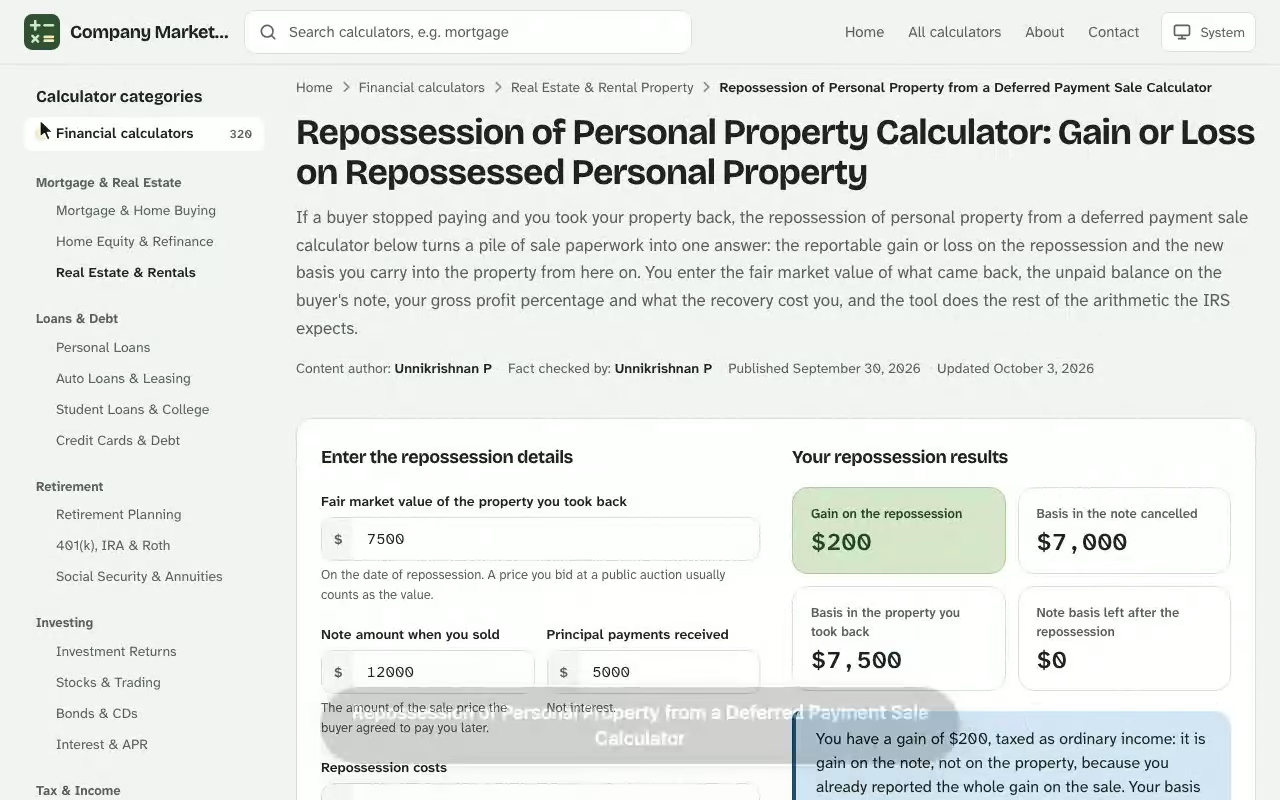
Your repossession results
Gain or loss on the repossession
–
Basis in the note cancelled
–
Basis in the property you took back
–
Note basis left after the repossession
–
–
How the gain or loss is worked out
Your basis in the note, plus the costs of getting the property back, compared with what the property is worth.
Step
Amount
Results are estimates for educational purposes and are not financial, tax or legal advice.
Repossession of Personal Property from a Deferred Payment Sale Calculator: What It Figures Out
When you sell a boat, a vehicle, a piece of equipment or a piano and let the buyer pay over time, the sale is an installment sale, also called an installment payment sale. Most sellers report the profit on the installment method, which means you pay tax on a slice of each payment instead of on the whole profit in the year of sale. If the buyer then defaults and you repossess the item, the story does not simply end. The unpaid balance of the installment obligation is wiped out, you receive the item back, and the tax code asks you to compare what the item is worth today with what you still had invested in the note. That comparison is the gain or loss on the repossession. The 1031 exchange timeline calculator online is free to use with no sign-up, and works on desktop and mobile.
The tool follows the same eight-line routine the IRS publishes for this situation, so you can check any result against the printed worksheet. It does not guess at facts it cannot know, such as what the item is worth today. You supply the value, and you stay in charge of the number that moves the answer the most.
Who uses a tool like this
The people who reach this page tend to fall into a handful of groups, and each one cares about a slightly different output:
Private sellers who financed a sale to a neighbor, relative or online buyer and now hold a defaulted note.
Small business owners who sell equipment, trailers or inventory on terms and need the loss for the books.
Bookkeepers and tax preparers who want a quick cross-check before they fill in the forms for a client.
Collectors and dealers of jewelry, art, instruments and similar items who sell on payment plans.
Students of tax who are working through the IRS worksheet and want to see the numbers move.
What you enter and what comes back
Five inputs drive the whole calculation, and each one maps to something you can find in your sale file or on the original tax return that reported the sale:
Fair market value (FMV) of the property on the day you take it back.
Unpaid balance of the installment obligation at the time of the repossession, net of any deficiency you cannot collect.
Gross profit percentage you used when you reported the installment sale.
Repossession costs: legal fees, towing, storage, auction fees and the cost of moving the item home.
Anything else received from the buyer besides the property, valued at what it is worth.
Out come the unrealized profit still sitting in the installment obligation, your basis of the obligation, the total you are treated as having invested, the gain or loss on the repossession and your basis in the repossessed property. A positive result is a gain and a negative result is a loss, and the next sections explain how each one is treated.
How an Installment Sale Sets Up the Repossession
Everything the repossession formula needs was decided on the day of the installment sale. If you can reconstruct four numbers from that day, you can reconstruct the whole answer: the selling price, your adjusted basis, the gross profit and the contract price. Getting these right matters because the gross profit percentage is not re-figured at repossession. It is carried over from the sale and applied to whatever balance is left. Next, open the free 1031 exchange calculator and enter your own details to see an estimate in seconds.
Selling price and adjusted basis
The selling price is everything the buyer agrees to give you in exchange for the property: cash up front, the face amount of the note and any debt the buyer takes over. Stated interest is not part of the selling price; it is interest income you report separately in the year you receive it.
Your adjusted basis is what you have invested in the item, generally what you paid for it plus improvements, less any depreciation you were allowed to take. For an installment sale you also add your selling expenses, such as commissions, advertising and legal fees, to the basis. A seller who forgets the selling expenses overstates profit, which overstates the gross profit percentage and, later, the unrealized profit tied up in a defaulted installment obligation.
Gross profit percentage: the figure that drives the formula
Gross profit is the selling price minus the adjusted basis. The gross profit percentage is that profit divided by the contract price. Each payment you receive, after setting aside the interest, is treated as part tax-free return of basis and part taxable installment sale income, split by that percentage. The percentage generally stays the same for the life of the note.
Because the percentage describes how much of every dollar of the installment obligation is profit, it also tells you how much of an unpaid balance is profit you never collected. That is why it appears at line 3 of the repossession worksheet.
Contract price and mortgage assumption
For most personal property sales, the contract price equals the selling price. The two part ways when the buyer takes over a debt on the item, such as a lien or an equipment loan. In that case the contract price is the selling price minus the debts the buyer assumed, plus the amount by which those debts exceed your adjusted basis. A boat sold subject to a $3,000 lender payoff, for example, has a smaller contract price than selling price unless the debt is no larger than your basis. A mortgage almost never enters a personal property deal, but it does come up with a mobile home sold with its financing, and the rule is the same one that governs real estate.
Payments received and how the installment obligation builds up
Under the installment method, the payments received in the year of the sale are the down payment and any principal paid before year-end. Total payments after that are whatever the buyer sends each period. You report the profit in proportion to the principal you collect, and you report all stated interest as ordinary income. The unpaid balance at any date is simply the selling price minus the principal paid so far. When the buyer stops paying, that unpaid balance is the amount that gets satisfied, in whole or in part, by taking the property back.
Item from the installment sale
Where you find it
Role in the repossession
Selling price
Sales contract
Starting point for gross profit
Adjusted basis
Purchase records, depreciation schedule
Determines gross profit
Gross profit percentage
Form 6252 from the year of sale
Line 3 of the formula
Principal paid to date
Payment ledger
Sets the unpaid balance
The Repossessed Personal Property Formula, Line by Line
The IRS lays the routine out as Worksheet C in Publication 537, and it only applies if you used the installment method to report the profit on the installment sale. Strip away the line numbers and the logic fits in one sentence: take the FMV of what you got back, subtract the basis of the obligation you gave up, and subtract your repossession costs. Whatever is left is the gain, or the loss if it is negative.
If the buyer hands over anything besides the property, such as a partial payment on the way out the door, add its value to line 1 before you subtract anything. The rule exists so the gain or loss reflects everything you actually recovered.
Unrealized profit and the basis of the obligation
Think of the unpaid balance as two layers. One layer is profit you have not yet been taxed on, and the other is the return of capital you already had in the property. The unpaid balance times the gross profit percentage gives you the unrealized profit. What remains is the basis of the obligation, which is the part of the installment obligation you are treated as having bought with your own money. The tax system lets you recover that layer tax-free, so it is the number you subtract from the value you get back.
At a 28.5% gross profit percentage, $9,831.25 of the $13,750 unpaid balance is basis and $3,918.75 is unrealized profit.
Fair market value of the repossessed property
The fair market value of repossessed property is a question of fact. The IRS says there is no formula; you establish it from the circumstances. One bright-line rule does help: if you bid for the property at a lawful public auction or judicial sale, its FMV is presumed to be the price it sells for, unless there is clear and convincing evidence to the contrary. Outside of a sale like that, document your figure with dealer quotes, published valuation guides, recent comparable sales and a dated condition report. A seller who picks a convenient number without support invites trouble in an audit.
Repossession costs you can include
Your repossession costs are the out-of-pocket expenses of getting the item back: attorney and court fees, a recovery agent, towing, transport, storage until resale and similar charges. They are added to the basis of the obligation, so a higher cost figure shrinks the gain or deepens the loss. Costs of reselling the item later are a different matter, and they belong to the resale, not the recovery. Keep receipts for every item you list, because the costs of repossessing are one of the few inputs you control entirely.
Gain or loss on repossession: positive, negative or zero
A positive result is a gain, the taxable gain this tax calculation exists to find. It means the item came back worth more than your net investment in the note, which tends to happen when the buyer paid down a meaningful share of the price before defaulting, or when the property has held its value. A negative result is a loss. It means the item is worth less than what you were still owed on your books, which tends to happen with fast-depreciating goods such as electronics, vehicles with high mileage and equipment that has seen hard use. A result near zero is common when the buyer defaulted late and the item is in decent shape. Only a gain counts as taxable gain, and a gain on an installment sale repossession is taxed in the year the property comes back, so a tax preparer will want the result before the tax return is drafted and before any tax payment estimate is made for the year.
Worked Example: Repossessing a Pontoon Boat Sold on the Installment Method
Here is a complete case with numbers you can verify by hand. Marguerite sells her used pontoon boat for $24,000. Her adjusted basis, including selling expenses, is $17,160. The buyer pays $4,000 down and agrees to pay the rest in monthly installments plus interest. Marguerite reports the sale on the installment method, so her return for the year of sale shows the gain as it comes in.
Step 1: Gross profit and the percentage
Gross profit is $24,000 − $17,160 = $6,840. With no debt assumed, the contract price equals the selling price of $24,000, so the gross profit percentage is $6,840 ÷ $24,000 = 28.5%. The percentage is the same for every payment from here on.
Step 2: The default and the unpaid balance
The buyer makes payments for several months, then stops. When Marguerite decides to recover the boat, the unpaid balance of the installment obligation stands at $13,750. A marina appraiser values the boat at a FMV of $11,900 on the repossession date. The legal fees and trailer move come to $1,180.
Step 3: Run the lines
Line
Description
Amount
1
FMV of the boat
$11,900.00
2
Unpaid balance
$13,750.00
3
Gross profit percentage
28.5%
4
Unrealized profit ($13,750 × 0.285)
$3,918.75
5
Basis of the obligation ($13,750 − $3,918.75)
$9,831.25
6
Repossession costs
$1,180.00
7
Lines 5 + 6
$11,011.25
8
Gain ($11,900 − $11,011.25)
$888.75
Marguerite has a gain of $888.75, and her basis in the repossessed boat is its FMV of $11,900. The gain keeps the same character as the gain on the original sale, so if the boat qualified for capital gain treatment the first time, it does again.
Worksheet lines 1 to 8 for the pontoon boat: value less obligation basis less repossession costs leaves an $888.75 gain.
What happens if the value drops
Suppose the boat was neglected and a second appraiser puts the FMV at $9,200. Line 7 stays at $11,011.25, so line 8 becomes $9,200 − $11,011.25 = a loss of $1,811.25. The new basis would be $9,200. The same case therefore swings from a modest gain to a loss of nearly two thousand dollars on the strength of the value assumption alone.
The break-even value
The break-even FMV is the point where the gain or loss is exactly zero, and it equals line 7. In this example the break-even is $11,011.25. Any appraised value above it produces a gain and any value below it a loss. Knowing the break-even before the appraisal tells you how much your estimate of value matters.
Appraised value swings the result far more than repossession costs; the outlined cell is the worked example.
Appraised FMV
Basis plus costs
Result
$13,000.00
$11,011.25
Gain of $1,988.75
$11,900.00
$11,011.25
Gain of $888.75
$11,011.25
$11,011.25
No gain or loss
$9,200.00
$11,011.25
Loss of $1,811.25
Reporting the Gain or Loss on Your Tax Return
You report the gain or loss from a repossession on the same form you used to report the original sale. If you reported the sale on Form 4797, you use that form for the repossession too. Installment sale income for earlier years was tracked on Form 6252, and the repossession closes the books on that obligation, so keep the old form with the new paperwork. The year of the repossession is the year the gain or loss lands on your tax return, not the year of the default or the year you first stopped getting paid.
If you reported the sale using the installment method
The formula above is the one that applies. Your basis in the installment obligation comes from multiplying the unpaid balance by the gross profit percentage and subtracting. The gain or loss on the repossession has the same character, capital or ordinary, as the gain on the original sale. A sale of a personal-use boat at a profit generally produces capital gain, and a repossession gain from that sale follows suit.
If you did not use the installment method
Some sellers elect out of the installment method and report all the profit in the year of sale. In that case the worksheet above does not apply, and the rules change in two ways. First, your basis in the installment obligation is generally the issue price of the note, adjusted for any original issue discount included in income and reduced by principal payments received. Second, any gain on the repossession is ordinary income, because it is gain on the obligation itself. If the FMV is less than your basis plus costs, you have a loss, and since you already included the full profit in income in the year of sale, the loss is treated as a bad debt.
Bad debt deduction: business versus nonbusiness
How you claim a bad debt deduction depends on whether the property you sold was business property or not. A nonbusiness bad debt is generally treated as a short-term capital loss, and it is explained in Publication 550. A business bad debt is deducted against ordinary income under the instructions for your income tax return. Either way, a repossession loss from an installment sale is not simply forgotten; it carries a defined place on the return, and a tax preparer will usually ask for the sale contract, the payment history and the valuation support.
Interest and payments before the default
Interest you collected before the default is ordinary interest income and was reported in the years you received it. Do not include it in the unpaid balance, and do not subtract it when you figure the gain or loss on repossession. Principal payments you received are already reflected in the unpaid balance, so they should not be counted a second time. The IRS expects you to report that interest as ordinary interest income on your tax return each year, separate from the installment sale income, and the tax year of each payment decides where it belongs. When these two pieces are kept apart, the worksheet lines stay clean.
What the IRS looks for on an installment sale return
The IRS matches the forms you file against each other, so the repossession figures should tie to the installment sale that came before them. The taxable gain you report must agree with the worksheet lines, the gross profit percentage must match the Form 6252 from the year of sale, and a loss claimed as a bad debt must tie to the installment obligation you wrote off. If the buyer assumed a mortgage or loan, the contract price on your form should also agree with the debt shown in the sales contract.
Where to find the official IRS guidance
Publication 537, Installment Sales, contains the worksheet that governs a repossession of personal property, and Publication 550 covers the nonbusiness bad debt rules. Use the edition that matches the tax year of your repossession, and report the result on the same form you used for the sale.
Installment Sale Income Before the Default: How Each Payment Is Taxed
To see why the repossession formula looks the way it does, it helps to follow one installment sale from the day you sign through the last payment you received. Each year, you report the sale on Form 6252, and the form divides every principal payment into two pieces. One piece is a tax-free return of your adjusted basis, and the other is installment sale income, which is taxable. The split never changes, because it comes from the gross profit percentage you fixed in the first year.
The year of sale usually includes the down payment plus any principal paid before December 31. A seller who receives a large down payment recognizes a large slice of profit right away, while one who receives almost nothing up front defers nearly all of it. Either way, interest the buyer pays on the note is not part of installment sale income. It is ordinary interest income, reported in full on your return for the year you receive it.
A payment schedule for the pontoon boat sale
Returning to Marguerite's sale at a 28.5% gross profit percentage, the table below shows how a few principal payments split. The figures are principal only, and the interest the buyer paid on top is ignored because it is reported separately.
See how the Repossession of Personal Property from a Deferred Payment Sale Calculator works: change the inputs and the loss on the repossession (bad debt) updates instantly. Enter your own numbers in the calculator above.
Principal payment received
Return of basis (71.5%)
Installment sale income (28.5%)
$4,000.00 (down payment)
$2,860.00
$1,140.00
$1,500.00
$1,072.50
$427.50
$2,000.00
$1,430.00
$570.00
$2,750.00
$1,966.25
$783.75
Add the principal payments together and the buyer's total payments to the seller reach $10,250 by the time Marguerite recovers the boat: the $4,000 down payment plus $6,250 of later principal. The $13,750 she is still owed is the $24,000 selling price less the $10,250 she collected. Her installment sale income to that point is $10,250 × 28.5% = $2,921.25, and the rest of the profit, $3,918.75, is exactly the unrealized profit that the repossession worksheet strips out of the note.
Why the tax return matters for the repossession
The repossession gain or loss belongs on the tax return for the year you take the property back, and the earlier returns tell you whether your inputs are right. Pull the Form 6252 from the year of sale and confirm three things: the selling price, the gross profit and the gross profit percentage. If you recorded a different percentage on a later-year form because the selling price was reduced, use the percentage from the most recent form. Mismatches between the returns and the worksheet are a common reason for IRS notices on installment obligations.
Installment Method Rules When the Selling Price Is Reduced
Sometimes a seller and buyer renegotiate before a default. A seller might agree to take less because the buyer found a flaw in the goods or because both parties want to avoid a fight. When the selling price drops after the sale, the gross profit percentage does not stay frozen at the old figure for the remaining payments. Instead, you figure a new percentage by subtracting the income already reported from the revised gross profit and dividing the result by the remaining contract price.
Suppose the selling price of $24,000 is cut to $22,500 after $4,000 of principal has been paid, and the seller reported $1,140 of installment sale income on that payment. The revised gross profit is $22,500 − $17,160 = $5,340. Subtract the $1,140 already reported and you are left with $4,200 of profit to spread over the remaining $18,500 of price, a new percentage of about 22.7%. A later repossession uses that new percentage, not the old one, so a seller who missed the adjustment will produce a wrong answer no matter how carefully the rest of the lines are filled in.
Checking which percentage applies
If the price never changed, use the percentage from the year of sale.
If the price was reduced, use the revised percentage from the date of the reduction forward.
If the price was reduced before the repossession, enter the revised percentage on line 3 of the repossession worksheet.
Depreciation Recapture, Related Parties and the Installment Obligation
Business owners face two wrinkles that individual sellers of personal-use goods rarely meet. The first is depreciation recapture. When you sell depreciable property on the installment method, any recapture income is reported in the year of sale, even if you receive no payment that year. That recaptured amount is added to your adjusted basis for the purpose of figuring the rest of the gain, which lowers the gross profit percentage. A seller who sold a delivery van for a price above its depreciated value should therefore check whether the percentage on Form 6252 already reflects recapture before using it on a repossession.
The second wrinkle is the related person rule. If you sell depreciable property to a spouse, a controlled entity or another related party, the installment method is generally unavailable and the entire profit is taxed in the year of sale. In that case the eight-line worksheet on this page may not apply to a later repossession.
Mortgage and loan assumptions in the sale
When the buyer takes over a mortgage, an equipment loan or another debt on the item, the arithmetic moves. The assumed debt is not treated as a payment to the seller unless it exceeds the seller's adjusted basis, and the contract price falls. If the mortgage is no more than your basis, it simply reduces the selling price to give the contract price. If the mortgage is larger than your basis, the excess is treated as a payment received in the year of sale, and the contract price equals the gross profit. In that second case the gross profit percentage is 100%, and the entire amount of every later payment is profit.
These mortgage and loan details matter for repossession because they change the gross profit percentage used on line 3. A seller of a mobile home who left a $9,000 lender balance with the buyer, with an adjusted basis of $6,000, would have a $3,000 excess treated as a payment in the year of sale, a contract price equal to the gross profit and a 100% profit percentage on the remaining note. The repossession formula still works, but the unrealized profit in the unpaid balance becomes the whole balance and the basis of the obligation falls to zero. If a lender holds a lien on the item, check whether the lender must be paid off first before you recover it.
Interest on the Installment Obligation and Your Repossession Figures
A seller-financed note should carry a realistic interest rate. When it does not, the IRS may treat part of the stated price as unstated interest, using the applicable federal rate it publishes every month. For the repossession, the practical effect is narrow but real. Unstated interest changes the issue price of the installment obligation, and the issue price is your starting basis in the note if you did not use the installment method.
Interest you received before the buyer stopped paying was ordinary income in the year of receipt. It is reported on the same return as the principal payments, but on a different line, and it never reduces the unpaid balance. Interest that accrued but was never paid is generally not income to a cash-method seller, and the repossession does not create income for amounts you never collected. Keep the interest out of both the unpaid balance and the repossession gain.
The IRS taxes interest as ordinary income at your regular tax rates, while installment sale income may qualify for capital gain rates, so the IRS expects you to separate the two on your tax return. Interest disputes usually turn on the written note, which makes the note and the payment ledger the most important tax records you hold. The interest you report each year should match the interest the buyer actually paid, and a mismatch between your tax return and the buyer's records is exactly the kind of gap the IRS can spot. If the note charged no interest, read the IRS rules on unstated interest before you assume every payment was principal, because the tax result of treating interest as principal can change the unpaid balance you enter.
Electing Out of the Installment Method
The installment method is the default for a qualifying sale, but you can choose not to use it. When you elect out, you report all of the gain in the year of sale, even though payments will arrive over several years. Sellers usually elect out when they have capital losses to offset the gain, when they expect to be in a higher bracket in later years or when they want to avoid the complexity of tracking a note.
The election is made on Form 6252 and filed with a timely return for the year of sale, including extensions. If you miss the deadline, there is a limited automatic extension for filing an amended return, and you can revoke an election only with the consent of the IRS. Because electing out changes the repossession rules, anyone who did so should avoid the eight-line worksheet above. If you elected out, the gain you report on a repossession is ordinary income, and any loss is a bad debt. The IRS explains the election in the Form 6252 instructions, and the IRS allows a tax year's election to be revoked only with its consent.
Which sales can use the installment method
Not every sale qualifies. Inventory sales and dealer sales generally do not, and sales of publicly traded stock or securities cannot use the installment method. The sale of a personal item, a business asset used in a trade and similar property can. If you are in the business of selling the items you repossess, the dealer rules may apply, so confirm that the original sale qualified before assuming the method was available. If the sale did not qualify, the worksheet on this page does not apply to the repossessed property.
State Law Notices and Repossession Costs After an Installment Sale
State law decides how you may take property back, and that in turn decides what you can include as repossession costs and what value you can defend on line 1. Most states follow some version of the Uniform Commercial Code, which generally lets a secured seller recover collateral after default without a court order, provided there is no breach of the peace, and requires a notice to the buyer before the collateral is sold. A buyer can often redeem the item by paying the full balance plus your expenses before the sale, and your security agreement may add terms for attorney fees. Those fees count as costs only to the extent you actually paid them.
When the item sells at a public auction, the price it brings is presumed to be the value you enter on line 1. A private sale or a related-party buyer needs more support, and if you keep the item, a dated independent appraisal is the best evidence of its worth.
Installment Sale Repossession Checklist
Use this checklist the day you decide to repossess, and again before you file the return for that year. Each item points to a source document:
Locate the sales contract and confirm the sale price, the payment terms and the security interest.
Find the Form 6252 and any later forms and note the gross profit percentage.
Confirm your original basis in the item and the adjusted basis you used at the time of sale.
Record the principal paid and the unpaid balance to the day of repossession.
Obtain a dated value for the item, ideally from an appraiser or a public sale.
Collect receipts for every recovery expense.
Run the eight lines, compare them with the tool and keep both with your records.
Report the result on the same form you used for the original sale, and keep the new basis for later use.
Questions to ask before you file
Did you use the installment method or elect out? Was the property personal-use or business property? Did you receive any other consideration from the buyer? Was the gross profit percentage ever adjusted? Do you hold a deficiency judgment? The answers decide which rules apply, so write them down in a short cover note. A seller who answers these five questions before starting the worksheet rarely needs to redo it.
Pricing a Repossessed Mower Package After an Installment Sale
Dale Okafor runs a small landscaping crew in Tulsa. Fourteen months ago he sold a used zero-turn mower and trailer package for $18,640 on terms, and the buyer, a start-up lawn service, has now missed three payments in a row. Dale pulls out his sale file because he needs to know what taking the equipment back does to his return before he sends the buyer a notice.
The file gives him the inputs. His adjusted basis, selling expenses included, was $12,861.60, so the gross profit was $5,778.40 and the gross profit percentage on his Form 6252 reads 31.0%. The buyer still owes $11,206.40. A local equipment dealer appraises the package at $9,480 as of this week, and Dale expects $742.15 in attorney fees and hauling.
He enters those five figures into the tool. The unrealized profit comes back at $3,473.98 (that is $11,206.40 × 0.31), which leaves a basis in the obligation of $7,732.42. Adding the $742.15 of costs gives $8,474.57, and the $9,480 appraisal minus that total is a gain of $1,005.43. His basis in the mower package becomes $9,480.
The result needs a sanity check against the published routine, so Dale compares each line with Worksheet C in IRS Publication 537 and finds the same eight steps. Because he reported the original sale on Form 4797, the same page tells him to report this gain there as well. The gain carries the character of the original sale, so he asks his preparer to confirm how that sale was classified.
Then Dale changes one input. A second dealer tells him the package might bring only $8,100 at auction. Rerunning the figures at $8,100 turns the gain into a loss of $374.57, which would be a business bad debt rather than a gain. The swing between the two appraisals is $1,380 on a single input, so before he moves forward he orders a written appraisal from a dealer who will put a date and a signature on it. That document, not a hunch, will be the support for whichever figure goes on the return.
Your Basis in Repossessed Property After You Take It Back
Your basis in repossessed personal property is its FMV at the time of the repossession. That single sentence settles several practical questions. If you keep the item, the FMV becomes the starting figure for any later depreciation. If you resell it, your gain or loss on the second sale is measured from that basis, not from the price you originally paid or from the old basis you had before the first sale. The tool reports this figure as the new basis so you can write it into your asset records on the same day.
Reselling the item
Resale after repossession is a fresh transaction with its own tax result. Take the earlier pontoon boat. With a new basis of $11,900, a resale at $12,400 would produce a $500 gain before selling expenses, and a resale at $10,800 would produce a $1,100 loss. The holding period and the character of that second result depend on how you used the item after it came back, so keep a short log of what you did with it between repossession and resale.
Putting repossessed equipment back to work
A business that repossesses a trailer or a machine and puts it back into service starts depreciating from the new basis. Depreciation you took before the original sale is already behind you; it reduced your adjusted basis then and forms part of the depreciation recapture that was recognized at the time of the sale. The new basis is a clean start, and a tax preparer will usually set up the item as a newly acquired asset.
Keeping records that stand up
Record the new basis (the value you entered), its source and the date, along with each repossession cost, the security agreement and the notice you sent to the buyer. A short memo summarizing the calculation takes a few minutes and lets you support the figures years later.
Personal Property Versus Real Property in a Repossession
The formula on this page is for personal property: boats, vehicles, equipment, jewelry, instruments and similar movable items. The rules for repossession of real property are different, and mixing them up is one of the most frequent mistakes sellers make when they search for a repossession tool.
Under the real property rules, you generally keep nearly the same adjusted basis in the property you had before the original sale, and you can recover that adjusted basis when you resell. The rules treat the payments you received from the buyer as income to the extent you have not already reported them, but the gain is capped. Taxable gain is limited to your gross profit on the original sale minus the gain you reported before the repossession and your repossession costs. The real property rules are mandatory and apply whether or not you used the installment method, provided certain conditions are met: the repossession protects your security rights, the obligation was received in the original sale, and you pay no additional consideration to the buyer to get the property back, with two limited exceptions.
Feature
Personal property
Real property
Basis after repossession
FMV on the repossession date
Close to your old adjusted basis
How gain is figured
FMV minus basis of the obligation and costs
Payments received less gain already reported, capped
Cap on gain
None under this formula
Gross profit less gain reported and costs
Rules optional?
Method-specific
Mandatory when conditions are met
Who uses it
Sellers of boats, equipment, vehicles
Sellers of land and buildings
If a repossession of real property fails one of the three conditions, the personal property rules apply to it as if it were personal property. That is an uncommon corner, but it explains why the personal property rules are sometimes used on a house or a parcel of land.
Installment Sale Terms Explained
Installment tax language is dense, and the same few words show up in every guide. This short glossary pins down the definitions used on this page.
Installment sale
A sale in which you receive at least one payment after the end of the tax year in which the sale occurs.
Installment obligation
The buyer's written promise to pay you over time, usually a note secured by the property.
Gross profit
The selling price minus your adjusted basis, including selling expenses.
Contract price
Generally the selling price less debt the buyer assumes, with an adjustment when that debt exceeds your basis.
Unrealized profit
The part of an unpaid balance that is profit you have not yet reported.
Deficiency judgment
A court order that makes a buyer pay the shortfall when a repossessed item sells for less than the balance owed.
Original issue discount
Interest that is built into the price of a note instead of being paid in cash.
Installment Sale Scenarios by Property Type
Different items behave differently after a default. The table below compares typical patterns using invented round figures, not tied to the worked example above, so you can see which way the result tends to point.
Property
Typical value trend
Likely result
What to watch
Used boat or trailer
Slow decline, condition-sensitive
Small gain or loss
Storage and winterizing costs
Vehicle with high mileage
Steady decline
Often a loss
Auction fees and towing
Commercial equipment
Depends on depreciation taken
Gain or loss
Depreciation recapture history
Jewelry or art
May hold or rise
Often a gain
Independent appraisal
Musical instruments
Stable if well kept
Small gain or loss
Condition and provenance
Why the buyer's payment history matters
A buyer who defaults after one payment leaves nearly the entire note outstanding, so the unrealized profit in the balance is large and the basis of the obligation is close to your original investment. A buyer who defaults near the end leaves only a small balance, so the repossession is a small event. The gross profit percentage and the unpaid balance together tell the story, which is why the tool asks for both.
Deficiency judgments and partial discharge
Repossession discharges the installment obligation only to the extent the property satisfies it. The discharged obligation must be secured by the property you repossess, and the requirement is met when you foreclose, auction the property and apply the obligation to your bid price. If you hold a deficiency judgment for the remainder, the part of the obligation that stays alive is figured separately, and you figure your basis only on the part the repossession satisfies.
Common Installment Method Mistakes to Avoid
Most errors on a repossession return come from a short list of avoidable slips. Here are the ones that appear most often:
Using the wrong percentage. The gross profit percentage comes from the year of sale. Substituting a percentage based on a later payment or on the current value of the property changes the answer.
Leaving out selling expenses. Commissions and legal fees from the original sale belong in the adjusted basis, and omitting them inflates profit.
Forgetting repossession costs. Legal fees, towing and storage reduce the gain or deepen the loss, and every missing receipt costs you money.
Counting interest as principal. Interest is ordinary income. It does not reduce the unpaid balance, and it does not belong in the basis of the obligation.
Using a round, unsupported FMV. A value you cannot defend is the first number an examiner questions.
Applying the personal property worksheet to real property. Land and buildings follow a different set of mandatory rules.
Ignoring other items received. Anything the buyer gives you besides the property must be added to the FMV before you subtract your basis.
Skipping the default notice. Many states require specific notices before a sale of repossessed collateral, and the security agreement may add its own terms.
Tax Planning Around a Defaulted Installment Obligation
A repossession is rarely planned, but the timing of paperwork often is. If you are weighing whether to repossess in December or in January, remember that the gain or loss lands on the return for the year of the repossession. A loss recognized before year-end can offset other income that year, while a gain pushed into the next year defers the tax bill by twelve months. That kind of tax planning only works when the repossession itself is genuine and well documented, and the facts, not the calendar, should drive the decision. Compare the tax rate you expect in each year as well: the IRS taxes ordinary income and capital gain differently, and a repossession gain that keeps the character of the original sale may land in either bucket, while interest income stays ordinary. Ask your preparer to estimate the tax bill under each timing before you choose, and keep that estimate with the other tax records.
Preparing for tax season
Give your preparer the worksheet lines, the appraisal, the receipts and the Form 6252 from the year of sale well before tax season begins. With those in hand, tax preparation is a quick review rather than a round of questions.
When to talk with an advisor
Consult a qualified advisor when your repossession involves a situation the tool does not model: a related-party buyer, depreciation recapture on a business asset, unstated interest, or a deficiency judgment you expect to collect. These facts add rules beyond the eight lines, and a professional can apply them to your return.
Putting the answer to use
The gain or loss goes on the return for the year of the repossession, and the new basis is your starting point for depreciating the item or measuring the result when you resell it. A gain tells you to set aside money for the tax, and a loss tells you to gather the support for the bad debt.
Repossession of Personal Property from a Deferred Payment Sale Calculator questions
What is a repossession of personal property from a deferred payment sale?
It happens when you sold movable property such as a boat, vehicle or equipment on installment payments, the buyer stopped paying, and you took the property back. The unpaid balance of the buyer's note is satisfied by the property, and you figure a gain or loss on the exchange.
How do I figure the gain or loss on the repossession?
Multiply the unpaid balance by your gross profit percentage to get the unrealized profit, subtract that from the unpaid balance to get your basis in the obligation, add your repossession costs, and subtract the total from the fair market value of the property. A positive result is a gain and a negative result is a loss.
What is my basis in the repossessed property?
Your basis in repossessed personal property is its fair market value on the date of the repossession. That figure is the starting point for later depreciation or for measuring gain or loss when you resell the property.
Where do I find my gross profit percentage?
It comes from the year of the original sale. Divide your gross profit (selling price minus adjusted basis) by the contract price. It is the percentage shown on the Form 6252 you filed for that sale.
Is the gain or loss capital or ordinary?
If you reported the original sale on the installment method, the gain or loss on the repossession has the same character, capital or ordinary, as the gain on the original sale. If you did not use the installment method, a gain is ordinary income and a loss is treated as a bad debt.
Which tax form do I use to report the repossession?
You report the gain or loss on the same form you used to report the original sale. If you reported the sale on Form 4797, use that form for the repossession as well.
Does this work for repossessed real property?
No. Real property follows different, mandatory rules that keep nearly your old adjusted basis and cap the taxable gain. Use a real property repossession tool for land or buildings.
What counts as repossession costs?
Legal fees, court costs, a recovery agent, towing, transport and storage incurred to get the property back. Costs of reselling the property later are not repossession costs.