Repossession of Personal Property from an Installment Sale Calculator
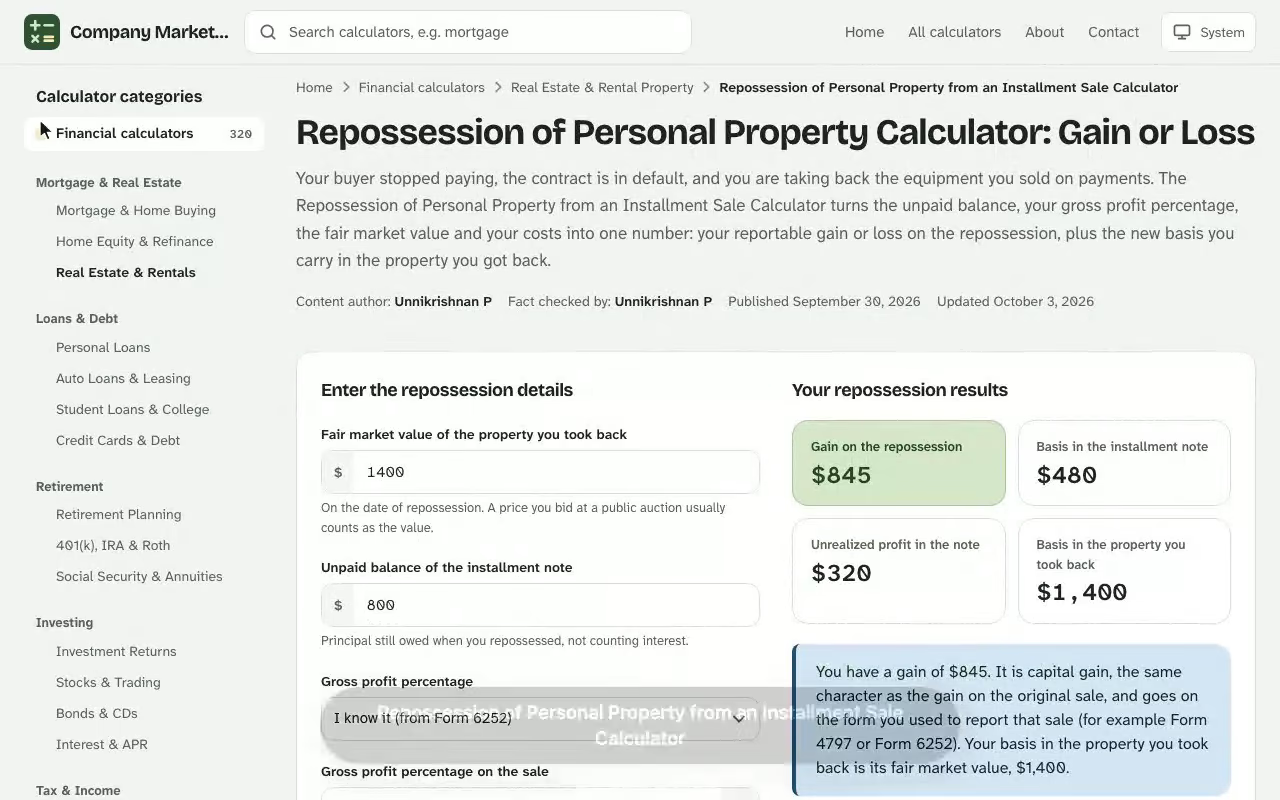
Repossession of Personal Property from an Installment Sale Calculator. Your buyer stopped paying, the contract is in default, and you are taking back the equipment you sold on payments. The Repossession of Personal Property from an Installment Sale Calculator turns the unpaid balance, your gross profit percentage, the fair market value and your costs into one number: your reportable gain or loss on the repossession, plus the new basis you carry in the property you got back. The free rent calculator is free to use with no sign-up, and works on desktop and mobile.
Your repossession results
Gain or loss on the repossession
–
Basis in the installment note
–
Unrealized profit in the note
–
Basis in the property you took back
–
–
Gross profit percentage used–
Gain or loss worksheet
The line-by-line calculation for personal property sold on the installment method, as laid out in IRS Publication 537.
Line
What it holds
Amount
Results are estimates for educational purposes and are not financial, tax or legal advice.
How the Repossession of Personal Property from an Installment Sale Calculator Works
When a seller finances a sale of movable goods such as vehicles, machinery, furniture, boats or equipment, the income tax rules let the seller spread the profit over the years in which payments arrive. That is the installment method. If the buyer later defaults and the seller retakes the goods, the unfinished business has to be closed out on the tax return: the seller trades an installment obligation for the goods themselves, and the difference between what the goods are worth and what the seller still has invested in the obligation is a gain or loss. If you want to see how the figures change, the 1031 exchange calculator online gives you an instant result you can adjust as you go.
The calculator follows the same eight steps as the IRS worksheet for this situation, so every figure it prints can be traced to a line you could fill in by hand. You enter four values and it handles the arithmetic, the sign of the result and the basis you take in the repossessed property.
Inputs you enter
Each field maps to a line on the worksheet. Having the original contract, your payment ledger and a dated valuation in front of you makes the entries quick.
Fair market value of the personal property on the date you take it back, including the value of anything else the buyer hands over besides the goods.
Unpaid balance of the installment obligation when the buyer defaulted, after subtracting any deficiency judgment you will not collect.
Gross profit percentage from the original installment sale, which you worked out when you reported the sale.
Repossession costs such as legal costs, towing, storage, auction fees and the expense of moving the property back to you.
Results you get back
The first result is the reportable gain or loss. A positive figure is a gain, a negative figure is a loss. Alongside it you see your unrealized profit, your basis in the installment obligation, and the new basis in the goods you now hold, which equals their fair market value on the repossession date.
Installment Payment Sale Calculator Formula for Gain or Loss
An installment payment sale calculator for repossessions rests on one short chain of arithmetic. First you strip out the profit that you have not yet reported, then you add what the retake cost you, then you compare the total with what the property is worth today. The free rental property calculator is free to use with no sign-up, and works on desktop and mobile.
Read the last line as a simple test. If the goods are worth more than everything you still have tied up in the contract plus the cost of retaking them, the difference is your gain. If they are worth less, the shortfall is your loss.
Basis in the installment obligation
Your basis in the installment obligation is the part of the unpaid balance that represents your own money coming back to you rather than profit. Because you reported profit only as payments arrived, the slice of the balance equal to the gross profit percentage was never taxed. The calculator removes that slice and keeps the rest. Put differently, the basis in the installment obligation is the unpaid balance multiplied by one minus the gross profit percentage.
Unrealized profit and the gross profit percentage
The unrealized profit is the profit still sitting inside the unpaid balance. A higher gross profit percentage means more of each future payment was going to be taxable profit, so a higher unrealized profit and a lower basis. A seller who sold an item at close to its tax basis has a low gross profit percentage and carries almost the entire balance as basis.
Why repossession costs are added to the basis
The costs of retaking the goods are part of what the default has cost you, so they sit on the same side of the comparison as your basis. They raise the amount the goods must be worth before you show a gain, and they deepen a loss when the goods have lost value. They are not deducted separately.
Worked Example: Installment Sale Repossession of a Used Skid-Steer Loader
Say you sold a used skid-steer loader to a landscaping crew. You had an adjusted basis of $15,275 in the machine and agreed on a selling price of $23,500. The buyer made a $4,700 down payment and signed a promissory note for the remaining $18,800, payable in monthly installments. Over ten months the principal payments you received totaled $4,900, and then the buyer defaulted.
First, the gross profit on the sale is the selling price less your basis: \(23{,}500 - 15{,}275 = 8{,}225\). Because there was no mortgage and no other debt assumed, the contract price equals the selling price, so your gross profit percentage is \(8{,}225 \div 23{,}500 = 35\%\).
The unpaid balance at default is the financed amount minus the principal you collected: \(18{,}800 - 4{,}900 = 13{,}900\). You retake the loader. A written appraisal puts its fair market value at $11,250, and towing, a mechanic's inspection and the legal costs of the repossession filing add up to $1,380.
Line
Item
Amount
1
Fair market value of the repossessed property
$11,250
2
Unpaid balance of the installment obligation
$13,900
3
Gross profit percentage
35%
4
Unrealized profit (line 2 × line 3)
$4,865
5
Basis in the installment obligation (line 2 − line 4)
$9,035
6
Repossession costs
$1,380
7
Basis plus costs (line 5 + line 6)
$10,415
8
Reportable gain or loss (line 1 − line 7)
$835 gain
The result is a $835 gain. You are taking back a machine worth $11,250 in exchange for an obligation in which you have only $9,035 of basis, and your costs of $1,380 still leave $835 on the table. Your new basis in the loader is its $11,250 fair market value, not the $10,415 you used to measure the gain.
Worked example: from the $13,900 unpaid balance to an $835 reportable gain on the repossessed loader.
What happens if the fair market value is lower
The same contract can produce very different answers depending on what the retaken goods are worth. Holding every other input steady, here is how the gain or loss moves as the appraisal changes.
Fair market value
Basis plus costs
Result
$8,900
$10,415
$1,515 loss
$10,415
$10,415
$0, the break-even point
$11,250
$10,415
$835 gain
$12,600
$10,415
$2,185 gain
The break-even value, $10,415, is simply the basis in the obligation plus the repossession costs. Any appraisal below that number produces a loss; any appraisal above it produces a gain.
Gain or loss on the loader at different appraisals and repossession cost levels.
Gross Profit Percentage and Installment Sale Income Explained
The gross profit percentage is the engine of the whole installment method, so it is worth knowing where your number came from. In the year of the original sale you split the contract into profit and return of capital, and every later payment was split the same way.
Gross profit is the selling price minus your adjusted basis, which includes selling expenses and any depreciation you claimed that lowered your basis. The contract price is the selling price less any existing debt the buyer assumed, up to your basis. For most sales of personal property with no assumed debt, the contract price and the selling price are the same figure.
Each year, installment sale income is the payments received in that year multiplied by the gross profit percentage. The rest of each payment is a return of capital. When a buyer defaults, the part of the balance that never produced income is what the calculator measures.
Gross profit
Selling price minus adjusted basis, including selling expenses.
Contract price
Selling price minus qualifying debt the buyer takes over.
Installment sale income
Payments received in the year multiplied by the gross profit percentage.
Unrealized profit
Unpaid balance multiplied by the gross profit percentage.
Depreciation deserves a separate warning. If the property you sold was used in a business, depreciation recapture is reported as income in the year of sale no matter when payments arrive, and that recaptured amount is added to your basis for the gross profit calculation. Pull the correct percentage from your original return and Form 6252 instead of recomputing it from memory.
Repossessing a Box Truck and Reading the Installment Sale Repossession Result
Marisol Okafor ran a catering business and sold her retired box truck for $19,200 on a note. Her adjusted basis after depreciation was $12,288, so gross profit was $6,912 and her gross profit percentage, reported on Form 4797 and Form 6252, was exactly 36%. Eleven months later the buyer misses a third payment in a row, and the unpaid balance stands at $9,740.
Before she lets the truck go to auction, she opens the calculator to see what a bid would mean for her return. She enters an unpaid balance of $9,740 and a gross profit percentage of 36%. For the property value she types $6,980, the price the truck fetches when she credits her bid at a public sale, which the IRS presumes to be its fair market value. Repossession costs come to $1,265: the tow, two months of storage and the auctioneer's fee.
The calculator returns an unrealized profit of $3,506.40 and a basis in the obligation of $6,233.60. Adding the $1,265 of costs gives $7,498.60, and the $6,980 value falls short of it by $518.60. The reportable gain or loss on the repossession is a $518.60 loss, and because she used the installment method, it keeps the character of her original gain, so it goes on Form 4797 where the sale was reported rather than being treated as a bad debt.
The break-even figure matters more to her than the loss. The truck has to be worth $7,499 or more for the repossession to avoid a loss, so she reruns the calculator with a $7,500 value and sees a $1.40 gain. She sets $7,500 as her reserve bid, writes the auction value and the invoices into the file, and records $7,500 as her new basis if the truck stays in her yard.
Fair Market Value of Repossessed Property
The fair market value of repossessed property is a question of fact, and it is the input that most often changes the answer. The value is what a willing buyer would pay a willing seller when neither is forced to act.
If you bid on the property at a lawful public auction or judicial sale, its fair market value is presumed to be the price at which it sells, unless clear and convincing evidence shows otherwise. That presumption cuts both ways: a credit bid that is much too low can understate your basis, and the figure will be hard to dispute later.
Use a dated appraisal, dealer quote or published valuation guide for the specific make, model, year and condition.
Photograph the property at the moment you retake it, because buyers in default rarely maintain what they hold.
Keep the appraisal with your repossession file, since it supports both the gain or loss and your new basis.
If the buyer hands over anything else with the goods, such as a cash settlement, add its value to the fair market value before using the calculator.
Repossession Costs That Raise Your Basis
The expenses of retaking the property count as part of the cost of the repossession. They include:
Legal costs of the foreclosure filing, court fees and attorney fees tied to the repossession.
Towing, transport and the cost of moving the property back to your location.
Storage, security and insurance during the period the goods are held for resale.
Auction fees and commissions incurred on a forced sale of the collateral.
Routine repairs made to prepare goods for resale are usually a separate question, since they relate to the resale rather than to the repossession itself. Keep invoices that separate the two, and enter only the repossession costs in the calculator.
Gain or Loss When the Installment Method Was Not Used
Not every sale on payments is reported on the installment method. A seller can elect out, and some sales, such as sales of inventory or sales of publicly traded securities, cannot use it at all. When you reported the full gain in the year of the original sale, the repossession is measured differently, and a loss is treated as a bad debt.
In that case your basis in the installment obligation is not reduced by any unrealized profit, because you already paid tax on all of it. The basis is generally the amount you could have collected: the issue price of the obligation, increased by any original issue discount you included in income, and decreased by payments other than qualified stated interest. For a simple note with stated interest, that works out to the unpaid face value.
Item
Installment method used
Installment method not used
Fair market value of the loader
$11,250
$11,250
Unpaid balance
$13,900
$13,900
Basis in the obligation
$9,035
$13,900
Repossession costs
$1,380
$1,380
Gain or loss
$835 gain
$4,030 loss
The comparison shows why the reporting method matters so much. The same loader, the same default and the same costs produce an $835 gain under the installment method and a $4,030 loss when the entire profit was reported up front, because in the second case you are recovering tax you already paid on profit you never collected.
That loss is a bad debt. How you deduct it depends on whether the original sale was a business or nonbusiness sale. Nonbusiness bad debts are covered in chapter 4 of IRS Publication 550, and business bad debts follow the instructions for your income tax return. The calculator on this page is built for the installment method, so use the IRS rules for the second column.
The same repossession reported two ways: each gap equals the $4,865 of unrealized profit.
Ordinary Income, Capital Gain and Bad Debt: The Character of Your Result
The amount is only half the answer; the character of the gain or loss decides which tax rate applies and where it goes on your return.
Installment method used: your gain or loss on the repossession has the same character as the gain on the original sale. If the sale produced a capital gain, so does the repossession gain. If part of the original gain was ordinary income, such as depreciation recapture, the repossession follows it.
Installment method not used: a gain is ordinary income because it is a gain on the obligation itself, and a loss is a bad debt.
Any gain you recognize increases taxable income in the year of repossession, not in the year of the original sale.
New Basis and Holding Period of the Repossessed Property
When you take personal property back, your new basis in it is its fair market value at the time of repossession. That is the figure you will use if you resell the goods or keep them for your own use, and it is the reason the calculator shows the basis separately from the gain.
The holding period for goods you retake also resets in practice: you measure how long you have held the repossessed property from the date you get it back, so a quick resale is generally a short-term transaction. Keep the date of repossession in your file along with the appraisal.
If you later sell the goods for more than the basis you took, that further difference is a separate gain. If you sell for less, it is a separate loss. Either way, the arithmetic starts from the new basis, not from the original cost you had before the first sale.
Reporting Installment Sale Repossession on Form 6252, Form 4797 and Schedule D
You report the gain or loss from a repossession on the same form you used to report the original sale. In most cases that means Form 6252 for the installment sale itself, and the result flows to Schedule D if the original gain was a capital gain. If you reported the original sale on Form 4797, because it involved business property, use that form for the repossession as well.
Pull the original return and the Form 6252 from the year of sale.
Confirm the gross profit percentage and the total payments received through the date of default.
Run the figures through the calculator, or fill in Worksheet C in Publication 537.
Report the gain or loss on the same form as the original sale, matching its character.
Record the new basis in the repossessed property in your asset records.
The IRS lays out the personal property procedure in Publication 537 under repossession, with Worksheet C as the figure-it-out-yourself version of the calculator on this page. Keep your copy of the worksheet, the appraisal and the invoices for the same period you keep the return.
Personal Property vs Real Property Repossession Under Sec. 1038
People often search for this calculator expecting the rules for land and buildings, so the difference is worth stating plainly. Repossession of real property is governed by Sec. 1038, and its rules are mandatory. Under Sec. 1038 the seller generally keeps essentially the same adjusted basis in the property that existed before the original sale, and the gain recognized on repossession is limited to the payments received that were not yet included in income, capped by the profit on the original sale.
Personal property works in the opposite direction. There is no mandatory carryover basis and no cap tied to the original profit. You compare the property's fair market value with your basis in the obligation, add your costs, and report whatever difference results, whether gain or loss.
Feature
Personal property
Real property (Sec. 1038)
Basis after repossession
Fair market value on the date retaken
Adjusted basis before the sale, adjusted for the repossession
Loss allowed
Yes, as a loss or bad debt
Generally no loss is recognized
Gain limit
None beyond the arithmetic
Capped at the original gain less amounts already reported
Rules are mandatory
No, the figures follow the method used
Yes, when the conditions are met
If your repossession involves land or a building, this calculator will not give the right answer. Use the IRS real property worksheets instead.
Seller Financing and Foreclosure: Retaking the Property and the Unpaid Balance You Enter
A seller-financed sale makes you a lender and a creditor as well as a seller, which is why the note has a basis of its own: the unpaid balance you enter in the calculator is the amount your buyer still owes on a note you hold. The repossession only counts as a settlement of that note if it discharges, in whole or in part, an obligation secured by the property, which is true when the goods are taken back after a foreclosure or auctioned and you apply the obligation against your bid. In everyday terms, seller financing means the amount you enter is a secured claim, and how you retake the goods decides how much of it the property satisfies.
The deficiency judgment is the legal claim that directly changes your input. If the goods sell for less than the balance, you may have a claim against the buyer for the difference. The unpaid balance you enter in the calculator should be net of any deficiency you cannot realistically collect, and any amount you later do collect needs separate tax treatment.
Installment Obligation Rules That Shape a Personal Property Repossession
The installment obligation is the buyer's promise to pay, and it is the asset you hold until the buyer pays it off or defaults. The IRS treats that promise as property of its own, with its own basis, and nearly every question about a repossession is really a question about what you still have invested in the installment obligation when the goods come back.
Three IRS rules about the installment obligation come up often enough to be worth knowing before you repossess anything.
Disposition. If you sell, give away, cancel or otherwise dispose of the installment obligation, the tax on the deferred profit generally comes due in that tax year. A repossession is a disposition in the sense that the obligation is satisfied with the goods, which is why the gain or loss is calculated at all.
Pledge. If you borrowed against the installment obligation, the IRS can treat the loan proceeds as a payment on it, which would already have lowered the unpaid balance you enter in the calculator.
Related buyers. A repossession from a relative or a business you control deserves a second look at the IRS rules in Publication 537.
None of these change the arithmetic in the calculator, but each can change whether a given repossession is simple. When any of them applies, the safest path is to read the installment sale rules in IRS Publication 537 before relying on a quick calculation, and to talk to a tax professional about the specific facts.
Which tax year the repossession belongs to
A repossession is reported in the tax year in which you take the property back, not in the tax year of the original sale and not in the tax year in which the buyer first missed a payment. That matters because the sale and the retake can sit in different years, with different tax rates, different income and sometimes different tax forms. Each tax year you filed on the installment method carried its own installment sale income, and the repossession year picks up whatever profit was still deferred. The taxpayer who reports it is the seller who still owns the installment obligation on the date of repossession.
Reconciling the loader example year by year
It helps to see that the calculator's figures reconcile with what you reported in the earlier tax year. In the loader example, the sale closed in March. By December the seller had collected the $4,700 down payment and $4,900 of principal, for payments received of $9,600 in that first tax year.
Item
Amount
Total gross profit on the sale
$8,225
Payments received in the year of sale
$9,600
Installment sale income reported (payments × 35%)
$3,360
Return of capital in those payments
$6,240
Profit never reported (the unrealized profit)
$4,865
The profit never reported, $4,865, is exactly the unrealized profit that the calculator printed on line 4 of its worksheet. The two sets of numbers describe the same thing from different directions: the seller reported $3,360 of the $8,225 of installment sale income, so $4,865 was left to report if the buyer had paid in full. When the loader came back, that unreported profit stopped mattering, because the obligation was satisfied with property instead of cash.
Keeping Interest Out of the Unpaid Balance: Unstated Interest and the Loan Behind the Sale
An installment sale is both a sale and a loan: you lend the buyer the unpaid price, and the IRS expects that loan to carry a fair rate of interest. For the calculator, that creates one rule and two adjustments.
See how the Repossession of Personal Property from an Installment Sale Calculator works: change the inputs and the gain on the repossession updates instantly. Enter your own numbers in the calculator above.
Stated interest stays out. Interest the buyer actually pays under the contract is interest income to you in the year you receive it. It is not part of the unpaid balance, the basis in the obligation or the gain or loss.
Unstated interest lowers the price. If a contract with payments due more than a year after the sale charges little or no interest, the IRS can treat part of each payment as unstated interest. That reduces the selling price, so your gross profit percentage should come from the adjusted price.
Issue price matters when the installment method was not used. The issue price of the obligation, adjusted for any discount you included in income, becomes the basis in that case.
In practice, check the contract before you type anything into the calculator: if it charged no interest and ran past a year, ask whether unstated interest was carved out of the price in the year of sale, because the adjusted price feeds your gross profit percentage. If the contract charged a fair rate, the interest you collected is already reported as interest income, and the unpaid balance holds principal only.
Keep the interest and the principal separate in your records. The unpaid balance is a principal figure only, so interest you accrued but never collected should not be added to it. Doing so overstates both the unrealized profit and the basis, and the result will no longer match the IRS worksheet.
Taxable Gain, Amount Realized and Your Deduction for a Loss
Three phrases from the tax rules show up in nearly every explanation of a repossession, and the calculator's result sits at the intersection of all three.
Amount realized
What you receive in exchange for giving up the obligation. In a personal property repossession, the amount realized is the fair market value of the property you take back, plus the value of anything else the buyer gives you.
Taxable gain
The portion of a gain that is included in income. Where you used the installment method, any taxable gain on the repossession is the amount realized less your basis in the obligation and less your repossession costs.
Deduction
A loss, or a bad debt, that reduces income. Whether it is a deduction against ordinary income or a capital loss depends on the character of the original sale.
In the loader example, the amount realized is $11,250, the taxable gain is $835 after subtracting the $9,035 basis and the $1,380 of repossession costs, and there is no deduction because the result is a gain. In the lower-value scenario the same arithmetic produces a $1,515 loss, which becomes a deduction only to the extent the tax rules allow it.
Any later recovery from the buyer, such as a collected deficiency, is reported separately from the gain or loss the calculator shows.
Sales the Installment Method Cannot Cover: Inventory, Securities and Dealer Sales
The calculator assumes the original sale was reported on the installment method, and some sales never qualify. Knowing which ones prevents a misapplied calculation.
Inventory. A dealer in personal property who sells items from inventory on an installment plan generally cannot use the installment method for those sales. The whole gain is reported in the year of sale, so a later repossession follows the bad debt rules instead.
Securities. Sales of stock or securities traded on an established market are reported in the year of the trade, even if payment arrives later, so they have no unreported profit to measure.
Depreciation recapture. Recapture income is reported in the year of sale, which raises your basis for the purposes of the gross profit percentage. The installment method defers only the remainder.
Electing out. You can choose to report the full gain in the year of sale. If you made that choice, treat the repossession the way the previous section describes for sales not reported on the installment method.
When in doubt about how a sale was reported, the original return answers the question. If it has a Form 6252 for the sale, the installment method was used. If it does not, the full gain was reported up front.
How Down Payment, Monthly Payment Schedule and Gross Profit Percentage Change a Repossession Result
Much of a repossession's outcome is decided on the day you set the terms of the sale, because the terms shape the two inputs the calculator weighs against each other: the unpaid balance and the fair market value. A larger down payment shrinks the unpaid balance you will enter at default, and a shorter monthly payment schedule cuts the time the property can lose value before the balance is paid off.
Equipment and vehicles also lose value faster than most loans amortize, so a long schedule with a small down payment is the combination most likely to leave a loss at default.
Contract feature
Effect on the repossession result
Larger down payment
Lowers the unpaid balance you enter, so the same property value is more likely to cover it.
Shorter monthly payment schedule
Cuts the time the property can lose value, which keeps the fair market value input higher.
Higher gross profit percentage
Raises the unrealized profit and lowers the basis in the obligation, which makes a gain more likely if the property holds its value.
A sale priced near the property's adjusted basis has a low gross profit percentage, so there is little deferred profit and a smaller tax swing if things go wrong. A sale priced far above the adjusted basis defers more profit, but a repossession of goods worth much less than the selling price can then produce a large loss.
Tax Planning Steps When a Buyer Stops Paying
A buyer in default creates a legal problem and a tax problem at the same time. Sellers who treat them separately usually do better on both.
Freeze the numbers. Note the date of the last payment and compute the unpaid balance on that date, so later disputes about interest and fees have a clear starting point.
Identify the reporting method. Check the return for the year of sale to see whether you reported on the installment method, and pull the gross profit percentage from it.
Value the property. Get an independent valuation, or document the public auction price, as close as possible to the repossession date.
Total the costs. Keep receipts for every expense of retaking the goods, separating repossession costs from the cost of preparing the property for resale.
Model the outcomes. Run the calculator at a range of values to see whether a quick resale at a lower price changes the tax outcome meaningfully.
Plan the filing. Decide which form carries the result, and make a note of the new basis and the date for the next sale.
A seller with several overdue contracts can run each one through the calculator separately. Each repossession has its own gross profit percentage, its own basis and its own fair market value, so combining them into one calculation hides the very differences that determine the tax result.
Documentation That Supports Your Repossession Figures
If the IRS ever questions a repossession, the figures are only as good as the paper behind them. A complete file shows how each input was derived and answers the questions a reviewer would ask in the same order the worksheet does.
The original contract, the note and the security agreement, showing the selling price, the down payment and the payment schedule.
The payment ledger, with principal and interest split on every line, so the interest income you already reported stays separate from the unpaid balance and from any interest you accrued but never received.
The tax return and Form 6252 for the year of sale, showing the gross profit percentage and the method used.
Default and repossession notices, with proof of delivery, and any court filings.
The valuation, auction record or dealer quote that supports the fair market value.
Invoices for towing, storage, legal work and other costs of retaking the property.
A printout of the calculator result, dated and kept with the return.
Keep the file at least as long as the period of limitations on the return that reports the repossession, generally three years from filing.
Each calculator input should trace to a record. A taxpayer who can point to the payment ledger for the unpaid balance, Form 6252 for the gross profit percentage and the valuation for fair market value can defend the result line by line, while a taxpayer who relies on memory has little to offer a reviewer. Write down where each figure came from at the time you enter it, since a taxpayer who documents as they go has the easier conversation.
Tax Consequences of Selling the Repossessed Property Afterward
Retaking the goods settles the question of gain or loss on the contract, but it starts a new transaction if you resell. The tax consequences of that resale are separate and are calculated against the new basis you took on the day of repossession.
Say the seller in the loader example resells the machine two months later for $10,800. The new basis was $11,250, so the resale produces a $450 loss on the property itself, in addition to the $835 gain already recognized on the repossession. The two results are separate lines on the return, and the first one does not offset the second automatically.
If the seller keeps the loader for business use, the new basis is also the starting point for depreciating it. Personal-use goods work the same way for gains, but a loss on later sale of personal-use property is generally not deductible, so the new basis may support a future gain without supporting a future loss.
Common Mistakes in Repossession of Personal Property Gain or Loss Calculations
Using the original sale price instead of the unpaid balance. The calculator starts from what the buyer still owed on the date of default.
Entering the wrong gross profit percentage. Use the percentage from your original Form 6252, not a rough guess.
Forgetting repossession costs. Legal costs and towing reduce a gain or increase a loss, so leaving them out overstates your gain.
Treating a bad debt as a capital loss. If you reported the whole gain up front, the loss belongs in the bad debt rules.
Ignoring the new basis. The gain or loss is settled, but the next sale of the goods starts from fair market value on the date retaken.
Mixing up personal property and real property rules. Sec. 1038 does not apply to a loader, a boat or a piano.
Checklist Before Repossessing Property From an Installment Sale
A few hours of preparation before you act can protect both the legal claim and the tax result.
Confirm the default under the contract and give any notice your state or your agreement requires.
Total every payment received, split into principal and interest, from the ledger, and note the interest rate the contract charged, because interest never enters the gain or loss figure.
Locate the original return, Form 6252 and the gross profit percentage.
Obtain an independent valuation on the date you retake the goods.
Track every repossession cost with receipts.
Run the calculator and save the result next to your records.
Decide whether to keep the goods, resell them or sell them at public auction.
Reading Your Reportable Gain or Loss
The number the calculator returns is only one part of the decision. A reportable gain or loss tells you what to put on the return, but it does not tell you whether repossessing was the right commercial move. Consider the following before you act on it.
A gain means you are getting back goods worth more than your remaining stake in the contract. You may owe tax on that gain even though you received no cash at default.
A loss means the collateral is worth less than your stake. It may reduce your tax, but it also signals that selling quickly may be better than holding the goods.
If the gain is ordinary income, expect it to be taxed at ordinary rates; if it keeps the capital character of the original sale, it may qualify for capital gain rates.
Your new basis is the starting point for the next sale, so a low appraisal today means a larger gain later if the market recovers.
For complicated situations, such as a related-party buyer, a pledged installment obligation, an obligation sold to a third party before default, or a contingent payment sale, review the full rules in IRS Publication 537 or consult a tax professional. The calculator handles the standard case reliably, but the rules around installment sales have many exceptions, and a personal income tax return is not a place to guess.
Used the way it is intended, a repossession calculator replaces a half-hour of worksheet arithmetic with a single pass, leaves a clear trail of inputs and results, and helps you understand the tax consequences of a default before you file.
Repossession of Personal Property from an Installment Sale Calculator questions
How do you calculate gain or loss on the repossession of personal property?
Multiply the unpaid balance by the gross profit percentage to get the unrealized profit, subtract it from the unpaid balance to get your basis in the installment obligation, add your repossession costs, and subtract that total from the property's fair market value. A positive result is a gain; a negative result is a loss.
What is the gross profit percentage and where do I find it?
It is the gross profit on the original sale divided by the contract price. You calculated it when you reported the sale on the installment method, so it appears on your original return and Form 6252.
What counts as repossession costs?
Legal costs of the foreclosure or repossession filing, towing and transport, storage, auction fees and the expense of moving the property back to you. Costs of repairing the property for resale are a separate question.
How is fair market value determined for repossessed property?
It is a question of fact. If you bid for the property at a lawful public auction or judicial sale, its fair market value is presumed to be the price it sells for unless there is clear and convincing evidence otherwise. Otherwise use a dated appraisal or dealer quote.
What is my new basis in the repossessed property?
For personal property, your new basis is its fair market value on the date of repossession. That is the starting point for any later gain or loss when you resell or keep the property.
What if I did not use the installment method for the original sale?
Then you already reported the full gain in the year of sale, your basis in the obligation is not reduced by any unrealized profit, and a loss on the repossession is treated as a bad debt. This calculator is built for sales reported on the installment method.
Is the gain or loss capital or ordinary?
Where the installment method was used, the gain or loss has the same character as the gain on the original sale. Where it was not used, a gain is ordinary income and a loss is a bad debt.
Does this calculator work for real property?
No. Repossession of real property follows different mandatory rules under Sec. 1038, with a different basis and a limit on taxable gain. Use the IRS real property worksheets instead.