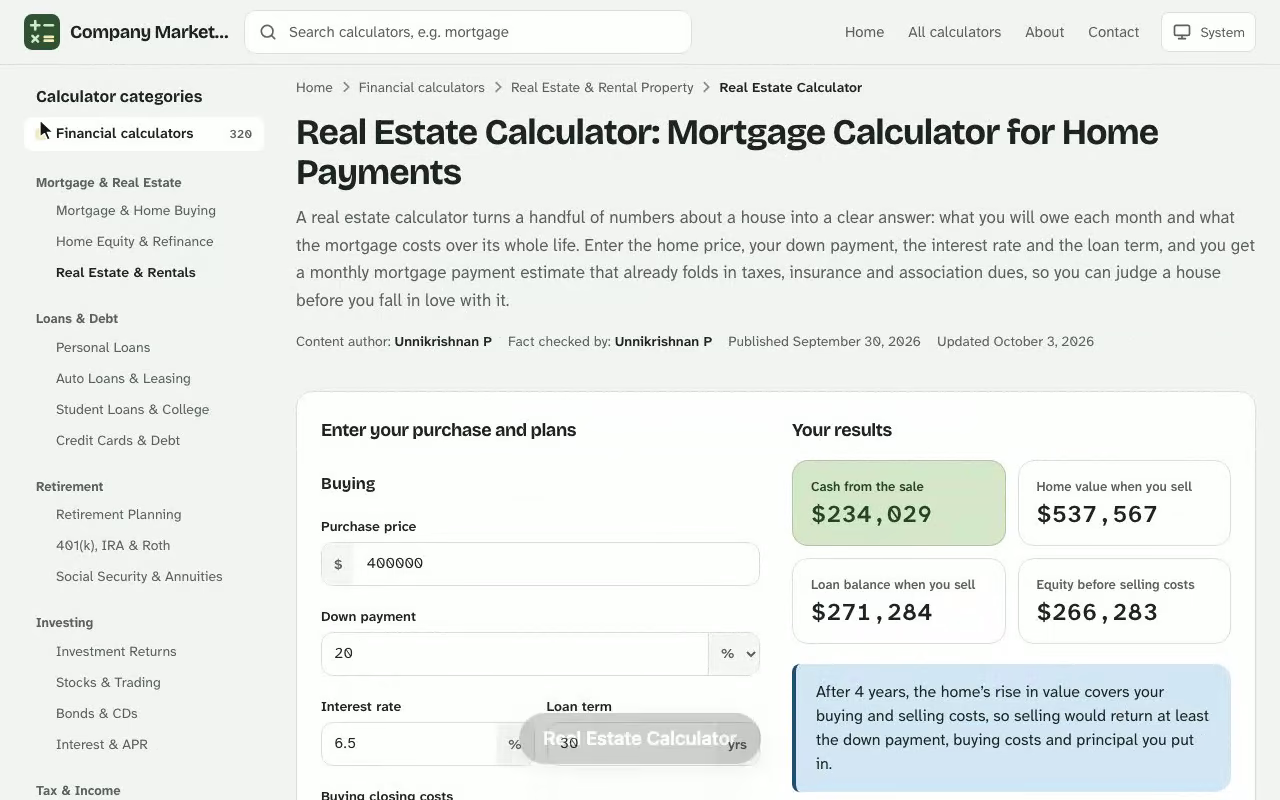
Real Estate Calculator. A real estate calculator turns a handful of numbers about a house into a clear answer: what you will owe each month and what the mortgage costs over its whole life. Enter the home price, your down payment, the interest rate and the loan term, and you get a monthly mortgage payment estimate that already folds in taxes, insurance and association dues, so you can judge a house before you fall in love with it. The rent calculator online uses the same plain-English approach, so you can compare results side by side.
Your results
Cash from the sale
–
Home value when you sell
–
Loan balance when you sell
–
Equity before selling costs
–
–
Where the sale money comes from
Down payment and buying costs–
Principal you repaid–
Change in value–
Selling costs–
Gain over the money you put in–
Cost of owning while you hold it
Monthly principal and interest–
Mortgage interest–
Property tax–
Home insurance–
Maintenance–
HOA dues–
Buying and selling costs–
Total cost of owning–
Average per month–
If you sold at the end of each year
Values are at the end of each year. Cash from the sale is after selling costs and paying off the loan. The gain compares it with your down payment, buying costs and principal repaid.
Year
Home value
Loan balance
Equity
Cash from sale
Gain
Results are estimates for educational purposes and are not financial, tax or legal advice.
How a Real Estate Calculator Works as a Mortgage Calculator
Most people searching for real estate tools want one thing first: the house payment they would face after closing. This mortgage calculator is built around that question. It takes the price of the property, subtracts what you pay up front, spreads the remaining loan amount across the term at your chosen rate, and then adds the recurring costs a lender collects with every check. The result is a full payment breakdown instead of a bare principal-and-interest figure. Try the equity line of credit payments calculator to run your own numbers — everything is calculated in your browser and nothing you enter is stored or sent anywhere.
Because the same inputs always give the same output, you can test a purchase from several angles in a few minutes. Change one field at a time, watch the monthly payment move, and you will learn which lever matters most for your budget.
The Inputs a Home Loan Calculator Asks For
Every home loan calculator starts with the same short list, and each field answers a different question:
Home price – the purchase price you expect to pay, or the current home value if you already own the place.
Down payment – cash you put in at closing, entered as a dollar amount or a percentage of the price.
Interest rate – the yearly cost of borrowing, quoted as a percentage.
Loan term – the number of years you take to repay, most often 15 or 30.
Property taxes – the yearly bill from your local government, entered as a percentage of value or a dollar figure.
Home insurance – the yearly premium for your homeowners insurance policy.
PMI – the extra monthly charge that applies when you put less than 20% down.
HOA fees – monthly dues for a condo or a planned community.
Down Payment and Loan Amount
The down payment is the first number that shapes everything else. Subtract it from the price and you have the amount you actually borrow. A bigger down payment shrinks the loan, which lowers the monthly payment, reduces total interest, and can remove the need for private mortgage insurance altogether. A smaller down payment keeps more cash in your pocket but leaves you carrying a larger balance for longer. Try a few percentages side by side, since a down payment of 12% and one of 20% on the same home can differ by hundreds of dollars a month once PMI is counted.
Interest Rate and Loan Term
The interest rate and the loan term work together. A longer term lowers the monthly payment because the balance is spread across more months, but you pay interest for more years. A shorter term raises the monthly payment and cuts the lifetime interest sharply. Your credit score influences the rate a lender offers, so a quote from a lender is always worth entering in place of a national average.
The Mortgage Payment Equation and Formula
Behind the screen sits one standard payment equation for a fixed-rate loan. Write the monthly interest rate as \(r\) (the annual rate divided by 12), the number of monthly payments as \(n\), and the amount borrowed as \(P\). The principal-and-interest portion of each month's bill is: The repossession of real property calculator online is free to use with no sign-up, and works on desktop and mobile.
$$M = P \times \frac{r\,(1+r)^{n}}{(1+r)^{n} - 1}$$
Your complete mortgage payment then adds the other recurring costs:
See how the Real Estate Calculator works: change the inputs and the cash from the sale updates instantly. Enter your own numbers in the calculator above.
Early in the loan, almost all of the principal and interest payment goes to interest, because interest is charged on a balance that is still large. Each month the balance falls slightly, the interest share shrinks, and more of the same fixed amount reduces what you owe. This gradual shift is the heart of amortization, and it is why extra payments made early are so powerful.
Taxes, Insurance and Escrow
Many lenders collect a twelfth of your yearly taxes and insurance with each payment and hold the money in escrow until the bills come due. The calculator mirrors this by dividing each annual figure by 12. That is why a monthly tax amount and an annual premium both appear as separate lines in the result: they are part of the monthly cost even though they never reduce your balance.
Worked Example: Monthly Payment on a $467,500 Home
Suppose you are pricing a $467,500 house with 12% down. The down payment is $56,100, so the loan amount is $411,400. You choose a 30-year fixed loan at 6.35%. Property taxes run 1.18% of the price each year, homeowners insurance costs $1,640 a year, the HOA charges $85 a month, and PMI is 0.62% of the loan each year.
The principal and interest payment comes to $2,559.88. Taxes add $459.71 a month, insurance adds $136.67, PMI adds $212.56 and the HOA adds $85.00. Together the total monthly payment is $3,453.81, and over 360 payments you would pay $510,155.97 in interest on top of the amount borrowed.
Payment component
Monthly amount
Share of total
Principal and interest
$2,559.88
74.1%
Property taxes
$459.71
13.3%
PMI
$212.56
6.2%
Home insurance
$136.67
4.0%
HOA fees
$85.00
2.5%
Total house payment
$3,453.81
100%
Taxes, PMI, insurance and HOA dues add $894 a month on top of the $2,559.88 loan payment in the worked example.
How the Balance Falls Over the Loan
In the very first month, $2,176.99 of your $2,559.88 goes to interest and only $382.89 reduces the balance. By the end of year five the balance is $384,444, and you have paid $126,637 in interest. The tipping point arrives in month 230, around year 19, when the balance has fallen to $241,451 and more of each payment goes to the loan than to interest.
Across 30 years the example loan costs $510,156 in interest on top of the $411,400 borrowed.
Loan year
Remaining balance
Interest paid so far
5
$384,444
$126,637
10
$347,447
$243,232
15
$296,666
$346,044
20
$226,967
$429,938
30
$0
$510,156
Running a $338,900 Condo Through a Mortgage Payment Calculator
Dana earns $7,900 a month before taxes, pays $410 a month on a car loan, and has $52,000 saved. A two-bedroom condo is listed at $338,900, and the seller's agent has asked how much Dana plans to put down. Before answering, Dana opens the calculator to get a monthly mortgage payment estimate.
The first run uses 10% down, which is $33,890 and leaves a $305,010 loan. Dana enters 6.125% over 30 years, property taxes of 0.94% a year, $1,284 a year for insurance, 0.55% a year for PMI from the lender's quote, and the condo's $212 monthly HOA dues. The result: $1,853.27 in principal and interest, and $2,577.54 once taxes, insurance, PMI and HOA are included.
Dana checks that figure against two named benchmarks. The 28% front-end guideline puts the housing cap at $2,212 a month, so $2,577.54, or 32.6% of income, is over it. Adding the $410 car payment brings total debt to 37.8% of income, above the 36% rule of thumb but under the 43% ceiling most lenders apply to a conventional loan.
So Dana changes one input: the down payment goes to 20%, or $67,780. The loan drops to $271,120, PMI disappears, and the payment becomes $2,231.83, which is 28.3% of income and 33.4% with the car loan. That is within the 36% rule and a quarter-point over the housing guideline, close enough to accept.
The decision follows from the numbers. A 20% down payment uses $67,780 of the $52,000 saved plus a $15,780 gift from a parent, so Dana asks the parent to confirm that gift in writing before making an offer at $338,900. The alternative, staying at 10% down and refinancing later, would mean carrying PMI for 91 months, until the balance reaches $270,783.
Mortgage Insurance, PMI and Your Equity
Mortgage insurance protects the lender, not you, if payments stop. On a conventional loan it appears as PMI whenever you borrow more than 80% of the home's value. In the example above, the loan starts at 88% of the price, so the $212.56 PMI charge applies from the first month. As you pay down the balance, equity builds, and once the balance drops to $374,000 (80% of $467,500), you can ask to have PMI removed. At this rate and term that happens after month 79, which would trim the monthly bill back to $3,241.25.
Avoiding PMI in the Calculator
Test the PMI field directly. Raise the amount you put down to 20% in the calculator and the $212.56 PMI line in the worked example disappears, while the loan amount falls with it. You can also set the loan program to VA or USDA, which do not charge the same PMI, or ask a lender about a lender-paid option with a slightly higher rate. Run each version and compare the total monthly payment, because the cheapest route depends on how long you plan to stay. A mortgage insurance charge is easy to overlook until it shows up as its own line in the result.
Loan Programs and Mortgage Types
The loan program you select changes the rate, the minimum down payment and the insurance rules. A good mortgage payment calculator lets you compare each loan type quickly, so you can see the effect before you apply.
Conventional, FHA, VA and USDA Loans
A conventional loan usually asks for as little as 3% down and charges PMI under 20%. An FHA loan lets buyers put down 3.5% with more flexible credit rules, but it carries its own mortgage insurance. A VA loan is available to eligible service members and veterans, often with no money down, and a USDA loan does the same for qualifying rural homes. A jumbo loan covers amounts above the conforming limit and tends to need a larger down payment and stronger credit.
Fixed-Rate Versus Adjustable-Rate Loans
A fixed-rate loan keeps the same rate for the whole term, so the principal and interest payment never changes. The 30-year fixed is the most common choice, while the 15-year fixed trades a higher payment for far less interest. An adjustable-rate loan, often called an ARM, starts with a lower rate that resets after a set period, which moves the risk of higher mortgage rates onto you.
Mortgage Terms Compared: 15-Year and 30-Year Home Loans
The same $411,400 loan costs very different amounts depending on the term and the rate. The table shows monthly principal and interest across three rates and three terms, using the same loan amount as the worked example.
Interest rate
15 years
20 years
30 years
5.35%
$3,329
$2,795
$2,297
6.35%
$3,550
$3,031
$2,560
7.35%
$3,779
$3,277
$2,834
Monthly principal and interest on $411,400 at three rates and three terms; the outlined cell is the worked example.
A one-point rise in the rate adds roughly $270 a month on the 30-year loan, so shopping for the lowest quote matters as much as the size of the down payment. Now compare terms directly. A 15-year loan at 5.75% has a payment of $3,416.31 and costs $203,535.28 in interest, while the 30-year loan at 6.35% costs $2,559.88 a month and $510,155.97 in interest. The shorter term saves $306,620.69 but needs $856.43 more every month, which is why checking house affordability against your income should come first.
Real Estate Calculators for Affordability, Refinance and Rental Property
One loan estimate rarely answers every question, which is why real estate calculators usually come as a set. Alongside the payment tool, buyers and owners reach for several others:
An affordability calculator that works backward from your income and debt to a price range.
A refinance tool that weighs a new loan against the old one.
A mortgage payoff tool that shows what extra payments save.
A rental property tool that reports cash flow and the capitalization rate.
A rent calculator and a rent-versus-buy comparison.
Practical tools for square footage, roofing and other project estimates.
Refinance and Extra Payments
To refinance, compare the new payment and its closing costs against what you pay now; refinancing only helps if you stay long enough to recover those costs. Extra payments are the cheaper alternative. Adding even a modest amount to principal every month shortens the schedule and cuts total interest, with no fees at all. If you need cash instead, a home equity loan or a HELOC lets you borrow against the part of the house you already own.
Using an Online Mortgage Calculator to Compare Mortgage Offers
An online mortgage calculator earns its keep when you hold several mortgage offers in your hand at once. Lenders quote different mortgage rates, different fees and different mortgage insurance rules, and the lowest rate does not always give the lowest mortgage cost. Enter each offer into the mortgage calculator in turn, keep the home price and the down payment fixed, and compare the total monthly payment, the total interest and the loan pay-off date side by side.
Mortgage Costs for First-Time Buyers
For a first-time buyer, the hardest part of a mortgage is guessing the costs that surround it. Your credit score shapes the mortgage rates you are offered, so check your report months before you apply, and compare any pre-qualified quote against a written Loan Estimate. Watch for origination charges, since a lender that advertises a low rate may recover the difference in fees. If a seller offers one of the assumable mortgages common on older FHA and VA loans, enter the existing balance and rate to see whether keeping that mortgage beats a new one. Compare each mortgage on its full cost, including private mortgage insurance and any condo fees, rather than on the headline payment alone.
Mortgage Planning for Investors and Owners
An investment purchase uses the same mortgage math with a different goal: the monthly payment has to leave room for vacancy, repairs and taxes. Many investors run the numbers on a mortgage with a larger down payment first, then test a smaller one to see how much debt they can carry without squeezing cash flow. Current housing costs, local market conditions and the mortgage rates on offer all feed into that decision, so rerun the estimate whenever the market moves. Owners weighing a second mortgage or a refinance should treat the existing mortgage balance as the starting loan amount and judge the new mortgage against it.
The same habit helps any homeowner: keep a short list of mortgage figures, such as your balance, your rate and your pay-off date, and update the mortgage calculator when one of them changes. A home that costs a bit more but comes with a lower mortgage payment can still beat a cheaper house with a higher one, and only a side-by-side mortgage comparison shows which is which. Treat each mortgage estimate as a snapshot, not a promise, and ask your lender to confirm the final home loan terms.
Costs a Home Loan Calculator Does Not Show
The monthly result covers the loan, taxes, insurance, PMI and HOA dues, but not every cost of buying. Closing costs commonly run 2% to 5% of the loan, so add them to the cash you need on top of what you put down. Budget for maintenance as well, since a common planning figure is about 1% of the home value each year, which you can divide by 12 and add to the calculator's monthly total. The appraisal and inspection fees come due before closing, and prices and mortgage terms shift with the housing market, so rerun your estimate whenever a new quote arrives.
Entering Your Lender's Numbers
Many homebuyers start with a prequalified estimate and then move to a preapproved letter once the lender has reviewed documents. Replace the calculator's default rate with the rate on that letter, and enter the exact cash you plan to bring, including any down payment assistance, to confirm the monthly figure. Check that your savings cover the full cash needed at closing. A strong credit history usually improves the quote, and a real estate agent can use your confirmed payment to keep your search inside a realistic price range. Each homeowner's situation differs, so treat every result as an estimate and confirm the details with a lender.
Real Estate Calculator questions
How much is a mortgage payment on a house?
It depends on the home price, your down payment, the interest rate and the loan term. Enter those values and the calculator adds property tax, home insurance, PMI and HOA dues to show the full monthly payment, not just principal and interest.
What does a monthly mortgage payment include?
Principal and interest are the core. Most payments also include property taxes and homeowners insurance (often collected in escrow), PMI when you put down less than 20%, and HOA dues if the home has them.
How much should I save for a down payment?
Many conventional loans accept 3% to 5% down and FHA loans allow 3.5%, while VA and USDA loans can require nothing. A larger down payment lowers the loan amount, the monthly payment and the interest paid, and 20% down avoids PMI on a conventional loan.
How do interest rates affect my home loan?
On a 30-year loan, each full percentage point added to the rate raises the monthly principal and interest payment by roughly 10%, and the effect on total interest over the loan is larger. Try a few rates in the calculator to see the difference.
When can I stop paying PMI?
On a conventional loan you can usually ask your lender to remove PMI once the balance falls to 80% of the home's original value. Raising the down payment to 20% in the calculator shows the payment without it.
Is a 15-year or a 30-year mortgage better?
A 15-year loan has a higher monthly payment but much less total interest and builds equity faster. A 30-year loan keeps the monthly payment lower. Change the loan term and compare the monthly payment with the total interest paid.
What is the difference between prequalified and preapproved?
Prequalification is a quick estimate of what you might borrow based on figures you report. Preapproval means a lender has verified your income, assets and credit and issued a written commitment, which carries more weight with sellers.
Do bi-weekly payments save money?
Paying half of the monthly principal and interest every two weeks makes 26 half-payments a year, equal to one extra monthly payment. That shortens the loan and cuts interest, and the calculator shows the estimated saving.