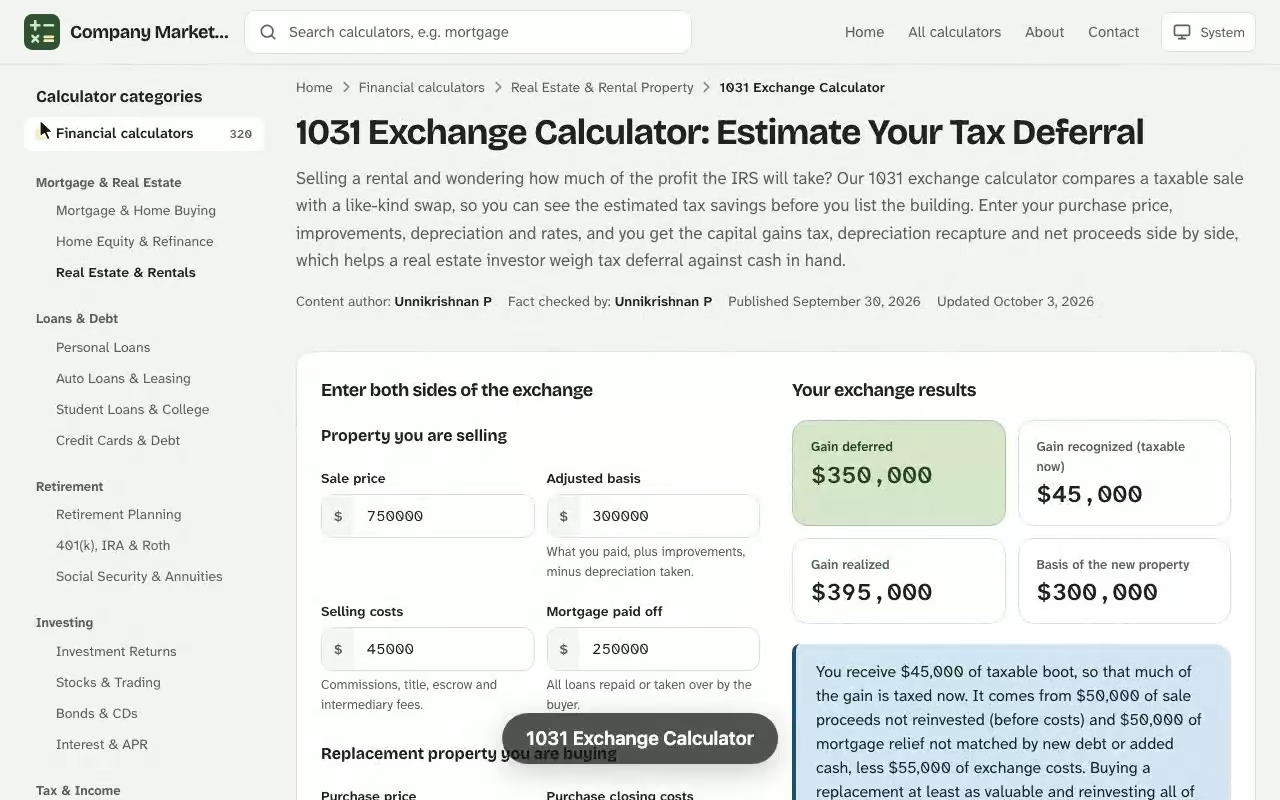
1031 Exchange Calculator. Selling a rental and wondering how much of the profit the IRS will take? Our 1031 exchange calculator compares a taxable sale with a like-kind swap, so you can see the estimated tax savings before you list the building. Enter your purchase price, improvements, depreciation and rates, and you get the capital gains tax, depreciation recapture and net proceeds side by side, which helps a real estate investor weigh tax deferral against cash in hand. The rent calculator online uses the same plain-English approach, so you can compare results side by side.
Your exchange results
Gain deferred
–
Gain recognized (taxable now)
–
Gain realized
–
Basis of the new property
–
–
Cash and boot
Net cash from the sale–
Cash needed for the purchase–
Cash left over for you–
Cash boot (proceeds not reinvested, before costs)–
Net mortgage relief (mortgage boot)–
Less exchange costs used against boot–
Taxable boot–
Estimated tax due now–
Estimated tax deferred–
Form 8824 Part III worksheet
How your figures map to the realized gain, recognized gain and basis lines of IRS Form 8824. Depreciation recapture (line 21) is not split out here: it is part of the recognized gain, not added to it.
Line
What it holds
Amount
Results are estimates for educational purposes and are not financial, tax or legal advice.
How the 1031 Exchange Calculator Estimates Your Tax Deferral
A 1031 exchange lets you postpone federal income tax on an investment property sale by rolling the proceeds into a replacement property. The tool runs the same numbers twice. First it builds a taxable sale scenario in which four separate taxes come due. Then it builds the exchange scenario, where those four lines show $0 because the gain is deferred rather than forgiven. The difference is your estimated tax savings, and it is also the amount of extra equity that stays invested. Next, open the free deferred payment repossession calculator and enter your own details to see an estimate in seconds.
The idea comes from Section 1031 of the Internal Revenue Code, which the IRS applies to real estate held for productive use in a trade or business or held for investment. A primary residence does not qualify. Because the tax is only postponed, the deferred gain carries over into the replacement property's tax basis, and it comes due later unless you keep exchanging or hold the property for life.
The four taxes in a taxable sale
A taxable sale of investment real estate can trigger up to four layers of tax, which is why the combined bill often surprises owners who only budgeted for the headline rate:
Federal capital gains tax at 0%, 15% or 20% on the long-term capital gain, depending on your taxable income.
Depreciation recapture at a flat 25% on the recaptured depreciation you deducted while you owned the asset.
State tax on the gain, which ranges from nothing in some states to double digits in others.
The net investment income tax of 3.8% for higher earners.
Net investment income tax and filing status
The net investment income tax applies when your modified adjusted gross income passes $200,000 as a single filer or $250,000 when filing jointly. It lands on the lesser of your net investment income or the amount over the threshold, and you report it on Form 8960. If your income sits below the line, set the rate to 0%. Your marginal tax rate matters here, because the calculator applies the top rate you select rather than an averaged one.
Calculator Inputs for a Like-Kind Exchange Estimate
Every field maps to a figure on your closing statement or depreciation schedule. Gather them before you start, because a wrong cost basis skews every result below it. The installment sale repossession calculator online uses the same plain-English approach, so you can compare results side by side.
Input
What to enter
Where to find it
Original purchase price
What you paid for the investment property
Your closing statement from the purchase
Capital improvements
Roofs, additions, major systems that add value
Receipts and your depreciation schedule
Accumulated depreciation
Total deductions taken over the holding period
Prior tax returns and Form 4562
Sales price
The gross sale price before costs
The purchase contract
Selling expenses
Commissions, title fees, transfer tax
The seller's settlement statement
Loan balances
Mortgage principal still owed at closing
Your lender payoff letter
Capital gain rate, state tax rate, depreciation recapture rate, NIIT rate
0%, 15% or 20%; your state's top rate; 25%; 0% or 3.8%
Your tax return and state tax tables
Cost basis and adjusted cost basis
Your cost basis is the original purchase price plus capital improvements. Subtract accumulated depreciation and you have the adjusted cost basis, also called the net adjusted basis. Routine repairs do not count as improvements, and the original tax basis also includes capitalized closing costs. A lower tax basis means a larger gain, so depreciation you took for years raises the bill at sale.
Selling expenses, sales proceeds and loan payoff
Selling expenses cover broker commissions and other cost of sale items. Subtract them from the sale price and you get the sales proceeds, sometimes labelled net sales proceeds. Subtract your loan balances as well and you reach the gross equity, the cash left before any tax is paid.
Worked Example: Taxable Sale vs. 1031 Tax Exchange
Take a fourplex bought years ago and now ready to sell. Here are the figures we use for this walk-through; they are our own illustration, not a quote from anyone's listing.
Original purchase price: $612,000, plus $84,500 of capital improvements
Accumulated depreciation: $187,300
Sales price: $1,215,000 with $72,900 of selling expenses
Loan balances: $398,000
Federal rate 15%, depreciation recapture 25%, state 5%, NIIT 3.8%
The calculator first derives the intermediate figures with these formulas:
That gives sales proceeds of $1,142,100, a cost basis of $696,500 and an adjusted cost basis of $509,200. The federal capital gain is $1,142,100 − $696,500 = $445,600. The adjusted capital gain, which drives the state and NIIT lines, is $1,142,100 − $509,200 = $632,900.
Capital gains tax and depreciation recapture in dollars
Now apply each rate. The capital gains tax is 15% of $445,600, or $66,840. The depreciation recapture is 25% of $187,300, or $46,825. Use the same inputs in a spreadsheet and you will match these lines to the cent.
State tax, net investment income tax and total tax paid
The state tax is 5% of $632,900, or $31,645. This is the state capital gains tax line, and it is the easiest one to get wrong, because the rate depends on where the building sits rather than where you live, and a few states charge nothing at all. Look up the top rate for the state before you type it in. The net investment income tax is 3.8% of $632,900, or $24,050.20. The total tax paid, which is the total tax due and the capital gain tax due on a taxable sale, is $169,360.20, about 14% of the sale price. This tax liability is the number a 1031 exchange defers.
In the taxable sale example, $169,360 of tax is the step a 1031 exchange defers.
$$\text{Total tax} = \text{Federal gain tax} + \text{Recapture} + \text{State} + \text{NIIT}$$
After-tax proceeds and net equity compared
Line
Taxable sale
1031 exchange
Capital gain tax
$66,840
$0
Depreciation recapture tax
$46,825
$0
State tax
$31,645
$0
Net investment income tax
$24,050
$0
Total tax paid
$169,360
$0
Net equity available to reinvest
$574,740
$744,100
Those after-tax proceeds, or net proceeds, of $574,740 are the net equity of a taxable sale. In the exchange, the gross equity of $744,100 goes to your qualified intermediary and stays invested. The gap is $169,360, and it works as purchasing power: with 25% down, $574,740 supports about $2.30 million of property, while $744,100 supports about $2.98 million. That is the leverage benefit of deferral, and it is why long-term holders call the exchange a wealth-preservation tool.
A 1031 exchange keeps the full $744,100 of equity invested; a taxable sale leaves $574,740.
Running a 1031 Tax Exchange Estimate on a Single-Tenant Retail Building
Dana and Marcus, a married couple, own a single-tenant retail building under contract at $887,450. Their broker's commission and closing costs come to $53,247, and $291,860 of mortgage principal is still owed. They want to know whether a 1031 exchange is worth the paperwork before the buyer's inspection period ends.
Into the calculator they type an original purchase price of $438,200, capital improvements of $61,750 and accumulated depreciation of $142,880, all read off their latest depreciation schedule. They choose the 20% federal rate, 25% depreciation recapture, a 6.6% state rate and the 3.8% net investment income tax, because their joint modified adjusted gross income already exceeds the $250,000 filing threshold for Form 8960.
The tool returns sales proceeds of $834,203, an adjusted cost basis of $357,070 and an adjusted capital gain of $477,133. The four taxes land at $66,851, $35,720, $31,491 and $18,131, a total tax of $152,192. After the loan payoff, a taxable sale leaves them $390,151, while the exchange column keeps $542,343 invested, the same tax deferral estimate framed as extra equity.
See how the 1031 Exchange Calculator works: change the inputs and the gain deferred updates instantly. Enter your own numbers in the calculator above.
The inspection then turns up a roof problem, and the buyers ask for a $25,450 price cut to $862,000. Dana changes only the sales price and selling expenses ($51,720) and re-runs it. The total tax drops to $144,920 and the exchange equity to $518,420. The numbers settle the question: roughly $145,000 of tax is too much to pay, so they call their intermediary the same afternoon and mark day 45 on the calendar as the date to name a replacement building in writing.
Section 1031 Exchange Rules: 45 Days, 180 Days and Boot
The calculator estimates the tax, but the exchange only works if you follow the rules. A section 1031 exchange runs on two fixed clocks that start the day you close on the relinquished property, and missing either deadline turns the deal into a taxable sale.
Relinquished property and replacement property
The relinquished property is the one you sell, and the replacement property is the one you buy. Both must be like-kind, which for real estate is broad: rental properties, vacant land, a commercial property or a multifamily building can usually trade for one another. To identify the replacement property, you must name it in writing within 45 days, and you must close within 180 days or by your tax return due date, whichever comes first. Check that timeline early, because the deadline cannot be extended for a weekend or a slow lender.
The 45-day and 180-day clocks both start when the relinquished property closes.
Qualified intermediary and boot
You may never touch the cash. A qualified intermediary holds the proceeds between closings, which is also why the calculator treats the exchange column as fully reinvest-ed money. Any cash you take out, or any loan relief that is not replaced, is boot and is taxed in the year you receive it. A good rule is to buy equal or higher in value and replace the debt. Full reinvestment of the net proceeds is what keeps the deferral intact, so size the purchase before you sell. Pay attention to closing costs and legal fees too, since paying them from exchange funds can create boot.
Delayed Exchange, Starker Exchange and Other Structures
Most investors use a delayed exchange, sometimes still called a Starker exchange after the court case that shaped the rules. Three variations also exist:
A simultaneous exchange closes both properties the same day.
A reverse exchange buys the replacement property first, parked in a separate entity.
A build-to-suit exchange uses the proceeds to improve the replacement property within the 180-day window.
The calculator models the standard timeline, so its tax deferment figure is the same whichever structure you choose. Investors who want passive ownership often reinvest into a DST, short for Delaware statutory trust, and some later use a 721 exchange to move into a fund; both are replacement options that keep the deferral. A real estate investor should still check the replacement's cash flow rate, since deferring tax does not make a weak asset strong, and the equity the tool reports as carried forward is what is exposed to appreciation or loss.
Capital Gain Tax Calculator Limits and Next Steps
Treat any capital gain tax calculator as an estimate. It uses a marginal rate and the figures you supply, so your own return can differ, for example when you have passive losses or when part of your threshold is already used by other income. It also cannot see a mortgage payoff quirk or a state that taxes differently. Before you commit, consult a tax advisor or tax professional and confirm the rules with your intermediary. Even a simple deadline slip can cost far more than the fee.
One more habit helps: save each run. Change one input at a time, such as the loan payoff or the selling expenses, and write down how the total moves. Seeing which line moves the result most tells you where to negotiate and where to double-check your records, and it gives your advisor a clean set of assumptions to review in one sitting.
Run the 1031 exchange calculator with a few scenarios, such as a lower sale price or a higher state rate, and compare the tax deferment each time. Used that way, it turns a vague idea into a concrete number you can bring to your advisor: how much each purchase basis, sale price and improvements budget changes your investment result, your income tax bill and the rate you pay on the equity you roll forward.
1031 Exchange Calculator questions
What does a 1031 exchange calculator do?
It compares selling an investment property outright with exchanging it for a like-kind replacement. It estimates the capital gains tax, depreciation recapture, state tax and net investment income tax a taxable sale would trigger, and shows how much more equity stays invested if you defer them.
How is the capital gain calculated?
Start with your net adjusted basis, which is the original purchase price plus capital improvements minus accumulated depreciation. The capital gain is the sales price minus that adjusted basis minus your selling expenses.
What is depreciation recapture?
It is the part of your gain that comes from depreciation deductions you took while you owned the property. It is generally taxed at up to 25% rather than the lower long-term capital gains rate.
When does the net investment income tax apply?
The 3.8% net investment income tax can apply when your income is above the statutory threshold for your filing status. If you are below it, set the rate to 0%.
What are the 45-day and 180-day rules?
You must identify replacement property within 45 days of closing on the property you sold and complete the purchase within 180 days. Missing either deadline generally makes the sale taxable.
Does a 1031 exchange eliminate the tax?
No. It defers the tax by carrying your basis into the replacement property, so the deferred gain can come due later unless you keep exchanging or hold the property for life.
Why does the calculator multiply equity by four?
The reinvestment lines assume a 25% down payment, so each dollar of equity supports roughly four dollars of replacement property. It shows how much more property the untaxed equity can buy.
Can I use this calculator for my primary residence?
No. Section 1031 applies to real estate held for investment or business use, not a personal home, and this estimate does not replace advice from a tax professional.