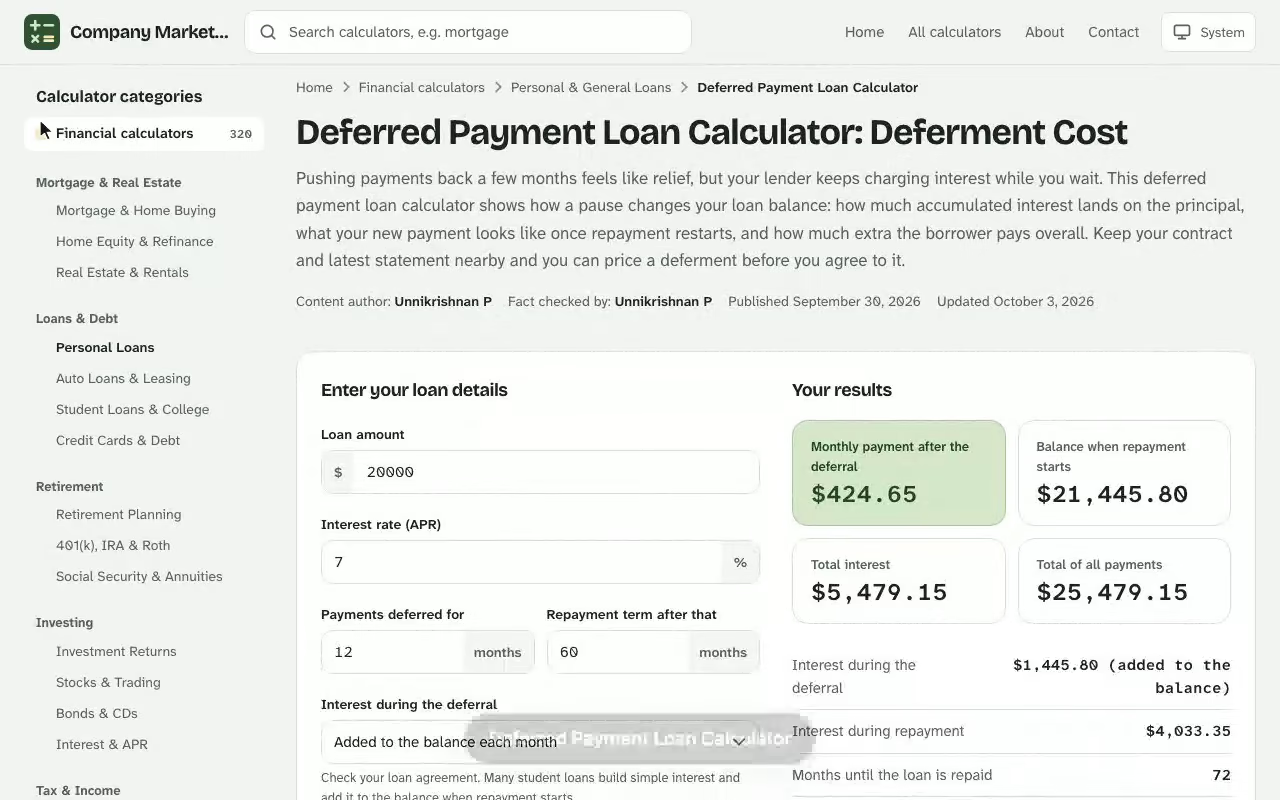
Deferred Payment Loan Calculator. Pushing payments back a few months feels like relief, but your lender keeps charging interest while you wait. This deferred payment loan calculator shows how a pause changes your loan balance: how much accumulated interest lands on the principal, what your new payment looks like once repayment restarts, and how much extra the borrower pays overall. Keep your contract and latest statement nearby and you can price a deferment before you agree to it. Try the payment calculator to run your own numbers — everything is calculated in your browser and nothing you enter is stored or sent anywhere.
Your results
Monthly payment after the deferral
–
Balance when repayment starts
–
Total interest
–
Total of all payments
–
Interest during the deferral–
Interest-only payment during the deferral–
Interest during repayment–
Months until the loan is repaid–
Compared with no deferral
Payment if repayment started now–
Total interest with no deferral–
Extra interest from deferring–
Payment schedule
The deferral months first, then each repayment month until the loan is paid off.
Year
Paid
Interest charged
Balance repaid
Ending balance
Results are estimates for educational purposes and are not financial, tax or legal advice.
How a Deferred Payment Loan Calculator Works
A loan deferment is an agreement in which the lender lets you skip some or all payments for a set stretch of time. Nothing about the debt disappears. The calculator takes your current balance, adds whatever interest the pause generates, and then rebuilds the repayment so you can compare the cost against a loan with no pause. Pair this with the existing loan calculator online for a fuller picture before you make a decision.
See how the Deferred Payment Loan Calculator works: change the inputs and the monthly payment after the deferral updates instantly. Enter your own numbers in the calculator above.
Inputs you provide
Every deferment estimate starts from the same short list of facts, all of which appear on your contract or monthly statement:
Loan amount or current balance, plus the date that balance applies to.
Interest rate, ideally the true annual interest rate rather than the APR, since fees distort the figure.
Loan term in months, together with your original monthly payment.
Deferment period: when the pause starts and how many months it lasts.
Compounding frequency, which is monthly for most consumer loans.
Interest treatment: whether interest is added to the balance or paid in cash during the pause.
Results you get back
The output is a side-by-side view: your new loan balance at the end of the pause, the revised monthly payment, the number of payments left, the new payoff date and the total interest compared with the no-pause schedule. The gap between those two columns is the true price of the delay, and it is usually larger than the interest of the paused months alone.
Loan Deferment Explained: What Happens to Your Balance
When a lender grants a deferral, it changes the schedule, not the debt. A deferred payment simply moves obligations to a later date. Two things can happen to the interest meanwhile, and the calculator needs to know which one applies to you. The free enhanced loan calculator is free to use with no sign-up, and works on desktop and mobile.
Capitalized interest on the loan balance
In the common case you skip everything. Each month the lender still computes interest and adds it to the principal, which is called capitalized interest. Because the base grows every month, the interest of month two is charged on the original principal plus month one's interest. This is compound interest at work, and it is why the accumulated interest grows slightly faster than a straight line.
Interest paid during the pause
Some lenders, particularly on a credit card, let you defer only the principal payment. You keep paying the monthly interest in cash, the balance stays flat, and the pause costs less. You pay the same interest accrued each month, so there is no compounding.
Simple interest versus compounding
Many auto loans use simple interest, which accrues daily on the outstanding balance. A calculator that compounds monthly will land within a few dollars of that, which is close enough for planning. Check your contract for the exact method, and note that late fees are never part of the estimate.
Deferred Payment Calculator Formulas
The math behind any deferred payment calculator takes two steps: grow the balance through the pause, then spread the new balance over the remaining schedule. When interest capitalizes, the balance after the pause is:
$$B_{d} = B_{0} \times (1 + r)^{d}$$
Here \(B_{0}\) is the opening balance, \(r\) is the monthly interest rate (the annual interest rate divided by 12) and \(d\) is the number of deferred months. The interest that accumulates is simply \(B_{d} - B_{0}\). If you pay the interest in cash instead, the monthly charge is:
$$I = B_{0} \times r$$
Once repayment restarts, the standard amortization formula gives the monthly payment for a balance \(B\), monthly rate \(r\) and \(n\) payments:
$$M = \frac{B \times r}{1 - (1 + r)^{-n}}$$
Loan term and original term choices
The lender restructures the loan in one of three ways after the pause, and each one changes \(n\) differently:
Increased payments with the original term: the loan still ends on schedule, so \(n\) shrinks by the deferred months and each payment grows.
Increased payments with an extended term: the lender adds the paused months to the end, so \(n\) stays the same but the starting balance is higher.
Original payment with an extended term: you keep paying the same amount and the loan simply lasts longer until the balance reaches zero.
Worked Example With a Deferred Loan Calculator
Suppose you owe $23,750 at a 6.85% annual interest rate with 60 months left, and your lender approves a 4-month deferment with interest added to the balance. These are the numbers a deferred loan calculator would work through.
Step 1: the baseline without a pause
The monthly rate is \(0.0685 \div 12 = 0.570833\%\). Running the amortization formula gives an original payment of $468.60. Over 60 payments you repay $28,115.97, so the loan costs $4,365.97 in total interest.
Step 2: the balance after the deferment period
Four months of compounding gives \(23{,}750 \times (1.00570833)^{4} = 24{,}296.95\). That means $546.95 of accumulated interest was added to the principal, and you restart repayment owing more than you did before the pause.
Step 3: compare the three restructuring options
Option
Monthly payment
Payments left
Total interest
Extra versus no pause
No deferment (baseline)
$468.60
60
$4,365.97
$0.00
Increased payments, original term
$508.14
56
$4,705.66
$339.69
Increased payments, extended term
$479.39
60
$5,013.47
$647.50
Original payment, extended term
$468.60
62 (last one smaller)
$5,141.42
$775.45
The cheapest route is the one with the highest payment, because it keeps the loan on its original timeline and gives interest the least time to build. The route that feels easiest, the unchanged payment, costs about $775 more than never pausing at all.
Principal, regular interest and the extra interest from a 4-month pause under each restructuring option.
Pricing a Three-Month Loan Deferment for a Car Loan
Dani's clinic cuts her shifts for the summer, and her lender offers a three-month pause on a car loan that has $31,842.18 left at 8.9% over 48 months. Before saying yes she opens the deferred payment calculator and enters the balance, the rate, 48 months and a 3-month deferment with interest added to the balance.
Her current payment comes out at $790.88. After the pause the balance reads $32,555.94, so $713.76 of interest was capitalized. The calculator then shows both ways the lender might restart the schedule:
Keep the original term: $853.55 for 45 months, with total interest of $6,567.64.
Extend the term: $808.61 for 48 months, with total interest of $6,971.14.
Without any pause the loan would cost $6,120.20 in interest, so the two paths add $447.44 and $850.94. Dani's budget, built from her reduced schedule, tops out at $825 a month, which rules out the $853.55 payment. The extended term fits, but it costs $403.50 more than the shorter one.
She reruns the estimate with one change, an extra $44.94 added to each payment once her hours return, since $853.55 minus $808.61 is exactly that gap. The calculator shows the loan ending near the 45-month mark again, trimming most of the extra cost. So she accepts the pause, asks for the extended-term restructuring in writing, and sets a calendar reminder for the first full-hours paycheck to start the larger payment. The result gave her a number to plan against rather than a vague worry about the pause.
Payment Frequency and Loan Amortization Schedule
The worked example uses a plain monthly installment, but real contracts vary. A weekly or bi-weekly schedule changes how fast principal falls, and a calculator that lets you set the payment frequency will show a slightly different outcome for the same pause. Match the setting to your contract, since a wrong frequency shifts every figure that follows.
Reading the loan amortization table
A full loan amortization table lists each installment with the share that goes to interest and the share that reduces principal. Early rows are interest-heavy, which is why a pause near the start of the loan hurts less in dollars than one taken late, when the balance is smaller but each skipped month still compounds. Scan the table for the row where the restructured schedule begins and confirm the balance there matches the post-pause figure.
Number of payments and total payments
Two final checks keep the estimate honest. Multiply the number of payments remaining by the new installment to confirm the total payments figure, then subtract the amount you borrowed. In the example, 56 payments at $508.14 total $28,455.66, which is the figure the second table row is built on. If your own totals do not reconcile, the interest is probably compounded monthly in the tool but daily in your contract.
Auto loan timing
For an auto loan, the start date you enter for the pause sets how many days of interest the calculator capitalizes, because accrual runs from the last payment you made. Use the exact statement date rather than the first of the month, and the post-pause balance will track what the servicer prints on your next bill much more closely.
Interest Cost and Monthly Payment After a Deferment
The interest cost of a deferment is more than the paused months' interest. In the example, only $546.95 accrued during the pause, yet the extended-term route adds $775.45 to the loan. The rest comes from interest on that capitalized amount for every month that follows.
How the $23,750 loan builds to $28,455.66 repaid when payments rise and the original term stays.
Total interest and payoff date
Compare total interest and the payoff date together. A longer schedule means a lower monthly payment but a later finish, and the finish date is where borrowers often get surprised. If a later payoff conflicts with another plan, such as selling the car, treat the higher-payment option as the better one.
Interest rate and compounding frequency
A higher interest rate magnifies everything above. At 6.85% four months added about 2.3% to the balance, but the same pause at 18% would add over 6%. More frequent compounding frequency nudges the figure up slightly, so enter the frequency your lender actually uses.
Deferment, Forbearance, Extension and Payment Holiday
Lenders use several names for the same move. A deferral, an extension, a forbearance and a payment holiday all push payments to later. The consumer finance regulators treat the terms as interchangeable, though a specific program, such as a student loan forbearance, may carry its own rules on interest. Always ask whether interest keeps accruing, whether it capitalizes, and how the lender will restructure the schedule.
Student loan, mortgage and credit card pauses
The same math covers a student loan, a mortgage and a credit card, although each handles interest differently. Some federal student loans do not accrue interest during certain deferments, while a mortgage forbearance usually adds the missed payments to the end of the loan. Always read the terms attached to your product before relying on a generic estimate.
Car loan deferment calculator use
For a car loan, a car loan deferment calculator is helpful because most auto loans accrue simple interest daily. Lenders sometimes approve a series of extensions, and each one adds a little cost, so enter every one of them. A loan deferment calculator that accepts several pauses shows the cumulative damage that a single-pause estimate hides.
Deferred Payment Loan vs Amortized Loan and Lump Sum
The phrase also describes a different product. An amortized loan repays principal and interest in regular payments. A deferred payment loan in this other sense charges nothing along the way and asks for a single lump sum at loan maturity. Commercial and short-term loans often work this way, and the final amount is the principal grown by compound interest over the full term. A balloon loan sits between the two, with small payments and a large final one.
Credit and budget effects
The calculator's output also feeds your budget. A pause reported as current protects your credit, yet an unauthorized skip triggers late fees and can lower your credit score, and neither cost appears in the estimate. Read the restructured post-deferment monthly payment as the figure your budget must absorb once the pause ends, and if that number is still out of reach, talk to the bank about a longer-term repayment plan before the deferment does.
Questions to Ask Before Entering Deferment Inputs
A calculator tells you what a pause costs; the conversation with the company tells you which values to enter. Before you sign anything, get the answers to these questions in writing, as a borrower would, because each one maps to a field in the estimate:
Does interest continue to accrue, and does it capitalize at the end? (This decides how interest is handled.)
Will the new schedule raise the installment, extend the loan, or both? (This picks the restructuring option.)
Is there a fee for processing the request?
Will the account be reported as current to the credit bureaus during the pause?
How many pauses are allowed over the life of the contract? (Each one is another deferment entry.)
Each answer is an input to the estimate. A borrower who skips these questions often finds out at the final payment that the finance charges were larger than expected. Those who ask can choose a plan, rather than inherit one. If the quote you receive differs from your calculation, ask the representative to show their own amortization, because a mismatch usually points to a different compounding rule or an added fee.
Comparing a deferment with a refinance in the same tool
If the shortfall is permanent, a pause only postpones the problem. Run the deferment once, note the total interest and payoff date it produces, then rerun the estimate with a lower interest rate or a longer term to price a refinance or modified loan. Whichever scenario shows the lowest total interest at a payment you can sustain is the better choice, and it often beats several stacked pauses.
Using the Loan Calculator Result to Decide
Run your own numbers through this loan calculator before accepting any offer. Check the contract for the interest rate and term, enter the exact months deferred, and compare the options in the table. Choose the shortest schedule you can afford, ask for the interest treatment in writing, and use the deferred payment loan calculator again if the lender changes the terms. Savings from a shorter schedule are real money, and a few minutes of comparison is the cheapest way to find them.
Deferred Payment Loan Calculator questions
What is a deferred payment loan?
It is a loan where the lender lets you postpone some or all payments for an agreed period. The debt and the interest rate stay the same, so the pause changes the schedule and usually the total cost, not the amount you owe.
Does interest still build up while my loan is deferred?
In most cases it does. Unless the lender marks the pause as interest-free, interest accrues every period. Pick the interest treatment that matches your contract so the calculator adds it to the balance, has you pay it, or spreads it over later payments.
What does capitalized interest mean?
Capitalized interest is accrued interest added to your principal at the end of the pause. Because the new, larger balance earns interest too, it raises both your later payments and your total interest.
How does the lender restructure the loan after a deferment?
There are three common ways: higher payments over the original term, higher payments over an extended term, or the original payment with a longer term. The calculator shows each one so you can compare the monthly payment, term and total interest.
Is a deferment the same as forbearance or an extension?
Lenders use deferment, deferral, extension, forbearance and payment holiday for the same basic idea of pushing payments to later. Specific programs, such as student loans, can have their own rules on interest, so check the terms of your own loan.
Which repayment option costs the least?
Increasing the payment and keeping the original term usually costs least, because the balance is paid off sooner and interest has less time to build. Keeping the original payment and extending the term usually costs most.
Can I use this for a car loan, student loan or mortgage?
Yes. Enter the balance, interest rate and remaining term from your statement. Some products work differently, for example certain federal student loan deferments do not accrue interest, so choose the interest treatment that fits.
Will a deferment hurt my credit?
An approved deferment is generally reported as current, but missing payments without an agreement can trigger late fees and lower your credit score. Confirm in writing how the lender will report the account.