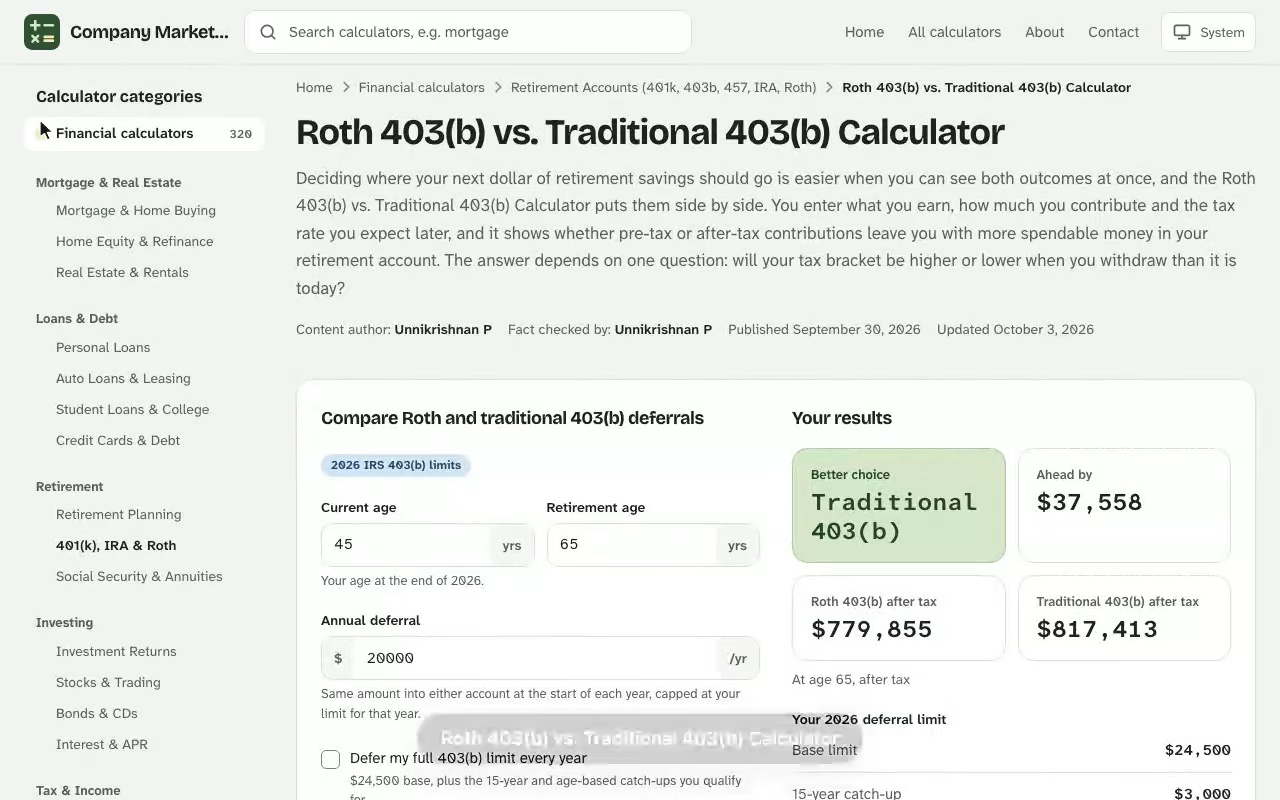
Roth 403(b) vs. Traditional 403(b) Calculator. Deciding where your next dollar of retirement savings should go is easier when you can see both outcomes at once, and the Roth 403(b) vs. Traditional 403(b) Calculator puts them side by side. You enter what you earn, how much you contribute and the tax rate you expect later, and it shows whether pre-tax or after-tax contributions leave you with more spendable money in your retirement account. The answer depends on one question: will your tax bracket be higher or lower when you withdraw than it is today? Pair this with the roth ira calculator online for a fuller picture before you make a decision.
Your results
Better choice
–
Ahead by
–
Roth 403(b) after tax
–
Traditional 403(b) after tax
–
Your 2026 deferral limit
Base limit–
15-year catch-up–
Age-based catch-up–
Total you can defer in 2026–
At retirement
Total deferred–
15-year catch-up used in the projection–
Pre-tax balance (traditional choice)–
Invested tax savings–
Break-even retirement tax rate–
Year-by-year comparison
Limits use 2026 dollar amounts every year. After-tax values are what you would keep if you withdrew everything at the end of that year.
Age
Your limit
Deferral
15-year catch-up
Roth 403(b)
Traditional after tax
Roth ahead by
Results are estimates for educational purposes and are not financial, tax or legal advice.
How the Roth 403(b) vs. Traditional 403(b) Calculator Compares Your Options
A 403(b) plan is a retirement plan that lets you save through your employer, and most plans now offer two ways to do it. A traditional 403(b) takes your money before income tax, so every dollar lowers your taxable pay today and is taxed when it comes out. A Roth 403(b) takes your money after income tax, so you pay now and qualifying withdrawals come out free of tax. The calculator turns that trade into two final numbers you can compare directly. The ira spend or save calculator is free to use with no sign-up, and works on desktop and mobile.
Pre-tax vs. after-tax contributions
With a pre-tax (or before-tax) deposit, your employer sends the money to the plan before it reaches your paycheck, so a $12,000 contribution does not appear in your taxable wages at all. With an after-tax deposit, the same plan receives the money only after tax has been withheld, which is why a Roth contribution reduces your take home pay by more per dollar saved. To compare them fairly, the calculator holds your out-of-pocket cost equal: the Roth side invests only what the pre-tax side would have cost you after the tax saving.
The formula behind the comparison
Both accounts grow with the same annual rate of return, so the difference comes entirely from when tax is paid. The future value of level yearly deposits is:
$$FV = C \times \frac{(1 + r)^{n} - 1}{r}$$
See how the Roth 403(b) vs. Traditional 403(b) Calculator works: change the inputs and the better choice updates instantly. Enter your own numbers in the calculator above.
The Roth result uses \(C = P \times (1 - t_{now})\) and keeps the whole balance, while the traditional result uses \(C = P\) and keeps only \(FV \times (1 - t_{ret})\) after withdrawal. Here \(P\) is the pre-tax contribution amount, \(r\) is the yearly return, \(n\) is the number of years, \(t_{now}\) is your tax rate today and \(t_{ret}\) is your tax rate in retirement. If \(t_{now} = t_{ret}\), the two ending values are identical.
Roth (after-tax) account or pre-tax account?
Think of it as paying the tax bill at the lowest rate you can find. If you expect to be in a lower bracket in retirement, deferring tax with a pre-tax account wins. If you expect a higher bracket, a Roth account wins, because you lock in today's rate on all future growth. Equal rates make it a tie on paper, though other features, covered below, can still tip the decision.
Your 403(b) Calculator Inputs Explained
This 403(b) calculator asks for a handful of numbers, most of which you can find on a pay stub or a plan statement. Each one moves the final comparison in a different way. The 72t distribution impact calculator uses the same plain-English approach, so you can compare results side by side.
Annual salary and contribution amount
Your annual salary sets how much room you have and how large a percentage a given dollar figure represents. The contribution amount is the pre-tax sum you plan to defer each year, either as a percentage of pay or a flat figure. Enter the same gross figure for both plan types and let the tool adjust the Roth deposit for tax.
Current balance and years until retirement
Your current balance is the amount already invested in the plan, and the years until retirement sets how long compounding has to work. Together with your current age and retirement age, they define the time horizon. A longer horizon magnifies any gap between the two choices, which is why a thirty-year saver sees bigger swings than a ten-year saver.
Rate of return and salary increase
Because the tool works as a 403(b) growth calculator too, the rate of return is the growth you expect each year after the funds are invested. A salary increase raises your contributions over time if they are a percentage of pay. Both are assumptions rather than promises, so a hypothetical estimate is best run at several values instead of one.
Tax rate now and in retirement
The tax rate inputs matter more than any other. Your current tax bracket is read from your taxable income, while the retirement bracket is your best estimate of what you will owe on withdrawals from pensions, Social Security, other accounts and this plan together. The many tax implications of retirement income, such as how a large withdrawal can push you into a higher bracket, are worth thinking through before you type a number.
Employer match and investment fees
An employer match is a free addition to your savings, and the maximum employer match is the cap your organization sets. In most plans, the employer contribution goes into the pre-tax side unless your plan document says otherwise, so it adds to the traditional balance even if your own deferrals are Roth. The investment fees you pay each year reduce growth on both sides equally, but a single investment fee of 1% can erase a large share of the gap you are trying to measure.
Pay period frequency
The pay period frequency, whether weekly, bi-weekly, semi-monthly or monthly, decides how often deposits are made and therefore how soon each one starts earning. It affects the Roth and traditional balances equally, so it never changes which side wins, only the size of both numbers by a small amount.
Worked Example: Traditional vs. Roth Results Over 20 Years
Suppose a school administrator can defer $12,000 a year before tax for 20 years, expects a 6.5% return and sits in the 32% bracket today. She expects a 24% bracket in retirement. Putting $12,000 into the traditional side costs her $12,000 × (1 − 0.32) = $8,160 in take-home pay, so that is what the Roth side receives each year.
Result after 20 years
Roth 403(b)
Traditional 403(b)
Yearly deposit
$8,160
$12,000
Total deposited
$163,200
$240,000
Plan balance at retirement
$316,815
$465,904
Tax owed on withdrawal (24%)
$0
$111,817
Spendable value
$316,815
$354,087
The accumulated plan balance is larger on the traditional side, but that figure is not yours to spend. After deferred taxes of $111,817, the traditional account is worth $354,087, which is $37,272 more than the Roth balance. The gain exists only because she expects to pay less tax later than she saves now.
After 24% tax, the traditional balance is worth $37,272 more than the Roth balance in this 20-year example.
How the retirement tax rate changes the winner
The same example, run with different retirement rates, shows where the answer flips. The break-even point is the 32% rate she pays today.
Retirement tax rate
Traditional spendable value
Advantage over Roth
12%
$409,995
+$93,181
18%
$382,041
+$65,227
24%
$354,087
+$37,272
32%
$316,815
$0
37%
$293,519
−$23,295
The traditional advantage grows with years of saving and shrinks to zero when your retirement rate equals today's 32%.
Reading the result as a plan balance at retirement
Many savers focus on the plan balance at retirement because that is what the statement shows, and it makes the traditional account look far ahead. A fair comparison always converts both sides to after-tax dollars, which is exactly what this calculator does before it reports a winner.
403(b) Contribution Limits and Catch-Up Contributions
The IRS caps how much you can defer, and the cap applies to your Roth and traditional deferrals combined, not to each one separately. Your 403(b) contribution type can be split, so you may send part of your pay to each side, and the contribution amount you enter in the calculator should stay at or below the cap.
Annual contribution limits for 2026
For 2026 the annual contribution limits allow an employee to defer up to $24,500. These contribution limits rise with inflation in $500 steps, so check the current figure before you set a dollar amount.
Catch-up contributions after age 50
If you are 50 or older, catch-up contributions of up to $8,000 raise your ceiling to $32,500, and savers aged 60 to 63 can add a larger amount of $11,250. Some long-serving employees of schools and hospitals also qualify for a separate 15-year service catch-up. Higher earners may be required to make catch-up deferrals to the Roth side, which is worth checking with your plan administrator.
Four ages that change how much you can contribute and how your 403(b) withdrawals are taxed.
Which contributions are tax-deferred and which are tax-free
Traditional deferrals and their earnings are tax-deferred, meaning tax is postponed until withdrawal. Roth deferrals are tax-free when the withdrawal is qualified, which generally means you are at least 59½ and the account has been open for five years.
Who Can Use a 403(b) Savings Calculator
A 403(b) savings calculator is built for employees of tax-exempt organizations described in section 501(c)(3) of the tax code, along with public school systems. Used as a 403(b) retirement calculator, it suits people who work at schools, colleges, universities, hospitals and other non-profit employers, though ministers and some other groups can also take part.
Comparing a 403(b) to a 401(k) and 457(b)
The same Roth-versus-pre-tax question appears in any employer retirement plan, from a 401(k) at a for-profit company and in a 457(b) at some government and non-profit employers. The math is the same, but contribution limits, loan rules and early-withdrawal penalties differ, so use the calculator that matches your plan.
Comparing to a Roth IRA and traditional IRA
A Roth IRA and a traditional IRA offer the same tax trade at a much lower contribution ceiling, and the Roth IRA has income limits that a Roth 403(b) does not. Many savers use the workplace plan for the bulk of their retirement savings and an IRA for extra room.
Traditional vs. Roth Results for a 29-Year-Old Pharmacy Technician
Dana Okafor, a pharmacy technician at a county hospital, has a $6,420 annual deferral in mind and a payroll form asking her to pick a side. Her taxable income is $47,200, which puts her in the 12% federal bracket, and she is 36 years from age 65. She opens the calculator and enters $6,420 as the pre-tax contribution, 36 years, a 7% return and 12% as today's rate.
Her first question is what happens if her bracket never changes. With a 12% retirement rate, the tool returns identical spendable balances of $841,301 on both sides, the break-even case. The Roth deposit is $5,649.60 a year, which is $6,420 × (1 − 0.12), so her take-home pay drops by the same amount either way.
Then she tests the rate she actually worries about. Her pension and 403(b) withdrawals together could easily land her in the 24% bracket, so she changes only the retirement rate:
Retirement rate
Traditional spendable
Roth spendable
Roth advantage
12%
$841,301
$841,301
$0
18%
$783,940
$841,301
$57,361
24%
$726,579
$841,301
$114,723
Because the traditional side only wins if she falls below 12%, a bracket she is already at the bottom of, the comparison favors the Roth side in every realistic case. She also notes that qualified withdrawals require her to be 59½ with the account open five years, which she will satisfy decades early. Her next step is concrete: she elects Roth for her own deferral, but she keeps her employer's match in the pre-tax side because the plan places matching money there. She plans to rerun the numbers after any raise that moves her taxable income past the top of the 12% bracket.
Factors That Change the Roth vs. Traditional 403(b) Decision
Numbers alone do not capture everything. Several practical factors can move you toward one side even when the math looks close.
Market conditions and risk
Because both sides invest in the same funds, market conditions raise or lower both balances in the same proportion. The risk is different in one respect: a Roth account puts more of your future wealth in a tax-free bucket, while a traditional account leaves you sharing growth with the government. Long-run averages for the S&P 500 are often quoted for planning, but they are not a forecast for your own investment choices, and the real performance of your funds can fall well short.
Inflation rate and growth
The inflation rate matters to this comparison through your tax bracket. Brackets are indexed to inflation, so a retirement rate you enter as a flat percentage may overstate how much tax the traditional side really owes in 20 years, which would make the Roth look better than it is. Run the calculator with your retirement rate a few points lower and higher to see how sensitive the result is, and treat the growth figure as a return after costs so both sides stay comparable.
Required minimum distributions
Required minimum distributions force traditional balances to be withdrawn and taxed once you reach the required age. Roth 403(b) balances no longer face lifetime distributions, which gives you more control over your retirement savings and retirement income and over how much taxable income you report each year.
Early withdrawals and loans
Early withdrawals before age 59½ may trigger income tax and a 10% penalty on the taxable portion. Roth contributions can be treated more favorably than earnings, but a loan or a hardship withdrawal still shrinks your future earnings because the money stops compounding. Withdrawal strategies such as drawing from a Roth balance in high-income years and a traditional balance in low-income years can keep your bracket steady.
Compound growth over a long time horizon
A longer time horizon does not favor one side by itself; it magnifies whichever direction your tax-rate comparison already points. In the worked example, 20 years of compound growth turn a $37,272 traditional lead into a larger or smaller dollar gap if you change only the years, while equal tax rates still give a tie. Whether the growth is compounded monthly or annually changes the result only slightly.
Using Your Roth vs. Traditional Results to Make a Decision
A single run gives you a number, and a few repeat runs give you a range you can trust. Treat the output as a guide to a decision about your retirement savings rather than a prediction, and judge the model by how reliably your assumed performance matches what your funds have actually delivered.
Scenario analysis with different tax rates
Run a scenario analysis with a low, middle and high retirement rate. If the traditional side wins in all three, favor pre-tax deferrals. If the Roth side wins in all three, favor Roth. When the answer flips inside your plausible range, splitting your contributions gives you tax diversification.
Savings goals and contribution planning
Set your savings goals and your target retirement savings first, then use contribution planning to decide how much of each paycheck to commit. Because traditional deferrals shrink your taxable pay, the same take-home budget can fund a larger gross deferral, which is a real benefit if you are trying to reach the maximum.
Investment strategy and fees
Your investment strategy should be decided separately from the Roth-or-traditional choice. Choose funds with low fees and an asset mix that suits your age, then let the calculator tell you only how those assets will be taxed; fees reduce both balances equally, so they do not change the tax-driven winner.
When to talk to a financial advisor
This tool gives financial guidance based only on the numbers you enter, and it does not replace tax advice. A financial advisor or other qualified professional can account for state tax, Social Security taxation, the survivor's bracket and other taxes that a simple model leaves out. Good financial education from your plan provider can also help you understand how your own plan treats Roth deferrals.
Choose traditional when you expect a lower tax rate in retirement.
Choose Roth when you expect a higher rate or want tax-free earnings.
Split your deferrals when you cannot predict your future bracket.
Revisit the comparison after a raise, a job change or a tax law change.
Roth 403(b) vs. Traditional 403(b) Calculator questions
What is the difference between a Roth 403(b) and a traditional 403(b)?
A traditional 403(b) takes your contribution before income tax and taxes withdrawals later, while a Roth 403(b) takes it after tax and lets qualified withdrawals come out tax-free.
Which is better, Roth or traditional 403(b)?
It depends mostly on whether your tax rate will be higher or lower in retirement. A lower future rate favors traditional, a higher one favors Roth, and equal rates leave you with the same spendable amount.
How does the calculator compare the two fairly?
It holds your take-home cost equal: the Roth deposit is your pre-tax contribution reduced by your current tax rate, and the traditional balance is reduced by your retirement tax rate before the two are compared.
How much can I contribute to a 403(b)?
The employee limit for 2026 is $24,500, with an extra $8,000 catch-up if you are 50 or older. The limit covers Roth and traditional deferrals combined, and the calculator caps each year's deferral accordingly.
Is my employer match Roth or traditional?
Most plans place employer contributions in the pre-tax side, so the calculator treats the match as traditional money under both options. Check your plan document if your employer offers a Roth match.
When can I take tax-free withdrawals from a Roth 403(b)?
Withdrawals are generally tax-free once you are at least 59½ and the Roth account has been open for five years. Earlier withdrawals may trigger tax and a penalty on the earnings.
Can I split my contributions between Roth and traditional?
Many plans let you divide your deferrals between both types, which spreads your tax risk. Run the calculator at a few retirement tax rates to decide how to split.
Who can have a 403(b) plan?
403(b) plans are offered by public schools, colleges, universities, hospitals and other 501(c)(3) tax-exempt organizations.