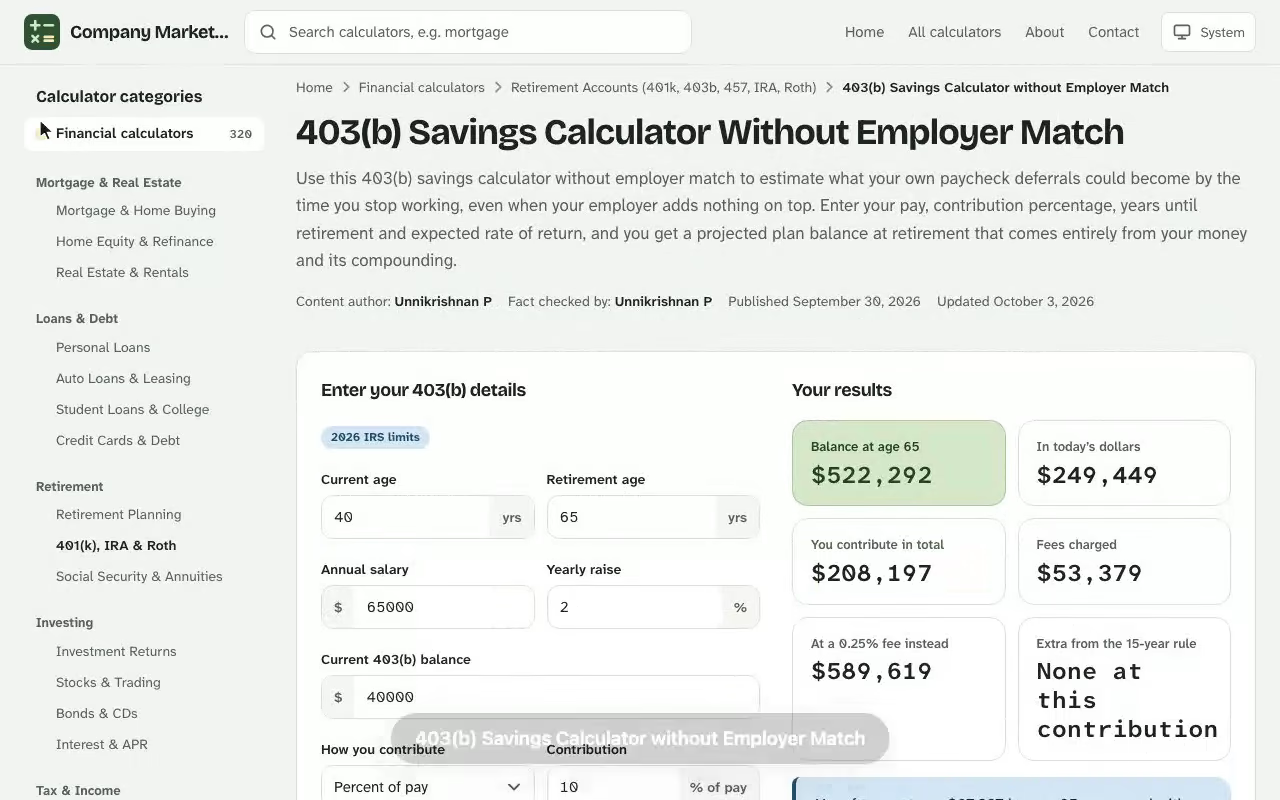
403(b) Savings Calculator without Employer Match. Use this 403(b) savings calculator without employer match to estimate what your own paycheck deferrals could become by the time you stop working, even when your employer adds nothing on top. Enter your pay, contribution percentage, years until retirement and expected rate of return, and you get a projected plan balance at retirement that comes entirely from your money and its compounding. The 401k calculator uses the same plain-English approach, so you can compare results side by side.
Your results
Balance at retirement
–
In today’s dollars
–
You contribute in total
–
Fees charged
–
At the lower fee
–
Extra from the 15-year rule
–
Your 2026 deferral limit this year
Basic limit–
15-year catch-up–
Age catch-up–
Your total limit–
Percent of pay to reach it–
No employer contributions are included. The 15-year catch-up adds up to $3,000 a year ($15,000 lifetime) and is used before the age 50+ catch-up.
Year-by-year projection
Your contributions, the part allowed by the 15-year rule, the fees charged and the balance at each year end.
Age
Salary
You
From 15-year rule
Fees
Balance
Results are estimates for educational purposes and are not financial, tax or legal advice.
How the 403(b) Savings Calculator Without Employer Match Works
A 403(b) plan is a payroll-deducted contributions program for people who work at public schools, hospitals, churches and other nonprofit or public-sector employers. Many of these plans never add employer matching contributions, so every dollar that grows in your account is a dollar you deferred yourself. When you run a 403b retirement plan projection on this page, it takes your current balance, adds a slice of each paycheck, raises your pay once a year, and compounds everything at the return you expect. If you want to see how the figures change, the free 401k save the max calculator gives you an instant result you can adjust as you go.
The calculator is built for planning, not promising. It treats your 403(b) as one employer-sponsored retirement plan among the several ways you might build retirement savings, and the output is a baseline you can stress-test by changing one input at a time. That is how a good 403b retirement calculator earns its keep.
What the Final Balance Tells You
The headline result, your plan balance at retirement, is the future value of everything you have saved and will save. Beside it you see your cumulative contributions, the share of the balance that came from investment growth, and the before-tax figure you could draw on later. Comparing that balance with your financial obligations and living expenses in retirement is the real purpose of the exercise.
Why Employer Contributions Are Left Out
Nearly every 403b calculator bundles a match into the result, which can overstate what an employee at a plan without one will actually have. Leaving any employer contribution out gives you a conservative floor. If your employer later starts matching, with a maximum employer match set as a share of pay, treat the matched dollars as a bonus on top of this number.
Why Not Just Use a Combined 401(k)/403(b) Calculator
Many providers publish a single 401(k)/403(b) calculator, but those tools usually assume a match and a generic return. A tool that leaves the match out is a better fit when your plan offers none, because it keeps your retirement savings estimate tied to what you actually control.
Inputs You Enter in a 403(b) Retirement Calculator
Each field maps to one term in the growth formula. Start with the figures on your latest pay stub, then adjust the rest. If you want to see how the figures change, the 457b savings calculator online gives you an instant result you can adjust as you go.
Current salary: your gross yearly pay before taxes and benefit deductions.
Contribution percentage: the share of each paycheck you defer, often called your before-tax contribution.
Current balance: what your 403(b) account holds today.
Years until retirement: how long contributions and growth continue, measured from today to your planned age of retirement.
Annual rate of return: the yearly growth you expect before taxes and fees.
Annual salary increase: the raise you expect each year, which lifts every later deferral.
Pay period frequency: weekly, bi-weekly, semi-monthly or monthly, which sets how often contributions are added and compounded.
Annual Contribution and Deferral Rate
Your annual contribution is your pay multiplied by the percentage you defer. At 7% on a $52,800 income that is $3,696 in the first year, split evenly across your paychecks.
Rate of Return and Investment Fees
The rate of return moves the result more than any other assumption, so choose it carefully. A diversified mix of mutual funds will not earn a smooth percentage, and investment fees or a high expense ratio quietly reduce your investment returns. If your plan lists fund costs, subtract them from the return you enter.
Your Time Horizon and Retirement Date
Your time horizon matters because growth accelerates late. Moving your target retirement age by a few years changes the outcome far more than most people expect, as the comparison below shows.
Choosing Realistic Salary Growth and Return Inputs
It is tempting to enter an optimistic return and a generous raise. A steadier approach is to match salary growth to what your employer's pay scale or union contract has actually delivered over the last few years, and to pick a return a little below the long-run average of the funds you hold. Rounder, cautious inputs make a more useful baseline, because you can always rerun the numbers upward if the plan outperforms. Also confirm the date your contribution starts if you only recently became eligible, since a late start shortens the horizon the calculator uses.
The Formula Behind a 403(b) Growth Calculator
The projection repeats one step for every pay period. The balance from the previous period earns a slice of the annual return, and one paycheck's contribution is added:
Here \(B\) is the balance, \(r\) is the annual rate of return, \(m\) is the number of pay periods per year, \(S\) is your pay and \(p\) is your deferral rate. When your pay stays flat, the same idea collapses into a closed form, which shows the two sources of growth:
where \(i = r \div m\) is the rate per period, \(n\) is the total number of periods, \(B_{0}\) is your starting balance and \(C\) is the contribution per paycheck. The first term is your current balance compounding on its own. The second is the stream of contributions. This calculator also raises \(S\) by your raise at the start of each year, which is why a flat-pay shortcut slightly understates the result.
Compound Growth and Why Early Years Matter
Compound growth means returns earn returns. A contribution made in year one has the longest runway, so it adds far more to the final balance than one made in the last year, even when both are the same size.
Tax-Deferred Growth and Pre-Tax Contributions
Traditional 403(b) deferrals are pre-tax contributions taken from pre-tax salary, so your taxable pay drops now and the account grows tax-deferred. These are real tax advantages, but you pay ordinary income tax when you withdraw. The balance shown is therefore a before-tax figure, and what you can spend in after-tax dollars will be lower.
Worked Example: A 24-Year 403b Plan With No Match From Your Employer
Take a school administrator earning $52,800 who is paid bi-weekly (26 paychecks a year). They have $8,350 in their account, defer 7% of each paycheck, expect 5.5% a year and a 2.5% raise, and plan to retire in 24 years. The employer adds nothing.
Running those figures through the projection gives a plan balance at retirement of $263,849. Their cumulative contributions total $119,562, which is the out-of-pocket cost. Investment growth supplies the remaining $135,936, more than half of the final balance.
Year
Pay
Contribution that year
Balance at year end
1
$52,800
$3,696
$12,617
5
$58,281
$4,080
$33,264
10
$65,940
$4,616
$68,981
15
$74,605
$5,222
$119,301
20
$84,409
$5,909
$189,277
24
$93,171
$6,522
$263,849
Reading Contributions Against Growth
For the first decade, deferrals do most of the work. By year 24 the account adds about $6,500 a year from paycheck deferrals but far more from growth, because the balance is now large. This is the practical meaning of the accumulation phase.
Investment growth overtakes your own contributions around year 21 and supplies $135,936 of the final $263,849 balance.
Scenario Analysis: Changing One Input at a Time
Good scenario analysis varies a single input and leaves the rest alone. Keeping the same pay, balance and raise, here is what each change does to the final balance:
Change
Final balance
Base case: 7% deferral, 5.5% return, 24 years
$263,849
Deferral raised to 10%
$363,549
Deferral cut to 5%
$197,382
Return of 4% instead of 5.5%
$213,080
Return of 7% instead of 5.5%
$330,562
Retire 5 years earlier (19 years)
$173,415
Retire 5 years later (29 years)
$387,551
How Deferral Rate and Rate of Return Shape Your Retirement Savings
Two levers decide most outcomes: how much you defer and how hard your investments work. The grid below crosses four deferral rates with three returns, using the same worked example and a 24-year horizon.
Deferral rate
4% return
5.5% return
7% return
5%
$158,426
$197,382
$248,888
7%
$213,080
$263,849
$330,562
10%
$295,061
$363,549
$453,074
12%
$349,715
$430,016
$534,748
See how the 403(b) Savings Calculator without Employer Match works: change the inputs and the balance at age 82 updates instantly. Enter your own numbers in the calculator above.Final balance by deferral rate and rate of return, using the worked example's $52,800 pay, $8,350 starting balance and 2.5% raise.
Investment Strategy and Market Conditions
Because the calculator's rate of return field is an assumption and not a promise, read across a whole row of the grid instead of fixating on one cell. You control your deferral rate; you do not control market conditions, and your investment strategy decides how much of that return range you are exposed to.
Inflation Rate and Real Purchasing Power
A balance that looks large in future dollars buys less than it does today. Subtracting the inflation rate from your return gives a rough real return, so try a return 2.5 to 3 points lower to see the balance in today's purchasing power.
The Rule of 72 as a Quick Check
The rule of 72 divides 72 by your return to estimate doubling time. At 5.5%, money doubles about every 13 years, which fits the way the worked example's balance climbs from $68,981 at year 10 to $189,277 at year 20.
Testing a School Nurse's 19-Year Savings Plan in a 403(b) Growth Calculator
A school nurse, 38 years old, wants to know whether the district's 403(b), which offers no match, can realistically fund a retirement paycheck of about $16,000 a year from savings alone. That figure comes from the common 4% withdrawal guideline applied to a $400,000 target.
The nurse enters a salary of $67,350, $22,780 already saved, a 9% deferral, a 6% return, a 3.1% raise and 19 years left to work, with 26 paychecks a year. Leaving the employer fields at zero is the whole point, since the district contributes nothing.
The calculator returns a projected balance of $342,219. The nurse's own deferrals total $153,715, so growth supplies the remaining $165,724. Applying the 4% guideline to $342,219 gives $13,689 a year, which is $2,311 short of the $16,000 goal.
Instead of guessing, the nurse reruns the calculator with a single change, an 11% deferral:
Deferral
First-year contribution
Projected balance
4% guideline income
9%
$6,062
$342,219
$13,689
11%
$7,408
$402,460
$16,098
At 11% the projection clears the target by $2,460, and the $7,408 first-year deferral sits comfortably below the IRS limit of $24,500. Even the last year's deferral, about $12,835 after 18 raises, stays under it. The decision is concrete: the nurse asks payroll to move the deferral from 9% to 11% at the next pay period and plans to recheck the figures after the next raise.
403(b) Contribution Limits and Tax Rules You Should Know
The IRS caps what you can defer each year through the elective deferral limit. For 2026 the limit is $24,500, and employees who are 50 or older by year-end can add catch-up contributions of $8,000, for a combined $32,500. The worked example's $3,696 first-year deferral is far under this ceiling, but a higher earner using a 15% rate should check it against the figures the IRS publishes each year.
Traditional Contribution and Roth Contribution
A traditional contribution reduces your current taxable pay and is taxed at withdrawal. A Roth contribution is made with after-tax money, so qualified withdrawals are tax-free. This calculator reports a traditional, before-tax balance. If your plan offers a Roth option, compare both against your expected tax bracket.
Withdrawals, Loans and Penalties
The calculator projects accumulation only and does not model withdrawals, loans or penalties, but the rules below decide how much of the projected balance you can use. Taking money out before age 59½ usually triggers an early withdrawal penalty of 10% on top of ordinary tax, with limited exceptions for hardship withdrawals. Some plans also have loan provisions, and later in life required minimum distributions force a yearly withdrawal. Different withdrawal strategies and their tax implications deserve a plan of their own before you retire.
403(b) Plan vs 401k and IRA: Where Each Retirement Account Fits
A 403(b) works much like a 401k, the plan most for-profit employers offer. The 403(b), once nicknamed a tax-sheltered annuity, serves nonprofit and government workers, and federal employees use the Thrift Savings Plan. Some 403(b) plans hold only an annuity or mutual funds, so your investment options may be narrower than a typical for-profit plan. This calculator models only your 403(b), so run any other account as a separate projection and compare the results.
ERISA and Why Matches Are Rare
Many 403(b) plans are exempt from ERISA oversight, which is one reason employers there often skip a match. A private-sector plan that matches must follow those rules, so matching is more common outside the nonprofit world.
Adding a Roth IRA Alongside Your 403(b)
An IRA sits outside the employer's plan, so you can fund one in addition to your 403(b). A Roth IRA adds a source of tax-free withdrawals, and a deductible option exists for people under the income rules. When your plan has no match, topping up an IRA is a common way to diversify your mix of accounts, and you should run it as a separate projection, since this calculator models only your 403(b).
Ways to Grow Retirement Savings When Your Employer Offers No Match
Without free money from an employer, the biggest gains come from habits you control. Each of these shows up as a different input on the calculator.
Raise your deferral rate by 1% whenever you get a raise, so your take-home pay barely changes.
Start now, because adding years beats adding dollars late in your career.
Keep fund costs low, since a lower expense ratio goes directly into your return.
Review your savings goals every year and rerun the numbers.
Talk to a financial advisor if your situation includes other pensions or a spouse's accounts.
Setting Retirement Goals and Savings Targets
Translate your retirement goals into a number. If you want your savings to replace a share of your pay, divide the projected balance by the years you expect to withdraw, then compare it with expected Social Security income. A gap tells you whether to raise contributions, extend your working years or adjust spending. Because the balance is only as strong as the habit behind it, your own retirement plan should name a deferral rate you can keep through lean years, not just good ones.
Retirement Planning Around Your Calculator Results
Careful retirement planning treats this projection as one input. Rerun the calculator after every raise or change of employer, and compare each result with your healthcare, tax and benefit-claiming estimates. The projection is the number you control directly each payday, and it anchors every other decision about your retirement savings.
Limits of a 403(b) Calculator and Its Assumptions
Every projection depends on assumptions that real life will not follow in a straight line. Returns vary from year to year, raises are uneven, and your contribution may change. Treat the result as an estimate and not a guarantee.
Disclaimer and What Is Not Included
This tool ignores employer contributions, loan repayments, plan fees that are not in your return, and taxes on withdrawal. The disclaimer is simple: figures are illustrative, based only on the numbers you supply, and not investment advice. Revisit the result when your pay, plan rules or goals change, and keep a record of each run so you can see how a change in one input moved the outcome.
403(b) Savings Calculator without Employer Match questions
What is a 403(b) savings calculator without employer match?
It projects how much a 403(b) account could grow when you are the only one contributing. You enter your pay, the share you defer, your balance, your ages and an expected return, and it compounds your contributions over time.
Who can contribute to a 403(b) plan?
A 403(b) is offered to employees of public schools, colleges, hospitals, churches and other tax-exempt nonprofit organizations. Your employer decides whether the plan exists and whether it adds a match.
How much can I contribute to a 403(b) each year?
The IRS sets an annual elective deferral limit, which is $24,500 for 2026. Employees 50 or older can add catch-up contributions of $8,000, for a combined $32,500. Limits change, so check the current year.
Is the calculator result before or after tax?
It is a before-tax figure. Traditional 403(b) deferrals are made from pre-tax pay and taxed when you withdraw, so the amount you can spend in after-tax dollars will be lower.
What rate of return should I enter?
Use a cautious long-run estimate for the funds you hold, then subtract fund fees. Testing a lower and a higher return shows the range of outcomes instead of one number.
Why do my results change if I switch pay frequency?
Contributions are added and compounded each pay period, so more frequent paychecks put your money to work slightly sooner. The difference is usually small.
How is a 403(b) different from a 401(k)?
They work much the same way, but a 401(k) is for private-sector employees and a 403(b) is for nonprofit and public-education employers. A 403(b) plan is less likely to include an employer match.
Can I model an employer match here too?
Yes. The optional employer fields let you add a fixed contribution, a percentage of salary or a match with a cap. Leave them at 0 to see the no-match result.