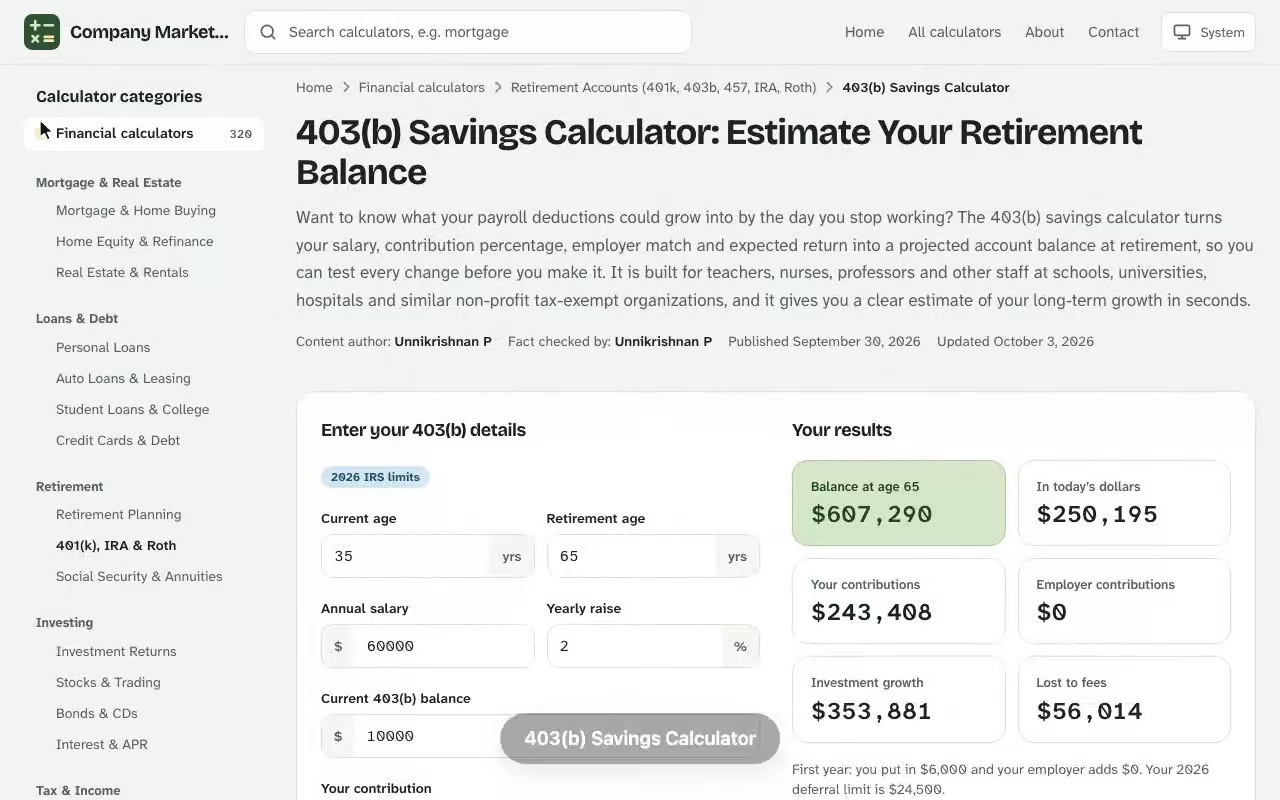
403(b) Savings Calculator. Want to know what your payroll deductions could grow into by the day you stop working? The 403(b) savings calculator turns your salary, contribution percentage, employer match and expected return into a projected account balance at retirement, so you can test every change before you make it. It is built for teachers, nurses, professors and other staff at schools, universities, hospitals and similar non-profit tax-exempt organizations, and it gives you a clear estimate of your long-term growth in seconds. If you want to see how the figures change, the 401k calculator gives you an instant result you can adjust as you go.
Your results
Balance at retirement
–
In today’s dollars
–
Your contributions
–
Employer contributions
–
Investment growth
–
Lost to fees
–
2026 IRS 403(b) limits
Employee deferral limit–
Catch-up, age 50 or older–
Catch-up, ages 60 to 63–
15-year catch-up–
Total limit, you plus employer–
If your 2025 Social Security wages from this employer were over $150,000, age-based catch-up contributions must go in as Roth.
Year-by-year projection
Contributions and the balance at the end of each year until you retire, after fees.
Age
Salary
You
From 15-year rule
Employer
Balance
Results are estimates for educational purposes and are not financial, tax or legal advice.
How the 403(b) Savings Calculator Estimates Your Balance
A 403(b) is a retirement savings plan offered by public schools, hospitals, churches and other tax-exempt organization employers. Your contributions come out of your paycheck before income tax, your employer may add a match, and everything stays invested until you withdraw it. The tool reports the future value of every deposit by replaying that process pay period by pay period for as many years as you have left to work, then reports the balance you could reach. If you want to see how the figures change, the free 401k spend or save calculator gives you an instant result you can adjust as you go.
It answers three questions a payroll deduction form never does: how large your plan balance could become, how much of it you paid in yourself, and how much came from your employer and from investment growth.
The Four Required Inputs
Only four fields are required for a quick estimate. Enter your current annual income, the years until retirement, your current balance and the percentage of salary you contribute each pay period. Everything else sits in an advanced section and already carries a sensible default, so you can get a first answer without a single assumption of your own.
What the Results Show
The headline figure is your accumulated plan balance at retirement. Beside it you will see your out-of-pocket cost (the total you contribute), the employer matching contributions, and the investment growth that compounding adds to your accumulation. An after-tax figure and an inflation-adjusted figure show what that balance is worth once taxes are paid and prices have risen.
Simple 403(b) Calculator Inputs Explained
Whether you call it a 403b calculator or a 403(b) calculator, each field maps to one piece of the formula, and knowing what it means keeps you from entering a number that quietly distorts the estimate. Work through them in order. Next, open the roth plan contributions calculator online and enter your own details to see an estimate in seconds.
Annual Salary and Salary Increase
Your annual salary is your gross pay before taxes and benefit deductions, because contributions are a percentage of it. The salary increase is the yearly raise you expect until you retire. A teacher on a step schedule might enter 2.5%, while someone with a flat pay scale can enter 0%. Because contributions are tied to pay, a higher salary increase lifts your deposits every year.
See how the 403(b) Savings Calculator works: change the inputs and the balance at age 45 updates instantly. Enter your own numbers in the calculator above.
Years Until Retirement and Current Balance
Subtract your current age from the age at which you plan to stop contributing, and keep the number of years of retirement you must fund in mind when you judge the result. Your current balance is whatever your 403(b) holds now; enter 0 if you are just opening the account. This starting balance keeps compounding for the full period, which is why it can be worth more than your first few years of deposits combined.
Before-Tax Contribution and Employer Match
The before-tax contribution is the share of each paycheck you send to the plan. The employer match is the percentage of your contribution that your employer adds, up to a cap. Employer matching contributions are free money, so the match percentage and the maximum employer match are two of the most valuable fields to check against your benefits summary.
Maximum Employer Match
If your employer matches 50% of the first 6% of pay you contribute, enter 50 as the match and 6 as the maximum. Contribute 4% and you receive a match on 4%; contribute 10% and the match still stops at 6%. Contributing less than the maximum means leaving part of the match on the table.
Pay Period Frequency
Choose how often you are paid. The calculator then splits each year's contribution across that many deposits, and growth is compounded at every one. The options are:
Weekly: 52 deposits a year
Bi-weekly: 26 deposits a year
Semi-monthly: 24 deposits a year
Monthly: 12 deposits a year
Annual: one deposit at the end of the year
Rate of Return and Investment Fees
The annual before-tax rate of return is the growth you expect from the investments your plan administrator offers. Your expected before-tax return should be a net figure, meaning the gross return minus investment fees, because expense ratios and administration charges reduce growth every year. Broad stock indexes such as the S&P 500 have historically averaged more than a cautious bond-heavy portfolio earns, but with larger swings, so match the number to the investments you actually hold.
403(b) Growth Calculator Formula
The 403(b) growth calculator applies one repeating step. At each pay period your balance earns a slice of the annual return, then your contribution and any employer match are added:
Here B is the plan balance, r is the annual rate of return, n is the number of pay periods per year, S is that year's salary, c is your contribution percentage, m is the maximum employer match and p is the match percentage. Your salary is multiplied by one plus your salary increase at the start of every new year. To see what the balance is worth in today's dollars, divide it by \((1 + i)^{y}\), where i is expected inflation and y is the number of years.
Worked Example: 403(b) Retirement Calculator Results
Take a hospital pharmacist who earns $72,400, expects 2.5% raises, and plans to work 27 more years. The current balance is $38,250, 7% of every paycheck goes in, the employer matches 50% of contributions up to 6% of pay, deposits happen semi-monthly, and the funds are expected to earn 6.5% a year.
Running those figures through the retirement calculator gives a projected plan balance of $899,402 at retirement. Here is where that money comes from:
Source
Amount
Current balance
$38,250
Your contributions
$192,138
Employer matching contributions
$82,345
Investment growth
$586,669
Plan balance at retirement
$899,402
How the worked example's $899,402 balance is built from your balance, deposits, employer match and growth.
Investment growth supplies about 65% of the total, which shows why the time horizon matters more than almost any other input. The table below tracks the same example year by year.
Year
Salary
Your contributions
Employer contributions
Ending balance
1
$72,400
$5,068
$2,172
$48,285
5
$79,916
$5,594
$2,397
$97,669
10
$90,418
$6,329
$2,713
$185,752
15
$102,299
$7,161
$3,069
$314,262
20
$115,742
$8,102
$3,472
$499,573
27
$137,581
$9,631
$4,127
$899,402
Investment growth overtakes the money paid in around year 17 of the example.
Reading Your Retirement Savings Calculator Results
A retirement savings calculator gives you a number; the useful part is deciding what that number means for your own plan. Treat the output as a projection, not a guarantee, and read it against your expected spending and the assumptions you entered.
Retirement Age and Your Plan Balance
Your planned retirement age sets how many years the calculator compounds. In the example, stopping five years sooner leaves $594,436, while working five years longer lifts the balance to $1,331,423. Those extra years add contributions and, more importantly, leave a larger balance compounding for longer.
After-Tax and Inflation-Adjusted Value
Traditional 403(b) money is taxed when you take it out. At an assumed 18% retirement tax rate, the example's $899,402 becomes about $737,509 in after-tax dollars. Dividing by 27 years of 2.4% inflation puts the pre-tax balance at roughly $474,083 in today's purchasing power, and the after-tax, inflation-adjusted figure at about $388,748. Those smaller numbers are the ones to compare with your future expenses.
Turning the Balance into Retirement Income
A balance only becomes retirement income once you start withdrawing from it. The headline result is taxed on withdrawal, so start from the after-tax and inflation-adjusted lines in your results. A rough planning approach is to spread that amount across the years you expect to live off it, then add Social Security and any pension to find the monthly income you can count on; a retirement income calculator can show how long a given balance lasts. If the total falls short of your budget, raise contributions or move your target date.
Testing a Higher Contribution with a 403(b) Growth Calculator
Marisol, a community-college librarian, wants to know whether her current deposits will leave her with $500,000 after tax when she retires. Her pay stub shows a salary of $58,730, her latest statement shows a balance of $21,460, and her benefits page says the college matches 100% of contributions up to 4% of pay. She is paid bi-weekly, expects 3% raises, assumes a 6% return, and has 24 years left to work.
She enters those figures with her current 5% contribution. The tool returns a projected plan balance of $464,015, built from $101,093 of her own deposits, $80,875 from the college and the rest from growth. At an assumed 15% tax rate in retirement, that is about $394,413 after tax, roughly $105,600 short of her $500,000 goal.
Before touching anything, she checks two limits. The 4% match cap is already captured, so the college is not leaving money behind. A 9% contribution would start at $5,286 a year, comfortably below the IRS elective deferral limit of $24,500 for 2026, so nothing blocks a bigger deduction.
She changes only the contribution field to 9% and recalculates. The projected balance climbs to $630,054, or about $535,546 after the 15% tax rate, which clears her goal by roughly $35,500. The extra four points cost $2,349 a year in pre-tax pay at the start, and because the deposits are pre-tax her take-home pay falls by less than that.
Her decision is specific: she submits a payroll change to 9% effective with the next pay period, and she sets a reminder to rerun the same inputs next January with her updated balance, since a market drop or a smaller raise would change the answer.
403(b) Plan Contribution Limits and Catch-Up Contributions
Your plan stays attractive only while deposits remain within the contribution rules, so check these figures before you raise your percentage.
2026 Contribution Limits
The IRS caps employee elective deferrals at $24,500 for 2026. That limit applies to the total you defer, and the employer match does not count against it. A person earning $137,581, as in the example's final year, would hit the cap at about 17.8% of pay.
Catch-Up Contributions After Age 50
If you turn 50 or older during the year, you can add $8,000 in catch-up contributions, for a combined $32,500. Some long-tenured employees of eligible organizations also qualify for a special 15-year service catch-up, so ask your plan administrator whether you do.
Tax-Deferred Growth and Pre-Tax Savings
Pre-tax contributions lower your taxable pay today, and the earnings grow tax-deferred. You pay taxes only when the money leaves the account. The calculator assumes exactly this treatment, which is why its results separate the balance you build from what you keep after withdrawal. Because less of each deposit goes to income tax, the same take-home sacrifice puts more money to work than a taxable savings account would.
Factors That Change Your 403(b) Savings Growth
A projection holds every assumption steady for decades, while real life does not. These are the factors most likely to move your result.
Market Conditions
Returns arrive unevenly. A few strong years followed by a downturn can leave you far from a smooth 6.5% line, which is why running a lower and a higher return gives you a more honest range, and why the risk of a weak decade just before retirement belongs in your plan.
Investment Choices
The investments you pick decide your risk, volatility and potential return. Cash and bond funds earn interest and protect principal but grow slowly, while stock-heavy investment options historically earn more and swing more. Your investment style should reflect how soon you need the money.
Time Horizon
The longer your time horizon, the more dividends and gains are compounded on earlier gains, and the sooner your retirement date arrives, the less of that effect you capture. Starting five years earlier adds more to the final balance than raising your contribution by a percentage point or two.
Inflation Rate
Inflation erodes what a dollar buys. A cost-of-living increase in your salary keeps your contributions rising, but your retirement spending will rise as well, so compare the inflation-adjusted balance with your future expenses.
Tax Implications
Deferred taxes come due on withdrawal, and your tax rate in retirement may differ from today's. A lower bracket later favors the pre-tax route; a higher one makes a Roth option worth a look.
Withdrawal Strategies
How fast you draw money down changes how long it lasts. Large early withdrawals in retirement can leave less to compound and may push you into a higher bracket. The calculator measures your balance at the moment you retire and does not model withdrawals, so treat its after-tax result as the starting figure for that plan.
Loan Provisions
Some plans let you borrow against your balance. A loan removes money from the market, so growth on that amount stops until you repay it. Any outstanding loan lowers the current balance you should enter, and with it the projection.
Behavioral Factors
Pausing contributions during a market drop or cashing out when changing jobs can cost more than any fee. Automatic payroll deductions protect you from those impulses, and they keep the calculator's core assumption true: that your contribution percentage continues every pay period.
403(b) vs Roth IRA and Traditional IRA
A 403(b) rarely stands alone. This calculator projects only the 403(b) balance, so its contribution and match inputs show how far the account carries you before an IRA matters, and the right order of saving depends on the match and your tax rate.
Capture the employer match first. The match is an immediate return that no IRA offers.
Consider a Roth IRA next. It is funded with after-tax dollars, and qualified withdrawals are tax-free, while a traditional IRA may add a deduction instead.
Return to the 403(b) to raise your annual contribution toward the IRS limit.
If you also have a 401(k) at another job, a combined 401(k)/403(b) calculator can total both plans, because the elective deferral limit applies across them.
Using a Retirement Calculator to Set Savings Goals
The most productive way to use a retirement calculator is to change one input at a time and watch the plan balance respond.
Scenario Analysis
Run a base case, then a cautious and an optimistic scenario. In the example, a 5.5% return gives $749,549, while 7.5% gives $1,086,252. The spread shows how much your plan depends on a rate you cannot control, and the table below shows how much a contribution you do control can offset.
Contribution
Employer match
Plan balance
5% of pay
2.5% of pay
$729,724
6% of pay
3% of pay
$831,531
7% of pay
3% of pay
$899,402
8% of pay
3% of pay
$967,273
10% of pay
3% of pay
$1,103,014
12% of pay
3% of pay
$1,238,756
Projected balance across contribution rates and returns, with the worked example outlined.
Going from 5% to 6% adds more than the next jump from 6% to 7%, because the first step also earns more match. Without any match, the example balance would be $695,789, so the employer contribution is worth about $203,613 over the career.
Savings Goals and Next Steps
Set a target, such as the amount that replaces a chosen share of your pay, and adjust contribution, retirement age or return until the projection reaches it. Then talk with a financial advisor who can fold in Social Security, other accounts and a full financial plan. Revisit the numbers each year, since raises, market conditions and plan rules all change.
403(b) Savings Calculator questions
Who can have a 403(b) plan?
A 403(b) is offered to employees of public schools, colleges and universities, hospitals, churches and other 501(c)(3) non-profit organizations.
What is the 403(b) contribution limit for 2026?
Employees can defer up to $24,500 in 2026. If you are 50 or older by year-end you can add $8,000 in catch-up contributions, for $32,500 in total.
Does the employer match count toward the limit?
No. The elective deferral limit applies to what you contribute from your own pay; employer matching contributions are added on top and are not part of that limit.
How does the calculator treat the employer match?
It matches your contribution at the percentage you enter, up to the maximum share of salary you set. Contributing more than that maximum earns no extra match.
Why do the results show an after-tax balance?
Traditional 403(b) money is taxed when you withdraw it, so the calculator applies your retirement tax rate to show roughly what you would keep.
How accurate is a 403(b) projection?
It is an estimate based on steady assumptions. Real returns, raises and plan rules change from year to year, so rerun it with a lower and a higher return to see a range.
Does pay period frequency matter?
Slightly. More frequent deposits start compounding sooner, so weekly or bi-weekly pay produces a marginally higher balance than annual deposits.