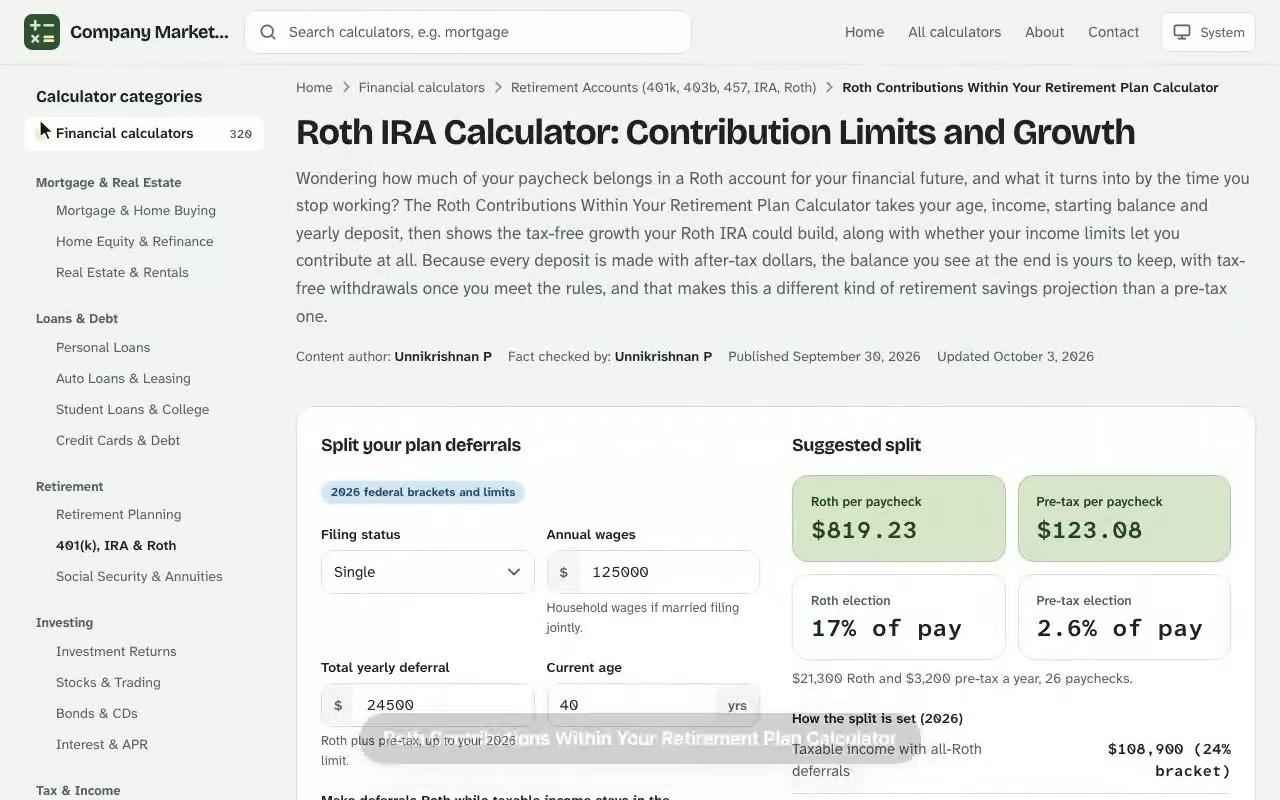
Roth Contributions Within Your Retirement Plan Calculator
Roth Contributions Within Your Retirement Plan Calculator. Wondering how much of your paycheck belongs in a Roth account for your financial future, and what it turns into by the time you stop working? The Roth Contributions Within Your Retirement Plan Calculator takes your age, income, starting balance and yearly deposit, then shows the tax-free growth your Roth IRA could build, along with whether your income limits let you contribute at all. Because every deposit is made with after-tax dollars, the balance you see at the end is yours to keep, with tax-free withdrawals once you meet the rules, and that makes this a different kind of retirement savings projection than a pre-tax one. The roth ira calculator uses the same plain-English approach, so you can compare results side by side.
Suggested split
Roth per paycheck
–
Pre-tax per paycheck
–
Roth election
–
Pre-tax election
–
How the split is set (2026)
Taxable income with all-Roth deferrals–
Top of the chosen bracket–
Taxable income with the split–
Tax saved by the pre-tax part–
Your 2026 deferral limit–
Roth and pre-tax deferrals are both subject to Social Security and Medicare tax, so only income tax changes. Employer contributions are usually pre-tax and are not included.
All Roth, split or all pre-tax
The same deferral every year until retirement, using 2026 brackets and limits throughout.
All Roth
Suggested split
All pre-tax
Results are estimates for educational purposes and are not financial, tax or legal advice.
How the Roth Contributions Within Your Retirement Plan Calculator Works
A Roth IRA calculator answers two questions in one pass: how much you are allowed to put in this year, and what that money could be worth when you retire. You enter a handful of inputs, and the tool grows your starting balance and each annual contribution forward at the rate of return you expect, one year at a time, until your chosen retirement age. The result is your projected balance at retirement, split into the money you put in and the earnings that piled up on top. Next, open the free 403b savings calculator and enter your own details to see an estimate in seconds.
Most people reach for a plain retirement calculator first, but that kind of tool often ignores contribution rules entirely. A Roth-specific retirement savings calculator checks your tax filing status and income against the IRS thresholds before it projects anything, so the deposit you model is one you can actually make.
The inputs you enter
Contribution year: the tax year the deposit counts toward. The IRS resets limits every year, and you can still fund the prior year until the filing deadline.
Current age: sets how many years of growth you get, and whether you qualify for the age-50 catch-up.
Tax filing status: single, married filing jointly, head of household and the rest each carry their own income thresholds.
Annual income: use your modified adjusted gross income, not your salary.
Starting balance: what your Roth account already holds today.
Estimated rate of return: the yearly gain you assume on your investments.
Retirement age: when you plan to start withdrawing.
What you get back
In a Roth IRA calculator, the output is a projected balance, your total principal, your total interest, and a year-by-year schedule. Some Roth IRA tools also compare the result with a regular taxable account, which is the fastest way to see what the Roth wrapper is worth to you in dollars.
Roth IRA Contribution Limit and Income Limits for 2026
The contribution limit for a Roth IRA contribution in 2026 is $7,500 if you are under 50. That works out to about $625 per month. The Internal Revenue Service sets this ceiling for all of your IRAs combined, so a Roth and a traditional account share the same $7,500. The 72t sepp calculator online uses the same plain-English approach, so you can compare results side by side.
Catch-up contribution at age 50
Once you turn 50, a catch-up contribution of $1,100 lifts the maximum contribution to $8,600. You also need earned income, such as wages, tips, bonuses or self-employment income, at least equal to what you put in. Investment income alone does not qualify you.
Phase-out ranges by tax filing status
Your tax filing status and modified adjusted gross income decide how much of that limit you keep. Below the lower threshold you can deposit the full amount; inside the phase-out window the allowed amount shrinks; above it you cannot make a direct Roth contribution at all.
Filing status
Full contribution below
Reduced between
No contribution at
Single, head of household, married filing separately (lived apart)
$153,000
$153,000 to $168,000
$168,000 or more
Married filing jointly, surviving spouse
$242,000
$242,000 to $252,000
$252,000 or more
Married filing separately (lived together)
None
Under $10,000
$10,000 or more
A raise, a bonus or a marriage (any big financial change) can push your adjusted gross income into one of these phase-out ranges without much warning, so rerun the numbers whenever your earnings change. If you land above the line, a backdoor Roth is the usual workaround, and an employer plan with a Roth option, such as a Roth 401(k), has no income cap at all.
Annual Contribution, Starting Balance and Rate of Return in the Roth IRA Formula
Under the hood, a Roth IRA calculator compounds your starting balance and then adds the future value of a stream of equal yearly deposits. This is the standard growth formula, and it is the one behind the schedule you see on screen:
See how the Roth Contributions Within Your Retirement Plan Calculator works: change the inputs and the roth per paycheck updates instantly. Enter your own numbers in the calculator above.
Here \(B_0\) is your starting balance, \(C\) is the annual contribution, \(r\) is the estimated rate of return and \(n\) is the number of years between your current age and your retirement age. The first term grows what you already have; the second grows every deposit you make along the way. Contributions are assumed to land at the end of each year.
The same math explains why the contribution year and timing matter. A deposit made in January of a year has twelve more months to earn than one made on the last day, and an extension to the filing deadline lets you fund the previous year as late as the following spring.
Worked Example: A Retirement Savings Calculator Projection to Age 65
Take a single saver who is 34, earns a modified adjusted gross income of $96,000 and already holds $18,400 in a Roth account. At that income, the full $7,500 limit is open, but the saver chooses to deposit $6,000 each year, assumes a 7% rate of return, and plans to retire at 65. That gives \(n = 31\) years.
Since 1.0731 is roughly 8.145, the balance at retirement comes to about $762,308. Of that, $204,400 is total principal (the $18,400 you started with plus 31 deposits of $6,000), and $557,908 is total interest earned along the way. In other words, about 73 cents of every dollar in the account is growth, not deposits.
Annual schedule at five-year milestones
Age
Balance
Growth so far
39
$60,311
$11,911
44
$119,094
$40,694
49
$201,540
$93,140
54
$317,175
$178,775
59
$479,359
$310,959
65
$762,308
$557,908
Notice how late the curve bends. The first fifteen years add roughly $183,000 to the balance; the last six add well over $280,000. That back-loaded shape is the reason a longer horizon beats a bigger deposit for most savers.
Changing one input at a time
Raise the annual contribution to the full $7,500 and the projected balance rises to about $915,418.
Cut the rate of return to 6% and it falls to roughly $620,831; lift it to 8% and it climbs to about $940,040.
Drop the deposit to $3,000 a year and you end near $456,089.
Try these scenarios side by side on your own numbers, because the spread between a cautious and an optimistic return is often larger than the spread between two contribution levels.
A Bonus Pushes Income Into the Roth IRA Phase-Out Range
Dana, 41 and single, plans to fund a Roth IRA in March. Her pay stub projects $148,200 of modified adjusted gross income, which sits $4,800 under the $153,000 single-filer threshold, so she assumes the full $7,500 is available.
Then her manager confirms a $9,500 bonus. Before depositing anything, Dana enters the new figure into the calculator's annual income field: $148,200 plus $9,500 is $157,700. The Roth IRA contribution limit the tool returns is no longer $7,500. It drops to $5,150, because her income now overshoots the threshold by $4,700 inside a $15,000-wide phase-out window:
That result matters in a specific way. The $2,350 she would lose is a limit set by the IRS, and anything she deposited above $5,150 would be an excess contribution taxed at 6% each year until she withdrew it. Dana sees two options on screen: accept $5,150, or push her income back to $153,000 or below.
She chooses the second. Her employer plan allows pre-tax deferrals, which reduce MAGI dollar for dollar, so she raises her next paychecks' 401(k) deferral by $4,700 in total. She reruns the numbers with $153,000 in the income field and the limit returns to the full $7,500. The next action is concrete: finish the $4,700 of extra deferrals before December 31, then deposit $7,500 into her Roth IRA before the April filing deadline.
Roth IRA Contribution vs a Taxable Account
The main reason to run a Roth projection is the comparison it makes possible. Money placed in a regular taxable account pays tax on its dividends and gains; money in a Roth does not. Suppose the same $6,000 deposits from the example above went into a taxable account instead and the only tax owed was 15% on the gains at the end. That would cost $83,686 on the $557,908 of growth and leave about $678,622, compared with the full $762,308 in the Roth.
Real taxable accounts usually do worse than that, because dividends and fund distributions are taxed year after year rather than once at the end. Treat the gap, a financial benefit you can measure, as a conservative estimate of your tax savings.
Saver's tax credit and other tax deductions
A Roth IRA contribution is not tax-deductible, which is the trade-off for tax-free growth later. Lower earners can still claim the saver's tax credit on IRS Form 8880, worth up to 50% of the first $2,000 contributed. That credit is a tax credit, not a tax deduction, so it lowers your bill dollar for dollar.
Roth IRA Withdrawal Rules, Tax-Free Withdrawals and the Five-Year Clock
Your Roth IRA projection above is only as good as your ability to use the money, so the withdrawal rules deserve a read before you commit. Your original deposits can come out at any time, tax-free and without a penalty. Earnings are different, and the rules depend on your age and on how old the account is.
The account must be open for five years before earnings can leave tax-free.
You must also be 59½ or older, disabled, or using the money for an approved purpose.
Approved purposes include a first-time home purchase (up to $10,000 over your lifetime) and qualified education expenses.
A distribution to a beneficiary after the owner's death also avoids the early-withdrawal penalty.
Pull earnings out too early and you owe ordinary tax plus a 10% penalty, unless one of those exceptions applies. There is no required minimum distribution on a Roth IRA during your lifetime, which sets it apart from a traditional IRA or most employer 401(k)s, and it lets the balance keep compounding as long as you like. That compound growth is the quiet advantage of leaving a Roth IRA alone.
Traditional IRA vs Roth Contribution in Your Retirement Plan
Choosing between a traditional IRA and a Roth IRA comes down to when you want to pay the tax, and the tax advantages of each point in opposite directions. A traditional deposit may lower this year's bill but is taxed when you withdraw it; a Roth deposit is taxed now and then escapes tax for good. If you expect a higher tax bracket in retirement than today, the Roth usually wins, and if you expect a lower one, the traditional account may.
Roth IRA: no upfront deduction, tax-free withdrawals, no required minimum distribution, income limits apply.
Traditional IRA: possible deduction, taxed on the way out, required minimum distributions start later in life.
Roth conversion: moving traditional money into a Roth triggers tax on the amount moved, so run it through a dedicated conversion tool first.
Employer plan and Roth 401(k) options
Many employers now offer a Roth feature in their workplace plan, and a Roth account of that kind counts as a retirement account with the same tax-free logic as an IRA. It follows the same after-tax logic, and an employer match, where offered, typically goes into a separate pre-tax bucket. Your IRA contribution and your workplace contribution are separate limits, so you can use both. Your Social Security check will cover only part of your spending, so enter workplace Roth deferrals separately from your IRA deposit and treat the projected tax-free balance as a second income source in your financial plan.
IRA Contribution Calculator Tips for Planning Your Next Deposit
An IRA contribution calculator is most useful when you use it as a yearly checkpoint, not a one-time curiosity. Here is a short routine that keeps your retirement planning honest:
Update your income and filing status each January, because the eligibility thresholds move with them.
Set up automatic contributions so the deposit happens before you can spend it.
Revisit the estimated rate of return each year so it reflects your actual investment choices and investment style, whether you hold stocks, bonds or mutual funds.
Match the plan to your long-term goals and your wider financial picture, and remember that estimates are not guarantees.
The Roth Contributions Within Your Retirement Plan Calculator will not decide your strategy for you, but it turns a vague intention into a number you can act on. Plug in your own age, income and Roth IRA balance, and compare a few scenarios before you fund this year's account.
Roth Contributions Within Your Retirement Plan Calculator questions
How much can I contribute to a Roth IRA in 2026?
The limit is $7,500 if you are under 50 and $8,600 if you are 50 or older, provided your income is below the phase-out range for your filing status. The limit is shared across all of your IRAs.
What are the Roth IRA income limits?
For 2026, a single filer can contribute the full amount below $153,000 of modified adjusted gross income, a reduced amount up to $168,000, and nothing above that. Married couples filing jointly have a $242,000 to $252,000 phase-out range.
Can I withdraw Roth IRA contributions before retirement?
Yes. Your direct contributions can come out at any time without tax or penalty. Earnings are tax-free only after the account is five years old and you are 59½ or meet an exception such as a first-time home purchase or disability.
What happens if my income is in the phase-out range?
Your allowed contribution shrinks in proportion to how far your income sits inside the range. The calculator shows the reduced maximum so you can deposit a compliant amount.
Is the Roth IRA better than a taxable account?
Roth growth is not taxed when you withdraw it under the qualified rules, while a taxable account pays tax on earnings. The comparison in this calculator shows the dollar difference for the rate and tax rate you enter.
How much should I put in a Roth IRA each month?
Reaching the full $7,500 limit takes about $625 a month if you are under 50. Any smaller amount still works; enter your own figure to see the result.
Can I still contribute for the previous tax year?
Yes, until the tax filing deadline for that year, including with an extension. Switch the contribution year to 2025 to model it.
Does a Roth IRA have required minimum distributions?
No. Unlike a traditional IRA or most employer plans, a Roth IRA has no required minimum distributions during your lifetime.