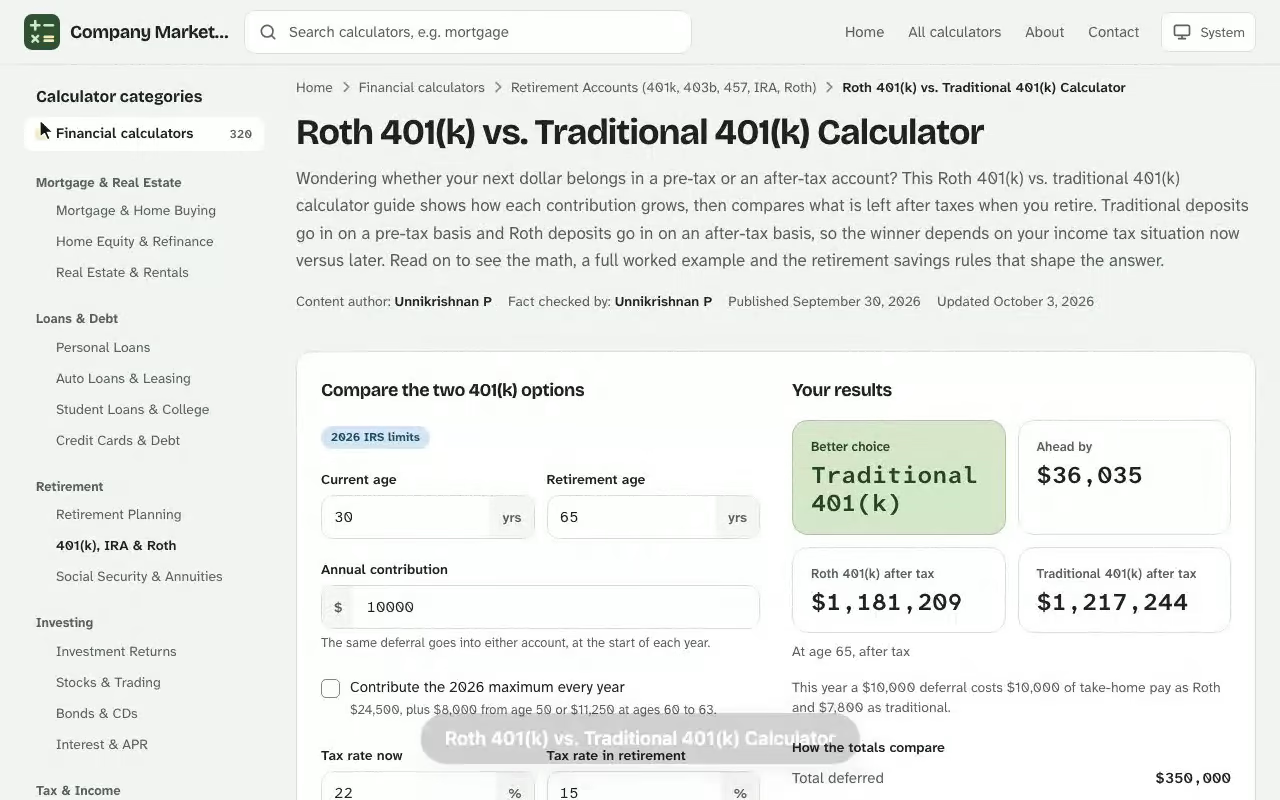
Roth 401(k) vs. Traditional 401(k) Calculator. Wondering whether your next dollar belongs in a pre-tax or an after-tax account? This Roth 401(k) vs. traditional 401(k) calculator guide shows how each contribution grows, then compares what is left after taxes when you retire. Traditional deposits go in on a pre-tax basis and Roth deposits go in on an after-tax basis, so the winner depends on your income tax situation now versus later. Read on to see the math, a full worked example and the retirement savings rules that shape the answer. If you want to see how the figures change, the roth ira calculator online gives you an instant result you can adjust as you go.
Your results
Better choice
–
Ahead by
–
Roth 401(k) after tax
–
Traditional 401(k) after tax
–
How the totals compare
Total deferred–
Either 401(k) balance before tax–
Tax on traditional withdrawals–
Invested tax savings–
Break-even retirement tax rate–
Year-by-year comparison
After-tax values at the end of each year, as if you withdrew everything then.
Age
Deferral
Roth 401(k)
Traditional after tax
Invested savings
Roth ahead by
Results are estimates for educational purposes and are not financial, tax or legal advice.
How the Roth 401(k) vs. Traditional 401(k) Calculator Works
A good comparison tool grows two accounts side by side using the same assumptions, then converts both to the one number that matters: spendable dollars after taxes. The Roth account is already taxed, so its balance is what you keep. The traditional account still owes federal income tax on every withdrawal, so its balance has to be reduced by your tax rate in retirement before the two can be compared fairly. The roth 401k paycheck calculator online uses the same plain-English approach, so you can compare results side by side.
Roth vs Traditional 401(k) Contributions
With a traditional 401(k), your contribution comes off your taxable income today, which lowers this year's tax bill and your paycheck deduction at the same time. With a Roth 401(k), you pay tax on that money first and then invest what remains. Roth contributions grow tax-free, and qualified distributions come out with no further tax. Many employers now offer both Roth 401(k)s and traditional 401(k)s, and every 401(k) contribution you make is tagged for one tax treatment or the other. Both accounts offer the same investment menu inside your employer's plan; only the timing of the tax differs.
Current Income, Tax Rate and Rate of Return
Your current income sets the bracket you are in today, and the tax rate you expect to pay on retirement account withdrawals sets the bracket later. The hypothetical rate of return is the average yearly growth you assume for the investments. Real returns vary from year to year and can be negative, so treat any single number as an assumption rather than a forecast.
Annual Contribution and Contribution Limit
Enter the annual contribution you plan to make, not your employer's share. The calculator assumes the same gross amount is invested every year until you stop working. Your plan document and the IRS contribution limit cap how much you can defer, and employer matching is usually tracked separately from your own deferrals.
Age at Retirement and Pay Frequency
The years between your current age and your age at retirement are the growth window, and each extra year of compounding widens the balances at retirement. Pay frequency matters only slightly: depositing every two weeks puts money to work a little earlier than a single annual deposit, so the balance edges higher.
Current Tax Rate vs Retirement Tax Rate
This pair of inputs drives the verdict. If your current tax rate is higher than your tax rate in retirement, the traditional deduction is worth more than the Roth's tax-free withdrawals. If it is lower, the Roth wins. When the two are equal, the balances tie and the account choice comes down to flexibility and risk.
Roth 401k vs Traditional 401k: Formula and Worked Example
The comparison reduces to two short formulas. Let C be the gross annual contribution, t0 your current tax rate, tr your retirement tax rate, r the rate of return and n the number of years you contribute. The free ira calculator is free to use with no sign-up, and works on desktop and mobile.
After-Tax Value Formula
The growth factor for level yearly deposits is shown first, followed by the after-tax value of each account:
$$F = \frac{(1 + r)^{n} - 1}{r}$$
$$\text{Traditional after-tax} = C \times F \times (1 - t_{r})$$
$$\text{Roth} = C \times (1 - t_{0}) \times F$$
Because both formulas share C × F, the growth factor cancels out of the comparison. The traditional account wins whenever (1 − tr) is larger than (1 − t0), which is the same as saying the retirement tax rate is lower than the current tax rate. The rate of return changes the size of both balances, not which one is ahead.
Worked Example: $15,000 a Year for 31 Years
Suppose you are 34, plan to retire at 65 and can defer a $15,000 annual contribution. Your current tax rate is 24%, you expect a 22% retirement tax rate and you assume a 6.5% rate of return. To keep your net take home pay identical, the Roth deposit is the traditional amount after tax: $15,000 × (1 − 0.24) = $11,400.
The growth factor is F = (1.06531 − 1) ÷ 0.065 = 92.989. That produces the figures below.
Account
Yearly deposit
Balance at age 65
Tax at 22%
After-tax balance
Traditional 401(k)
$15,000
$1,394,838
$306,864
$1,087,974
Roth 401(k)
$11,400
$1,060,077
$0
$1,060,077
A traditional balance of $1,394,838 shrinks to $1,087,974 once 22% tax is paid.
The traditional account finishes $27,897 ahead, about 2.6%, because the 24% deduction today beats the 22% tax later by two points. Pushing the retirement tax rate to 24% would erase the gap entirely.
Balances at Retirement by Tax Rate Scenario
Holding every other input fixed, here is how the verdict moves as your retirement tax rate changes:
Retirement tax rate
Traditional after tax
Roth
Better choice
12%
$1,227,458
$1,060,077
Traditional by $167,381
22%
$1,087,974
$1,060,077
Traditional by $27,897
24%
$1,060,077
$1,060,077
Tie
32%
$948,490
$1,060,077
Roth by $111,587
The gap between traditional and Roth balances flips at a 24% retirement tax rate.
A 4% return shrinks the 22% scenario to $694,142 against $676,343, and a 9% return lifts it to $1,750,030 against $1,705,157. The ranking never flips because only the tax rates decide it.
Traditional 401k vs Roth 401k: Which Tax Bracket Favors Each
The table above is the heart of the decision, and your tax bracket is the lever. Use these rules of thumb as a starting point, then confirm them with real numbers in the 401(k) calculator.
When a Higher Tax Bracket Now Favors Traditional
If you are at the peak of your earning years in a high bracket and expect a modest income in retirement, deferring tax is attractive. The immediate tax benefits are real money in your pocket this year, and you may withdraw in a lower tax bracket later. A big deduction can also push you under a threshold such as a credit phase-out, which adds tax savings the basic formula does not capture.
When a Lower Tax Bracket Now Favors Roth
Early-career workers, people between jobs and anyone with a temporarily low income often sit in a low bracket today. Paying the tax now at 12% or 22% and then taking tax-free withdrawals can beat a later bill at 24% or 32%. Younger investors with decades of tax-free growth ahead tend to gain the most.
When the Rates Are Close
If your current and retirement rates are within a few points, the result is nearly a tie, and other factors matter more. Many savers split the difference and keep both account types for tax diversification, which gives you control over how much taxable income you report each year in retirement.
Paycheck and Take Home Pay: Roth 401(k) Contributions vs Traditional Contributions
A fair comparison keeps your take home pay the same. A traditional deferral of $15,000 lowers your taxable income, so your paycheck drops by only $11,400 once the tax savings are counted. A Roth contribution of $15,000 would lower your paycheck by the full $15,000 because there is no deduction. That is why many calculators invest a smaller Roth amount when they hold net take home pay constant.
See how the Roth 401(k) vs. Traditional 401(k) Calculator works: change the inputs and the better choice updates instantly. Enter your own numbers in the calculator above.
If you instead put the same gross $15,000 into each account, the Roth holds more after-tax money in effect, because you have shielded more dollars from future tax. The calculator lets you choose either approach through the current contribution type and the pay frequency settings.
Testing a Traditional 401(k) vs Roth 401(k) Choice at $98,750 of Income
Dana, 41, is a single filer earning $98,750, and the payroll portal is asking whether the next raise goes to a Roth or a traditional deferral. Dana has $9,600 a year to commit, which works out to $800 a month before tax, and plans to work until 67. That gives the calculator 26 years of contributions.
Dana enters age 41, retirement at 67, a current tax rate of 22% (the 2026 single-filer bracket runs from $50,400 to $105,700) and a hypothetical rate of return of 7%. The first guess for the retirement tax rate is 12%, because a modest pension and Social Security should keep taxable income under $50,400.
Result
Traditional
Roth
Yearly deposit
$9,600
$7,488
Balance at 67
$659,294
$514,249
After tax at 12%
$580,179
$514,249
The traditional side leads by $65,930. Before trusting that, Dana changes one input: a 22% tax rate in retirement. The two columns land on $514,249 each, so the whole advantage depends on Dana staying in the 12% bracket. Dana notes the IRS line to watch, $50,400 of taxable income, and checks that required minimum distributions starting at 73 would not push a $580,000 balance above it.
The decision: put $6,000 into the traditional account to capture the 22% deduction, and send the remaining $3,600 to the Roth side as insurance against a higher rate.
Pros and Cons of a Traditional 401(k) and a Roth 401(k)
Traditional 401(k) Advantages and Drawbacks
Immediate tax benefits: contributions reduce your taxable income this year.
Employer matching: matches are widely available and boost your retirement savings.
Tax-deferred growth: investments compound without yearly tax, so more stays invested.
Taxable withdrawals: every distribution is taxed as ordinary income, and it is costly if your rate rises.
Required minimum distributions: RMDs begin at age 73 whether you need the money or not.
Roth 401(k) Advantages and Drawbacks
Tax-free withdrawals: qualified distributions come out with no tax on contributions or earnings.
No lifetime RMDs: the account keeps growing, which helps estate and income planning.
Tax-free growth: a long runway multiplies the benefit for younger savers.
After-tax contributions: you pay tax up front, so your paycheck is smaller and you get no deduction.
Possible lower tax advantages: if your tax rate in retirement is lower, the upfront tax may not pay off.
Rules That Affect Any 401(k) Calculator Result
Contribution Limit and Catch-Up Contributions
For 2026 the employee deferral limit is $24,500 across traditional and Roth accounts combined. Savers 50 and older may add a catch-up contribution of $8,000, and the SECURE 2.0 Act raised that to $11,250 for ages 60 to 63. Employees classified as highly compensated can face lower limits, so check your plan document. Employer matching contributions sit outside the employee limit. Keep the annual contribution you enter at or below that limit: it applies to Roth and traditional deferrals combined, so the comparison is only valid inside it.
Qualified Distributions, Penalty and RMDs
A Roth distribution is a qualified distribution when you are at least 59½ and the account has been open five years. Taking money earlier can trigger an early distribution penalty of 10% on top of income tax on the earnings or pre-tax amount. Traditional balances face required minimum distributions starting at 73, which can push your taxable income and tax bracket higher.
What a Calculator Cannot See
State taxes, future law changes, Social Security taxation and inflation are not part of the basic math, and results are shown for illustrative purposes only. A licensed financial advisor or tax advisor can model them for your situation.
Roth 401(k) vs. IRA: Where a Traditional IRA or Roth IRA Fits
A 401(k) is an employer plan with high limits, while an IRA is an individual account with a smaller yearly cap. The same tax logic applies: a Traditional IRA may give a deduction now, and a Roth IRA gives tax-free withdrawals, but the Roth IRA has income limits that a Roth 401(k) does not. If you earn too much for a Roth IRA, the Roth 401(k) is often the way to build tax-free savings. Compare each account type with the same rate assumptions before splitting money among them, and keep your retirement account choices consistent with your wider investments.
Using Your Traditional 401(k) vs Roth 401(k) Result in a Financial Plan
Treat the output as a starting point for your financial plan, not a final answer. Read the gap between the two after-tax balances first: a large gap means your current and retirement tax rates are far apart, while a small one means either account works. Re-run the 401(k) calculator with a lower and a higher retirement tax rate, and test a pessimistic and an optimistic rate of return, to see how stable the verdict is. When the gap is small, splitting contributions between Roth and traditional hedges against surprises in future tax rates, and a financial planner can help you weigh the investing side of that split and the accumulation phase that comes before it. Results are in today's nominal dollars, so they are not adjusted for inflation.
Roth 401(k) vs. Traditional 401(k) Calculator questions
Is a Roth 401(k) or a traditional 401(k) better?
It depends mainly on your tax rate now versus in retirement. If your retirement tax rate is lower than your current rate, the traditional 401(k) usually leaves more after tax; if it is higher, the Roth 401(k) wins; if they match, the two tie.
What is the difference between pre-tax and after-tax 401(k) contributions?
Traditional contributions are made before income tax, lowering your taxable income today, and are taxed when withdrawn. Roth contributions are made after tax, so qualified withdrawals, including growth, are tax-free.
Why does the calculator invest a different amount in each account?
To compare fairly, both options reduce your take-home pay by the same amount. A traditional deferral saves tax now, so the matching Roth deposit is smaller, equal to the traditional amount times one minus your current tax rate.
What retirement tax rate should I enter?
Use the marginal federal rate you expect on withdrawals, based on your likely retirement income and filing status. The calculator does not include state taxes, which could change the comparison.
What are the 401(k) contribution limits?
For 2026 the employee limit is $24,500, with an extra $8,000 catch-up for ages 50 and over and $11,250 for ages 60 to 63 if your plan allows it. The limit covers Roth and traditional deferrals combined, and employer matching does not count toward it.
Do Roth 401(k)s have required minimum distributions?
Traditional 401(k)s require minimum distributions starting at age 73. Roth 401(k)s are not subject to lifetime RMDs, so the money can keep growing tax-free.
Can I withdraw early without a penalty?
Withdrawals before age 59½ may be subject to a 10% early distribution penalty, and a Roth withdrawal must be qualified for its earnings to be tax-free. Check your plan document for exceptions.
Does the calculator include my employer match?
No. It compares only your own deferrals. Employer matching is usually made on a pre-tax basis, so consider it separately when planning your account split.