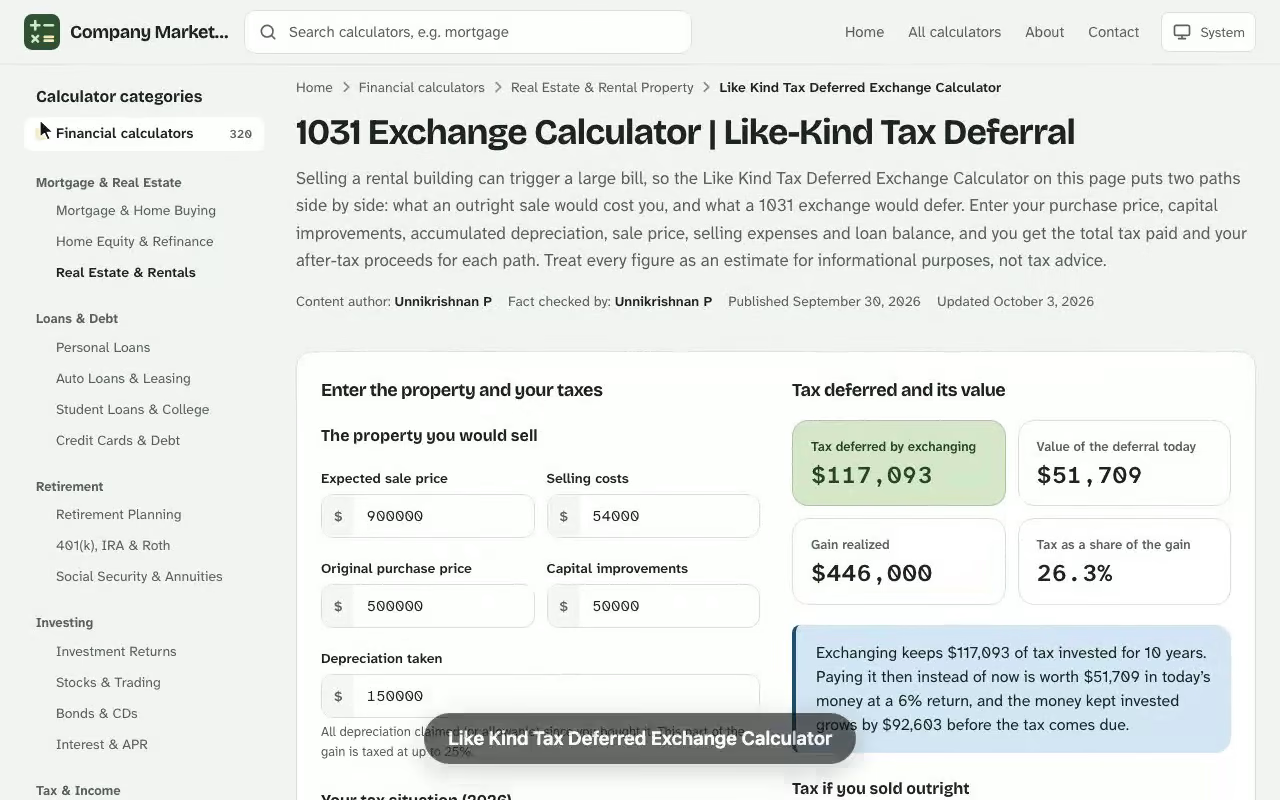
Like Kind Tax Deferred Exchange Calculator. Selling a rental building can trigger a large bill, so the Like Kind Tax Deferred Exchange Calculator on this page puts two paths side by side: what an outright sale would cost you, and what a 1031 exchange would defer. Enter your purchase price, capital improvements, accumulated depreciation, sale price, selling expenses and loan balance, and you get the total tax paid and your after-tax proceeds for each path. Treat every figure as an estimate for informational purposes, not tax advice. Next, open the rent calculator online and enter your own details to see an estimate in seconds.
Tax deferred and its value
Tax deferred by exchanging
–
Value of the deferral today
–
Gain realized
–
Tax as a share of the gain
–
–
Tax if you sold outright
Adjusted basis–
Gain realized–
Unrecaptured section 1250 gain (up to 25%)–
Other long-term capital gain (0%, 15% or 20%)–
Deductions used–
Federal income tax on the gain–
Net investment income tax–
State income tax–
Total tax deferred–
What deferral is worth
Present value of the tax paid later–
Value of deferring it–
Growth on the tax kept invested–
Extra wealth at the end, after any tax–
Value of deferral by year of sale
If you sold the replacement property in a given year and paid the deferred tax then, this is what the money kept invested would be worth and what deferring saves in today’s money.
Year
Tax money kept invested
Present value of paying the tax
Deferral value today
Results are estimates for educational purposes and are not financial, tax or legal advice.
How the 1031 Exchange Calculator Compares a Taxable Sale With Tax Deferment
A like-kind exchange lets you sell investment property and roll the money into a new one without paying tax on the gain right away. The calculator makes that trade-off visible. It runs your numbers through two columns: a taxable sale, where every tax line is due this year, and a 1031 tax exchange, where those same lines show $0 because the gain is deferred rather than erased. The gap between the columns is your estimated tax savings from tax deferment. Next, open the free rental property calculator and enter your own details to see an estimate in seconds.
People call this strategy a starker exchange, a deferred 1031 exchange, or simply a tax deferred exchange. They all describe the same thing: a transaction that qualifies under Section 1031 of the Internal Revenue Code, where you swap one qualifying real property for another.
Property and Sale Inputs: Purchase Price, Capital Improvements, and Accumulated Depreciation
Six dollar figures describe the property and the sale. Gather them from your closing statement and your depreciation schedule before you start.
Input
What to enter
Original purchase price
What you paid for the property, excluding financing costs
Capital improvements
Permanent additions such as a new roof or an added unit, not routine repairs
Accumulated depreciation
Total depreciation deductions you have claimed while owning the property
Sales price
The gross price the buyer pays
Selling expenses
Commissions, title fees, transfer tax and other closing costs
Loan balance at sale
The mortgage principal still owed when the sale closes
Your cost basis is the purchase price plus capital improvements, and your adjusted cost basis is that figure minus accumulated depreciation. A lower adjusted basis means a larger gain, which is why a property you have depreciated for many years often produces the biggest tax liability.
Tax Rate Elections: Capital Gains Rate, State Tax, and Net Investment Income Tax
Four rates drive the estimated tax. The federal capital gains rate for long-term holdings is 0%, 15% or 20%, depending on your income. Depreciation recapture is taxed at a federal rate of up to 25%. The net investment income tax (NIIT) adds 3.8% for investors above the income thresholds, and your state tax depends on where the property sits, from 0% in states without a gain tax to 13.3% in California. Use your highest marginal rate for a conservative estimate, because the calculator cannot see the rest of your income.
Like-Kind Exchange Formulas: From Cost Basis to After-Tax Proceeds
The math behind a 1031 exchange calculator runs in three steps. Knowing them lets you check any result by hand. The mortgage required income calculator online uses the same plain-English approach, so you can compare results side by side.
Step 1: Sale Proceeds, Cost Basis, and Adjusted Cost Basis
Start with the figures the calculator derives from your inputs:
Two gains follow. The capital gain equals net proceeds minus cost basis, and it feeds the federal capital gains tax. The adjusted capital gain equals net proceeds minus adjusted cost basis, so it also contains the depreciation you took, and it feeds the state tax and the NIIT.
Step 2: Capital Gains Tax, Depreciation Recapture, and State Capital Gains
In the exchange column, the tax is $0, so the full amount left after the loan payoff goes to a qualified intermediary and stays invested.
Worked Example: Tax Deferment on a $1,640,000 Rental Sale
Suppose an investor owns a small apartment building bought for $735,000, with $86,500 of capital improvements and $214,300 of accumulated depreciation. It sells for $1,640,000, selling expenses are $98,400, and $412,000 is still owed on the loan. The investor uses a 20% federal rate, 6% state rate, 3.8% NIIT and the 25% recapture rate.
Net proceeds are $1,541,600. Cost basis is $821,500 and adjusted cost basis is $607,200, so the capital gain is $720,100 and the adjusted capital gain is $934,400.
Line item
Outright sale
1031 exchange
Federal capital gains tax (20% of $720,100)
$144,020
$0
Depreciation recapture (25% of $214,300)
$53,575
$0
State tax (6% of $934,400)
$56,064
$0
Net investment income tax (3.8% of $934,400)
$35,507
$0
Total tax paid
$289,166
$0
After-tax proceeds
$840,434
$1,129,600
See how the Like Kind Tax Deferred Exchange Calculator works: change the inputs and the tax deferred by exchanging updates instantly. Enter your own numbers in the calculator above.
The exchange keeps $289,166 of equity working in real estate. That is the figure the calculator reports as your estimated tax savings, and it is deferred, not forgiven.
What an outright sale leaves you after costs, the loan payoff and tax; a 1031 exchange defers the tax step.
Understanding the Results of a Like Kind Tax Deferred Exchange Calculator
Read the output as a comparison, not a bill. The sale column shows what you would owe if the sale were a cash sale with no exchange. The exchange column shows the same property after you follow the 1031 rules.
Why Deferral Is Not Elimination
A tax-deferred result postpones the liability. Your basis in the replacement carries over, so the deferred gain comes due when you eventually sell without another exchange. Investors who keep exchanging can defer taxes for decades, and some pass the property to heirs, but the estimate on screen never means the taxes disappeared.
Which Tax Line Moves the Total Most
Compare the lines to see where your taxes come from. In the example the federal capital gains line is the largest, yet depreciation recapture still costs $53,575 on a property that appreciated modestly. A longer ownership period raises accumulated depreciation, and so does this line.
Estimated tax deferment by federal and state rate, with the worked example outlined.
1031 Exchange Rules: Qualifying Property, Deadlines, and the Qualified Intermediary
The calculator only estimates the tax. Whether the exchange itself is valid depends on rules you must meet.
Which Like-Kind Property Qualifies
Properties are of like-kind when they share the same nature or character, even if grade or quality differs. Since the Tax Cuts and Jobs Act, only real property qualifies; machinery, vehicles and artwork no longer do. Both the property you give up and the one you receive must be held for investment purposes or used in a trade or business.
Rental properties, including residential, commercial, industrial and retail buildings
Vacant land, farmland and raw land
A multifamily or apartment building swapped for a strip mall
A Delaware Statutory Trust (DST) interest, treated as real property
Not eligible: your primary residence, a second home used personally, or a flip held for sale
The 45 Days and 180 Days Timeline
From the day you close on the relinquished property, you have 45 days to identify the replacement property in writing and 180 days to complete the purchase, or until your tax return is due if that comes first. Both clocks start together. The 45-day identification window and the 180-day deadline are strict, with extensions only for federally declared disasters.
The 45-day and 180-day clocks both start when the relinquished property sale closes.
Three-Property Rule and 200% Rule
You may identify up to three candidates regardless of price under the three-property rule. Under the 200% rule, you may name more, provided their combined fair market value does not exceed 200% of what you sold for. A properly signed identification letter goes to your intermediary.
Boot and Recognized Gain
Any cash or non-like-kind property you take out is boot. You recognize gain up to the amount of boot, and you cannot recognize a loss. Buying a replacement that costs less than what you sold, or not reinvesting all net sales proceeds, creates boot. Report the exchange on Form 8824 with your return.
Delayed Exchange and Other Deferred 1031 Exchange Structures
Most investors use a delayed exchange: sell first, then buy within the 180 days. A simultaneous exchange closes both on the same day. In a reverse exchange you acquire the new property before selling the old one, usually through a separate entity. A build-to-suit exchange lets sale funds improve the replacement property. The calculator output is the same for each, because the tax on the original sale does not depend on the structure.
Testing a Duplex Sale With a 1031 Tax Exchange Estimate
Marisol Quintero holds a signed offer of $1,312,500 on a duplex she bought in 2014, and before she answers she pulls the paperwork. The settlement statement shows a $498,250 purchase, her improvement invoices add up to $61,800 for a new roof and two kitchens, and her accountant's schedule shows $167,940 of depreciation taken. The lender's payoff letter says $286,300 is still owed, and the listing agent puts selling expenses at $78,750.
She enters all six figures, picks the 15% federal rate because her taxable income stays under the 20% bracket, adds a 4.25% state rate, and sets the net investment income tax to 0% because her household income is below the $250,000 joint threshold. The calculator derives net proceeds of $1,233,750, an adjusted cost basis of $392,110 and a capital gain of $673,700.
The taxable-sale column then reads $101,055 of federal capital gains tax, $41,985 of recapture at the 25% rate and $35,770 of state tax. That is $178,810 in total, leaving $768,640 after tax. The exchange column shows $947,450 available to reinvest, so the tax deferment is worth $178,810 to her, not a figure she can spend but cash that stays inside the next building.
The result gives her two concrete instructions. First, because boot is taxed, the replacement must cost at least $1,312,500 and carry at least $286,300 of debt, so she tells her agent to search only above that price. Second, with the closing set for March 12, her 45th day is April 26 and her 180th is September 8, so she puts the identification letter to her intermediary on the calendar for April 24, two days early.
Who Uses a Like-Kind Exchange Calculator and When It Helps
A real estate investor runs the numbers before listing, because the estimate shapes the decision to sell, hold or swap. Landlords with older rental properties get the most from it: decades of depreciation push the tax basis down, and a low basis means more of the sale price counts as gain. Investors weighing a move from active management into a passive interest also use it to see how much wealth an exchange would keep invested.
The tool shines when you compare scenarios. Change the tax rate to see how long-term capital gains brackets alter the outcome, raise the sales price by 5% to test a stronger offer, or drop the loan payoff to model a debt-free sale. Each change shows how the taxes on the relinquished property shift, and how much cash is available to reinvest. Keep in mind that the reinvestment must cover both the net equity and the debt you replace, or the shortfall becomes boot. Every number here is illustrative until your accountant confirms it.
Because exchanges can be chained, one investment property can lead to a series of replacement property purchases, each deferring the gain a little longer. Re-run the calculator for each link in the chain, entering the carried-over basis, and you see the cumulative deferral the tool is estimating. A long hold raises the benefit, while a small gain may not justify an intermediary fee.
Limits of Any Tax Deferral Estimate
The calculator applies flat rates, so the taxes it shows ignore your full income picture, passive loss carryforwards, state-specific rules such as California clawback reporting, and any prior deferred gain. As the IRS notes about real property exchanges, a loss is never recognized. Confirm the figures with a tax professional, ideally a CPA or tax advisor, before you list the property; tax advice beyond an estimate is outside what any online tool can give.
Like Kind Tax Deferred Exchange Calculator questions
What does a like-kind exchange calculator estimate?
It compares the tax due on an outright sale of investment property with the tax deferred when you reinvest in a replacement property through a 1031 exchange, plus the equity left in each case.
Is a 1031 exchange tax-free?
No. It defers capital gains tax, depreciation recapture and related taxes. The deferred gain carries into the replacement property and comes due when you sell without another exchange.
What property qualifies for a 1031 exchange?
Real property held for investment or business use. Your primary residence, a second home used personally, and property held mainly for resale do not qualify.
What are the 45-day and 180-day rules?
From the day the relinquished property sale closes, you have 45 days to identify replacement property in writing and 180 days to close on it. Both clocks start together.
What is boot in a 1031 exchange?
Boot is cash or other non-like-kind property you receive. It is taxable up to the gain recognized, so reinvest all net equity and replace the debt to avoid it.
Why does depreciation recapture matter?
Depreciation you deducted lowers your basis, and that portion of the gain is taxed at up to 25% on a sale. A 1031 exchange defers it along with the capital gain.
Do I need a qualified intermediary?
Yes for a delayed exchange. A qualified intermediary holds the sale proceeds so you never take constructive receipt of the money.
How accurate is this estimate?
It uses flat rates you enter and ignores your other income and state-specific rules, so confirm the numbers with a CPA or tax advisor before you sell.