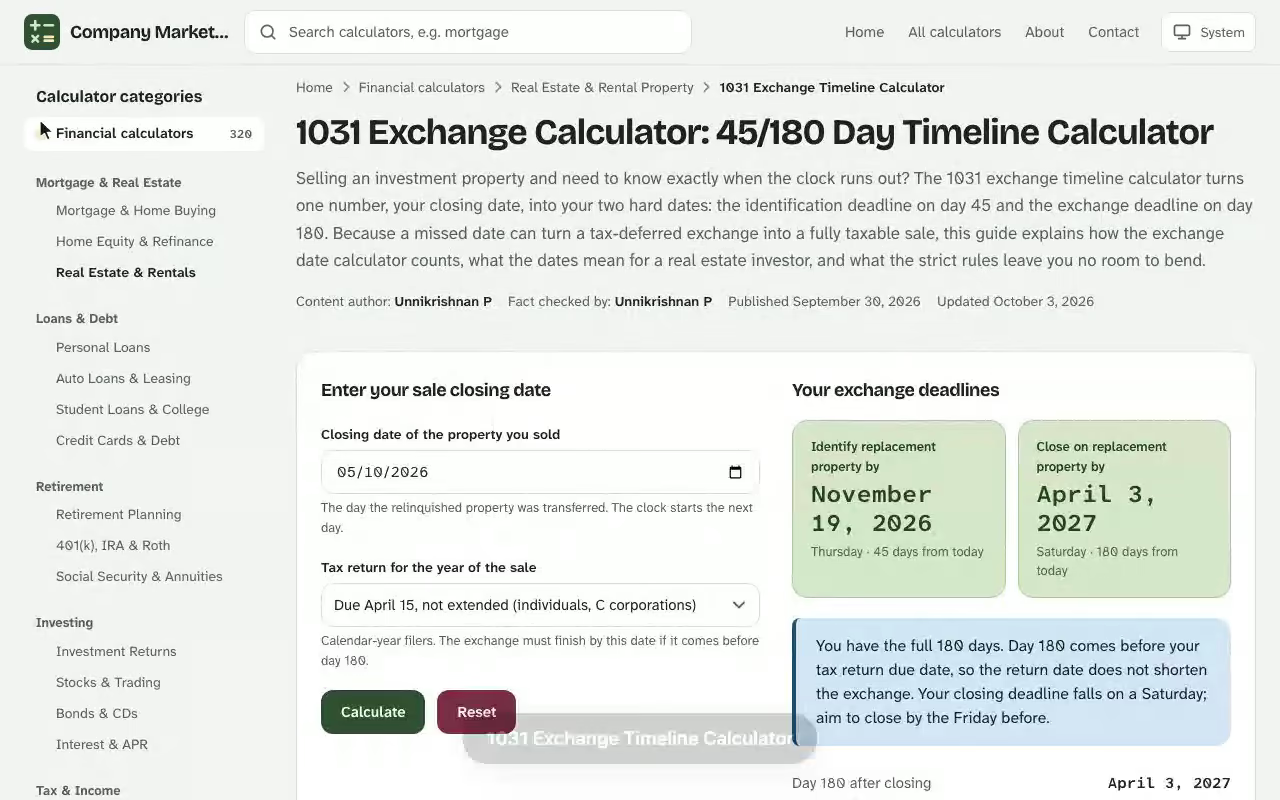
1031 Exchange Timeline Calculator. Selling an investment property and need to know exactly when the clock runs out? The 1031 exchange timeline calculator turns one number, your closing date, into your two hard dates: the identification deadline on day 45 and the exchange deadline on day 180. Because a missed date can turn a tax-deferred exchange into a fully taxable sale, this guide explains how the exchange date calculator counts, what the dates mean for a real estate investor, and what the strict rules leave you no room to bend. The rent calculator is free to use with no sign-up, and works on desktop and mobile.
Your exchange deadlines
Identify replacement property by
–
–
Close on replacement property by
–
–
–
Day 180 after closing–
Tax return due date–
Length of your exchange period–
Neither deadline moves when it lands on a weekend or holiday, so plan to finish by the last business day before it. Only an IRS disaster-relief notice can extend them.
Exchange timeline
Key dates counted in calendar days from your closing date.
Milestone
Date
Day
Days after closing
Days from today
Identify replacements in a signed, written notice to your qualified intermediary or another non-disqualified party. You can name up to three properties of any value, or more if their total value is no more than 200% of the property you sold.
Results are estimates for educational purposes and are not financial, tax or legal advice.
How the 1031 Exchange Timeline Calculator Counts Your Dates
Every 1031 exchange runs on two overlapping clocks that start together. The 45-day identification period and the 180-day exchange period both begin the day after your relinquished property closes, and the second clock does not restart when the first one ends. Used as a 45/180 day exchange calculator, it simply adds calendar days to your sale date and shows where each one lands, an arithmetic job with zero room for interpretation. Pair this with the like kind exchange calculator for a fuller picture before you make a decision.
That is why the 1031 timeline calculator only asks for one input. Escrow closes, the funds go to the qualified intermediary, and the countdown begins. Weekends and holidays are counted like any other day, so the tool does not skip them either.
The Two Deadlines in Plain Terms
Identification period: within 45 calendar days of closing, you must name your candidate replacement properties in writing.
Exchange period: you must receive the replacement property within 180 calendar days of closing, or by the due date of your tax return (including extensions) for the year of the sale, whichever is earlier.
Day counting: the closing date itself is day zero, so day 1 is the following calendar day.
The Formula Behind the Dates
The math is plain date addition. With the relinquished property sale date written as \(D_{close}\), the two deadlines are:
Here \(D_{return}\) is the due date of your federal tax return for the year of the transfer. A calendar-year filer who sells late in the year can therefore see the closing deadline arrive before day 180 unless a filing extension is in place.
Worked Example: A 1031 Exchange Date Calculator Run
Say your relinquished property closes on Tuesday, April 14, 2026. Running that date through the 1031 exchange date calculator gives these milestones: Try the deferred payment repossession calculator online to run your own numbers — everything is calculated in your browser and nothing you enter is stored or sent anywhere.
Milestone
Day count
Date
Closing date (sale of relinquished property)
Day 0
Tuesday, April 14, 2026
Identification clock starts
Day 1
Wednesday, April 15, 2026
Halfway through identification
Day 23
Thursday, May 7, 2026
Identification deadline
Day 45
Friday, May 29, 2026
Acquisition window opens for planning closings
Day 90
Monday, July 13, 2026
Closing deadline on replacement property
Day 180
Sunday, October 11, 2026
The Day 180 result is the instructive one. October 11, 2026 is a Sunday, and the rule does not roll forward to Monday. You would treat the previous business day, Friday, October 9, 2026, as your real deadline for closing on the replacement property, since title companies and lenders do not fund on weekends.
Days Left After Identification
Once you identify replacement properties on day 45, you have 135 additional calendar days to close. In this example that is the stretch from May 30 through October 11, 2026. This is the span that actually matters for financing, inspections and appraisals, so the exchange timeline is far tighter than the 180-day headline suggests.
Reading Exchange Deadlines for a Late-November Closing
Priya Raman owns a four-unit building in Dayton that she has agreed to sell for $1,186,400, with escrow set to close on Friday, November 20, 2026. Before signing, she wants to know whether a six-month search is realistic, so she opens the calculator and types in that closing date.
The identification line comes back as Monday, January 4, 2027. She counts the holiday week against it: three weeks of her 45 days overlap Thanksgiving, Christmas and New Year, when sellers and lenders answer slowly. The exchange line reads Wednesday, May 19, 2027, day 180.
That second date is where she pauses, because she files as a calendar-year individual and the tool's own note says it ignores tax filing date limits. Under Internal Revenue Code Section 1031(k), the exchange period ends on the earlier of day 180 or the due date of the return for the year of the sale. Her 2026 return is due Thursday, April 15, 2027, which is 34 days before May 19. She would have only 146 days, not 180, to close, unless she extends.
So she makes two decisions the same afternoon:
Ask her CPA to file Form 4868 before April 15, 2027, which pushes the return due date to October 15, 2027 and restores the full 180 days.
Tell her intermediary she will hand over her written list of replacement properties by Wednesday, December 30, 2026, five days ahead of January 4, so a delayed holiday mail delivery cannot cost her the exchange.
See how the 1031 Exchange Timeline Calculator works: change the inputs and the identify replacement property by updates instantly. Enter your own numbers in the calculator above.
With both dates on her calendar and the extension filed, she goes back to the listing agent knowing the identification list, not the closing, is the date to protect.
Understanding the 45-Day Identification Deadline
The identification deadline is non-negotiable in practice. Within 45 days of your property sale you must designate the potential replacement property, or properties, in writing, and deliver that notice to your intermediary or another party to the exchange who is not a disqualified person. Verbal intentions and emails to your broker do not count.
Identification Rules That Limit Your Choices
Three identification limits sit on top of the date, and the identify replacement properties step must satisfy at least one of them:
Three-property rule: name up to three candidate replacement properties of any value.
200% rule: name more than three, provided their combined fair market value is no more than 200% of what you sold.
95% rule: exceed both limits only if you ultimately acquire at least 95% of the total value you identified.
The calculator returns only the day-45 date and does not test your list against these limits, so confirm your list meets one of them before that date arrives. Treat the date as the outer limit, not the plan. Research, offers and diligence all have to happen inside those 45 calendar days, so most advisors ask you to begin scouting before escrow closes.
The 180-Day Exchange Deadline and the Tax Return Trap
The 180-day exchange period is the window to close on the replacement property. It looks simple until you factor in the tax filing date. The exchange period ends on the earlier of day 180 or the due date, including extensions, of your return for the year you sold. For a calendar-year taxpayer, a sale in the final quarter can therefore cut the window short.
For instance, a sale closing on Friday, November 20, 2026 reaches day 180 on Wednesday, May 19, 2027, but an unextended return for 2026 is due April 15, 2027. Filing an extension, or simply not filing before you complete the exchange, keeps the full 180 days available. The calculator shows the day 180 result and treats this return-date restriction as an estimate you need to confirm with a tax professional.
Disaster Extensions and Why Weekends Do Not Help
The two periods cannot be extended even when the 45th or 180th day lands on a Saturday, a Sunday or a legal holiday. The one meaningful exception is a federally declared disaster: under Rev. Proc. 2007-56, the IRS can grant a disaster extension of up to 120 days when your exchange is affected. Outside of that, extensions are not available and the countdown keeps moving. The calculator's day-45 and day-180 results assume no extension, so if disaster relief applies to you, add the extra days to those results yourself.
What Else Shapes Your Exchange Timeline
The dates are only part of what makes an exchange succeed. Compliance depends on the structure around them as well, and the figures that follow come from the rules, not from the tool.
Qualified Intermediary and Escrow
The qualified intermediary (sometimes called an accommodator) must hold your net sales proceeds from the moment escrow closes. If you touch the money, even briefly, constructive receipt can disqualify the whole exchange regardless of how well you kept to the schedule. Line up your intermediary before the sale closes, not after.
Replacement Options Beyond a Single Property
Some investors complete their exchange with a Delaware Statutory Trust (DST) interest, which can close faster than a direct purchase when the 180th day is near. A DST purchase still has to close before the calculator's day-180 result, so it changes your options, not either date.
Capital Gains Tax and Deferral at Stake
The reason investors watch these dates so closely is money. A completed exchange offers tax deferral on capital gains tax, depreciation recapture and, where it applies, the net investment income tax. Miss either date and the gain is recognized in the year of the sale. That is why the tax savings from a successful exchange can dwarf any fee you pay for planning, and why each date deserves a place on your calendar the day the sale closes.
Who Should Review Your Dates
Treat any exchange calculator as an educational resource and a tool for informal planning. Its results are estimates. Before relying on a date, confirm it with your legal advisors, your CPA and your accommodator, because only an advisor can account for your own tax situation and the regulations that apply to it. Each exchanger faces the same requirements on timing, whether the replacement is bought through a brokerage, a lender or a syndication platform. Real estate professionals who handle exchanges daily can also tell you which of your key dates sit nearest the edge.
Exchange Deadlines Checklist for Every Investor
Use this sequence to keep a like-kind exchange on schedule from the day you list the property:
Before listing, choose a qualified intermediary and sign the exchange agreement.
Enter the closing date in the days calculator the day escrow closes and record both deadlines in your calendar.
Move any sale date or closing change straight into the tool so the dates stay accurate.
Deliver your written identification before midnight on day 45.
Lock in financing early; close before the earlier of day 180 or your return due date.
Keep records of every identification notice and every due date your advisors give you.
Done this way, the planning around exchange deadlines becomes routine. Each date you track in advance is a costly mistake you do not have to explain to the IRS later.
The 1031 exchange timeline rewards early action. A strong 1031 exchange calculator handles the arithmetic, but you still own the decisions: which properties to identify, when to lock in financing, and who to call about weekends, holidays and anything unusual. Enter your closing date, note the first day of each clock, and work backward from both deadlines.
1031 Exchange Timeline Calculator questions
How many days do I have in a 1031 exchange?
You have 45 calendar days from the closing of your relinquished property to identify replacement properties in writing, and 180 calendar days to close on them, or until your tax return due date for that year if that comes first.
When does the 45-day clock start?
The closing date is day zero. Day 1 is the next calendar day, so the 45th day is 45 days after your closing date.
What if day 45 or day 180 falls on a weekend or holiday?
The deadline does not move. Weekends and legal holidays count as normal days, so plan to finish on the last business day before the deadline.
Can the 1031 exchange deadlines be extended?
Generally no. The main exception is a federally declared disaster, where Rev. Proc. 2007-56 can add up to 120 days when the exchange is affected.
Why can my exchange period be shorter than 180 days?
The exchange period ends on the earlier of day 180 or the due date, including extensions, of your tax return for the year of the sale. A late-year sale can hit the return date first, which this calculator does not account for.
Does this calculator check my identification list?
No. It only returns the two dates. Your list must still satisfy the three-property rule, the 200% rule or the 95% rule.
Who holds the sale proceeds during the exchange?
A qualified intermediary holds your net proceeds. If you receive the funds yourself, the exchange can be disqualified.
Is this calculator tax or legal advice?
No. It is an educational planning tool. Confirm your dates with a tax professional and your qualified intermediary.