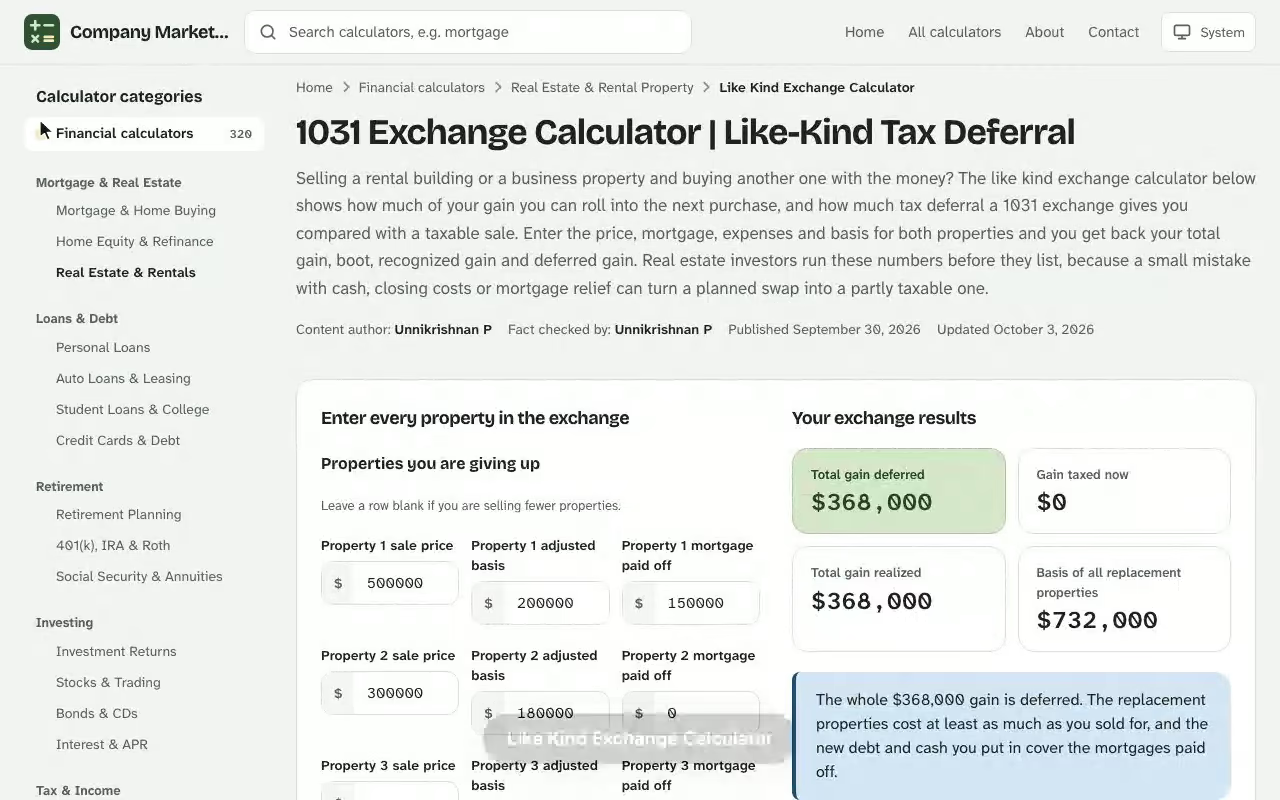
Like Kind Exchange Calculator. Selling a rental building or a business property and buying another one with the money? The like kind exchange calculator below shows how much of your gain you can roll into the next purchase, and how much tax deferral a 1031 exchange gives you compared with a taxable sale. Enter the price, mortgage, expenses and basis for both properties and you get back your total gain, boot, recognized gain and deferred gain. Real estate investors run these numbers before they list, because a small mistake with cash, closing costs or mortgage relief can turn a planned swap into a partly taxable one. The rent calculator uses the same plain-English approach, so you can compare results side by side.
Your exchange results
Total gain deferred
–
Gain taxed now
–
Total gain realized
–
Basis of all replacement properties
–
–
Totals and boot
Value of properties given up–
Value of replacement properties–
Cash left over for you after costs–
Cash boot (before costs)–
Net mortgage relief–
Other property received–
Less exchange costs used against boot–
Taxable boot–
Identification check
Replacement properties–
Rule that covers them–
–
Gain on each property you give up
Exchange costs (selling and purchase) are shared out in proportion to sale price, so the gains add up to the total realized gain.
Property
Sale price
Adjusted basis
Share of costs
Gain realized
Basis of each replacement property
The carryover basis is split among the replacement properties in proportion to their purchase prices. Built-in deferred gain is what would be taxed if you later sold a property for its purchase price.
Property
Purchase price
Share of value
Basis
Built-in deferred gain
Your equity
Each property’s basis still has to be split between land and building for depreciation, usually by the ratio on the property tax assessment.
Results are estimates for educational purposes and are not financial, tax or legal advice.
How the Like Kind Exchange Calculator Works
A like-kind exchange is the sale of one investment property followed by the purchase of another property of the same nature, with the sale proceeds held by a qualified intermediary. When you meet the rules, the IRS lets you postpone the tax on the gain instead of paying it in the year of sale. The calculator follows the same order of steps used on the IRS exchange form: it works out your adjusted basis, measures the total gain, adds up the boot you received, and then decides how much of the gain is recognized now and how much is deferred. The rent vs buy calculator online uses the same plain-English approach, so you can compare results side by side.
Because it handles the arithmetic in one pass, you can test several replacement properties in minutes. Change the purchase price or the new mortgage, and you immediately see whether the exchange stays fully tax-deferred or leaves a taxable remainder.
IRC Section 1031 Basics for the Real Estate Investor
A 1031 like-kind exchange takes its name from IRC Section 1031, the part of the tax code that lets a real estate investor defer tax when swapping property held for productive use in a trade or business or for investment. Some people call it a 1031 tax exchange. The rule postpones the realized gain rather than erasing it, which makes it a wealth-preservation tool for an investor who keeps trading up: equity that would have gone to the IRS stays invested, and that reinvestment is what compounds over time.
The Core Formulas Behind a 1031 Exchange
Every result on the page comes from five short formulas. The first two measure your gain, and the last three apply the boot rule.
The key idea is that you only pay tax on the smaller of your gain and your boot. A seller with a large gain but no boot owes nothing now, while a seller who walks away with cash owes tax on that cash, up to the full gain.
Capital Gains Tax and Depreciation Recapture
If you skip the exchange, a sale triggers several layers of taxes on the taxable gain. The federal capital gains tax is 15% or 20% for most investors, depending on income, and it applies to the capital gain left after you subtract basis. The depreciation you claimed while you owned the property is taxed separately as depreciation recapture at up to 25%. Higher earners also pay the 3.8% net investment income tax, and many states add their own state tax, with state capital gains rates ranging from zero to over 13%. Together these taxes make up your tax liability for the year, and a 1031 exchange postpones all four, not just the headline capital gains tax line, which is why the savings are often larger than an investor expects.
Inputs for the 1031 Exchange Calculator
The 1031 exchange calculator asks for nine numbers, split between the property you sell (the relinquished property) and the property you buy (the replacement property). Gather them from your closing statement, your purchase records and last year's tax return before you start. If you want to see how the figures change, the 1031 exchange timeline calculator online gives you an instant result you can adjust as you go.
Input
What to enter
Sales price
The amount the old property sells for; use fair market value if you are estimating
Selling expenses
Commissions, title fees, transfer taxes and other closing costs you pay as seller
Existing mortgage
The loan balance paid off at the sale
Original purchase price
What you paid for the old property, plus the closing costs of that purchase
Capital improvements
A new roof, an addition or a system replacement; routine repairs do not count
Depreciation taken
The total deducted over the years, found on your tax returns
Purchase price
The price of the replacement property
New mortgage
The loan you take on the replacement property
Purchase expenses
Closing costs and fees you pay to buy the replacement property
Relinquished Property and Replacement Property
The relinquished property is the one you give up, and the replacement property is the one you acquire. Both must be held for investment or for use in a trade or business. A few examples of what qualifies:
A rental property such as an apartment building, a duplex or a single-family rental
Commercial property, including office, retail space and a strip mall
Vacant land held for investment, including farmland
Residential property rented to tenants, as long as it is not your home
Industrial property and multifamily property of any size
An interest in a Delaware Statutory Trust (DST) that owns qualifying property
Selling and purchase costs together are your exchange expenses, and they reduce the gain you report. Your primary residence does not qualify, and neither does property you hold as inventory to flip. Two properties are like-kind when they share the same nature or character, so you can trade vacant land for an apartment building, but not a building for a truck.
Adjusted Basis and Cost Basis
Your cost basis is the original price plus capital improvements; some forms call the starting figure your original basis. Either way, it is your tax basis before depreciation enters the picture. The adjusted basis subtracts the accumulated depreciation you have claimed. Because depreciation lowers basis, a long-held rental often has an adjusted basis far below its purchase price, which inflates the gain. If the property you are selling was itself bought through an earlier exchange, include the gain you deferred then, since it lowers your basis the same way.
Worked Example: Tax Deferral on a Like-Kind Sale
Here is a full run with figures chosen for this page. You sell a mixed-use building for $1,385,000 and pay $79,650 in selling expenses. You still owe $402,500 on the mortgage. You originally paid $498,300, added $74,200 of capital improvements, and have deducted $168,940 of depreciation. You then buy a replacement property for $1,185,000, pay $16,200 in purchase expenses, and take out a new mortgage of $430,000.
Step
Calculation
Result
Adjusted basis
$498,300 + $74,200 − $168,940
$403,560
Net sale value
$1,385,000 − $79,650
$1,305,350
Total gain
$1,305,350 − $403,560
$901,790
Replacement cost
$1,185,000 + $16,200
$1,201,200
Boot
$1,305,350 − $1,201,200
$104,150
Recognized gain
Smaller of $901,790 and $104,150
$104,150
Deferred gain
$901,790 − $104,150
$797,640
The exchange is only partly tax-deferred because the replacement property costs less than the net sale value. The extra $104,150 is boot, and you report it as gain this year. The other $797,640 is deferred and carried into the new property's basis. Check your cash too: you collect $902,850 after the sale and mortgage payoff, invest $771,200 of your own money in the purchase, and the leftover $131,650 is partly offset by the $27,500 of extra debt you assume.
Boot caps the gain you recognize; the rest of the gain is deferred into the new basis.
Deferred Gain and the New Basis
The new basis is the replacement cost minus the deferred gain: $1,201,200 − $797,640 = $403,560. That equals the old adjusted basis, which is exactly what you would expect when every dollar of boot is taxed. Your depreciation schedule then restarts on that lower figure, and the deferred tax comes due only if you eventually sell without another exchange.
Reading Your Results: Boot, Recognized Gain and Tax Deferment
The results panel gives you five figures, and each one answers a different question. Knowing what they mean tells you whether to adjust the deal before you close.
Total gain
The profit on paper, after selling expenses and basis.
Boot
Cash or other value you receive that is not like-kind property.
Recognized gain
The part you report now, which is the lower of the total gain and the boot.
Deferred gain
The part that moves into the new basis and stays untaxed for now.
Adjusted basis of the new property
Replacement cost minus the deferred gain, the figure that drives future depreciation and gain.
Boot: Cash and Mortgage Relief
Boot comes in two forms. Cash boot is money you keep instead of reinvesting. Mortgage relief is created when the loan you pay off is larger than the loan you take on, because the IRS treats that difference as if you had received cash. In the example the new mortgage is bigger than the old one, so there is no mortgage relief and the entire $104,150 comes from cash and value left over. Paying a little extra cash into the purchase, or buying a slightly more expensive property, brings boot toward zero.
Net Sales Proceeds and After-Tax Proceeds
Net sales proceeds are what remains after commissions and closing costs, so your net proceeds are always lower than the headline sales price. After-tax proceeds are what you keep once the sale and loan payoff are settled and the tax is paid. In an exchange, your proceeds sit with the qualified intermediary and go straight into the replacement property, so the money can reinvest instead of going to the IRS. Compare the cash flow of the replacement property too: a deferral only helps if the new asset earns its keep, and its taxes and debt service should fit your plan.
Testing a Delayed Exchange on a Self-Storage Sale
Dana Whitfield has a signed contract to sell a self-storage facility for $2,146,000 and a $1,990,000 replacement facility under letter of intent. Before she tells her qualified intermediary to proceed, she opens the calculator to check whether the swap is fully deferred.
She enters the sale side first: $2,146,000 sales price, $118,030 in selling expenses, and a $731,400 loan payoff. From her depreciation schedule she adds the original cost of $784,250, $96,380 of capital improvements and $301,775 of depreciation taken. On the purchase side she types $1,990,000, $23,880 in closing costs and a $1,150,000 new mortgage.
See how the Like Kind Exchange Calculator works: change the inputs and the total gain deferred updates instantly. Enter your own numbers in the calculator above.
The calculator returns an adjusted basis of $578,855 and a total gain of $1,449,115. It also returns boot of $14,090, because her net sale value of $2,027,970 is greater than the $2,013,880 replacement cost. The new loan is $418,600 larger than the old one, so there is no mortgage relief; the whole shortfall is value left over, not debt.
Result
Amount
Recognized gain
$14,090
Deferred gain
$1,435,025
Tax on boot at the 25% recapture rate
$3,522.50
Adjusted basis of the new property
$578,855
Because $14,090 is less than her $301,775 of depreciation, the IRS taxes the whole amount at the 25% unrecaptured section 1250 rate, so she owes $3,522.50 before any state tax. She does not accept that. She reruns the 1031 exchange estimate with the purchase price raised by exactly $14,090, to $2,004,090, and boot falls to $0. She asks the seller to hold the price at that figure, then moves the 45-day identification letter forward so it names the facility at the higher price.
Outright Sale vs 1031 Exchange: Comparing Taxes
The most useful test is to run the same property through both paths. The table uses the example above with a 20% federal capital gains rate, 25% recapture, the 3.8% net investment income tax and a 5% state rate. Those rates are assumptions; replace them with your own marginal rates.
Tax line
Outright sale
1031 exchange
Federal capital gains and recapture
$188,805
$26,038
Net investment income tax
$34,268
$3,958
State tax
$45,090
$5,208
Total tax due now
$268,163
$35,203
On a cash sale, you owe about $268,163 in the year of sale. Using the exchange, your tax due now falls to about $35,203, which is roughly $232,960 of tax savings kept invested. The saving is a deferral, not a cancellation: the tax returns when you sell the replacement property in a taxable sale.
Tax due now drops from $268,163 on an outright sale to $35,203 with a 1031 exchange.
Why Recapture Is Taxed First
When boot is recognized, the gain is taxed as depreciation recapture first, up to the depreciation you have claimed. In the example, the $104,150 recognized gain is lower than the $168,940 of depreciation, so all of it is taxed at the 25% recapture rate rather than the 20% capital gains rate. That is why even a small boot can cost more than you would guess from the headline rate.
Like-Kind Exchange Rules: 45 Days, 180 Days and a Qualified Intermediary
A calculator can tell you what a perfect exchange would save, but the savings exist only if you meet the timing and structure rules. Missing either one turns the whole deal into a taxable sale, and the IRS grants no extensions except for federally declared disasters.
Both clocks start at closing on the relinquished property and run at the same time.
45 Days to Identify, 180 Days to Close
Identification is the first deadline: you have 45 days from closing on the old property to name the replacement properties in writing
The second deadline is closing on the replacement property within 180 days, or by your tax return due date if that comes first
Both clocks start on the same day and run at the same time, not one after the other
You may identify up to three properties, or more if their combined value stays within the 200% rule
A qualified intermediary must hold the sale proceeds, because touching the money yourself voids the exchange
Qualified Intermediary
The qualified intermediary is an independent company that holds the funds between closings. You cannot use your own agent, attorney or accountant if they have acted for you in the past two years. Hire one before you close on the relinquished property, since the assignment documents are signed at closing.
Delayed Exchange, Reverse Exchange and Other Structures
Most investors use a delayed exchange, also called a Starker exchange, where the sale closes first and the purchase follows within the 180-day window. A simultaneous exchange closes both sides on the same day. In a reverse exchange, you acquire the replacement property first and hold it through a separate entity until the old property sells. A build-to-suit exchange lets you use the proceeds to improve the replacement property before the 180 days end. Each structure follows the same boot arithmetic, so the calculator's results apply to all four.
Tax Professional Review and Estimates
Treat every output as an estimate. Your actual liability depends on your total income, state rules, passive losses and how your depreciation was calculated, so confirm the numbers with a tax professional or tax advisor before you sign. Bring the results from this page to that meeting: the boot figure and the deferred gain tell the advisor exactly where your deal stands.
Mistakes That Create Taxable Boot
Buying a replacement property for less than the net sale value, which leaves cash on the table
Selling one asset and buying several smaller replacement properties without checking how each affects your boot and your taxes
Taking on a smaller mortgage than the one you paid off without adding cash to cover the gap
Pulling cash out of the exchange account for personal use before the deal is complete
Forgetting that closing costs paid on the investment property purchase reduce boot, while some prorations do not
Moving into the rental property too soon, which can cost the deal its investment-use status
Like Kind Exchange Calculator questions
What is a like-kind exchange?
A like-kind exchange, often called a 1031 exchange, lets you sell business or investment real estate and reinvest the proceeds in similar property while postponing the tax on your gain. The tax is deferred, not forgiven.
What is boot in a 1031 exchange?
Boot is cash or other non-like-kind value you receive, plus any mortgage relief. Boot is taxable up to the amount of your gain, so a partly tax-deferred exchange usually means some boot was left over.
How long do I have to identify and buy a replacement property?
You have 45 days from closing on the old property to identify replacement properties in writing and 180 days to close on them. Both clocks run at the same time, and there are no extensions outside federally declared disasters.
Do I need a qualified intermediary?
Yes. A qualified intermediary must hold the sale proceeds between closings. If you take control of the money yourself, the exchange fails and the sale becomes taxable.
Which properties qualify for a 1031 exchange?
Real estate held for investment or for use in a trade or business qualifies, including rentals, commercial buildings, land and Delaware Statutory Trust interests. Your primary residence and property held for resale do not.
What is depreciation recapture and does an exchange avoid it?
Recapture is the tax on depreciation deductions you took while you owned the property, taxed at up to 25%. A fully tax-deferred exchange postpones it, and it comes due when you eventually sell without another exchange.
Does this calculator give exact tax figures?
No. It gives estimates from the rates you enter. Your income, state rules and passive losses change the real bill, so confirm the figures with a tax professional before you sign.