457(b) Special Catch-Up Election Contribution Calculator
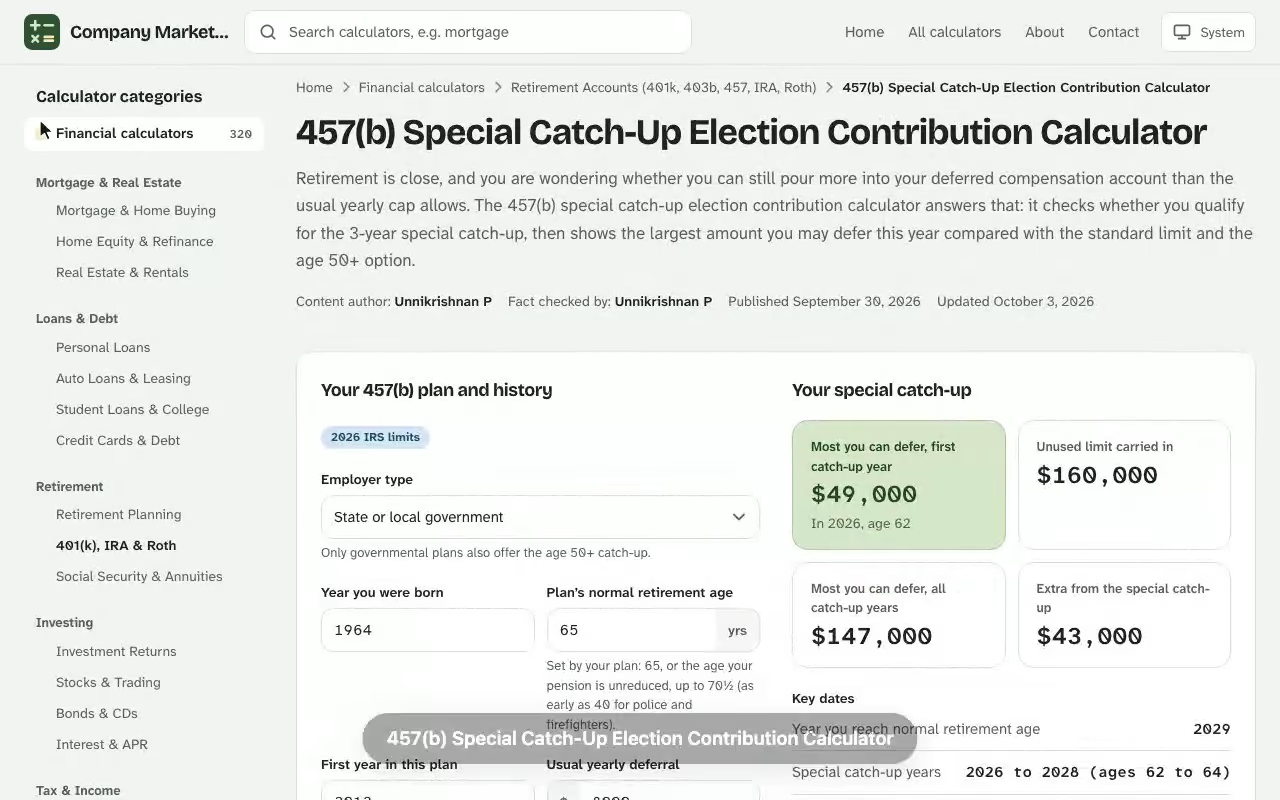
457(b) Special Catch-Up Election Contribution Calculator. Retirement is close, and you are wondering whether you can still pour more into your deferred compensation account than the usual yearly cap allows. The 457(b) special catch-up election contribution calculator answers that: it checks whether you qualify for the 3-year special catch-up, then shows the largest amount you may defer this year compared with the standard limit and the age 50+ option. If you want to see how the figures change, the free 401k calculator gives you an instant result you can adjust as you go.
Your special catch-up
Most you can defer, first catch-up year
–
Unused limit carried in
–
Most you can defer, all catch-up years
–
Extra from the special catch-up
–
Key dates
Year you reach normal retirement age–
Special catch-up years–
2026 basic limit–
2026 special catch-up ceiling–
Your catch-up years
The limit that applies in each of the three years before your normal retirement age, if you defer the most allowed each year.
Year
Age
Basic limit
With age 50+ catch-up
Special catch-up
Your maximum
Which applies
Unused limit left
Unused limit worksheet
Enter what went into this employer’s 457(b) each year, employer contributions included but age 50+ catch-ups left out. If you already used the special catch-up in a year, enter the full amount. Change the limit only if your pay that year was below it.
Results are estimates for educational purposes and are not financial, tax or legal advice.
How the 457(b) Special Catch-Up Election Works
A 457(b) is a deferred compensation plan offered by state and local government employers and by some tax-exempt organizations. Each year the IRS sets an elective deferral limit, and for 2026 that limit is $24,500. The special catch-up election, also called the final three-year catch-up or the double-limit catch-up, lets you exceed that cap during the last stretch before retirement, provided you left room unused in earlier years. The payroll deduction calculator with 457 contributions is free to use with no sign-up, and works on desktop and mobile.
You may use it only during the three years that come right before the year you reach your plan's normal retirement age. The year you actually reach that age is not part of the window. Inside it, your ceiling is the lesser of two numbers: twice the annual limit, or the basic limit plus every dollar of underutilization you accumulated while you were eligible to defer. Your plan document must also allow the election, so ask your plan administrator whether you are eligible before you count on it.
Because the catch-up election rewards eligible people who contributed less than they could have in the past, it suits public employees who started saving late, took a career break, or watched their pay rise sharply near the end of their careers.
The Special Catch-Up Contribution Calculator Formula
The math behind this calculator is short. First your basic limit is capped by your pay, because contributions cannot exceed 100% of includible compensation. Then the special amount is the smaller of the doubled limit and the basic limit plus your total unused room. The 401k paycheck calculator uses the same plain-English approach, so you can compare results side by side.
$$\text{Special limit} = \min\left(2 \times L,\; L + U,\; A\right)$$
Here \(L\) is the annual IRS limit, \(U\) is your total underutilized contributions from earlier years, and \(A\) is your adjusted compensation, meaning gross pay less any 414(h) pick-up. Subtract the amount you have already deferred this year to see what you can still add per paycheck.
$$\text{Per paycheck} = \frac{\text{Special limit}}{\text{Pay periods per year}}$$
Why the doubled cap exists
Congress wanted participants who are within three years of retirement to make up for missed years without letting anyone defer an unlimited amount. The doubled limit is that ceiling, which is why even a very large underutilization total cannot push you past $49,000 in 2026.
Inputs You Enter Into the 457(b) Calculator
Every field in the 457(b) calculator maps to one piece of the formula. Having these ready before you start keeps the result accurate, and it tells you at once whether you are eligible.
Date of birth
Used to work out your age as of December 31 of the current year.
Normal retirement age
The age your plan names as normal, usually between 65 and 70½, though some plans choose an earlier age. Your plan document or summary plan description states it.
Current gross compensation
Your pay before taxes for the year.
Year of hire
The first year you worked for the employer that sponsors the plan.
414(h) pick-up contributions
Some governmental employers "pick up" part of your required retirement contribution and treat it as an employer contribution. Section 414(h) of the Internal Revenue Code allows this, and the picked-up percentage reduces your compensation for the limit calculation. Enter the percentage, and the calculator subtracts it to produce your adjusted compensation.
Normal retirement year
This is the calendar year you reach your normal retirement age. If your birthday is January 20 and your plan's normal retirement age is 65, you reach it on that birthday that year. The three catch-up years are the ones immediately before it, so a mistake here shifts your whole window.
Underutilized contributions
Underutilized contributions are the difference between the maximum your plan allowed in a past year and what you actually deferred. You can enter one total if you know it, or itemize each year starting with the first year you were eligible. For years before 2002, deferrals to a 401(k), SARSEP or SIMPLE plan, plus contributions to a 403(b), reduce the amount that counts as unused.
Non-governmental plan
Tick this box if your sponsor is a tax-exempt organization rather than a government. A non-governmental plan can use the special election, but it cannot use the age 50+ catch-up, which changes the comparison the calculator shows you.
Special Catch-Up Election vs Age 50+ Catch-Up
You may not use both catch-up options in the same year, so the practical question is which one gives you a higher ceiling. In 2026 a participant in a governmental plan has these choices:
Option
Who qualifies
2026 maximum deferral
Basic limit
Any participant who is eligible to defer
$24,500
Age 50+ catch-up
Age 50 or older, governmental plan
$32,500 ($24,500 plus $8,000)
Age 50+ catch-up, ages 60 to 63
Ages 60 through 63
$35,750 ($24,500 plus $11,250)
Special catch-up election
Within three years of normal retirement age, with unused room
Up to $49,000
Tax-exempt, non-governmental participants cannot use the age 50+ row at all, so the special catch-up is their only route above the basic limit. If your underutilization is small, the age 50+ amount may beat the special amount, and the calculator reports the higher figure for you.
Worked Example for the 457(b) Special Catch-Up Election Contribution Calculator
Consider a county records supervisor born on March 9, 1964, hired in 2009. Her plan sets a normal retirement age of 65, so her normal retirement year is 2029 and the special window covers 2026, 2027 and 2028. She earns $96,400, and her employer picks up 6% of it under 414(h).
Input or step
Value
Gross compensation
$96,400
414(h) pick-up at 6%
$5,784
Adjusted compensation
$90,616
Basic limit \(L\)
$24,500
Total underutilization \(U\)
$18,260
Basic limit plus underutilization
$42,760
Twice the limit
$49,000
Special catch-up limit
$42,760
Her past years of unused room come from itemizing the five years she contributed less than the maximum:
Year
Limit
She deferred
Underutilization
2021
$19,500
$12,000
$7,500
2022
$20,500
$15,000
$5,500
2023
$22,500
$19,000
$3,500
2024
$23,000
$22,000
$1,000
2025
$23,500
$22,740
$760
At 62 she could also take the ages 60 to 63 option of $35,750. The special figure of $42,760 is $7,010 higher, so that is the election to make. Spread over 26 pay periods, the maximum comes to about $1,644.62 per paycheck. The same arithmetic works for any participant, which is why the calculator asks for the full history rather than a single number.
Eligibility Rules for the 3-Year Catch-Up
Several conditions must line up before you are eligible to rely on the result. Treat them as a checklist, and confirm each one before you decide you are eligible:
Your employer sponsors a governmental 457(b) plan or a tax-exempt 457(b) plan, and the plan document allows the election.
You are within three years of the year you reach normal retirement age, and you have not yet reached it.
You have unused room from earlier years in which you were eligible to participate, since only years of eligible service count.
You did not use the special election in a prior stretch and then change your mind about retirement. Once you elect it, you are no longer eligible for the age 50+ option under that plan, and the choice is permanent.
You are not combining it with the age 50+ catch-up in the same year.
Governmental plan vs top hat plan
A top hat plan, offered by a tax-exempt employer to a select group of highly compensated employees, follows different rules, and its balances stay exposed to the employer's creditors. A governmental plan holds assets in trust for participants. The calculator treats these two structures differently, and only an eligible governmental participant can combine the election with the age 50+ option in a later year, which is why the plan type matters to your answer.
Special Catch-Up Deferral per Paycheck by Pay Frequency
The calculator divides your special catch-up limit by the number of pay periods, because the annual figure is a ceiling, not a requirement. Your pay frequency sets the payroll deduction needed to reach it, and because the deferral is pre-tax, the drop in take-home pay is smaller than the deduction itself.
Pay frequency
Periods per year
Deferral to reach $42,760
Weekly
52
$822.31
Biweekly
26
$1,644.62
Semi-monthly
24
$1,781.67
Monthly
12
$3,563.33
See how the 457(b) Special Catch-Up Election Contribution Calculator works: change the inputs and the most you can defer, first catch-up year updates instantly. Enter your own numbers in the calculator above.
If you start the election midyear, divide only by the remaining pay periods, and expect a much larger deduction in each one.
Rechecking a Special Catch-Up Election for a Water Utility Engineer
Deepa, a county water utility engineer born May 21, 1966, sits down with her December pay stub and her plan's contribution history. Her plan sets a normal retirement age of 63, so the final three-year window runs 2026, 2027 and 2028. She is 60 at the end of 2026, which means the age 60 to 63 catch-up is also on the table.
She enters a gross compensation of $112,380, a 414(h) pick-up of 0%, and underutilized contributions of $9,870, the total of the shortfalls the plan's statement shows. The calculator returns a special catch-up limit of $34,370, which is the $24,500 basic limit plus $9,870. Beside it sits the ages 60 to 63 figure, $35,750, so the age-based option wins by $1,380 and the calculator labels it the higher ceiling.
Something bothers her: the history starts in 2014, but she was hired in 2012. She digs out an old statement and finds that in 2013 she deferred $15,620 against the IRS limit of $17,500, leaving $1,880 unused. She adds that year, and the total becomes $11,750.
Basic limit plus unused room: $24,500 + $11,750 = $36,250.
Twice the limit is $49,000, so it does not cap the result.
Adjusted compensation of $112,380 is far above $36,250, so pay does not cap it either.
The special catch-up election now beats the $35,750 option by $500. Spread across 26 paychecks, her maximum is $1,394.23 per paycheck, compared with $1,375.00 under the age-based option. She takes the number to the benefits office, asks them to confirm the 2013 record, and sets the new deferral to start with the first January payroll.
Coordinating a 457(b) With 401(k) and 403(b) Plans
The 457(b) limit stands apart from the limits on a 401(k) or 403(b). A teacher or hospital employee who has access to both plans may be able to defer the full amount into each, which is rare among retirement accounts. For earlier years, though, the old rules apply: deferrals to a 401(k), SARSEP or SIMPLE plan reduce your pre-2002 underutilization, so keep records of those years.
Two other limits still apply. Annual contributions to a 457(b), including employer match, cannot exceed 100% of includible compensation, and the combined annual additions limit for defined contribution plans sits near $72,000 in 2026. If your employer match is generous, it can count toward that outer limit even though it does not use up your own elective deferral limit.
Adjusted Compensation and 414(h) Pick-Up in a Special Catch-Up Calculation
Pay is the first cap on any 457(b) deferral, so the calculator spends real effort getting it right. The IRS limits your annual contribution to 100% of includible compensation, which for most public workers is the salary shown on the payroll record. When your employer treats part of your required pension payment as a 414(h) pick-up, that amount is excluded, leaving adjusted compensation as the figure the limit is tested against.
Take a worker with a $58,200 salary and a 4% 414(h) pick-up. The pick-up is $2,328, so adjusted compensation is $55,872. The basic limit of $24,500 is far below that figure, and the pay cap does not bite. It starts to matter for part-time employees, seasonal staff and people with a modest salary who try to defer a large special catch-up amount: if adjusted compensation is $30,000, no one who is eligible can defer more than $30,000, however much unused room exists.
Keep three points in mind when you enter compensation:
Use the pay for the current year, not the amount from last year's W-2, because the limit is applied to the year you defer in.
Enter the 414(h) pick-up as a percentage of that compensation, exactly as your payroll office reports it.
If your pay changes midyear, use your best estimate of the full-year figure; the calculator can be rerun after a raise.
Because a 414(h) pick-up comes out before the cap is applied, two workers with the same gross compensation can land on different results. The one with the larger pick-up has less adjusted compensation, and therefore a lower pay cap.
SARSEP, SIMPLE and Pre-2002 Underutilization in the Special Catch-Up Election
Before 2002, the IRS applied separate and more complicated rules, and your underutilization for those years depends on more than your 457(b) account. If you were eligible to defer to a 457(b) in a year before 2002, the unused amount is reduced by your deferrals to other salary reduction arrangements: a 401(k), a SARSEP, a SIMPLE plan and a 403(b). That is why the itemized form asks about each of them.
A SARSEP is a salary reduction simplified employee pension that some small employers set up before 1997. A SIMPLE arrangement is a plan for small businesses with one hundred or fewer employees. Neither is common among government workers today, but anyone who worked in the private sector earlier in a career may have contributed to one. Enter those deferrals, since an eligible participant's contribution room depends on them, so the IRS formula is respected, and leave the fields at zero if none applies.
For 2002 and later years, the rules are simpler. Only your 457(b) deferrals, together with any employer contributions to the same plan, reduce the room. Deferrals to a 401(k), SARSEP, SIMPLE or 403(b) no longer matter, because the 457(b) limit became its own separate bucket. A few practical rules follow:
A year in which you were not eligible to participate adds nothing to your underutilization, even if your pay was high.
Catch-up amounts you contributed in earlier special election years reduce what you can use again.
When you do not have records, ask your plan administrator for a contribution history, since the plan's recordkeeper keeps the data for every year you were eligible.
Employer Match and Payroll Timing for Your Special Catch-Up Deferral
A good 457 plan calculator, like this special catch-up tool, separates three things that people often blur together: what you may defer, what your employer adds, and what your balance becomes. Your employee deferral is capped by the special limit. An employer match, where one exists, is not part of that cap, but it counts toward the combined annual additions test, so an unusually generous employer match can interact with the outer IRS limit.
Payroll timing matters just as much for reaching the special limit. A deferral election can usually be changed only on certain dates, so if you wait until the fourth quarter, the few remaining paychecks must carry nearly the entire special catch-up amount. Elect early and the per-paycheck figure the calculator shows stays manageable.
Whatever the result, it adds to your account balance dollar for dollar, and any investment growth on top is a bonus rather than the point: with only three years left, the special catch-up is about moving more money into tax-deferred savings, not about returns.
Lifetime Limits and Revoking the Special Catch-Up Election
The election works on a lifetime basis for each plan. Once you use the final three-year option, the special catch-up contribution limit is a lifetime election: you cannot return to the age 50+ catch-up for that plan, and you cannot use the special catch-up a second time if you later move to another employer and the new plan has its own rules. Consult your plan administrator before you elect it, especially if you might continue working past normal retirement age, in which case you would want to keep the age 50+ option in reserve.
Common Mistakes When Calculating a Catch-Up Election
Counting the wrong years. The retirement year itself is excluded, so the window ends one year earlier than many people expect.
Forgetting the 414(h) reduction. Using gross pay instead of adjusted compensation overstates the cap.
Treating employer contributions as your own. Match dollars do not reduce your deferral room, but they do appear in the annual additions test.
Assuming every plan allows it. Some plans omit the election, and the plan document is the final word.
Ignoring tax effects. A larger deferral lowers your taxable income and changes your tax withholding, so review your tax situation with a tax advisor.
Roth 457(b) and the Special Catch-Up
If your plan offers a Roth source, you can direct some or all of the extra deferral there. Roth contributions are taxed now, qualified withdrawals come out tax-free later, and the doubled limit applies to the combined total of pre-tax and Roth money. The calculator reports the limit only; it does not model which tax treatment is better for you.
Reading Your Special Catch-Up Result and Planning Next Steps
The calculator gives you three figures to act on: your special catch-up limit, the age 50+ comparison, and the amount per paycheck. Take the higher of the first two, check it against your income, your retirement savings target, your remaining budget and your current account balance, and bring the per-paycheck number to your plan administrator when you update your deferral election. Public employees and nonprofit workers alike should remember that the tool reflects only the facts you enter, so compare its answer with what your retirement plan documents and latest balance statement say. Also, confirm your plan's normal retirement age and your underutilization history before you rely on it, and talk to a tax advisor about how the larger deferral changes your withholding.
457(b) Special Catch-Up Election Contribution Calculator questions
What is the 457(b) special catch-up election?
It lets a participant in the last three years before the plan's normal retirement age defer up to the lesser of twice the annual limit or the basic limit plus unused contribution room from earlier years.
Which three years count for the 3-year catch-up?
The three consecutive calendar years immediately before the year you reach your plan's normal retirement age. The year you reach that age itself is not included.
Can I use the special catch-up and the age 50+ catch-up in the same year?
No. You choose whichever gives the higher limit for that year. The calculator shows both so you can compare them.
What are underutilized contributions?
They are the difference between the maximum your plan allowed in a past year and what you actually deferred, counted only for years you were eligible to participate.
What is a 414(h) pick-up and why does it matter?
A 414(h) pick-up is a share of your required contribution that a governmental employer pays and treats as an employer contribution. It reduces your compensation for the limit test, leaving adjusted compensation.
Do tax-exempt, non-governmental plans qualify?
They can use the special catch-up election if the plan allows it, but they cannot use the age 50+ catch-up.
Does the special limit have a ceiling?
Yes. It can never exceed twice the annual elective deferral limit, and it can never exceed 100% of your adjusted compensation.
Does my plan have to offer the election?
Yes. Ask your plan administrator or check your plan document; the calculator cannot confirm what your employer's plan permits.