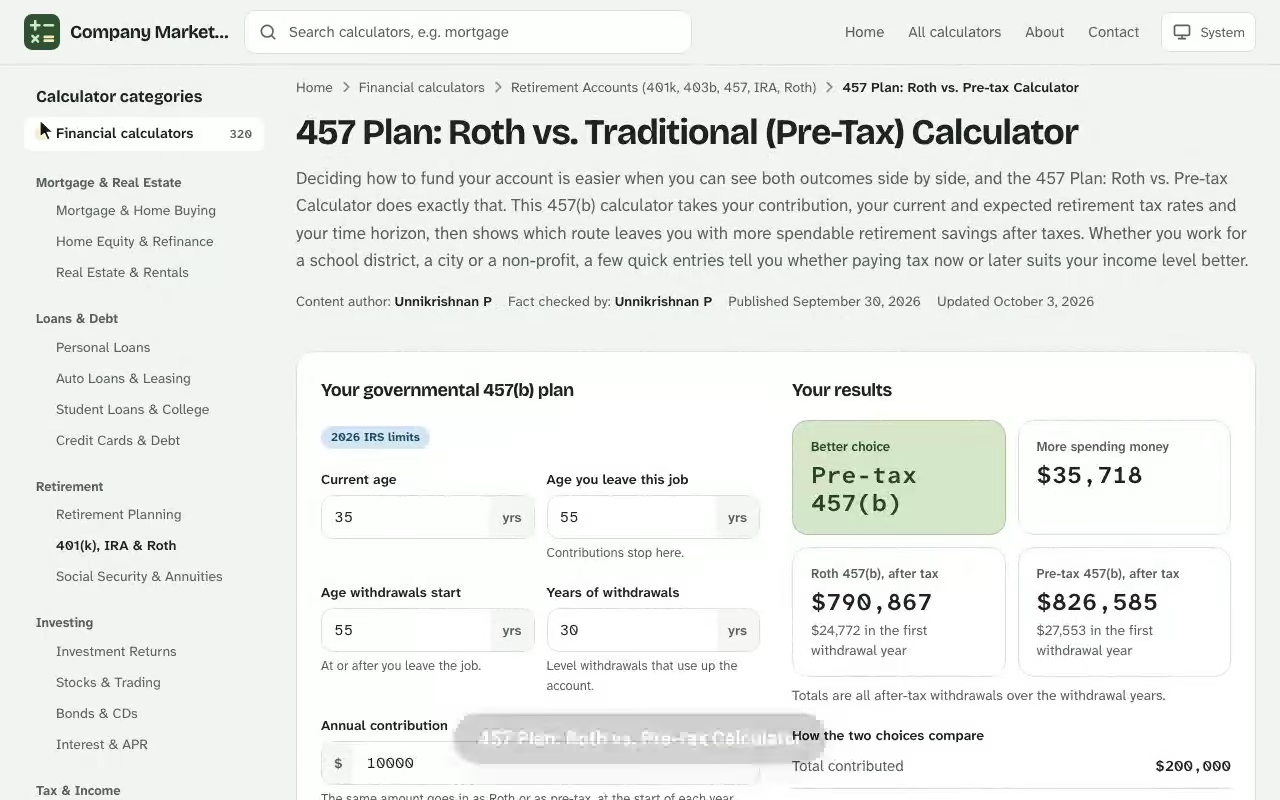
457 Plan: Roth vs. Pre-tax Calculator. Deciding how to fund your account is easier when you can see both outcomes side by side, and the 457 Plan: Roth vs. Pre-tax Calculator does exactly that. This 457(b) calculator takes your contribution, your current and expected retirement tax rates and your time horizon, then shows which route leaves you with more spendable retirement savings after taxes. Whether you work for a school district, a city or a non-profit, a few quick entries tell you whether paying tax now or later suits your income level better. The free roth ira calculator uses the same plain-English approach, so you can compare results side by side.
Your results
Better choice
–
More spending money
–
Roth 457(b), after tax
–
Pre-tax 457(b), after tax
–
Totals are all after-tax withdrawals over the withdrawal years.
How the two choices compare
Total contributed–
Balance when withdrawals start–
Yearly withdrawal from either account–
Tax on pre-tax withdrawals–
Tax on Roth withdrawals–
Invested tax savings, paid out–
Break-even tax rate on withdrawals–
Year-by-year comparison
Both accounts hold the same balance; only the tax on what comes out differs.
Age
Contribution
Withdrawal
Roth taxable part
Roth after tax
Pre-tax after tax
Account balance
Results are estimates for educational purposes and are not financial, tax or legal advice.
How the Roth vs. Traditional 457 Comparison Works
A 457(b) plan lets you defer part of your salary into a retirement account, and most plans now offer two flavors of the same account. With traditional (pre-tax) deferrals you skip tax today and pay it later; with Roth deferrals you pay tax today and skip it later. The roth vs. traditional question is therefore a timing question about when the IRS collects its share, not about which account grows faster, because both versions earn the same investment return inside the plan. The free 72t distribution impact calculator is free to use with no sign-up, and works on desktop and mobile.
The calculator turns that timing question into dollars. It grows each version of your contributions to your planned retirement age, removes the tax that is still owed, and compares what remains. If the numbers come out close, the decision rests on factors the model cannot see, such as how stable your future income will be.
Pre-Tax Contributions and Taxable Income
Pre-tax contributions come out of your paycheck before income tax is calculated, so each deferral lowers your taxable income for the year. That is the tax benefits today argument: a $12,000 deferral from a 24% bracket keeps about $2,880 out of this year's tax bill. The catch is that the whole balance, deferrals plus earnings, is taxed as ordinary income tax when you take it out, which is why the money is described as taxed when withdrawn. Other retirement savings vehicles, such as a traditional IRA or 401(k)s at past employers, follow the same pattern.
After-Tax Dollars and Tax-Free Withdrawals
Roth deferrals use after-tax dollars, so your take home pay shrinks by more per dollar contributed, yet nothing is owed later. Qualifying distributions from a Roth 457(b), generally those taken after a five-year holding period and once you are eligible to withdraw, are fully tax-free withdrawals, growth included. The tax-exempt treatment of the growth is the reason many savers with decades ahead of them lean toward Roth.
Traditional vs. Roth Inputs for the 457(b) Calculator
Every entry maps to one step in the comparison, and the defaults can be changed one at a time to test different scenarios. These are the fields you will fill in before you click the Calculate button: Next, open the 72t calculator and enter your own details to see an estimate in seconds.
Annual contribution: the pre-tax amount you plan to defer each year from your salary.
Current tax bracket: your marginal federal rate on the next dollar of income today.
Retirement tax bracket: the marginal rate you expect on withdrawals, which is the hardest input to estimate.
Years until retirement: how long each deposit grows, from your current age to your projected retirement age.
Rate of return: the average annual before-tax return you expect on your investment options.
Annual Contribution and Contribution Limits
Your annual contribution is capped by IRS contribution limits, which are $24,500 for 2026 in a governmental 457(b) plan, and the same limit is shared across both Roth and pre-tax dollars in the plan. Enter the gross amount you would defer pre-tax; the calculator then reduces the Roth deposit so your paycheck falls by the same dollar amount under either choice. Holding take home pay equal keeps the comparison fair.
Current Tax Bracket and Retirement Tax Bracket
Your tax bracket is the engine of the result. Estimate your future rate from the retirement income you expect, including a pension, Social Security and any other withdrawals, rather than assuming it equals today's. If your salary will fall sharply after you stop working, a lower tax bracket in retirement favors pre-tax. If you expect to finish your career in a lower bracket than you will eventually retire in, Roth wins.
Years Until Retirement and Rate of Return
A longer time horizon amplifies compound interest but does not change which side wins, since both balances grow at the same rate. What it changes is the size of the dollar gap. Use a realistic rate of return after investment fees and expense ratios, and keep the inflation rate in mind when judging the estimated future values you see.
457 Plan: Roth vs. Pre-tax Calculator Formula and Worked Example
The calculator uses the future value of a stream of year-end deposits, then applies tax to the pre-tax path only:
$$FV = C \times \frac{(1+r)^{n}-1}{r}$$
Here \(C\) is the yearly deposit, \(r\) is the annual rate of return and \(n\) is the number of years. For the pre-tax path the spendable amount is:
For the Roth path, the deposit is first reduced by today's rate, \(C_{\text{Roth}} = C \times (1 - t_{\text{now}})\), and the grown balance is already tax-free, so nothing more is subtracted.
Step-by-Step Results
Take a county employee who defers $12,000 a year pre-tax for 25 years at a 6.5% return, sits in the 24% bracket now and expects a 22% bracket in retirement. The growth factor is 58.89, so the traditional account reaches a plan balance of $706,652. After 22% tax, $551,189 is spendable. The Roth path deposits $9,120 a year (that is $12,000 times 0.76), reaching an account value of $537,056 with no tax due.
Item
Traditional (pre-tax)
Roth (after-tax)
Yearly deposit
$12,000
$9,120
Balance at retirement
$706,652
$537,056
Tax owed on withdrawals (22%)
$155,463
$0
Spendable amount
$551,189
$537,056
Pre-tax finishes $14,133 ahead because the 22% retirement rate is two points below today's 24%. Each additional point of retirement rate shifts the result by about $7,067 in Roth's favor, and at 24% the two paths tie exactly.
How the pre-tax balance in the worked example shrinks to its spendable amount after tax.
Roth or Pre-Tax: Reading Your Results
The comparison reduces to one rule. When your expected retirement rate is below your current rate, pre-tax wins; when it is higher, Roth wins; when it is equal, they tie. The calculator reports each ending amount so you can see the size of the difference, not only the winner.
Roth advantage by current and retirement tax bracket; negative values mean pre-tax comes out ahead.
Pre-Tax Basis and After-Tax Basis in Your Retirement Plan
Every retirement plan balance has a tax character. On a pre-tax basis the money is taxed when withdrawn, so a $706,652 balance is not really $706,652 of spending power; on an after-tax basis the Roth balance is already clean. Comparing the two on equal footing is the whole job of this tool, and it is why a bigger headline balance can still lose. The calculator models only the new deferrals, not your current balance, so if you already hold a large pre-tax pile in 401(k)s or an IRA rollover, treat a Roth result as a tilt in your retirement savings mix and not a verdict on the whole retirement plan.
Higher Tax Bracket vs. Lower Tax Bracket in Retirement
A higher tax bracket later, common for early-career workers whose salary will grow, points toward Roth.
A lower tax bracket later, common for peak earners who will live on modest retirement income, points toward pre-tax.
Uncertainty about tax law favors splitting contributions between both, so you hold a tax-free pool and a deferred pool.
Qualifying Distributions and Required Minimum Distributions
Traditional balances must start required minimum distributions at age 73, which can push you into a higher bracket. Roth money inside an employer plan no longer carries that requirement, so it can keep growing and be passed on. Only qualifying distributions from a Roth are untaxed, so check the holding period before you plan around that benefit.
Key ages that shape a 457(b) saver's Roth versus pre-tax decision.
A School Business Manager Weighs Roth or Pre-Tax 457(b) Deferrals
Priya Raman, 44, runs the budget office of a school district and earns $96,400. Her 457(b) offers both flavors, and she plans to defer $9,500 a year until she retires at 62, 18 years away. Before touching her election form she opens the tool to compare the two accounts.
See how the 457 Plan: Roth vs. Pre-tax Calculator works: change the inputs and the better choice updates instantly. Enter your own numbers in the calculator above.
After the standard deduction her taxable income lands in the 22% federal bracket, so she enters 22% for today. Her pension estimate of $31,200 plus a modest withdrawal puts her projected retirement income near $44,800, under the $50,400 ceiling of the 12% single-filer bracket for 2026, so she enters 12% for later. She sets the return at 6%.
The tool grows $9,500 a year to $293,604 on the pre-tax side. Taking 12% off leaves $258,371 spendable. The Roth side deposits $7,410 a year ($9,500 times 0.78) and ends at $229,011. Pre-tax leads by $29,360, which tells her the comparison is not close at a 10-point bracket gap.
Then she stress-tests the one number she cannot be sure of. Entering 22% for retirement makes the two columns identical at $229,011, so 22% is her break-even rate: only a retirement bracket at or above that would flip the answer, and that would take roughly $105,700 of taxable income in 2026, far above her pension math.
Result at 12% later: pre-tax ahead by $29,360.
Result at 22% later: a dead tie at $229,011.
Decision: keep the full $9,500 deferral pre-tax this year.
Her next step is concrete. She keeps the election pre-tax and adds a calendar note to rerun the tool each January; if her pension projection climbs past $50,400 of taxable retirement income, she moves the next year's deferral to Roth.
457 Plan Rules That Change the Roth vs. Traditional Choice
A 457 plan differs from a 401(k) or 403(b) in ways that matter for this decision, and none of them show up in a simple growth projection. Read your plan document for the specifics, as governmental and non-profit versions are not identical.
Early Withdrawal and Separation From Service
A governmental 457(b) pays out after separation from service at any age without the 10% early withdrawal penalty that applies to a 401(k) or IRA, although distributions are still taxed as ordinary income. That flexibility makes pre-tax withdrawals attractive for someone retiring in their fifties, since penalties vanish and income may be low enough for a lower bracket. Plans run by a non-profit rather than a government employer carry different rules, so confirm yours before relying on this feature.
Catch-Up Contributions and Employer Match
Savers aged 50 and over can add catch-up contributions, and many plans also allow a special catch-up in the three years before normal retirement age. An employer match, where offered, has traditionally been deposited pre-tax, with Roth treatment now an option in some plans. Check how your employer deposits it, because pre-tax match dollars add to the pre-tax side of the comparison: enter your own deferral in the calculator and treat the match as a separate pre-tax pool. Matched dollars may also be subject to vesting, which affects how much of that pool is truly yours.
Withdrawal Strategies and Tax Implications
Careful withdrawal strategies can blunt the tax implications of a large pre-tax balance, for example by drawing deferred money in low-income years. Roth balances are valuable here because they let you take tax-free withdrawals to avoid crossing a bracket line, which is the flexibility the Roth result is paying for. Loan provisions, where a plan allows loans, interrupt the steady accumulation the calculator assumes, so read them before you borrow.
Comparing a Roth 401(k) vs. Traditional 401(k) Calculator and a 457 Savings Calculator
If you also have access to other plans, a roth vs. traditional ira calculator or a roth 401(k) vs. traditional 401(k) calculator uses the same logic with different limits and rules. A 457 savings calculator, by contrast, only projects growth and says nothing about taxes. The tax comparison in this tool is the piece those projections leave out.
Because the 457(b) and 403(b) sit alongside each other for some employees of schools and hospitals, you can reuse the same tax-bracket logic when allocating money between them. The same bracket comparison applies to a Roth 403(b) vs. a traditional 403(b), so you can reuse the result when choosing how to split money between the two. A financial advisor can help you match investment options and asset allocation to whichever version you choose and to the investment risk you can tolerate.
Limits of a 457(b) Plan Calculator Estimate
Treat every output as a hypothetical illustration. Hypothetical results rely on a constant rate of return, a steady tax code and a single retirement tax rate, none of which is guaranteed. Annual salary increases, pay period frequency and changes in your personal financial situation will move the answer, and so will contributions that fluctuate. Rerun the tool whenever your pay or plan changes.
Because the calculator is not tax advice, confirm major choices with a tax professional or financial planner who knows your full picture, including deferred compensation, pensions and other retirement accounts. Stay invested for the long term, review your deferral each year, and revisit the 457 Plan: Roth vs. Pre-tax Calculator after any raise or move.
457 Plan: Roth vs. Pre-tax Calculator questions
Should I choose Roth or pre-tax for my 457(b)?
It depends mostly on whether you expect a higher or lower tax bracket in retirement than you have now. A higher bracket later favors Roth, a lower bracket later favors pre-tax, and equal brackets produce a tie.
How does the calculator keep the comparison fair?
It assumes your take-home pay falls by the same amount either way. The pre-tax deferral is the amount you enter, and the Roth deposit is that amount reduced by your current tax rate.
Are Roth 457(b) withdrawals really tax-free?
Qualifying distributions are tax-free, generally those taken after a five-year holding period and once you are eligible to withdraw. Check your plan's rules, since eligibility conditions apply.
Is there a 10% early withdrawal penalty on a 457(b)?
A governmental 457(b) generally does not charge the 10% early withdrawal penalty on distributions after separation from service, though pre-tax withdrawals are still taxed as ordinary income. Plans of non-governmental tax-exempt employers differ.
Do Roth 457(b) accounts have required minimum distributions?
Roth balances in employer plans no longer require minimum distributions during your lifetime, while pre-tax balances must begin minimum distributions at the age set by current law.
What if I am not sure about my retirement tax rate?
Run several rates. Finding the rate where the two results tie shows you your break-even point, and splitting contributions between Roth and pre-tax hedges against being wrong.
Can I split my contributions between Roth and pre-tax?
Many plans allow it. Running this calculator with each portion shows how each pool performs, and a mix gives you both tax-free and tax-deferred money in retirement.
Does this calculator include employer match or catch-up contributions?
No. It compares only the contribution you enter. Employer match dollars are usually pre-tax, so treat them as a separate pool when planning.