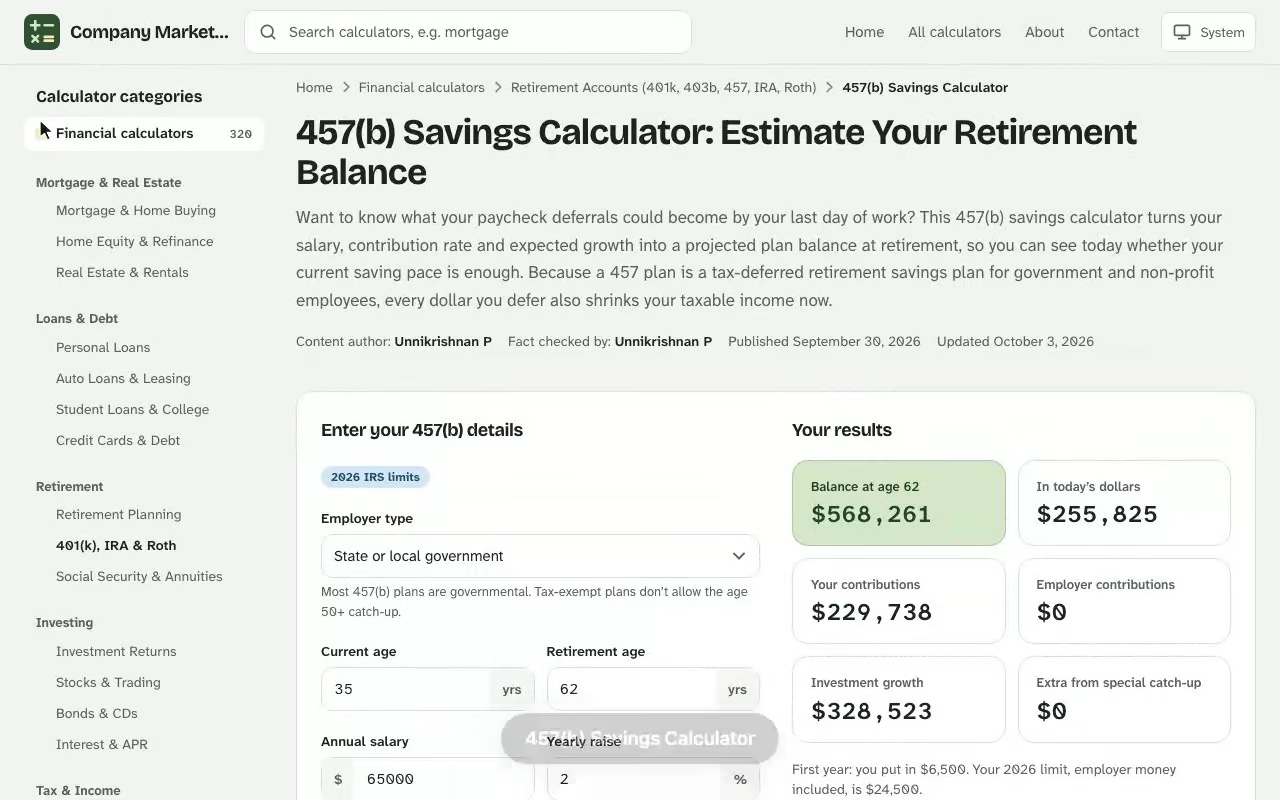
457(b) Savings Calculator. Want to know what your paycheck deferrals could become by your last day of work? This 457(b) savings calculator turns your salary, contribution rate and expected growth into a projected plan balance at retirement, so you can see today whether your current saving pace is enough. Because a 457 plan is a tax-deferred retirement savings plan for government and non-profit employees, every dollar you defer also shrinks your taxable income now. If you want to see how the figures change, the 401k calculator online gives you an instant result you can adjust as you go.
Your results
Balance at retirement
–
In today’s dollars
–
Your contributions
–
Employer contributions
–
Investment growth
–
Extra from special catch-up
–
Withdrawals from a governmental 457(b) after you leave the job are taxed as income but don’t owe the 10% early withdrawal tax at any age, unless the money was rolled in from an IRA, 401(k) or 403(b).
A tax-exempt employer’s 457(b) stays the employer’s property until it is paid out, so it can be reached by the employer’s creditors, and it can’t be rolled into an IRA.
2026 IRS 457(b) limits
Basic limit, you plus employer–
Catch-up, age 50 or older (governmental)–
Catch-up, ages 60 to 63 (governmental)–
Special 457(b) catch-up, 3 years–
The 457(b) limit is separate from the 401(k) and 403(b) limit, so you can contribute the maximum to both.
Year-by-year projection
Contributions, the limit that applies and the balance at the end of each year until you retire.
Age
Salary
You
Employer
Limit used
Balance
Results are estimates for educational purposes and are not financial, tax or legal advice.
How the 457(b) Savings Calculator Estimates Your Retirement Savings
A 457(b) calculator repeats one simple cycle for every year until you retire: take your annual salary, apply your contribution percentage, add any employer match, and let the whole account grow at your assumed rate of return. Nothing in the projection is a guarantee. It is a hypothetical illustration built from the assumptions you enter, which is exactly why you should run it more than once. Pair this with the 403b savings calculator without employer match for a fuller picture before you make a decision.
See how the 457(b) Savings Calculator works: change the inputs and the balance at age 43 updates instantly. Enter your own numbers in the calculator above.
The Growth Formula Behind the Plan Balance
Each pay period, your account earns a slice of the annual return and receives that period's share of your deferral plus the employer's match. With \(p\) pay periods per year, the balance after each period is:
Here \(B\) is the balance, \(r\) is the annual rate of return, \(C\) is your annual contribution (salary \(\times\) contribution percentage) and \(M\) is the employer contribution. The match equals the match percentage \(\times\) the smaller of your contribution rate and the maximum match rate \(\times\) your salary. After a year of raises, the salary is multiplied by \((1 + g)\), where \(g\) is your annual salary increase, and the cycle starts again.
Pre-Tax Deferrals and Tax-Deferred Growth
Traditional 457(b) deferrals are pre-tax: the money leaves your paycheck before income tax is calculated, and the account grows tax-deferred until withdrawals begin. Many government plans also offer a Roth option funded with after-tax dollars; there you pay taxes now and take qualified withdrawals tax-free later. The projection above treats every dollar the same way, so compare the result against your expected tax bracket in retirement before choosing between the two.
Inputs for Your 457(b) Plan Calculator
You only need a handful of numbers to get a useful estimate. Each field below changes the projection in a different way. Pair this with the payroll deduction calculator with 457 contributions for a fuller picture before you make a decision.
Current annual salary: your gross pay before taxes and benefit deductions. Contributions and the employer match are both calculated from it.
Percent to contribute: your before-tax contribution, the share of each paycheck you defer, which sets your annual contribution.
Current age and age at retirement: together they give the years until retirement, the single biggest driver of compound interest.
Current balance: what your 457(b) plan already holds today.
Annual salary increases: the yearly raise you expect, which grows each deferral over time.
Annual before-tax return: the rate of return you assume on your investments.
Employer match and maximum employer match: the percentage of your deferral the employer adds, and the cap on your salary it applies to. Not every 457(b) plan offers a match.
Pay period frequency: weekly, bi-weekly, semi-monthly, monthly or annually, which controls how often contributions are compounded.
Percent to Contribute and Contribution Limits
The IRS sets annual contribution limits for each plan year, and the calculator should be read alongside them. For 2026 the standard employee limit is $24,500, with an additional catch-up provision of $8,000 for participants age 50 and over. A 457(b) also has its own special catch-up in the three years before normal retirement age. Because employer contributions count toward the annual maximum in some plans, check your plan document before entering a very high percentage.
Rate of Return and Investment Choices
Your assumed rate of return should reflect how your money is actually invested. A stock-heavy asset allocation has historically earned more than a stable-value fund, but with greater risk, including the possibility of a loss of principal. Investment fees and expense ratios quietly reduce what you keep, so use a net figure rather than a fund's headline performance. Some tools assume returns compounded annually; this projection compounds every pay period instead, so the same example lands near $981,976 here against roughly $928,277 with a once-a-year assumption.
Worked Example: A $72,400 Salary Over 27 Years
Suppose a county employee earns an annual salary of $72,400, already holds $41,250 in a 457(b) plan, and plans to retire in 27 years. They defer 9% of pay, expect 2.5% yearly raises, assume a 6.5% return, and have an employer that matches 50% of deferrals up to 4% of salary, paid monthly.
In year one, the annual contribution is $6,516 (9% of $72,400) and the employer adds $1,448 (50% of 4% of salary). Running that cycle for 27 years gives a projected plan balance of $981,976 at retirement.
Year
Annual salary
Employee contribution
Employer match
Year-end balance
1
$72,400
$6,516
$1,448
$52,218
5
$79,916
$7,192
$1,598
$106,192
10
$90,418
$8,138
$1,808
$202,454
15
$102,299
$9,207
$2,046
$342,875
20
$115,742
$10,417
$2,315
$545,319
27
$137,581
$12,382
$2,752
$981,976
Understanding Your Results
Of the $981,976 final balance, only $247,035 is your own total contributions, and $54,897 comes from employer contributions. The starting balance is $41,250, so the remaining $638,795 is investment growth. In other words, about 65% of the final accumulation was earned by the money itself, which is the practical meaning of compound interest over a long time horizon.
Test Different Scenarios and Assumptions
Change one input at a time to see what matters. Using the same example, a 6% contribution produces about $778,921, a 12% contribution about $1,185,031, and a 15% contribution about $1,388,087. Raising the return assumption from 4.5% to 8.5% moves the result from roughly $688,052 to $1,437,746, which shows how sensitive the outcome is to market conditions. Dropping the employer match entirely lowers the balance to about $846,606.
Running a 457 Savings Calculator for a County Librarian's Last 18 Years
Marisol, 47, manages library systems for her county and has never checked where her deferred compensation is headed. In the calculator she enters her latest statement figure of $118,400 as her starting balance and $64,850 as her salary, a 7% contribution through 26 bi-weekly paychecks, and zero in both match fields because her county offers none. Her target age of 65 means 18 years, and she assumes 3% raises and a 6% return.
The projected total comes back at $530,433, and she judges that figure against two reference points. First, the common 4% withdrawal rate turns that balance into about $21,217 a year. Second, her salary should reach roughly $110,403 by then, and replacing 70% of it means $77,282 a year. Her county pension statement projects $41,200, so $21,217 plus $41,200 gives $62,417, which leaves a gap of about $14,865.
Instead of guessing, she changes one input: the contribution from 7% to 12%. That is $7,782 in the first year, comfortably under the $24,500 IRS limit for 2026. The projection rises to $660,588, a 4% draw of $26,424, and her combined income becomes $67,624.
At 7%: $530,433 balance, $62,417 total income, short of the $77,282 goal by $14,865.
At 12%: $660,588 balance, $67,624 total income, short by $9,658.
The gap is still open, so she reruns the 12% case with a retirement age of 67. Twenty years of deferrals produce $773,235, a 4% draw of $30,929. Her next step is concrete: ask payroll to move her deferral to 12% on the next pay period and revisit the retirement date after her pension estimate is updated.
What Affects Your 457(b) Plan Growth
The calculator only models the inputs you type in, so market swings, taxes, employer rules, loans and your own contribution behavior can move your real balance away from the projection. Check each factor below against the field it affects before you rely on a single result.
Inflation, Taxes and Withdrawals
A balance of nearly $1 million in 27 years will not buy what $1 million buys today, because inflation erodes purchasing power. Withdrawals from a traditional account are taxed as income, while qualified Roth withdrawals are not, and a 457(b) has the advantage that distributions after leaving your employer generally avoid the early withdrawal penalty. Plan your retirement income in after-tax terms rather than counting the full balance as spendable.
Vesting, Loans and Behavior
Your own deferrals are always yours, but employer contributions may be subject to vesting, meaning you must work a set number of years to keep them. Loan provisions can also reduce the balance that stays invested. Finally, the biggest risk to a projection is behavioral: stopping contributions during a market downturn undoes the growth the model assumed.
Tips for Using a 457 Savings Calculator Well
A calculator is only as useful as the inputs and habits behind it. These practices keep your projected balance honest and the decisions that follow sensible.
Review Your Projection Every Year
Once a year, pull your latest statement, update your balance, salary and contribution percent fields, and compare the new projected balance at retirement with last year's. A raise, a job change or a strong market year all shift the answer, and small corrections made early cost far less than large ones made in your last decade of work.
Pair a 457 Plan Calculator With Your Other Savings
A governmental 457(b) has its own limit, separate from the one that applies to a 403(b), so a worker with both can often defer into each. The calculator covers only your 457(b) account, so its projected balance is one part of your combined total. That makes the tool most useful when you run it next to your pension, 403(b) and Social Security estimates and add the pieces together. Treat the combined figure, not any single account, as your real picture of retirement readiness.
Stress-Test the Downside
Optimistic assumptions flatter every projection. Lower the return assumption, for example to the 4.5% case that produced $688,052 in the example above, and check whether the projected result still lets you retire on schedule. If it would not, a higher deferral rate or a later retirement date is cheaper to choose now than to discover later, and a cautious scenario is a better guide to spending than a hopeful one.
Who Should Use a Retirement Calculator for a 457(b)
A 457(b) plan serves state and local government workers and some non-profit employees, and it sits alongside the 401(k) and 403(b) as a form of deferred compensation, much like the 401(k)s offered in the private sector. Anyone who earns a salary and has years until retirement can benefit from running the numbers each year.
New hires deciding how much to defer and whether to capture the full employer match.
Mid-career employees checking whether their plan balance is on track for their retirement goals.
Workers near retirement age comparing catch-up contributions and withdrawal timing.
Review the estimate whenever your pay, your contribution or the market changes, and consult a financial advisor for investment advice and tax advice specific to your situation.
457(b) Savings Calculator questions
How does a 457(b) savings calculator work?
It repeats one cycle for every year until retirement: your salary times your contribution percentage, plus any employer match, is added each pay period while the whole balance grows at your assumed rate of return. Salary then rises by your yearly increase and the cycle repeats.
How much can I contribute to a 457(b) plan?
The IRS sets the annual limit for each plan year; for 2026 it is $24,500, with an additional $8,000 catch-up for participants age 50 and over. A 457(b) also has a special catch-up in the three years before normal retirement age, and employer contributions can count toward the limit, so check your plan document.
What rate of return should I assume?
Use a rate that matches how your money is invested and subtract investment fees. Stock-heavy portfolios have historically returned more than stable-value funds but carry greater risk, including loss of principal, so it helps to run a cautious and an optimistic scenario.
Does every 457(b) plan have an employer match?
No. Matching is not a feature of all 457(b) plans, particularly some governmental plans. If yours has none, set the employer match to 0 and the projection will count only your own deferrals.
What is the difference between a traditional and a Roth 457(b)?
Traditional deferrals are pre-tax and grow tax-deferred, with withdrawals taxed as income. Roth deferrals are made with after-tax dollars, and qualified withdrawals are tax-free. This calculator projects the balance; compare the tax treatment separately.
Why does the pay period frequency change my result?
Contributions are added, and growth is compounded, every pay period. More frequent periods put each deferral to work sooner, so weekly or bi-weekly schedules produce a slightly higher balance than a once-a-year assumption.
Is the projected balance guaranteed?
No. It is a hypothetical estimate based on your assumptions. Actual returns vary, past performance does not ensure future results, and inflation reduces what the balance will buy, so review it each year and consider speaking with a financial advisor.