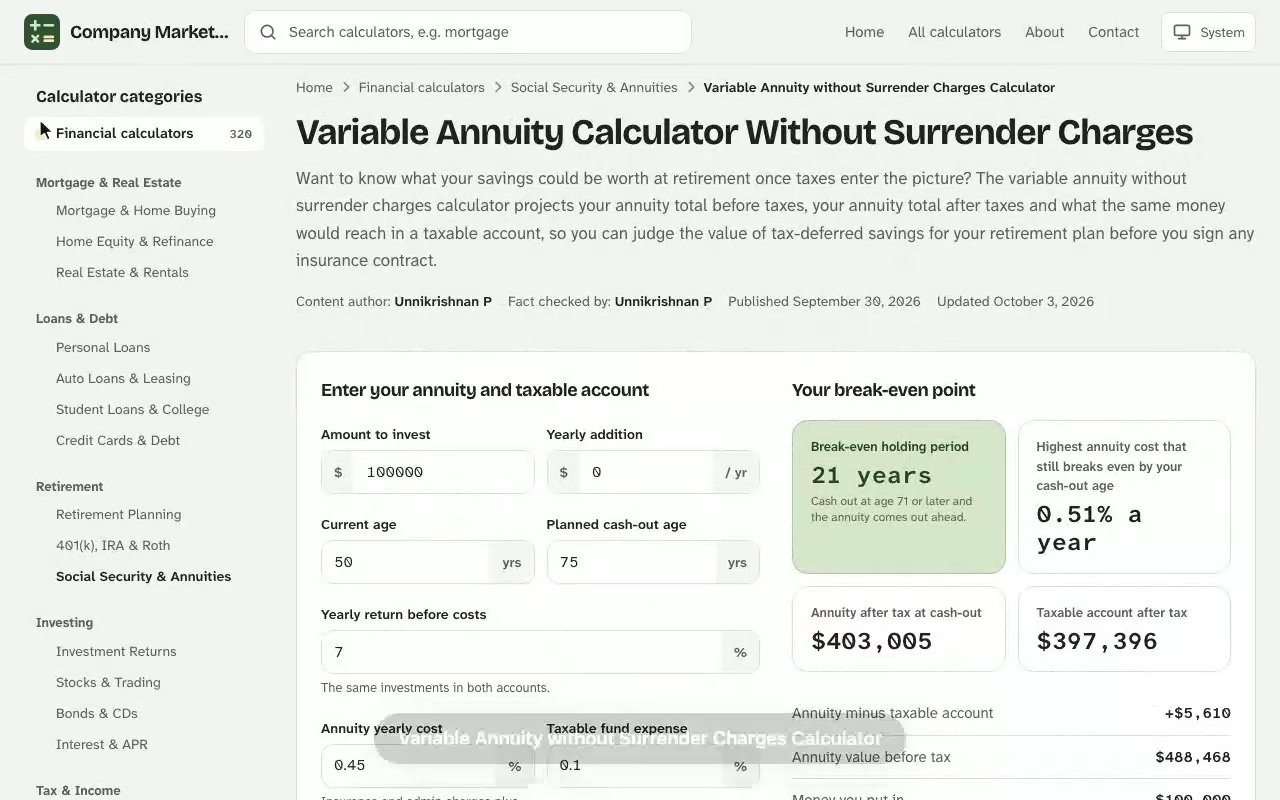
Variable Annuity without Surrender Charges Calculator
Variable Annuity without Surrender Charges Calculator. Want to know what your savings could be worth at retirement once taxes enter the picture? The variable annuity without surrender charges calculator projects your annuity total before taxes, your annuity total after taxes and what the same money would reach in a taxable account, so you can judge the value of tax-deferred savings for your retirement plan before you sign any insurance contract. The free annuity calculator is free to use with no sign-up, and works on desktop and mobile.
Your break-even point
Break-even holding period
–
Highest annuity cost that still breaks even by your cash-out age
–
Annuity after tax at cash-out
–
Taxable account after tax
–
Annuity minus taxable account–
Annuity value before tax–
Money you put in–
Taxable account before tax–
Cashing out before age 59½ adds a 10% additional tax on the annuity gain (2026 rules), which is included above.
Break-even by annuity cost
How long you would need to hold the annuity at different yearly costs, keeping your other figures.
Annuity yearly cost
Break-even holding period
Annuity minus taxable at your cash-out age
After-tax value if you cash out each year
With no surrender charge you can leave in any year; this is what each choice would be worth after tax.
Year
Age
Annuity value
Annuity after tax
Taxable after tax
Difference
Results are estimates for educational purposes and are not financial, tax or legal advice.
Variable Annuity Without Surrender Charges Calculator Inputs and Definitions
A variable annuity is an insurance product built for long-term growth. You receive no tax deduction on the money you deposit, but you owe nothing until you begin withdrawals. There is no annual contribution limit and no income limit, which is why people who have already filled their 401(k) or IRA often consider a deferred annuity next. The calculator assumes every contribution lands at the beginning of each year and that your return is compounded annually. Because it assumes no surrender charge applies, it shows the cleanest picture of what the contract earns when you stay invested until your chosen withdrawal age. Next, open the free fixed annuity calculator and enter your own details to see an estimate in seconds.
Starting balance
Your starting balance is the lump sum you place in the annuity on day one. It begins earning a return immediately, so a larger opening deposit has the most time to compound. Enter zero if you plan to build the contract only through yearly deposits.
Annual contribution
Your annual contribution is the amount you add at the start of every year until you begin withdrawals. The calculator treats it as a level amount, so choose a figure you can sustain through your working years.
Expected rate of return
The expected rate of return is the yearly growth you assume for the underlying subaccounts. Investment options inside a contract range from conservative bond funds to stock funds, and your actual rate of return depends on the mix you select. Treat the figure as a planning assumption, never a promise, because returns carry risk and volatility.
Current age
Your current age sets the start of the accumulation phase. Together with the age at which you plan to draw money out, it fixes the number of years your balance has to grow.
Withdrawal age
Your withdrawal age is the age you start taking money out. The calculator assumes you make no deposit in that year, so if you start at 62, your last contribution happens at age 61.
See how the Variable Annuity without Surrender Charges Calculator works: change the inputs and the break-even holding period updates instantly. Enter your own numbers in the calculator above.
Current tax rate
Your current tax rate is the marginal tax rate you pay today on taxable investments. It matters because the comparison account is taxed on its earnings every year, while the annuity is not.
Retirement tax rate
Your retirement tax rate is the marginal tax rate you expect when you withdraw. Annuity gains are taxed as ordinary income, so a lower rate in retirement widens the advantage of deferral.
How to Use the Variable Annuity Calculator
Using the variable annuity calculator takes about a minute. Gather your balances, your tax brackets and your target retirement date, then work through the fields in order. If you want to see how the figures change, the annuity payout calculator online gives you an instant result you can adjust as you go.
Type your starting balance and your annual contribution in dollars.
Enter your current age and the withdrawal age you are aiming for.
Set an expected rate of return that you consider realistic after fees.
Add your current tax rate and your retirement tax rate as percentages.
Click the Calculate button to see the years until retirement, the totals and the comparison with a taxable account.
If you already hold a contract, look up its surrender charge schedule first. A calculator that models surrender charges asks for each percentage and the year it applies; this version leaves them out so you can see the growth itself, and the later section on surrender charges explains how to adjust for them by hand.
Annuity Calculator Formulas for the Four Results
An annuity calculator is only as trustworthy as its formulas, so here is exactly what each result means and how it is built.
Years until retirement
The first result is simple subtraction of your current age from your withdrawal age. With \(r\) as the yearly return and \(n\) as the number of years:
The annuity total before taxes is the contract value at the withdrawal age. The starting balance compounds for all \(n\) years, and each yearly deposit compounds for the years remaining after it is made:
$$FV = S(1+r)^{n} + C\sum_{k=1}^{n}(1+r)^{k}$$
Here \(S\) is the starting balance and \(C\) the annual contribution. Because deposits happen at the start of each year, the last deposit earns one full year of growth.
Annuity total after taxes
The annuity total after taxes removes the tax owed on your earnings. Only the gain is taxable, since you already paid tax on the money you deposited:
$$FV_{after} = FV - (FV - S - C \times n) \times t_{ret}$$
where \(t_{ret}\) is your retirement tax rate.
Total taxable account
The total taxable account is the benchmark. The same deposits go into an ordinary account where earnings are taxed every year at your current rate, so the growth rate falls from \(r\) to \(r(1-t_{cur})\):
Variable Annuity Calculator Worked Example: 21 Years of Tax-Deferred Growth
Suppose you are 41, you have $18,500 to start with, and you add $6,300 a year until age 62. You assume a 6.4% rate of return, a 24% current tax rate and a 22% retirement tax rate. That gives 21 years of growth.
Result
Amount
Years until retirement
21
Total you deposit (principal)
$150,800
Annuity total before taxes
$348,700
Earnings taxed at 22%
$197,900 gain, $43,538 tax
Annuity total after taxes
$305,162
Total taxable account (4.864% after-tax growth)
$282,571
The deferral advantage is $22,591: $305,162 in the annuity after taxes against $282,571 in the taxable account. The table below shows how the gap opens as the years pass.
The annuity total after taxes is $305,162 once the 22% retirement tax on $197,900 of earnings is removed.
Year
Annuity before taxes
Annuity after taxes
Taxable account
5
$63,317
$60,388
$59,864
10
$124,433
$114,988
$112,316
15
$207,775
$186,924
$178,826
21
$348,700
$305,162
$282,571
Notice that the contract trails nothing early on, yet the gain grows mostly in the later years, when compounding does the heavy lifting. Roughly $68,068 of the final balance comes from the starting balance alone.
The gap between the annuity after taxes and a taxable account grows to $22,591 by year 21.
Surrender Charges, Surrender Period and Early Withdrawal
This is the part the calculator deliberately leaves out, and the reason it is titled the way it is. Understanding it keeps the projection honest.
What surrender charges are
Surrender charges are a percentage of the balance an insurance company keeps if you pull money out early. A surrender charge schedule usually starts high in the first year and falls each year until it reaches zero. The charge applies to a full surrender or a withdrawal above the free amount in your contract, so read the terms before you buy.
The surrender period
The surrender period is the number of years the schedule lasts, commonly six to eight years. Once it ends, you can take money out without paying a surrender charge. A projection to a withdrawal age 21 years away, like the example above, runs well past that window, which is why leaving the charges out barely changes the result.
Early withdrawal and the IRS penalty
Beyond the contract rules, an early withdrawal before age 59½ typically carries a 10% IRS penalty on the taxable earnings, on top of ordinary income tax. Those two costs differ: one goes to the insurer, the other to the government.
Adjusting the result for surrender charges
To model surrender charges yourself, multiply the balance in the withdrawal year by one minus the charge percentage from your contract. Applying the surrender charges this way tells you the cash you would actually receive if you left the contract before the schedule ran out.
Fees, commissions and ongoing costs
Beyond surrender charges, fees reduce your rate of return every year. Look for mortality and expense charges, administrative fees and the cost of any rider. A sales commission may be built into these costs even when no line item shows it. Compare the annual fees of each product, and subtract them from your expected return before you enter it.
Accumulation Schedule: How Your Annuity Value Builds Each Year
Behind the four totals sits an accumulation schedule, a year-by-year record of how the money builds. Each row starts from the prior year's ending annuity value, adds that year's deposit, and applies the return. In the example, year one ends at $26,387 and year two at $34,779, because the first deposit and the opening lump sum both start earning at once. Reading the schedule one row at a time shows why the early years feel slow and the later years feel fast: the return is applied to a larger base every period.
Deposits reach $150,800 while earnings add $197,900 by year 21, before taxes.
Why your investment mix matters
Your investment choices decide how closely the schedule matches reality. A contract that tracks a broad stock index such as the S&P 500 will swing more than one invested in bond funds, and each investment lives inside a subaccount that charges its own expense. A higher assumed return suits a stock-heavy investment, while a cautious investment deserves a lower one. Running the calculator at two or three different returns gives you a range instead of a single number, which is a more honest way to plan.
Interest, compounding and the tax-deferred advantage
Compounding means interest and gains earn further interest. Inside the contract, nothing leaks to the tax collector along the way, so the full 6.4% keeps working. In the comparison account, the yearly bill cuts the growth rate to 4.864%, and that quiet drag explains the $22,591 gap between the after-tax annuity result and the taxable account result in the example. The longer the horizon, the more interest on interest the deferral protects.
Testing a Variable Annuity Calculator Against a Brokerage Account
Marguerite is 48, and her credit union adviser has just pitched a variable annuity with a 1.9% yearly fee. Before she meets him again, she wants to know whether deferral could pay for that fee over the 17 years until she plans to start withdrawals at 65.
She enters a starting balance of $42,350, an annual contribution of $9,200 and an expected rate of return of 5.7%, the figure she has been using for her index funds. Her current tax rate is 22%; she expects the 12% bracket in retirement, because her pension will be small.
The variable annuity calculator reports 17 years until retirement and a before-tax value of $375,858. Her deposits total $198,750, so the taxable gain is $177,108, and the 12% retirement rate takes $21,253. The after-tax figure is $354,605, against $325,354 for the same deposits in a taxable account that loses 22% of each year's earnings. On those inputs the deferral is worth $29,251.
But those inputs ignore the 1.9% fee. She subtracts it, retypes the return as 3.8% and runs the numbers again. The tax-deferred contract now ends at $302,291 before taxes and $289,866 after, which is $35,488 below the taxable account that still earns the full 5.7% in a low-cost fund. The fee outweighs the tax benefit at a 12% retirement rate.
Her next step is specific: she will ask the adviser for a contract whose total annual fees stay under 0.8%, and for the full surrender charge schedule, then rerun the calculator at 4.9% before deciding.
Insurance Company Guarantees and the Annuity Contract
Every variable annuity is a legal agreement with an insurance company, and the annuity contract controls what you really receive. Ask for the prospectus and read three things: the list of investment options, the full fee table, and the surrender charge schedule. Because the insurance carrier backs any guarantee, the strength of the company behind the promise matters as much as the investment returns inside the contract.
Fixed annuity interest rates versus market returns
A fixed annuity credits a stated interest rate, so its future value is easy to compute. You can use this same tool as a rough check on a fixed annuity by entering the guaranteed rate as the expected return, though a fixed annuity with a rate that resets after a few years will need a second run at the new rate. Comparing that result with your variable annuity projection shows what the market exposure is worth to you, and what it could cost you.
Annuity income after accumulation
When you retire, you can take a lump sum or convert the annuity value into a monthly check. The annuity income you receive depends on the amount in the contract, your age and the insurance company's payout rates. Because a fixed annuity and a variable annuity may both offer a lifetime option, request quotes before you annuitize, since the choice generally cannot be reversed. The calculator itself stops at your withdrawal age, so the after-tax result is the starting figure to bring to those payout quotes.
Questions to ask before you buy an annuity
Which surrender charge schedule does the annuity contract use, and does it reset when you add money?
What are the total annual fees, including the insurance charge, fund expenses and any rider?
Is there a free withdrawal amount each year, and how does the insurance company define it?
Which investment options are available, and can you move between them without a charge?
How does the insurer treat your contributions if you die before the income phase begins?
Fixed Annuity Versus Variable Annuity
A fixed annuity pays a guaranteed interest rate, much like a certificate of deposit, while a variable annuity ties its value to subaccounts and moves with the market. A fixed annuity offers principal protection and predictable interest, with less upside. A variable annuity can grow faster but you carry the risk.
Variable annuity features
Many contracts add a death benefit for your beneficiary, or an income rider that promises guaranteed income and lifetime income regardless of market performance. These features cost extra and sit outside the basic variable annuity calculation.
Immediate annuity versus deferred annuity
An immediate annuity starts paying at once, while a deferred annuity builds up first. Everything in this article concerns the deferred kind and its accumulation. When you later convert the balance to a stream of annuity income, the annuity payout depends on your age, the rate the insurer offers and the payout option you choose.
Limitations and Considerations for Your Retirement Plan
No projection can predict markets, so treat the output as an illustration of tax deferral and tax-deferred growth, not a forecast of your account. Several choices change the outcome.
Taxes on withdrawals
Withdrawals of earnings are taxable income, taxed at your ordinary income rate rather than the lower capital gains rate. The calculator uses a single marginal tax rate, but real withdrawals might straddle two brackets, so test a few retirement tax rates.
Risk, liquidity and inflation
Market risk and volatility can lower the balance, and an annuity is less liquid than a savings account. Inflation also erodes the buying power of a fixed annual contribution, so consider raising it over time.
Placing an annuity beside a 401(k) or IRA
Most savers use an annuity only after maxing out an IRA or 401(k) plan, because those accounts offer a tax deduction that a nonqualified annuity does not, which is why the calculator assumes your deposits are made with after-tax money and taxes only the gain at your retirement rate. A balanced portfolio and an adviser's review of the contract are wise before you commit, and the penalty for leaving early makes a decision here hard to reverse.
Who Should Use a Variable Annuity Calculator Before Buying
This calculator suits savers who have a long runway and who have already used their workplace plan; the after-tax annuity result against the taxable account result tells you whether deferral is paying off. If you are within a few years of retirement, the deferral benefit has little time to build, and surrender charges deserve far more weight than the projection itself. If you are decades away, the calculation can show whether the insurance wrapper earns its cost.
Savers with a long investment horizon
A long horizon gives tax-deferred growth room to outrun the extra costs of an insurance product. Run the calculator once with your expected fees subtracted from the return, then again with a return two points lower. If the contract still beats the taxable account in the lower case, the investment decision looks sturdier.
Savers who expect a lower bracket later
The deferral benefit is largest when your retirement tax rate sits below your current tax rate, because the earnings are taxed at the lower rate. In the example, 24% now and 22% later produce the $22,591 advantage; raise the retirement rate and the gap between the annuity after taxes and the taxable account narrows. If you expect your income to rise instead, the benefit shrinks, and a plain index fund in a taxable account may deserve a look. The calculator lets you test both situations in seconds by changing a single field.
Comparing products with the same inputs
When two insurance companies quote different fees or interest guarantees, enter the same deposits and ages for each and adjust only the return. Because every other input is identical, any gap in the results traces directly to the product, which makes the comparison fair. Keep a note of each run so you can revisit the numbers when a renewal or rate change arrives.
What the calculator cannot tell you
It cannot see your contract's actual charges, guarantee riders or the investment funds you pick, and it assumes one steady return every year. Real markets deliver uneven years, and a bad year early in the accumulation phase hurts more than one late. Use the output as one input to a wider plan that also covers emergency cash, other retirement accounts and the insurance coverage your family needs.
Variable Annuity without Surrender Charges Calculator questions
What is a variable annuity without surrender charges?
It is an annuity contract whose value follows the subaccounts you choose and that does not penalize you for withdrawing early, either because it has no surrender schedule or because you are past it. This calculator leaves the charges at zero by default so you can see the growth alone.
How does the variable annuity calculator work?
It compounds your starting balance and yearly contributions at your expected rate of return until your withdrawal age, taxes only the gain at your retirement tax rate, and compares the result with the same deposits in a taxable account.
What are surrender charges and how do they affect my annuity?
Surrender charges are a percentage of your balance that the insurance company keeps if you withdraw during the surrender period. They shrink each year until they reach zero, so entering them lowers the balance you would actually receive.
Are variable annuity earnings taxed?
Yes. Earnings grow tax-deferred, and the gain is taxed as ordinary income when you withdraw. Withdrawals before age 59½ can also add a 10% IRS penalty on the taxable portion.
Why is the annuity compared with a taxable account?
The comparison shows what tax deferral is worth. In a taxable account earnings are taxed every year at your current rate, which slows compounding; in the annuity the tax is paid once, at your retirement rate.
Does the calculator include annuity fees?
No. Mortality and expense charges, administrative fees and rider costs are not modeled, so subtract your contract's total annual fees from the expected rate of return before you calculate.
What rate of return should I enter?
Use a cautious figure that reflects your investment mix and the contract's fees. Returns are not guaranteed, so try two or three rates to see a range.
How is a variable annuity different from a fixed annuity?
A fixed annuity credits a guaranteed interest rate, while a variable annuity's value rises and falls with its underlying investments, so it carries market risk in exchange for more growth potential.