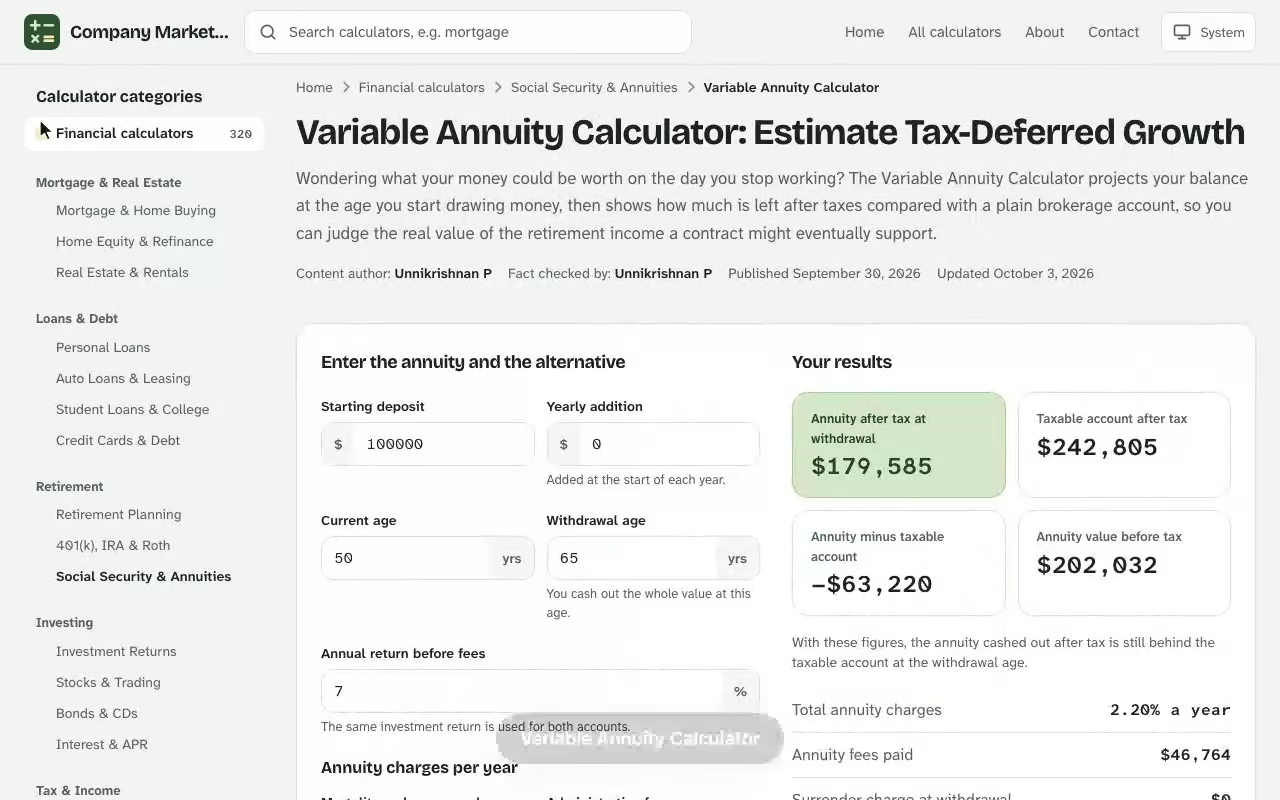
Variable Annuity Calculator. Wondering what your money could be worth on the day you stop working? The Variable Annuity Calculator projects your balance at the age you start drawing money, then shows how much is left after taxes compared with a plain brokerage account, so you can judge the real value of the retirement income a contract might eventually support. Try the free annuity calculator to run your own numbers — everything is calculated in your browser and nothing you enter is stored or sent anywhere.
Your results
Annuity after tax at withdrawal
–
Taxable account after tax
–
Annuity minus taxable account
–
Annuity value before tax
–
Withdrawing before age 59½ usually adds a 10% federal tax on the earnings, which is included here.
Total annuity charges
–
Annuity fees paid
–
Surrender charge at withdrawal
–
Tax on annuity earnings
–
Taxable account before final tax
–
Taxable account fund fees
–
Taxable account taxes, yearly and final
–
Total deposited
–
A steady return is assumed every year; real returns vary, and rider guarantees can have value this comparison does not measure. The annuity is cashed out as one lump sum.
Year-by-year comparison
Values at the end of each year, and what you would keep after surrender charges and tax if you cashed out then.
Year
Age
Annuity value
Fees to date
Annuity after tax
Taxable account
Taxable after tax
Results are estimates for educational purposes and are not financial, tax or legal advice.
How the Variable Annuity Calculator Projects Your Balance
A variable annuity is an insurance product that lets you place money into market-based investment vehicles inside a contract. Nothing the account gains is taxed until you take money out, so gains compound on the full amount every year, a pattern known as tax-deferred growth. This page turns that idea into numbers: you enter seven core assumptions, and the tool grows the account year by year, then subtracts the tax you would owe on the gains when you start drawing the money. Pair this with the free annuity payout calculator for a fuller picture before you make a decision.
Think of it as an annuity estimator for the accumulation phase only, the stretch of years before any payments begin. It assumes you add your contribution at the beginning of every year and that returns are compounded annually. In the year the draw begins, no new money goes in, so your final deposit lands the year before.
Starting balance and annual contribution
Your starting balance is the lump sum you place into the contract on day one, and it starts earning immediately. Your annual contribution is the amount you add each year after that. Unlike a 401(k) or an IRA, a variable annuity has no yearly cap on deposits, which is why people who have already reached the contribution limits on a workplace plan often look at it. You get no tax deduction on what you deposit, though. Another catch: pulling out gains early can trigger a penalty on top of ordinary tax.
See how the Variable Annuity Calculator works: change the inputs and the annuity after tax at withdrawal updates instantly. Enter your own numbers in the calculator above.
Current age and withdrawal age
Subtract your current age from your withdrawal age and you have the number of years the money compounds. A 41-year-old who plans to start taking money out at 62 gives the account 21 years. Push the start date out by five years and the final balance rises sharply, because the last years of compounding are the most productive. Counting the years until retirement this way also tells you how long the contract has to recover from a weak market.
Expected rate of return
The expected rate of return is the single assumption that moves the result most. Over the long run the S&P 500 has delivered roughly 10 percent a year before costs, while a bank account pays far less and carries almost no chance of loss. Because insurance charges reduce what you actually keep, a prudent plan uses a figure a little below the market average. The rate of return you choose should reflect the subaccounts you will really hold, whether stocks, bonds or a blend.
Current tax rate and retirement tax rate
Two tax inputs drive the comparison. Your current tax rate is the marginal tax rate you pay today on investment gains in an ordinary account; your retirement tax rate is the rate you expect to pay when the annuity's gains are taxed as ordinary income. Your filing status decides which federal bracket applies, so look up the bracket for single filers or married couples before you type a number. If you expect to be in a lower bracket later, deferral works in your favor.
Variable Annuity Formula: Yearly Compounding and Ending Balance
Each year the calculator adds that year's deposit to the prior balance and applies one year of return. In notation, the balance after year \(t\) is: Next, open the free social security calculator and enter your own details to see an estimate in seconds.
$$B_t = \left(B_{t-1} + C\right) \times (1 + r)$$
Here \(B_0\) is your opening deposit, \(C\) is the yearly deposit and \(r\) is the annual return as a decimal. After the last year, the balance \(B_n\) is what you hold, where \(n\) equals the number of years from now until you start drawing.
Tax then comes off the gains, not the money you put in. The after-tax figure is:
The term in parentheses is your total profit, and \(t_{later}\) is the tax rate you expect when withdrawals begin. The result is the annuity total after taxes, the number you can actually plan around. Any surrender charge that applies in the withdrawal year is subtracted too, covered in its own section below.
Annuity total before and after tax
The pre-tax figure is simply the balance at the end of the last year. It is the larger, more flattering number, but it overstates what reaches your pocket. The after-tax figure is the realistic one. The gap between the two is the deferred tax bill that comes due when you start taking money out, which is why the tax rate you expect later matters so much.
Tax at the 22% withdrawal rate removes $59,989, leaving an after-tax annuity total of $402,388.
Worked Example: A 21-Year Accumulation Phase
To see the numbers move, take a saver who is 41 and wants to start drawing from the contract at 62. These are the inputs, chosen for illustration only:
Input
Value
Opening deposit
$38,500
Yearly deposit
$7,200
Age now / age at first withdrawal
41 / 62 (21 years)
Annual return
6.4% a year
Tax rate today
24%
Tax rate at withdrawal
22%
Over 21 years the saver deposits $38,500 plus 21 contributions of $7,200, which is $189,700 in total. At 6.4 percent, the ending balance reaches $462,377, so total earnings are $272,677. Taxed at 22 percent, those gains generate a bill of $59,989, which leaves an after-tax total of $402,388.
Every year of the run is a row in the accumulation schedule, and the figures are hypothetical: they assume one steady return and no fees. A real contract will wobble around that line, so treat the schedule as a yardstick rather than a promise.
Growth overtakes deposits in year 17 of the example, ending at $462,377 on $189,700 deposited.
Balance by year
The growth is back-loaded. Deposits rise in a straight line, while the balance curves upward as gains start to earn their own gains. The table compares the contract with an ordinary account that is taxed on its return at 24 percent every year.
Year
Total deposited
Variable annuity balance
Brokerage balance
3
$60,100
$70,860
$68,166
6
$81,700
$109,839
$102,374
9
$103,300
$156,791
$141,822
12
$124,900
$213,347
$187,309
15
$146,500
$281,472
$239,763
18
$168,100
$363,532
$300,248
21
$189,700
$462,377
$369,996
Variable Annuity vs Taxable Account: Where Deferral Pays
The comparison above is the real point of the exercise. In a taxable account the saver pays 24 percent each year on that year's return, so only 4.864 percent is reinvested. Over 21 years that tax drag leaves $369,996. The variable annuity ends at $402,388 after paying its own tax bill at withdrawal, a difference of $32,392 in favor of deferral.
At year 21 the annuity holds $402,388 after tax against $369,996 in an account taxed every year.
That edge comes from tax deferral: money that would have gone to the tax office every April stays invested and keeps compounding. It is the same logic behind tax shields such as a 401(k), only without a deposit ceiling, which makes tax-deferred savings in an annuity attractive to high earners who have used up their other options.
Total return after tax
Measured as a total return, the contract keeps compounding the money that would otherwise leave as annual tax. The advantage grows with time, with the return you earn and with the gap between your current and later rates. Shrink that gap, say to a 24 percent bracket now and 24 percent later, and the lead narrows. Raise it, and deferral looks better still.
Deferral is not free, however. A variable annuity carries extra costs that an index fund held in a brokerage account does not, and those costs can erase the tax benefit for short horizons or small balances. Gains are also taxed as ordinary income rather than at lower capital gains rates. The default assumptions leave these costs out of the return, so subtract them yourself before trusting a close result.
Annuity Estimator Check: A $61,850 Contract at Age 53
A hospital billing manager, 53, has $61,850 sitting in a contract her brother-in-law sold her years ago. Before she adds more, she wants to know whether the tax deferral is actually worth the paperwork, so she opens this variable annuity calculator and types in what she knows.
She enters a $61,850 starting balance, a $9,400 yearly deposit, a withdrawal age of 67 and a 5.8 percent return, which is below the 6.4 percent she first guessed because the fund fees take a slice. For tax she enters 32 percent today and 24 percent for later, her estimate for the bracket she will fall into on a smaller income.
The result appears immediately: a $342,278 balance after 14 years on $193,450 of deposits, so $148,828 of gains. The 24 percent bill on those gains is $35,719, leaving $306,559 after tax. The ordinary-account comparison shows $284,340, so deferral is worth $22,219 to her.
Scenario
After-tax result
5.8% return, 24% later rate
$306,559
4.8% return, 24% later rate
$281,758
5.8% return, 32% later rate
$294,653
She does not stop there. A one-point lower return drops the figure to $281,758, still above the $265,820 an ordinary account would hold at that return. If her bracket stays at 32 percent, the after-tax result slips to $294,653, which is $12,000 less but still ahead. She decides the deferral holds up, though the 4.8 percent case is the one she carries to her advisor, along with a request for the exact surrender schedule. Her contract is past year 7, but she wants it in writing before she raises her deposit, and she notes that nothing here touches the 10 percent charge that applies only to withdrawals before age 59½.
Surrender Charges and Fees in a Variable Annuity
Insurance companies recover their upfront costs through a declining charge if you pull money out early. The calculator lets you enter up to five of these steps, each paired with the contract year it applies to.
How surrender charges work
Surrender charges are a percentage of your balance, charged only if you withdraw before the schedule ends. A common structure starts high and falls by one point a year. Terms vary widely from contract to contract, so check the schedule in your own prospectus rather than relying on a typical figure.
Example surrender charges schedule
Suppose the contract charges 7 percent in year 1, falling one point a year. Our saver's balance after four years of deposits is $83,056. A full withdrawal in year 4 triggers a 4 percent charge of $3,322, leaving $79,734 before tax.
Withdrawal in year
Charge
1
7%
2
6%
3
5%
4
4%
5
3%
6 and later
0%
Other costs inside the contract
Surrender charges are only one layer. Some contracts also levy separate withdrawal charges on partial redemptions. Most deduct a mortality and expense risk charge, an administrative fee and the expense ratios of the underlying funds. Riders add more. Because each of these reduces your net return, the fees you pay can change the answer more than the tax rate does.
Mortality and expense risk charges cover the insurer's guarantees
Administrative fees pay for record keeping and statements
Rider fees apply to extras such as a guaranteed income benefit
Early withdrawal before age 59½ can add a 10 percent federal tax charge
Variable Annuity vs Fixed Annuity: Choosing a Contract Type
When people search for an annuity they meet several labels. Understanding them keeps you from running the wrong projection.
Fixed or variable: who bears the swings
A fixed annuity pays a declared interest rate, so the insurer carries the market risk. A variable annuity passes investment performance, and the possible loss of principal, straight to you. An indexed annuity sits between them, tying credits to an index with a cap. A registered index-linked annuity adds buffers against loss in exchange for limited upside.
Immediate annuity or deferred annuity
An immediate annuity converts a lump-sum premium into payments that begin right away. A deferred annuity waits, letting the balance grow first, which is the pattern this tool models. If you want to know what a finished balance could pay out, an income calculator or a dedicated annuity payout tool handles that second stage.
Retirement income and income payment options
Once those years of saving end you can take a lump sum, take partial withdrawals or convert the contract value into lifetime income. Some contracts offer guaranteed income through a rider, usually with a level or an increasing income payment. Your contract value, not the original purchase payment, drives that guarantee. Depending on the option, the result can be annual income, monthly income or income for life that continues as long as you live. This tool stops at the balance before payments begin and does not project those payouts, so treat its after-tax total as the starting point for that second stage.
Who holds which role
Every annuity contract names three roles. They do not change this projection, which tracks only the account's balance, but they decide who controls and who receives the money:
The annuity owner controls the policy and can withdraw money or assign it
The annuitant is the person whose life expectancy sets the payout terms
The beneficiary receives any remaining value or a death benefit
Often the owner and annuitant are the same person. Choosing a beneficiary also shapes your legacy, since a spouse or a child can inherit what you do not spend, subject to the contract's terms and to the insurance company that issues it.
Reading Your Variable Annuity Results Wisely
Treat the output as an illustration, not a quote. The projection uses one steady rate of return, while real markets rise and fall, and that volatility changes outcomes depending on the order in which good and bad years arrive. Run the tool three times with a low, middle and high rate to see the range. Then ask a financial advisor or a tax advisor, or any financial professional you trust, to review the actual annuity contract, its prospectus and the surrounding portfolio.
Some points to keep in mind when you compare outcomes:
A longer horizon usually helps deferral more than a higher contribution
A larger gap between your two tax rates favors the annuity
Higher annual costs can offset the investment advantage
Guaranteed lifetime income may matter more to you than the largest balance
Use the after-tax total from your results as one piece of a wider retirement plan rather than the whole of it. Pairing the contract with mutual funds or a pension helps diversify the sources you draw on, and a written retirement strategy tells you how much of your principal to place in a contract at all. Interest rates, inflation and your health all feed into that decision, so revisit the numbers whenever one of them changes.
The tool does not model inflation, a spouse's joint payout, state income tax or the extra charge before age 59½. It also assumes a single contribution at the start of each year. These simplifications keep the result easy to follow, but your contract may differ. Rolling money in from another plan, for example, changes the tax basis and the numbers above.
Variable Annuity Calculator questions
What does a variable annuity calculator tell you?
It projects the balance of a variable annuity at the age you plan to start withdrawals, shows what remains after taxes and any surrender charge, and compares the result with investing the same money in a taxable account.
How are variable annuities taxed?
You get no deduction for deposits, but earnings grow tax-deferred. When you withdraw, the gains are taxed as ordinary income at your rate that year, and withdrawals before age 59½ can add a 10 percent federal tax charge.
What are surrender charges?
A surrender charge is a percentage of your balance that the insurer deducts if you withdraw early. It usually starts high and declines over several years, and the schedule differs by contract, so check your prospectus.
Is there a limit on how much I can put into a variable annuity?
Federal tax law sets no annual contribution limit for non-qualified annuities, although each insurer may set its own minimums and maximums.
What rate of return should I enter?
Use a figure that reflects the subaccounts you plan to hold, net of the annual fees the contract charges. A rate below the long-run stock market average is a prudent starting point.
Why does the calculator compare the annuity with a taxable account?
The comparison isolates the value of tax deferral: both start with the same deposits and return, but the taxable account loses part of each year's gain to tax while the annuity defers it until withdrawal.
What does this calculator leave out?
It uses one steady return and does not model inflation, mortality and expense charges, rider fees, state taxes, or the payout phase. Use it as a general illustration, not a quote for a specific contract.