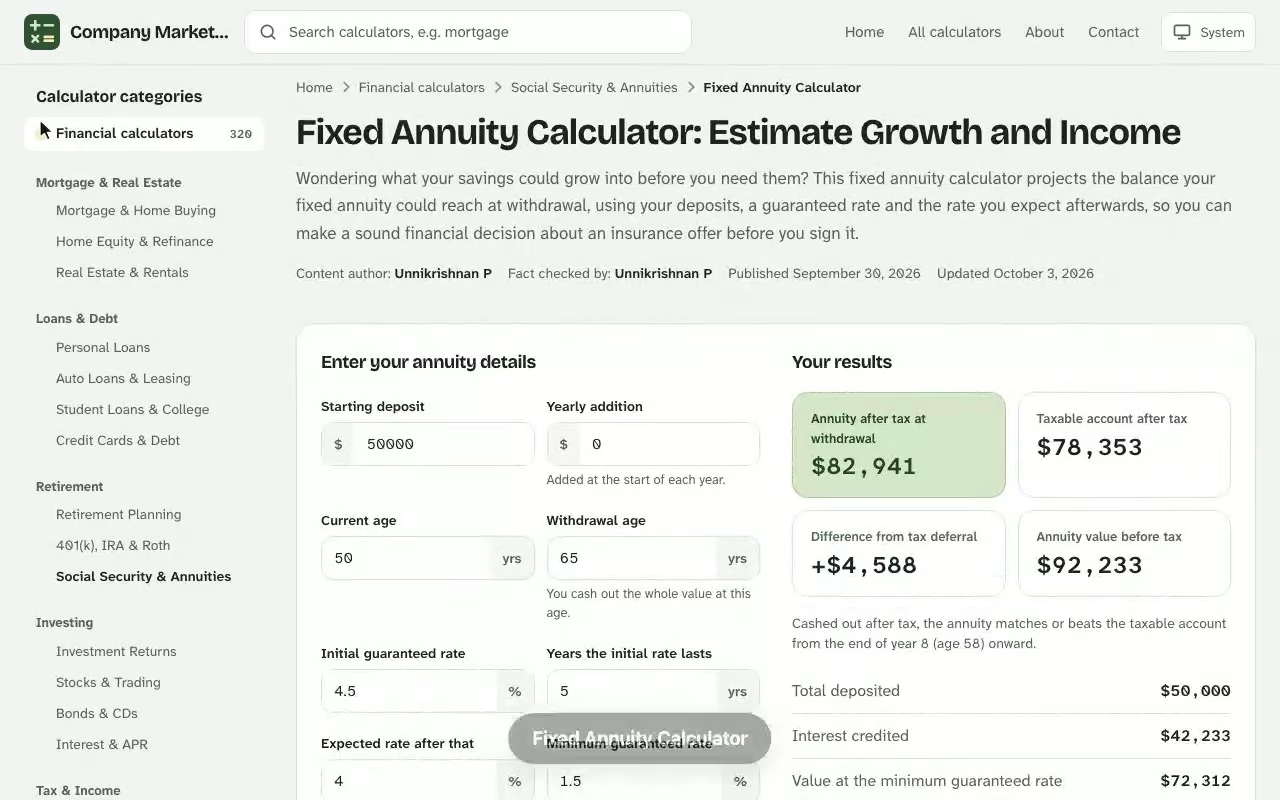
Fixed Annuity Calculator. Wondering what your savings could grow into before you need them? This fixed annuity calculator projects the balance your fixed annuity could reach at withdrawal, using your deposits, a guaranteed rate and the rate you expect afterwards, so you can make a sound financial decision about an insurance offer before you sign it. The free annuity calculator uses the same plain-English approach, so you can compare results side by side.
Your results
Annuity after tax at withdrawal
–
Taxable account after tax
–
Difference from tax deferral
–
Annuity value before tax
–
Withdrawing before age 59½ usually adds a 10% federal tax on the earnings, which is included here.
Total deposited
–
Interest credited
–
Value at the minimum guaranteed rate
–
Surrender charge at withdrawal
–
Income tax on the earnings
–
Early withdrawal tax
–
Annuity earnings are taxed as ordinary income only when withdrawn, here as one lump sum. Rates after the initial period are not guaranteed above the contract minimum.
Year-by-year value
What the annuity is worth each year, what you would keep after surrender charges and tax if you cashed out then, and the taxable account for comparison.
Year
Age
Annuity value
Surrender charge
Annuity after tax
Taxable account
Results are estimates for educational purposes and are not financial, tax or legal advice.
Fixed Annuity Calculator Inputs Explained
A fixed annuity is an insurance product that pays a stated rate of interest while your money stays inside the contract. The calculator needs a handful of facts about you and about the contract, and each one changes the projected fixed annuity total in a different way. Work through them in the order below and you will have a complete picture within a few minutes. Try the beneficiary rmd payout options calculator to run your own numbers — everything is calculated in your browser and nothing you enter is stored or sent anywhere.
Starting balance and annual contribution
Your starting balance is the lump sum you place into the contract on day one. Your annual contribution is the amount you add at the beginning of every year after that. Together they form the principal that earns interest, and the calculator treats the two as separate inputs because a large opening deposit compounds for longer than any single yearly addition.
Current age and withdrawal age
Your current age and your withdrawal age set how many years the money has to grow. The gap between them is the length of the accumulation phase. If you plan to start withdrawals at 62, your last deposit is made during the year you are 61, because no contribution is added in the year you withdraw.
Initial interest rate and years initial rate is guaranteed
Most contracts advertise a headline initial interest rate that applies only for a set stretch. Enter that rate, then enter the number of years initial rate is guaranteed. Insurers often offer a fixed rate of interest for three, five, seven or ten years, and the calculator applies it to exactly that many years before switching to the next assumption.
Expected average interest rate and minimum guaranteed interest rate
Once the introductory period ends, the insurer usually resets the credited rate. The expected average interest rate is your own estimate of what the contract will pay on average from then on. The minimum guaranteed interest rate is the floor written into the contract, typically between 1% and 3%, and it protects you if market rates drop. A useful habit is to run the calculation twice, once with the expected rate and once with the floor, to see the spread between the likely and the worst contractual outcome.
Current tax rate and retirement tax rate
Two tax inputs let the calculator compare your annuity with an ordinary savings account. Your current tax rate is the marginal tax rate you pay today on taxable investment earnings. Your retirement tax rate is the rate you expect to pay when the annuity earnings are taxed on withdrawal. Because tax is deferred, these two numbers often decide whether the contract beats a taxable account.
Surrender charges by year
The final block of inputs lists up to five surrender charges, each paired with the contract year it applies to. Leave them as written in your contract. Surrender charges only reduce your result if you withdraw before the schedule ends, and the calculator uses them to show the balance you would actually receive after the penalty.
How the Fixed Annuity Total Is Calculated
The projection is a year-by-year compounding loop, the same financial arithmetic every insurance illustration relies on, and it is easy to follow. Each January you add your contribution to the running balance, and the whole sum then earns that year's credited rate, so every year's interest can compound on the last. The same formula works for the first five guaranteed years and for every year afterwards; only the rate changes. The variable annuity without surrender charges calculator is free to use with no sign-up, and works on desktop and mobile.
$$B_t = (B_{t-1} + C) \times (1 + r_t)$$
Here \(B_t\) is the end balance after year \(t\), \(C\) is your annual contribution, and \(r_t\) is the credited rate for that year, which is the initial rate during the guarantee period and the expected average rate afterwards. Earnings are compounded annually, so interest earned in one year becomes principal for the next.
The accumulation phase step by step
During the accumulation phase, nothing leaves the contract. Regular deposits go in, the credited rate is applied, and the balance rolls forward. The calculator repeats the formula once for every year between your current age and your withdrawal age, then reports the final figure as your fixed annuity total at withdrawal.
Tax-deferred growth versus a taxable account
A contract's earnings are tax-deferred, which means no tax is due until you withdraw. In a taxable account you pay tax on earnings every year, so the effective rate is lower: a 4.00% rate of return taxed at 24% grows at only 3.04% after tax. The calculator models the taxable account with that reduced rate, then taxes the annuity earnings once at your retirement tax rate. The comparison shows whether tax-deferred savings actually come out ahead for your numbers.
Fixed Annuity Worked Example: Fifteen Years of Deposits
Take a saver aged 47 who wants to withdraw at 62. They open a fixed annuity with a starting principal of $38,000 and add $6,500 at the start of each year. The contract credits 4.35% for the first 5 years, and the saver expects a 3.60% average after that. The minimum rate in the contract is 1.75%. The saver pays 24% tax today, expects 22% at retirement, and a comparable taxable account would return 4.00%.
Balance at selected years
The year-by-year accumulation schedule below samples four of the fifteen years, which is enough to see the shape of the growth.
The fixed annuity balance over 15 years: your deposits form the base and interest earned builds on top.
Contract year
Annuity balance
Taxable account balance
Year 1
$46,436
$45,853
Year 5
$84,011
$79,725
Year 10
$136,445
$128,190
Year 15
$199,022
$184,483
Reading the results
Result
Amount
Total additions (starting principal plus 15 deposits)
$135,500.00
Interest earned
$63,521.67
End balance of the fixed annuity at age 62
$199,021.67
Tax owed on earnings at 22%
$13,974.77
Annuity balance after tax
$185,046.90
Taxable account balance
$184,482.53
Of the $63,521.67 earned, $13,511.43 came during the five guaranteed years and $50,010.24 afterwards, which shows how much the later, lower rate still matters because the balance is much larger by then. After paying tax on the earnings, the annuity leaves the saver with $185,046.90, about $564 more than the taxable account. The edge is modest here because the saver's tax rate falls only two points between working life and retirement; a bigger drop widens it.
How the fixed annuity total builds up and what tax at 22% takes at withdrawal.
What happens if rates fall to the minimum
Rerunning the same inputs with the 1.75% minimum rate applied after year 5 lowers the end balance to $171,523.42. Pushing the expected average up to 4.50% raises it to $213,934.84. That $42,411 spread between floor and optimistic case is the reason to enter both rates before you compare any quote.
Projected fixed annuity balance for four expected average rates and three withdrawal ages.
Testing a Pension Rollover Against Fixed Annuities
Marisol is 55, and a small pension plan has just paid out a rollover of $112,400. Before she commits it, she wants the projected balance at 62, the age her husband plans to retire, so she opens the calculator and enters what the insurer's quote sheet states.
Starting balance: $112,400, with an annual contribution of $4,800.
Current age 55 and withdrawal age 62, which gives seven contribution years.
An initial rate of 4.60% for 5 years, then an expected average of 3.25%.
A minimum guaranteed rate of 2.00% from the contract.
After she clicks the Calculate button, the fixed annuity total at withdrawal reads $189,452.60. That is $146,000 of her own money plus $43,452.60 of interest. She reruns it with the 2.00% floor in place of 3.25% and gets $184,952.41, only $4,500.19 lower, so the downside after year 5 looks tolerable.
Two outside numbers shape her decision. Many state guaranty associations cover annuity benefits up to $250,000 per insurer, and $189,452.60 sits comfortably under that line, so she keeps the whole amount with one company rather than splitting it. The surrender schedule is the second: at year 5 her balance would be $168,264.60, and a 6% charge would take $10,095.88. She therefore moves $11,000 into a separate savings account first, so an emergency never forces an early withdrawal.
Surrender Charges and Early Withdrawal Rules
A fixed annuity is built for long holding periods, and the contract enforces that with a declining penalty schedule. Understanding it matters as much as understanding the interest rate.
How a surrender charge schedule works
A surrender charge is a percentage of the balance withheld if you take an early withdrawal beyond any free amount the contract allows. A common schedule starts near 7% and falls by one point each year until it reaches zero. In the worked example above, withdrawing during year 4 would cost 4% of $74,009, or $2,960, leaving $71,049. Withdrawals after the schedule ends carry no penalty at all.
Withdrawal year
Surrender charge
Balance
Amount you keep
Year 1
7%
$46,436
$43,185
Year 3
5%
$64,424
$61,203
Year 5
3%
$84,011
$81,491
Cash surrender value explained
The cash surrender value is the balance minus any surrender charge, which is the amount the insurer would actually pay if you cancelled today. Early on it sits below the account balance; once the schedule expires the two figures match. Check it against your own timeline and your need for liquidity before committing.
Tax penalties on early withdrawals
A financial penalty can apply as well: withdrawals before age 59½ may also trigger a 10% federal penalty on top of ordinary tax on earnings. Taxes are charged on the earnings portion first, so an early exit can cost more than the surrender charge alone suggests. The calculator's balance after surrender charge leaves this penalty out, so add it separately when you test an early exit.
Fixed Annuities Compared With Other Annuity Types
Insurers sell several kinds of contract, and this page's fixed annuities are only one family. Knowing the others helps you decide whether the numbers from the calculator are really the numbers you need.
Fixed vs. variable annuities
Fixed contracts credit a declared rate and guarantee your principal against market losses. Variable contracts invest in subaccounts, offering more investment options and more risk, so they cannot be projected with a single rate. The calculator here assumes a fixed rate and is not designed for variable products.
Immediate vs. deferred annuities
An immediate contract starts paying right after a lump sum purchase, while a deferred contract spends years building a balance first. The projection on this page covers the deferred case: you save now and withdraw later. Someone who already has the money and wants paychecks right away would use a fixed income annuity instead, which is priced from age and amount rather than from a growth schedule.
Annuity fees to watch
This calculator has no fee input, so net any rider cost out of your expected average rate before you enter it. Because insurance carriers price products differently, plain fixed contracts rarely carry the ongoing annuity fees typical of variable products, but riders for guaranteed income, long-term care or a death benefit often add a yearly cost. Any rider fee lowers the effective rate, so subtract it from your expected average rate before you enter it.
Pros and cons of a fixed contract
Pro: a guaranteed minimum interest rate and protected principal.
Pro: tax benefits from deferring tax until withdrawal, with no annual contribution limits.
Con: surrender charges that limit access to your money in the early years.
Con: credited rates that may trail inflation or stock market returns over decades.
See how the Fixed Annuity Calculator works: change the inputs and the annuity after tax at withdrawal updates instantly. Enter your own numbers in the calculator above.
Your inputs put numbers on them: the surrender charge fields price the first con, and the expected average rate tests the second. These pros and cons explain why most people hold an annuity alongside an IRA or a 401(k) rather than instead of one.
Income Annuity Estimator: From Fixed Annuity Balance to Payout
Building a balance is only the first half of the story. At withdrawal age, you decide how the money comes out, and that choice changes how far it stretches.
Lump sum versus lifetime payout
In the distribution phase you can take the whole balance as a lump sum, or convert it into annuity payments that arrive monthly. A lifetime payout continues for as long as you live, no matter how long that turns out to be, and it is the only choice that fully removes the risk of outliving your savings. A period-certain option pays for a fixed number of years, often 10, and can pass to a beneficiary if you die early.
Estimating monthly income
This calculator stops at your end balance, and payout size then depends on your age, life expectancy tables, prevailing rates and the option you choose. A dedicated income annuity estimator or an annuity payout calculator converts your final balance into a monthly income figure, and an annuities calculator that quotes immediate contracts can do the same. Use the end balance from this page as the amount you plan to convert.
Guaranteed income and the role of the contract owner
This calculator stops at your end balance, so the payout choice comes afterwards. The annuity owner decides how that balance is used, while the annuitant's life sets the payment length; a survivor option trades a smaller check for guaranteed income that outlasts you.
Using Fixed Annuity Results: Safety, Taxes and Planning
How safe is your fixed annuity?
Your money is backed by the financial strength of the insurance company that issues the contract, and in most states a guaranty association covers a limited amount if the insurer fails. Compare insurer ratings from independent financial agencies before you buy, and consider splitting a large deposit across more than one issuer, which means entering only the share you place with each insurer as your starting balance.
Annuities and your retirement plan
Read the projected balance and the minimum-rate balance as the guaranteed layer of your retirement strategy. Because it pays a set rate, that layer can diversify a market-driven portfolio and reduce risk, much like a certificate of deposit with deferred tax and a longer horizon. If the floor result still covers your essential bills, it supplies guaranteed retirement income that your wider retirement plan can lean on, and a clear financial goal tells you how much to place in the insurance contract.
Legacy and beneficiaries
During accumulation, most contracts pay a death benefit of at least the balance, so your projection doubles as the amount a beneficiary would receive and a quick check on legacy planning.
Rolling over from other accounts
A rollover from a 401(k), an IRA or an old pension is simply your starting balance in the calculator. Check contribution limits on the source account, and remember that a rollover into a qualified annuity adds no extra tax deferral because the money was already sheltered; the reason to do it is the guaranteed rate.
Using the results to decide
Compare the after-tax annuity balance with your taxable alternative, then check that the minimum floor still gives you enough. If the gap is tiny, other factors such as liquidity and surrender charges weigh more than the projected growth. If the gap is large, the deferral is doing real work for you, and that is a sign to look closer at the contract. This kind of financial planning works best with an insurance adviser and when you rerun the numbers whenever rates, your tax bracket or your retirement planning timeline changes.
Finally, remember that every annuity contract has its own rules, so use this projection as a general illustration and confirm the details with the insurer and a licensed financial adviser. Smart financial choices start with accurate inputs, and the more precisely you enter your surrender charges, rates and ages, the closer the estimate will be to what the insurer offers.
Fixed Annuity Calculator questions
What is a fixed annuity?
A fixed annuity is an insurance contract that credits a declared interest rate while your money stays inside it. It usually has two phases: an accumulation phase where your balance grows, and a distribution phase where you take a lump sum or regular payments.
How is a fixed annuity taxed?
Earnings grow tax-deferred, so you owe no tax until you withdraw. Withdrawals are taxed as ordinary income on the earnings portion, and withdrawals before age 59½ may also face a 10% federal penalty.
What are surrender charges?
A surrender charge is a percentage of your balance the insurer keeps if you withdraw early, usually on a schedule that falls to zero after several years. Enter your contract's schedule to see how much an early withdrawal would cost.
What other fees come with a fixed annuity?
Plain fixed annuities often carry no annual fee, but optional riders such as guaranteed income, long-term care or enhanced death benefits can add a yearly cost that lowers your effective interest rate.
What is the minimum guaranteed interest rate?
It is the floor rate written into the contract, commonly 1% to 3%. After the initial rate ends, the insurer cannot credit less than this rate even if market rates fall.
How safe is a fixed annuity?
Your balance is backed by the financial strength of the issuing insurance company, and state guaranty associations typically protect a limited amount if an insurer fails. Check the insurer's ratings before you buy.
How is a fixed annuity different from a certificate of deposit?
Both pay a declared rate, but a fixed annuity defers tax on earnings, has no annual contribution limit and is issued by an insurer, while a certificate of deposit is a bank product whose interest is taxed each year.
Why does the calculator compare my annuity with a taxable account?
Tax deferral is the main advantage of an annuity. Comparing the after-tax annuity balance with a taxable account earning your chosen return shows whether deferral is actually helping given your current and retirement tax rates.