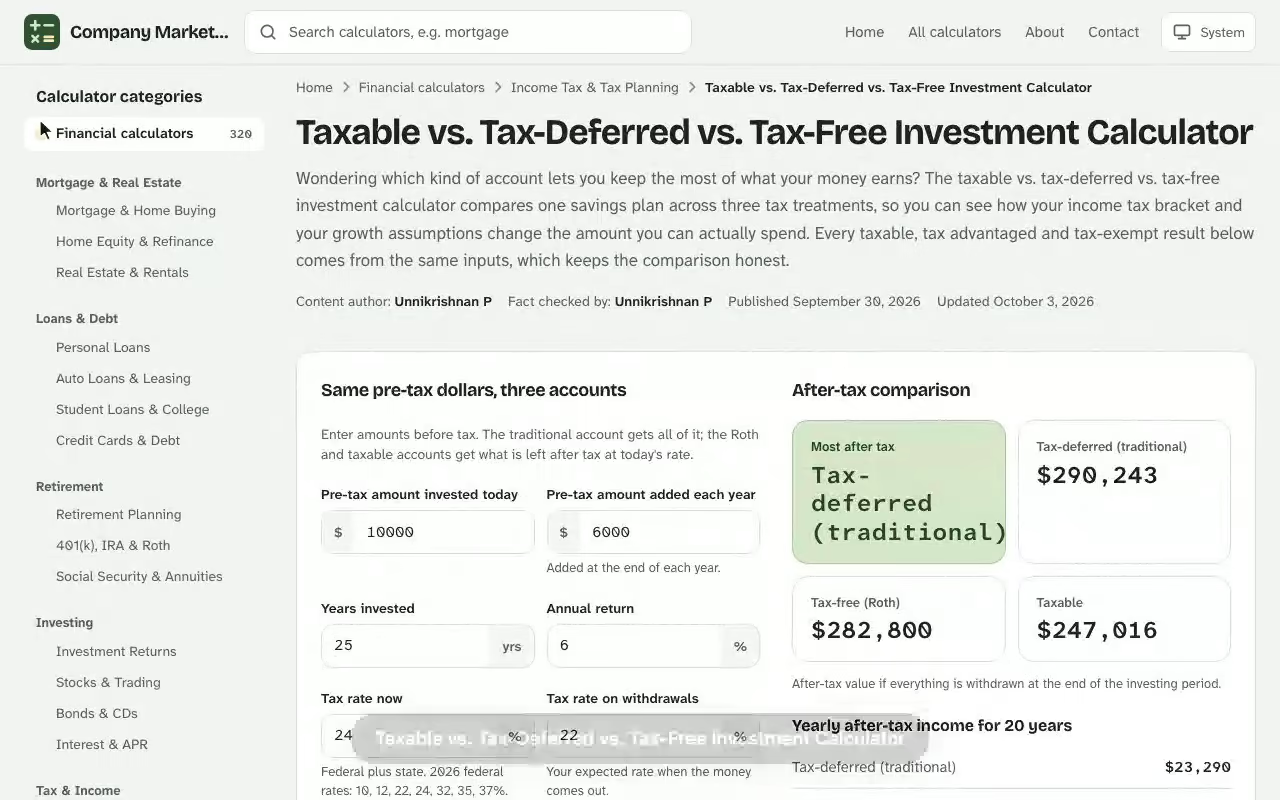
Taxable vs. Tax-Deferred vs. Tax-Free Investment Calculator
Taxable vs. Tax-Deferred vs. Tax-Free Investment Calculator. Wondering which kind of account lets you keep the most of what your money earns? The taxable vs. tax-deferred vs. tax-free investment calculator compares one savings plan across three tax treatments, so you can see how your income tax bracket and your growth assumptions change the amount you can actually spend. Every taxable, tax advantaged and tax-exempt result below comes from the same inputs, which keeps the comparison honest. The free income tax calculator uses the same plain-English approach, so you can compare results side by side.
After-tax comparison
Most after tax
–
Tax-deferred (traditional)
–
Tax-free (Roth)
–
Taxable
–
After-tax value if everything is withdrawn at the end of the investing period.
Yearly after-tax income
Tax-deferred (traditional)–
Tax-free (Roth)–
Taxable–
Where the tax goes
Invested, traditional (pre-tax)–
Invested, Roth (after tax)–
Invested, taxable (after tax)–
Tax paid up front, Roth or taxable–
Traditional balance before tax–
Tax due on the traditional balance–
Roth balance–
Taxable balance (earnings taxed yearly)–
Year-by-year balances
The traditional account is shown before and after the tax due on withdrawal; Roth and taxable balances are already after tax.
Year
Traditional, before tax
Traditional, after tax
Roth
Taxable
Results are estimates for educational purposes and are not financial, tax or legal advice.
Taxable vs. Tax-Deferred vs. Tax-Free Investment Calculator: How the Three Accounts Differ
Every dollar you invest is taxed at some point, and the account's tax treatment decides when. A taxable account taxes earnings every year, a tax-deferred account postpones the bill until you take money out, and a tax-free account collects the tax up front and then leaves your withdrawals alone. Because each one handles the tax liability differently, two people who save the same amount for the same number of years can retire with very different spending power. The self employment tax calculator uses the same plain-English approach, so you can compare results side by side.
Taxable account
A taxable account, such as an ordinary brokerage account, has none of the tax benefits the other two offer. Interest, dividends and realized capital gains are taxed in the year you receive them, so part of your earnings leaves the account before it can compound again. Long-term capital gains and qualified dividends are often taxed at lower rates than ordinary income, which narrows the gap somewhat, but the annual drag never fully disappears.
Tax-deferred account
Your tax-deferred options include a traditional IRA and employer-sponsored plans such as a 401(k) or 403(b). Contributions may be pre-tax, which lowers the income you report now, and tax-deferred growth means nothing is owed while the money stays inside. The bill arrives with your distributions, which are taxed as ordinary income. Take money out before age 59½ and an early withdrawal usually adds a 10% penalty on top.
Tax-free account
A Roth IRA or Roth 401(k) is funded on an after-tax basis, so there is no up-front deduction. In return, qualifying withdrawals of both contributions and earnings are free of income tax, which is why this tax-exempt account category is the one people picture when they hear the phrase tax-free growth.
What the Tax-Deferred vs. Tax-Free Calculator Needs From You
The tool asks for a handful of values. Each one maps to a step in the formulas further down, so it helps to know what to enter before you click the Calculate button. Pair this with the free marriage tax calculator for a fuller picture before you make a decision.
Annual rate of return
This is the yearly rate of return you expect from the investment before tax, and the single most influential assumption. A diversified investment portfolio and a savings account sit at very different ends of the risk scale, so choose a figure that matches how the money is invested. Pick a conservative number rather than a recent peak.
Existing balance and contributions
Your existing balance is what you already hold, and your contributions are the amount you add each period. Years to contribute sets how long the saving phase lasts, and years of withdrawals sets how long the money must last afterward. Enter 1 for a lump sum if you plan to take everything out at once.
Contribution frequency and withdrawal frequency
Choose monthly, quarterly or annual timing for each phase. A faster contribution frequency puts money to work sooner, and a more regular withdrawal frequency smooths what you spend. Both change the compounded result slightly, though never as much as the rate of return does.
Marginal tax rate and tax deduction
Your marginal tax rate is the rate applied to your last dollar of income, not your average rate. It taxes the taxable account's yearly earnings and the tax-deferred account's withdrawals. A checkbox lets you treat the tax-deferred balance as pre-tax money, which adds the tax deduction savings back into that account so all three start from equal after-tax dollars.
Formulas Behind the Taxable vs. Tax-Deferred Calculator
The method is plain compound interest with one difference per account. Let \(r\) be the annual rate of return, \(t\) the tax rate, \(n\) the periods per year, and \(C\) the contribution each period. The per-period rate for the taxable account is reduced by tax, while the other two use the full rate:
The balance after each contribution period then grows as:
$$B_{k+1} = (B_k + C) \times (1 + i)$$
When the saving phase ends, the withdrawal that uses up the whole balance over \(N\) periods is:
$$\text{Payment} = B \times \frac{i}{1 - (1 + i)^{-N}}$$
Only the tax-deferred payment is then multiplied by \((1 - t)\), because that is the one account where income tax is still due on the way out. These are the same tax rates you enter, applied at different moments.
Worked Example: Comparing a Taxable, Tax-Deferred and Tax-Free Investment
Suppose you start with an existing balance of $12,000, contribute $450 a month for 22 years, and expect a 6.8% annual rate of return. You then withdraw monthly over 18 years, and your marginal tax rate is 24% throughout. Run this taxable vs. tax deferred vs. tax free investment scenario yourself and you will see the same figures. It puts the same $130,800 of after-tax money (the $12,000 plus $118,800 of contributions) into every account, with no extra deduction applied.
Account
Balance after 22 years
Monthly withdrawal before tax
Monthly withdrawal after tax
Taxable
$258,704
$1,842
$1,842
Tax-deferred
$328,463
$2,640
$2,007
Tax-free
$328,463
$2,640
$2,640
The tax-free account wins by a wide margin because its balance never shrinks to a tax bill. Notice that the tax-deferred account holds the same $328,463 as the tax-free one, yet $78,831 of it belongs to the government, which leaves about $249,632 you can spend. Now tick the tax-deduction box so the tax-deferred account starts from pre-tax dollars instead. Its balance grows to $432,188, the after-tax value rises to $328,463, and the monthly payment lands at $2,640, exactly level with the Roth. That equality is no accident: with the same tax rates now and later, tax-deferred vs. tax-free is a tie, and both beat the taxable route.
Reading Your Results: Tax Diversification and Tax-Free Growth
The gap between columns, not any single number, is the answer. In the example, the taxable account trails by $798 a month, which is the cumulative cost of paying tax on dividends and growth every year for 22 years.
When tax-deferred growth beats a Roth
The tie above depends on one assumption: that your tax bracket stays the same. If you expect a lower bracket in retirement, deferral can come out ahead. In the example, withdrawing at 12% instead of 24% lifts the tax-deferred payment from $2,640 to about $3,057 a month, an extra $417. If you expect a higher bracket later, the Roth takes the lead.
Why tax diversification helps
Future taxes are hard to predict, so many savers practise tax diversification: holding money in all three account types and choosing which to draw from each year. That flexibility lets you keep taxable income low in a good year and use tax-free money in a high-income one. A financial advisor can help you plan that mix, and nothing here is tax advice for your situation.
Testing a 22% Bracket With the Taxable vs. Tax-Deferred Calculator
A 41-year-old engineer has just gotten a raise and has $850 a month to redirect. The choice is a brokerage account, a traditional 401(k) or a Roth 401(k). To settle it, they open the calculator and enter what they actually know.
Existing balance: $46,380 already invested
Monthly contribution: $850 for 17 years, until age 58
Annual rate of return: 6.2%, deliberately below the recent run of the market
Withdrawals: monthly for 20 years
Marginal tax rate: 22%, the federal bracket on their last dollar of pay, with the tax-deduction box ticked
The results come back as a taxable balance of $374,631, which supports $2,439 a month after tax. The tax-deferred and tax-free accounts both land at $3,207 a month after tax, a gap of $768 in favour of either retirement account. The two sheltered columns match to the dollar because one rate is applied now and later, so the account choice reduces to a bet on the future bracket.
To see how sensitive the taxable column is, they rerun the form at 32%, and the brokerage payment drops to $2,152 a month while the other two stay at $3,207. That settles the first question: the $850 goes into the 401(k), not the brokerage account. For the second, they hedge. Half of each paycheck's contribution, $425, goes pre-tax and $425 goes Roth, so a lower bracket in retirement rewards the deferral and a higher one rewards the Roth. The next step is a calendar reminder to rerun the numbers once the next raise changes the 22% bracket.
Roth IRA, Traditional IRA and 401(k) Rules Behind Each Account
A calculator can only model the math, so check the rules that govern each account before you rely on a result.
See how the Taxable vs. Tax-Deferred vs. Tax-Free Investment Calculator works: change the inputs and the most after tax updates instantly. Enter your own numbers in the calculator above.
Traditional IRA and 401(k): pre-tax contributions may be deductible, growth is deferred, and required minimum distributions begin later in life.
Roth IRA: after-tax contributions, tax benefits on qualifying withdrawals, and no required minimum distributions for the original owner.
403(b) and other sponsored plans: run through an employer, with catch-up contributions available once you reach age 50.
Earned income: you generally need it to contribute to an IRA, and the annual contribution limits change with inflation, so confirm the current figures with the IRS.
A health savings account (HSA) deserves a mention as another tax-exempt option. Contributions are deductible, growth is tax-deferred, and withdrawals for qualified expenses are untaxed. Other withdrawals face ordinary income tax and a 20% penalty before age 65. A spouse who inherits an HSA can keep these tax advantaged situations through a spousal rollover. In the calculator, an HSA spent on qualified expenses behaves like the tax-free column, so it needs no separate input.
Limits of This Investment Growth Calculator for Retirement Planning
Treat the output of this taxable vs. tax-deferred vs. tax-free calculator as a hypothetical illustration, not a forecast. Real retirement planning involves moving targets, and this investment keeps the following fixed:
A single constant return, whereas real volatility and market risk mean a broad index such as the S&P 500 rises and falls from year to year.
One flat tax rate for the whole period, although brackets and rules change.
No inflation, so future dollars buy less than the figures suggest.
No fees and no loss of principal from a bad stretch.
Run the numbers under several return and tax assumptions, compare the spread, and then bring the findings to a qualified professional before you pick an investing strategy and put your savings to work.
Taxable vs. Tax-Deferred vs. Tax-Free Investment Calculator questions
What is the difference between taxable, tax-deferred and tax-free accounts?
A taxable account taxes your earnings every year. A tax-deferred account, such as a traditional IRA or 401(k), delays the tax until you withdraw. A tax-free account, such as a Roth IRA, is funded with after-tax money and qualifying withdrawals are not taxed.
Which account is best if my tax rate stays the same?
With the same tax rate now and later, a tax-deferred and a tax-free account give the same after-tax result once the deferred account's tax deduction is counted. Both beat a taxable account, whose earnings are taxed every year.
When does a tax-deferred account beat a Roth?
When your marginal tax rate in retirement is lower than the rate you pay while contributing, deferral usually comes out ahead. If you expect a higher rate later, the tax-free account tends to win.
What does the tax deduction option do?
It treats the tax-deferred balance and contributions as pre-tax money, so you put more into that account for the same after-tax cost. Leave it off to compare the same dollars in all three accounts.
Can I use this for a 401(k), IRA or HSA?
Yes, as an approximation. A traditional 401(k) or IRA behaves like the tax-deferred column, a Roth like the tax-free column, and a brokerage account like the taxable column. Contribution limits and early-withdrawal penalties are not modelled.
Why are the taxable results lower?
Tax on interest, dividends and gains is paid each year, which lowers the amount left to compound. The calculator models this by reducing the taxable return by your marginal tax rate.
How accurate is the calculator?
It is a hypothetical illustration. It assumes a constant return and tax rate and ignores inflation, fees, contribution limits and rule changes, so use it to compare accounts rather than to forecast exact balances.