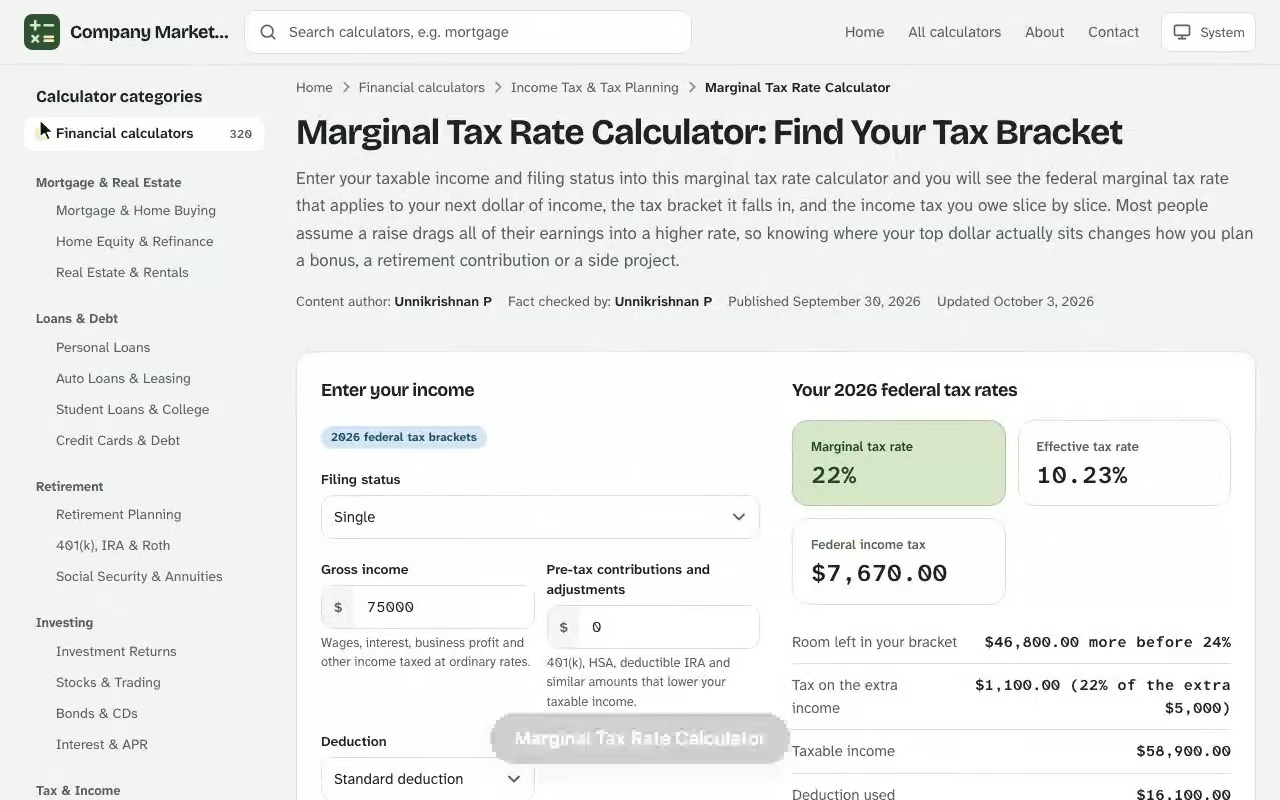
Marginal Tax Rate Calculator. Enter your taxable income and filing status into this marginal tax rate calculator and you will see the federal marginal tax rate that applies to your next dollar of income, the tax bracket it falls in, and the income tax you owe slice by slice. Most people assume a raise drags all of their earnings into a higher rate, so knowing where your top dollar actually sits changes how you plan a bonus, a retirement contribution or a side project. The income tax calculator uses the same plain-English approach, so you can compare results side by side.
Your 2026 federal tax rates
Marginal tax rate
–
Effective tax rate
–
Federal income tax
–
Room left in your bracket–
Tax on the extra income–
Taxable income–
Deduction used–
Average rate on taxable income–
The effective rate is federal income tax divided by gross income. Rates cover ordinary income only, before credits, and leave out Social Security, Medicare and state taxes. Qualified dividends and long-term capital gains have their own lower rates.
How your taxable income fills the brackets
Each rate applies only to the slice of income inside its bracket. The bracket holding your last dollar, shown in bold, is your marginal rate.
Rate
Taxable income in bracket
Your income taxed
Tax
Results are estimates for educational purposes and are not financial, tax or legal advice.
How the Marginal Tax Rate Calculator Works
The United States uses a progressive tax system, which means the government does not tax every dollar you earn at one percentage. Instead, your taxable income is divided into slices, and each slice is taxed at its own rate. The calculator takes three inputs: the tax year, your filing status and your taxable income. It then finds the highest federal tax bracket your income reaches, and that bracket's percentage is your marginal rate. A good tax rate calculator also shows the lower slices underneath, because your actual tax liability is the sum of every slice, not one percentage applied to the whole amount. Try the free estate tax calculator to run your own numbers — everything is calculated in your browser and nothing you enter is stored or sent anywhere.
What a marginal tax rate really measures
Your marginal tax rate is the percentage the IRS takes from the last dollar of taxable income you earn, and from each additional dollar that follows until you cross into the next bracket. It is a statement about the edge of your income, not the whole of it. If you are in the 22% bracket, only the dollars inside that bracket's range are taxed at 22%; the dollars below it were already taxed at 10% and 12%.
Why marginal tax rates matter for decisions
Because marginal tax rates describe the cost of earning one more dollar, they are the number to use when you weigh overtime, a freelance project or a deductible contribution. A $1,000 deduction saves you more tax when your top dollar is taxed at 24% than when it is taxed at 12%, since the deduction removes income from the highest slice first.
Inputs the calculator needs
Tax year: the IRS publishes new tax tables every year, so the brackets for 2025 differ from those for 2026.
Filing status: single filers, married filing jointly, married filing separately, head of household or qualifying surviving spouse each have different bracket widths.
Taxable income: your income after the standard deduction or itemized deductions, not your paycheck total.
If you only know your pay, subtract your deductions first. Gross income minus adjustments gives adjusted gross income, and adjusted gross income minus the standard deduction (or your itemized deductions) gives taxable income, the figure you should type into the calculator.
2025 Federal Tax Bracket Calculator Tables
Every tax bracket calculator is built on the same published rate schedule. The table below lists the seven federal rates for the 2025 tax year, the one you report on a return filed in 2026. Each cell shows the taxable income range that the rate applies to. The civilian to military pay calculator online uses the same plain-English approach, so you can compare results side by side.
Tax rate
Single filers
Married filing jointly
Married filing separately
Head of household
10%
$0 to $11,925
$0 to $23,850
$0 to $11,925
$0 to $17,000
12%
$11,925 to $48,475
$23,850 to $96,950
$11,925 to $48,475
$17,000 to $64,850
22%
$48,475 to $103,350
$96,950 to $206,700
$48,475 to $103,350
$64,850 to $103,350
24%
$103,350 to $197,300
$206,700 to $394,600
$103,350 to $197,300
$103,350 to $197,300
32%
$197,300 to $250,525
$394,600 to $501,050
$197,300 to $250,525
$197,300 to $250,500
35%
$250,525 to $626,350
$501,050 to $751,600
$250,525 to $375,800
$250,500 to $626,350
37%
Over $626,350
Over $751,600
Over $375,800
Over $626,350
Single filers and head of household
For single filers, the 10% rate covers the first $11,925 and the 22% rate runs from $48,475 to $103,350. A head of household gets wider low brackets, with the 10% slice reaching $17,000, which is why the same income produces a lower bill than it would on a single return. Married taxpayers who file separately face the same widths as single filers until the top two brackets, where the ranges are cut roughly in half from the joint schedule.
Married filing jointly and surviving spouses
Couples who choose married filing jointly, along with a qualifying surviving spouse, use bracket widths that are about double the single ones through the 24% rate. That is why two earners with a combined $150,000 often land in a lower bracket together than either would alone.
2026 federal tax brackets for a quick comparison
The IRS applies indexing for inflation each year so that rising prices alone do not push people into higher rates, a problem known as bracket creep. The 2026 thresholds below are higher than 2025's for the same reason.
Tax rate
Single filers
Married filing jointly
Head of household
10%
$0 to $12,400
$0 to $24,800
$0 to $17,700
12%
$12,400 to $50,400
$24,800 to $100,800
$17,700 to $67,450
22%
$50,400 to $105,700
$100,800 to $211,400
$67,450 to $105,700
24%
$105,700 to $201,775
$211,400 to $403,550
$105,700 to $201,750
32%
$201,775 to $256,225
$403,550 to $512,450
$201,750 to $256,200
35%
$256,225 to $640,600
$512,450 to $768,700
$256,200 to $640,600
37%
Over $640,600
Over $768,700
Over $640,600
Standard deduction by filing status
Brackets apply only to taxable income, so the standard deduction comes off first. For the 2025 tax year it is $15,750 for single filers and for married filing separately, $23,625 for head of household and $31,500 for married filing jointly. Taxpayers whose itemized deductions exceed that amount can itemize instead, which usually requires listing mortgage interest, charitable contributions and state and local taxes on Schedule A.
Worked Example: Finding the Marginal Rate on $87,640
Here is how a federal tax rate calculator turns one set of inputs into a result. Suppose a single filer earns $103,390 in wages for 2025. After the $15,750 standard deduction, their taxable income is $87,640. That figure falls in the 22% bracket for single filers, so the answer to "what is my marginal tax rate?" is 22%. The tax itself is built slice by slice:
Bracket
Income taxed in the bracket
Calculation
Tax from the bracket
10%
$11,925.00
$11,925 × 0.10
$1,192.50
12%
$36,550.00
$36,550 × 0.12
$4,386.00
22%
$39,165.00
$39,165 × 0.22
$8,616.30
Total
$87,640.00
$14,194.80
The marginal tax formula
Each bracket contributes the part of your income that sits inside its range, multiplied by its rate. Written out, the total tax is a sum over every bracket your income reaches:
Here \(I\) is taxable income, \(L_i\) and \(U_i\) are the lower and upper limits of bracket \(i\), and \(r_i\) is its rate. Only brackets where \(I\) exceeds \(L_i\) count, and the highest one gives the marginal rate.
What the result tells you
The filer's total is $14,194.80, an effective tax rate of 16.2% of taxable income, noticeably below the 22% marginal rate. Compare that with a flat tax at 22% on everything, which would cost $19,280.80. The progressive structure saves $5,086.00. As a share of the full $103,390 in wages, the tax is 13.73%, because the deduction shields $15,750 from tax entirely.
Each bracket contributes its own slice, and only the last $39,165 is taxed at the 22% marginal rate.
What a raise does to your next dollar
Say a $4,000 raise lands in this filer's salary. Taxable income rises to $91,640 and the added tax is $4,000 × 0.22 = $880, so $3,120 stays in their pocket. The filer remains in the 22% bracket, with $15,710 of room left before the first dollar reaches 24%. A raise therefore never reduces take-home pay: only the dollars above a bracket line are taxed at the higher rate.
The example filer sits $15,710 below the 24% bracket threshold.
Marginal Rate vs Effective Tax Rate vs Average Rate
People use these terms loosely, and mixing them up leads to bad estimates. The marginal rate is the percentage on your top slice. The effective rate, also called the average tax rate, is total tax divided by income. The calculator reports both because they answer different questions: the first predicts what an extra dollar costs, the second describes what you pay overall.
For the example above, \(\frac{14{,}194.80}{87{,}640} \times 100 = 16.20\%\). Dividing by gross income instead gives a lower figure, so state which income you are using whenever you quote a percentage.
How the gap widens as income rises
The distance between the two rates grows with income because the low slices keep pulling the average down. For a single filer in 2025, a taxable income of $60,000 has a 22% marginal rate and a 13.52% effective rate. At $150,000 the marginal rate is 24% and the effective rate is 19.23%. At $250,000 the marginal rate is 32% against 22.83%, and at $400,000 it is 35% against 27.39%.
The gap between marginal and effective tax rates widens as taxable income rises.
Marginal tax rate vs flat tax
Under a flat tax, every taxpayer pays the same percentage regardless of earnings. Marginal rates scale up with income, so a higher earner pays a larger share. Neither system is automatically cheaper; the answer depends on where your income sits compared with the flat rate.
Using a Tax Percentage Calculator for Different Income Types
A tax percentage calculator is most reliable for ordinary income, but not all of your income is taxed the same way. Knowing which rules apply keeps your estimate honest.
Wages, bonuses and unexpected income
Wages, tips and a bonus are taxed as ordinary income and stack on top of your other earnings, so the extra dollars land in your highest bracket. Employers often withhold a flat 22% on supplemental pay, which can produce a bigger or smaller tax refund later, because the real tax is settled on your tax return. The same stacking logic applies to unexpected income such as a settlement or a one-time payout.
Investment income and capital gains
Interest and non-qualified dividends count as investment income at ordinary rates. Long-term capital gains use their own 0%, 15% and 20% schedule, so a calculator that handles only ordinary rates will overstate the tax on those dollars. Include them separately or ask a tax professional to model them.
See how the Marginal Tax Rate Calculator works: change the inputs and the marginal tax rate updates instantly. Enter your own numbers in the calculator above.
Self-employed workers and independent contractors
Independent contractors receive no withholding, so they owe income tax plus self-employment tax on their net earnings. That payroll levy covers Social Security and Medicare. Unlike employees, who split the FICA tax with an employer, a contractor pays both halves. The calculator's marginal rate reflects income tax only, so add roughly 15.3% on the first slice of net earnings when budgeting.
How to Lower Your Federal Tax Bracket
You cannot change the published rates, but you can change the income they apply to. Every strategy below reduces taxable income, which either shrinks the top slice or pulls it out of the highest bracket entirely. Treat these as tax planning ideas to verify against your own situation.
Contribute to retirement accounts
Pre-tax contributions to a 401(k) or a traditional IRA reduce taxable income dollar for dollar. For someone whose top slice is taxed at 22%, a $6,000 contribution lowers the tax bill by $1,320. A Roth IRA does not lower taxable income today, since you pay tax first. These retirement accounts are central to retirement planning because they cut your current tax burden and defer the rest.
Claim every deduction and credit you qualify for
Beyond the standard deduction, tax deductions such as student loan interest, health savings account contributions and the SALT deduction for state and local taxes reduce taxable income. Tax credits work differently: a credit subtracts from the tax itself rather than from income, so a $1,000 credit is worth $1,000 regardless of bracket. If you itemize, compare the total against the standard deduction first.
Time income and deductions around a bracket line
Because your marginal rate changes only at a bracket threshold, the calculator's headroom figure tells you how many more dollars you can earn before the rate steps up. If a bonus would cross the line, you can push part of it back below by raising your pre-tax deferral or by bunching deductions into one year. Adjusting your withholding after a raise will not change the rate on your next dollar, but it keeps your tax bill and your paycheck aligned with what the calculator shows.
How to Calculate Your Marginal Tax Rate by Hand
You do not need software to check a result. The manual method is useful when you want to confirm the calculator or when you are modelling a change in income, because it shows exactly which slice each dollar lands in.
Step-by-step bracket method
Find taxable income. Start with gross income, subtract adjustments to reach adjusted gross income, then subtract the standard deduction or your itemized deductions.
Pick the right table. Choose the schedule for your filing status and the correct tax year from the IRS tax tables.
Locate the top bracket. The highest range your taxable income reaches is your marginal rate.
Fill each slice. Tax the full width of every lower bracket, then tax only the leftover amount in the top one.
Add the slices. The sum is your federal income tax before credits, and dividing it by income gives your effective tax rate.
A useful picture is a row of glasses of increasing size: you fill the 10% glass first, pour the overflow into the 12% glass, and keep going until you run out of income. Only the last glass is partly full, and its rate is your marginal rate.
Checking a result for reasonableness
Two quick tests catch most typing errors. First, the effective rate must always be lower than the marginal rate, unless all of your income sits inside the 10% bracket, where the two are equal. Second, the total tax must be smaller than taxable income multiplied by the marginal rate. If either test fails, recheck the filing status and the tax year you selected.
Reading Each Federal Tax Bracket Rate by Rate
Each of the seven rates describes a band of income, and each band has its own planning implications. For the 2025 tax year, single filers move through them like this.
The 10% and 12% brackets
The 10% bracket taxes the first $11,925 of taxable income, and the 12% bracket stretches to $48,475. Taxpayers here are often early in their careers, retired, or working part time. Because the rates are low, a traditional IRA deduction saves little now, and a Roth contribution can be the better choice since you pay tax at a cheap rate today and withdraw tax-free later.
The 22% and 24% brackets
This is where most salaried households sit, so your marginal rate here is 22% or 24%, and each extra dollar of bonus or deferral is taxed or saved at that rate. The 22% bracket runs to $103,350 and the 24% bracket to $197,300, so the jump from one to the other is two percentage points on every extra dollar. Pre-tax savings are most valuable here, and so are decisions about timing a bonus or deferring income into the following year.
The 32%, 35% and 37% brackets
The upper brackets start at $197,300, $250,525 and $626,350 for single filers. The 37% rate applies only to income above the final threshold, not to the whole amount. High earners rely on charitable contributions, equity compensation timing and retirement plans with large limits to reduce their exposure, and they should model every change with a tax professional because phaseouts and the alternative minimum tax can add complexity beyond the simple bracket schedule.
Tax Bracket Check Before Accepting an $11,350 Consulting Payment
Dana and Luis, who file jointly, have $198,420 of 2025 taxable income after their standard deduction and a client has just offered Dana an $11,350 consulting payment. Before replying, Dana opens the tax bracket calculator, selects 2025 and married filing jointly, and types 198,420. The result: a 22% bracket and $33,480.40 of federal income tax.
Next Dana adds the payment and enters $209,770. The answer flips to 24%, and the tax becomes $36,038.80, so the payment costs $2,558.40 in tax. That is 22.5% of the money, not the 22% Dana expected, because only $8,280 of it fits below the IRS's $206,700 line for joint filers; the remaining $3,070 is taxed at 24%.
Scenario
Taxable income
Top rate
Federal tax
Before the payment
$198,420
22%
$33,480.40
With the payment
$209,770
24%
$36,038.80
Payment plus $3,070 extra 401(k) deferral
$206,700
22%
$35,302.00
The third row is the decision. Luis checks his payroll portal and raises his pre-tax 401(k) deferral by exactly $3,070, which sets taxable income at $206,700 and keeps every extra dollar at 22%. The rerun shows tax of $35,302.00, which is $736.80 less than the middle row, equal to $3,070 × 24%. Dana accepts the work, Luis changes the deferral, and the couple notes that the estimated payment due in January should cover the extra $1,821.60 of tax on the $8,280 slice, so their tax return shows no surprise balance and the tax refund they expected stays intact.
Common Mistakes When Using a Tax Rate Calculator
A calculator is only as good as its inputs. These are the errors that most often produce a misleading marginal rate.
Entering gross income instead of taxable income
The brackets are written in terms of taxable income. If you type your salary directly, you overstate income by the full amount of your deductions and may land one bracket too high. For a single filer in 2025, that means at least $15,750 of difference before any other adjustments.
Assuming a raise can lower your pay
The persistent fear that moving into a higher tax bracket will reduce take-home pay comes from misreading how a progressive tax system works. Crossing a threshold changes the rate only on the dollars above it. A person who earns $200 more than the bracket line pays the higher percentage on those $200, nothing more, so total after-tax income always rises with pay.
Mixing up years and filing statuses
Quoting 2026 thresholds against a 2025 return, or a single schedule against a joint return, can move the top slice by thousands of dollars. Check both selectors before you read the answer, and rerun the calculation for the second year if you are comparing two tax years.
Forgetting credits and other taxes
The marginal rate describes ordinary income tax on the last dollar of income, not your final bill. Credits reduce what you owe, while payroll taxes, self-employment tax and state levies add to it. Think of the result as one input into a larger budget rather than the full picture of what you owe.
Who Benefits From Knowing Their Federal Tax Bracket
The same number supports very different choices depending on who is asking.
Employees weighing overtime or a new job
If you are comparing a job offer with a higher salary, the calculator shows what share of the increase survives tax. A $12,000 pay difference might leave $9,360 after a 22% marginal rate but only $9,120 at 24%, so the real value of a promotion depends on where it moves your top dollar. Add FICA and state taxes for the complete take-home estimate.
Retirees managing withdrawals
Retirees often draw from several accounts. Knowing your marginal rate helps you decide how much to take from a traditional IRA, which counts as taxable income, by showing the room left in your current bracket before the next one begins, and how much to take from a Roth account, which does not. Filling the 12% or 22% bracket on purpose each year, instead of waiting for required distributions, can reduce lifetime tax.
Investors and business owners
Selling an asset, collecting a large dividend or taking a distribution from a business can add thousands of dollars of income in one year. Because revenue from these sources stacks on top of regular earnings, the calculator shows the marginal rate on the added income and how much of it fits below the next bracket, so you can time a sale date before the rate steps up.
Couples comparing how to file
Joint returns are not always cheaper. Running the calculator once for married filing jointly and once for married filing separately, using each partner's income and deductions, shows which choice yields the lower combined tax, along with how credits and deductions change in each case.
Why Your Real Marginal Rate Can Differ From the Bracket
The bracket table is the starting point, not the final word. Several rules can make the true cost of one more dollar higher or lower than the rate shown in a simple tax rate calculator.
Phaseouts and thresholds that act like hidden rates
Some tax credits and deductions shrink as income grows. When a benefit falls by 5 cents for every extra dollar you earn, the effective marginal rate on that range is the bracket rate plus five percentage points. Education credits, the child tax credit and the net investment income surtax all work this way, and each one has its own threshold.
Payroll taxes sit on top of income tax
Wages are also subject to Social Security tax up to an annual wage base and to Medicare tax with no cap. An employee's share is 7.65% of wages, so the real cost of an extra dollar of salary for a worker in the 22% bracket is closer to 29.65% before state taxes. Self-employed people pay both halves, raising the total further.
Standard deduction and brackets move together
Both figures change with each tax year, so a nominal raise of 3% may leave you in the same bracket while the thresholds move up slightly. This is exactly why the IRS adjusts for inflation, and why last year's marginal rate is a weak guide to this year's.
Tax Brackets, Your Tax Return and Your Refund
Your bracket decides how much tax you owe, but whether you receive a refund depends on how much you already paid. The refund is the difference between your withholding plus any credits and your final tax liability. Neither number changes the rate on your next dollar, but both change what your tax return shows, so it helps to see where the marginal rate fits in.
How the marginal rate shows up on your tax return
When you file your tax return, the IRS compares your total tax liability, built from the brackets above, with the money already paid through paycheck withholding and estimated payments. If you paid more, the surplus is your tax refund; if you paid less, you owe the balance. A refund is your own money returned, so a large refund means the tax on your income was overpaid in advance, and a small refund means your withholding was close.
Tax withheld: the taxes your employer sent to the IRS on each paycheck.
Estimated payments: quarterly amounts paid by contractors and investors.
Refundable credit amounts: a credit that can increase a refund even when your tax liability is zero.
Final tax liability: the figure produced by applying your tax brackets to taxable income.
Why a higher bracket does not mean a smaller refund
Moving up a bracket raises the tax on the added dollars only, so it cannot shrink a refund by itself. A smaller refund happens when withholding falls behind the true tax liability. After a raise, payroll may withhold at a rate that fits your old pay, and the refund you expected in spring turns into a small balance due. Rerun the calculator, adjust your W-4, and the next refund will line up with the real figure, whether that refund is large, small or zero.
Credits, deductions and your marginal rate
A credit is applied after bracket tax is computed, so it is worth its full face value. A deduction is different: it reduces taxable income and saves only your marginal rate on each dollar. A $2,000 credit cuts your tax by $2,000, while a $2,000 deduction at a 22% marginal rate cuts it by $440, which is why a credit beats an equal deduction for almost every taxpayer and why your bracket decides what a deduction is worth. Any refund then reflects both.
Money held by the IRS earns no interest, so if your refund is consistently several thousand dollars, rerun the calculator and consider lowering your withholding so each refund stays small. After you file, divide total tax by income to see your overall income tax rate for the year; it will sit below your marginal rate, and the gap shows how much the lower slices and credits trimmed your tax refund or balance due. A financial advisor or tax professional can help set the right amount.
Federal Income Tax vs State Income Tax
The calculator above covers federal income tax only. Each state sets its own system: some use progressive brackets, some tax all income at one rate, and several have no income tax at all. Your combined marginal rate is the federal rate plus the state income tax rate, adjusted for the fact that state taxes may be deductible if you itemize.
Why the IRS tables and your state tables differ
The IRS publishes tax tables for federal rates, while your state revenue agency publishes its own. A taxpayer in a state with a 5% top rate and a 24% federal bracket faces a combined rate near 29% on the last dollar, before any deduction effect. Always run both numbers when you compare job offers across states or plan a move.
Keeping your estimate current
Brackets are updated annually, standard deductions change, and new laws can reset thresholds. Confirm the tax year in the calculator before you trust the output, and talk to a financial advisor or tax professional when a large financial decision, such as selling a business or exercising stock options, could push your income across a bracket line.
Marginal Tax Rate Calculator questions
What is a marginal tax rate?
It is the percentage of tax charged on the last dollar of your taxable income. Under the progressive US system each bracket applies only to the income inside its range, so your marginal rate is the rate of the highest bracket your income reaches.
How do I calculate my marginal tax rate?
Subtract your deductions from gross income to get taxable income, find the bracket for your filing status and tax year that contains it, and read off that bracket's rate. The calculator above does these steps for you.
Is my marginal tax rate the same as my effective tax rate?
No. The effective rate is your total tax divided by your income, so it is usually lower because the first slices of income are taxed at 10% and 12%. The marginal rate only describes your top slice.
Can a raise push me into a bracket where I take home less?
No. Moving into a higher bracket raises the rate only on the dollars above the bracket threshold, so total after-tax income still rises with pay.
How can I lower my marginal tax rate?
Reduce taxable income with pre-tax retirement contributions, such as a 401(k) or traditional IRA, and with deductions you qualify for. Enough of a reduction can place your top dollar in a lower bracket.
Do the brackets change every year?
Yes. The IRS adjusts thresholds and standard deductions for inflation, so choose the correct tax year before reading your result.
Does this calculator include state income tax?
Only if you enter a flat state rate. Otherwise it shows federal income tax and the employee share of FICA. State brackets differ widely, and some states have no income tax.