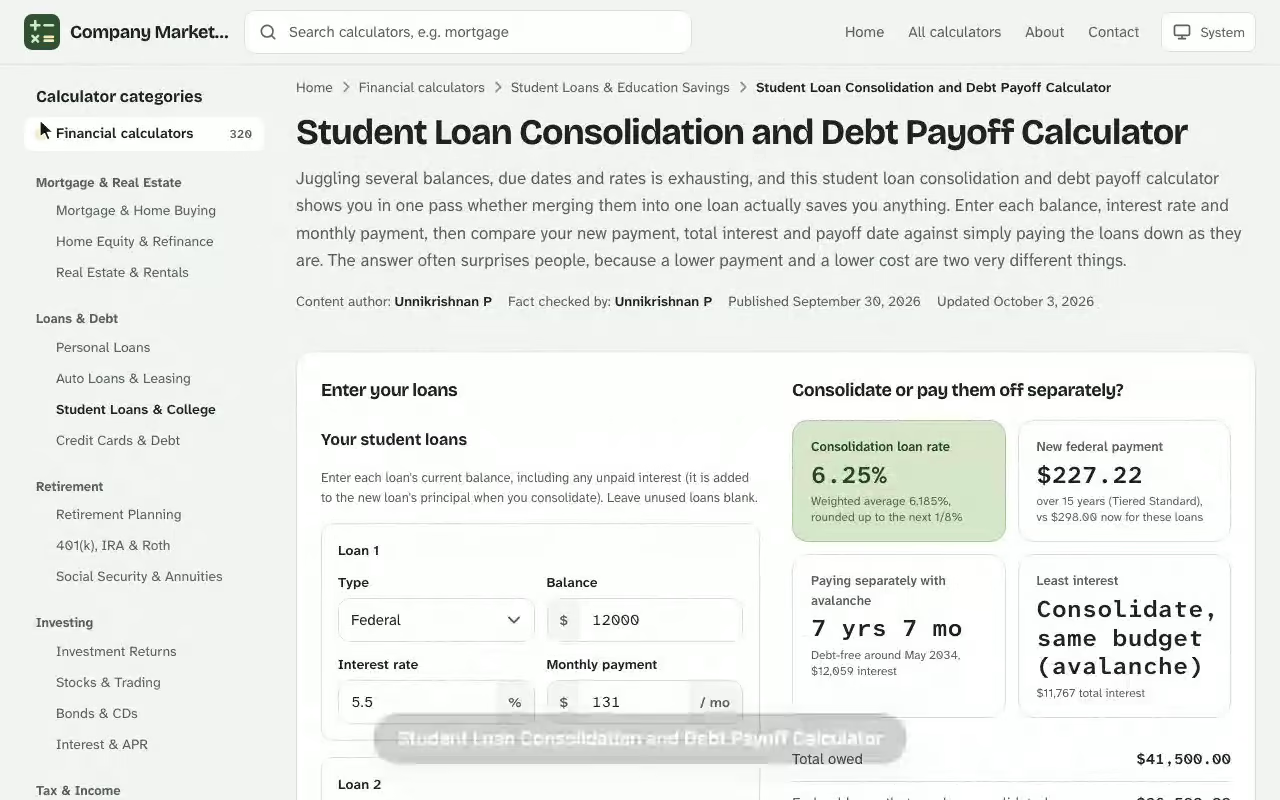
Student Loan Consolidation and Debt Payoff Calculator
Student Loan Consolidation and Debt Payoff Calculator. Juggling several balances, due dates and rates is exhausting, and this student loan consolidation and debt payoff calculator shows you in one pass whether merging them into one loan actually saves you anything. Enter each balance, interest rate and monthly payment, then compare your new payment, total interest and payoff date against simply paying the loans down as they are. The answer often surprises people, because a lower payment and a lower cost are two very different things. Next, open the free student loan calculator and enter your own details to see an estimate in seconds.
Consolidate or pay them off separately?
Consolidation loan rate
–
New federal payment
–
Paying separately with avalanche
–
Least interest
–
Total owed–
Federal loans that can be consolidated–
Private loans kept as they are–
Federal payment change–
Monthly budget with your extra payment–
Only federal student loans can go into a Direct Consolidation Loan. Mark at least one loan as federal to see the consolidation plans.
Four ways to repay
Required payments only, or a fixed monthly budget that puts everything left over on the highest-rate loan (avalanche).
Plan
Monthly payment
Debt-free in
Total interest
Total paid
2026 consolidation rules
The new rate is the weighted average of your federal rates rounded up to the next 1/8%, so consolidating never lowers your rate. A consolidation loan made on or after July 1, 2026 can be repaid only under the Tiered Standard plan (shown here, with a 10- to 25-year term set by the balance) or the income-based Repayment Assistance Plan, which is not estimated here, and your other Direct Loans move to those plans too. Private loans cannot be consolidated with federal ones.
When each loan is paid off
Paying separately with avalanche, and after consolidating with the same monthly budget.
Loan
Type
Balance
Rate
Separate (avalanche)
Consolidated, same budget
Balance left at the end of each year
What you still owe in total under each plan.
Year
Keep, required
Keep, avalanche
Consolidate, required
Consolidate, same budget
Results are estimates for educational purposes and are not financial, tax or legal advice.
How the Student Loan Consolidation and Debt Payoff Calculator Works
The tool runs two scenarios side by side. In the first, you keep every loan separate and pay each one on its current schedule. In the second, your balances are combined into a single loan at a weighted average rate, and you choose a new repayment term. Both scenarios can then include an extra monthly payment, so you can see how much sooner you could be debt-free and how much interest you would avoid. If you want to see how the figures change, the free college cost calculator gives you an instant result you can adjust as you go.
Every result comes from the same amortization engine your lender uses: interest accrues each month on the remaining balance, your payment covers that interest first, and whatever is left reduces the principal. Because the balance shrinks a little every month, the interest portion of each payment shrinks too, and that is why paying extra early in the schedule is so powerful.
See how the Student Loan Consolidation and Debt Payoff Calculator works: change the inputs and the consolidation loan rate updates instantly. Enter your own numbers in the calculator above.
What you get back
Your combined monthly payment before and after consolidation
The total interest and total payments over the life of each option
Your payoff date, shown as years and months remaining
The interest saved when you add an extra payment
Student Loan Repayment Calculator Inputs You Need
Before you start, log in to your loan servicer account (federal borrowers can also check studentaid.gov) and write down four things for every loan: the current loan balance, the interest rate, the remaining term, and the minimum payment. Use the balance you owe today, not the amount you originally borrowed, because interest has been accruing and may have been capitalized. If you want to see how the figures change, the student loan interest deduction calculator gives you an instant result you can adjust as you go.
Loan amount
The remaining balance on each loan, including any unpaid interest that has been capitalized into the principal.
Interest rate
The annual rate on each loan. Federal loans carry a fixed interest rate; private lenders may offer a variable interest rate tied to a benchmark rate.
Repayment term
How many years or months are left before the loan is paid off. A new term applies after consolidation.
Extra monthly payment
Any additional amount you can put toward debt every month, on top of your minimum payment.
If a servicer lists the rate as an APR, remember that the annual percentage rate includes fees as well as interest, so it will run slightly above the plain note rate. Use the note rate in the calculator and keep the APR for comparing offers.
Debt Consolidation for Student Loans: What Changes and What Stays
Debt consolidation replaces several loans with one. You make one monthly payment instead of several, and in most cases you get lower monthly payments because the loan term stretches over a longer time period. That trade is the heart of the decision: your cash flow improves now, and your cost usually rises later. What consolidation does not do is erase interest or reduce what you borrowed.
The Direct Consolidation Loan and the weighted average rate
A Direct Consolidation Loan combines multiple federal loans into one. Its fixed interest rate is the weighted average of the rates on the loans you consolidate, rounded up to the nearest one-eighth of a percentage point. The calculator mirrors that rule:
Because the rounding always goes up, a federal consolidation never lowers your rate; it only blends the rates you already have. Consolidating can also reset benefits attached to individual loans, such as interest rate discounts, principal rebates or cancellation terms, so check what you would give up.
Federal student loans versus private student loans
Federal student loans qualify for the Direct Consolidation Loan and keep access to income-driven repayment and forgiveness programs. Private student loans cannot join a federal consolidation. Merging them means taking a new private loan or refinancing, which is underwritten on your credit score and income, and a cosigner may help you secure a lower rate. Refinancing federal loans into a private loan permanently ends federal protections such as deferment and forbearance options, so treat that step as irreversible.
This calculator models education loans only, so a general debt consolidation calculator built for cards is the better tool to price higher-interest debts such as credit card debt, perhaps with a fixed-rate loan from a bank. A personal loan marketed for debt consolidation will not do the job for your education balances: some lenders state plainly that college student loan debt is not eligible for it.
Who Should Use a Student Loan Calculator Like This One
Any borrower with more than one education loan can learn something from a side-by-side comparison. The most common situations are a recent graduate facing the first bills after graduation, a parent repaying Parent PLUS loans, and a professional who borrowed a mix of Stafford loans and private loans over several years of college.
The same student loans look very different depending on your financial goals. If you plan to apply for a mortgage in the next year or two, a lower required payment improves your debt-to-income ratio, and that may matter more to you than total cost. If your priority is simply to be done, the shortest term wins. Neither answer is wrong, but you should choose it knowingly rather than discover it later.
Seeing the numbers also keeps your motivation up: the payoff date moves in whenever you add extra money, so a sacrifice becomes a date on the calendar. The education that created the debt is already paid for; what remains is a plan. The calculator handles federal student loans and private student loans alike, and your student loans are best tracked by rerunning the student loan calculator whenever a rate or balance changes.
Student Loan Payoff Math: The Formulas Behind Your Results
Each loan is priced with the standard fixed-payment formula, where P is the balance, i is the monthly rate (annual rate divided by 12) and n is the number of monthly payments:
$$M = P \times \frac{i(1+i)^{n}}{(1+i)^{n}-1}$$
Total interest is simply what you pay minus what you borrowed:
$$\text{Total interest} = (M \times n) - P$$
When you add an extra payment, the calculator steps through the schedule one month at a time. Each month the interest is \(P \times i\), the rest of the payment reduces the balance, and the loop ends when the balance reaches zero. That count of months is your payoff timeline.
All educational loans in the U.S. allow prepayment without a penalty, and the calculator assumes every extra dollar reduces the principal. In real life, confirm in writing that your servicer applies extra money that way; otherwise your student loans may treat it as an early payment on next month's bill, which does nothing for the balance and weakens your financial plan.
Worked Example: Three Loans Under a Debt Payoff Plan
Suppose you owe $34,850 across three loans, each with a 10-year standard term remaining. Here are the loans and the payments the calculator finds for them:
Loan
Balance
Interest rate
Monthly payment
Total interest
Loan A
$14,280
4.99%
$151.39
$3,887.01
Loan B
$11,650
6.31%
$131.16
$4,089.19
Loan C
$8,920
7.92%
$107.85
$4,021.70
All three
$34,850
6.18% weighted
$390.40
$11,997.91
The weighted average of 4.99%, 6.31% and 7.92% is 6.18%, which rounds up to 6.25% on a consolidation. Now compare what happens with each choice, including a $175 extra monthly payment on top of your current $390.40 (a $565.40 budget):
Option
Monthly payment
Time to pay off
Total interest
Keep three loans, minimum payments
$390.40
10 years
$11,997.91
Consolidate at 6.25%, 10-year term
$391.30
10 years
$12,105.54
Consolidate at 6.25%, 20-year term
$254.73
20 years
$26,284.83
Keep three loans, $175 extra to highest rate
$565.40
6 years 2 months
$6,673.13
Consolidate at 6.25%, $175 extra
$565.40
6 years 3 months
$7,290.58
What the comparison tells you
Stretching the term to 20 years cuts your monthly payment by $135.67, but it adds $14,286.92 in total interest compared with the current plan. The shorter the new term, the closer consolidation gets to your current cost; at 10 years it is actually $107.63 more expensive, because the blended rate was rounded up. The lowest-cost route is the one that keeps the payment high: with the extra $175, you pay the loan with the highest rate first and keep your total interest at $6,673.13, which is $617.45 less than the consolidated loan at the same payment.
Principal and total interest on $34,850 by repayment option.
Reading Your Student Loan Payment Calculator Results
Look at three numbers in this order: the total interest, the payoff date, and only then the monthly payment. A lower payment feels like relief, but it is a cash-flow benefit, not a savings. Use the first two numbers to judge cost and the third to judge whether the budget can handle the plan.
The table below shows how the payment on a $34,850 balance moves with the rate and the term, which is useful if your servicer quotes a slightly different consolidation rate:
Rate
10 years
15 years
20 years
25 years
5.75%
$383
$289
$245
$219
6.00%
$387
$294
$250
$225
6.25%
$391
$299
$255
$230
6.50%
$396
$304
$260
$235
6.75%
$400
$308
$265
$241
Notice that a quarter-point change in the rate moves your monthly payment by only $4 to $6, while moving from a 10-year to a 20-year term cuts it by well over a hundred dollars. The term, not the rate, is what drives your cost.
Monthly payment by rate and term for a $34,850 consolidation loan.
A Student Loan Repayment Calculator Check Before Filing a Consolidation Form
Dana has two federal loans with 120 months left: $16,382 at 3.73% and $9,847 at 6.09%. She is tired of two due dates and wants to know whether a Direct Consolidation Loan helps or just feels tidier. She enters both balances, both rates and both 10-year terms into the calculator.
The separate payments come back as $163.77 and $109.77, a combined $273.53 a month, with $6,594.99 in total interest. The calculator then blends the loans: the weighted average works out to 4.616%, and the federal rounding rule lifts it to 4.625% on a combined $26,229. That rate sits well under the 6.09% on her costlier loan but above the 3.73% on the cheap one, so she knows the blend raises the cost of the cheap loan to lower the cost of the other.
Next she tests terms. A 15-year consolidation drops the required payment to $202.33, which is 3.7% of her $5,420 gross monthly income against 5.0% today, but total interest climbs to $10,190.36, up $3,595.37. A 20-year term at $167.71 pushes interest to $14,022.02. Her mortgage lender's guideline of a 43% back-end debt-to-income ratio is not at risk either way, so she has no reason to pay for the lower payment with extra years.
The decision comes from one more run. She keeps the 15-year term, but enters $273.53 as her planned monthly payment. The result: payoff in exactly 120 months with $6,577.31 in interest, $17.68 less than keeping the loans apart. Dana files the consolidation with the 15-year term, because the required $202.33 gives her breathing room if her income dips, and sets her autopay to $273.53 so her debt payoff schedule is unchanged. Single bill, same finish line, and a cushion she can use only when she needs it.
Paying Off Debt Faster with Extra Payments
Extra payments are the most reliable lever you control. Because each one goes straight to the principal, it removes the interest that balance would have generated for every remaining month. An extra $175 a month cut the payoff from 120 months to 74 in the example above, saving $5,324.78 in interest.
Debt-free dates under three repayment plans.
Debt snowball or highest interest rate first
The debt snowball pays debts from smallest to largest balance regardless of rate; each payoff frees up cash and builds momentum for the next one. Targeting the highest interest rate first costs less in pure math, and with the example loans it means attacking Loan C (7.92%) before the others. The snowball would start with Loan C too, since it has the smallest balance, so here both approaches agree. When they disagree, the difference in interest is usually modest, and the strategy you will actually stick with wins.
Choosing the extra payment to enter
Pick an extra amount your budget can sustain, enter it in the extra-payment field, and compare the new payoff date with the old one. Your student loans bill should sit alongside your other financial obligations when you choose that number, and a small emergency fund keeps one surprise bill from pushing you back onto credit cards. If you are weighing whether to use that money to pay off student loans or to invest, compare the guaranteed return of retiring a 6.31% loan with what a risk-free alternative pays.
Loan Repayment Plans for Federal Student Loans
If you cannot afford your current payment, a different federal loan repayment plan may help before you reach for consolidation. Most borrowers are placed on the standard repayment plan of 10 years by default. A graduated repayment plan starts with smaller bills that step up every two years, which suits a borrower whose pay is expected to climb.
Plan
Length
How the payment works
Forgiveness
Standard
10 years
Fixed amount
No
Graduated
10 years
Starts low, rises every two years
No
Extended
Up to 25 years
Fixed or graduated
No
Income-based repayment
20 or 25 years
A share of discretionary income
Yes, on the remaining balance
Under income-driven repayment, your payment is tied to discretionary income, so it flexes with your earnings. The trade-off is the same as with a longer consolidation term: the lower payment adds interest. Some plans end with forgiveness of what remains, and borrowers working in public service may qualify earlier.
Student Loan Payoff Calculator Tips Before You Consolidate
Run the calculator with the shortest term you can afford first, then lengthen it only if the payment is out of reach.
Check whether any of your loans is subsidized; consolidating can end that treatment on interest, and unsubsidized loans keep accruing interest through grace period and deferment.
Find out whether unpaid interest will be capitalized, because it raises the principal you pay interest on.
Keep paying your current bills until the consolidation is confirmed; a missed payment can land on your credit report and a default makes the whole balance due.
Remember that you can always pay extra: all U.S. education loans are penalty-free to prepay, so a longer term does not lock you into the slower schedule.
Look for an origination fee on any new loan and compare offers by APR rather than by rate alone; a private refinance can also trigger a hard credit check that briefly dips your credit score, while federal consolidation does not require one.
Rerun the Student Loan Payment Calculator to Protect Your Debt-Free Date
Once you have your debt-free date, treat it as a target to protect. Paying down student loans is a long game, and the financial payoff comes from steady habits, not one big move: the money you commit in month one matters as much as the money you commit in year five. Set up automatic payments for all of your student loans, then raise the amount whenever your income rises. If you had a loan with a variable interest rate, rerun the calculator whenever the rate resets, since the payoff date moves with it. Re-entering your remaining balance once or twice a year keeps the numbers honest and shows you the payoff timeline shrinking.
Student Loan Consolidation and Debt Payoff Calculator questions
Is it better to consolidate student loans or pay them off individually?
It depends on what you want. Consolidation gives you one bill and, with a longer term, a lower payment, but a longer term usually adds interest. Keeping loans separate and sending extra money to the highest-rate loan generally costs less. Enter both options in the calculator and compare the total interest.
What interest rate will my consolidation loan have?
A federal Direct Consolidation Loan uses the weighted average of your loan rates, rounded up to the nearest one-eighth of a percent, so it never lowers your rate. Leave the consolidation rate at 0 and the calculator applies that rule for you.
Can I consolidate private student loans?
Private loans cannot be added to a federal Direct Consolidation Loan. You can combine them through private refinancing, which depends on your credit and may end federal protections if you refinance federal loans.
How do extra payments change my payoff date?
Extra payments reduce your principal sooner, which lowers the interest that builds each month and brings your payoff date closer. Add a monthly, yearly or one-time amount and the calculator shows the new payoff time and interest saved.
Where do I find my loan balance and interest rate?
Log in to your loan servicer account or, for federal loans, to studentaid.gov. Each loan lists its current balance, interest rate and monthly payment. Private lenders show the same details in their own portals.
Does consolidating hurt my credit score?
A federal consolidation does not require a hard credit check. A private refinance usually does, which can lower your score briefly. Paying on time afterward helps it recover.
Will I lose any federal benefits if I consolidate?
You may lose benefits attached to individual loans, such as interest rate discounts, principal rebates or some cancellation terms. Check with your servicer before you consolidate.