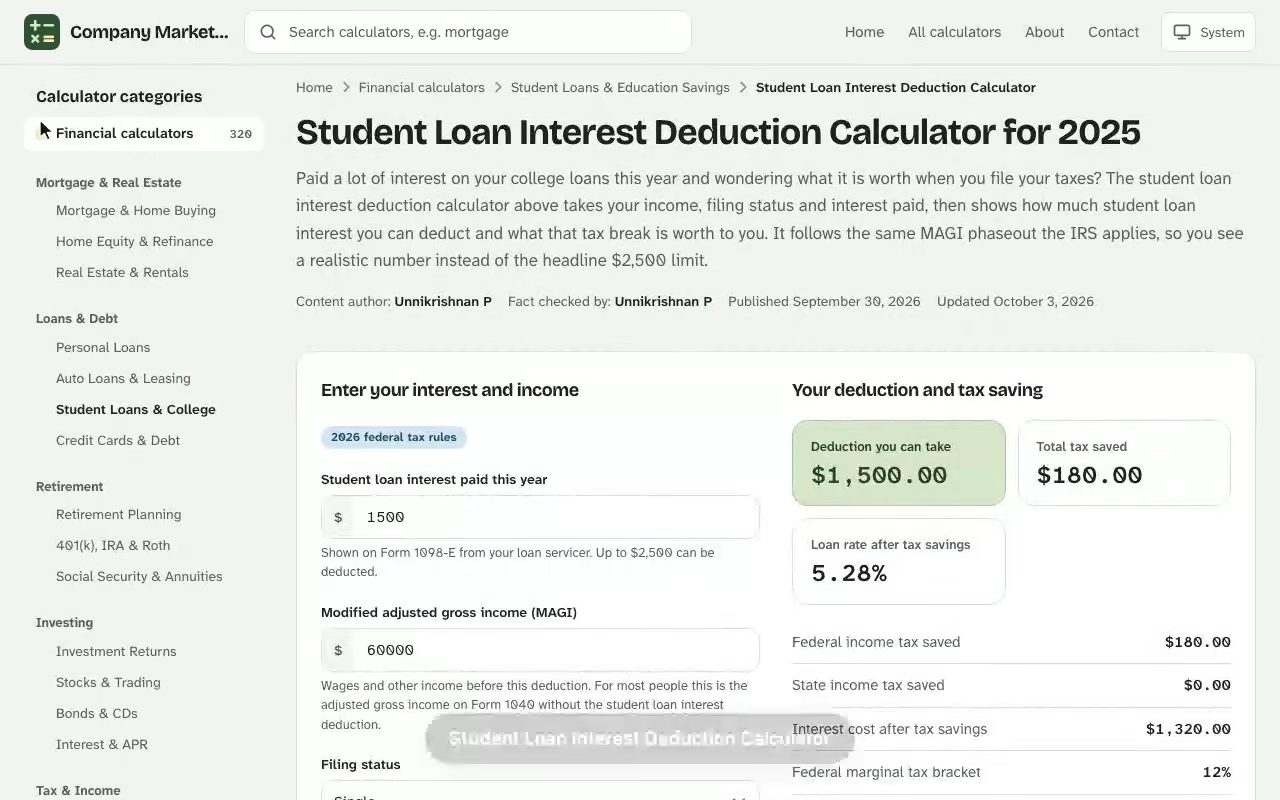
Student Loan Interest Deduction Calculator. Paid a lot of interest on your college loans this year and wondering what it is worth when you file your taxes? The student loan interest deduction calculator above takes your income, filing status and interest paid, then shows how much student loan interest you can deduct and what that tax break is worth to you. It follows the same MAGI phaseout the IRS applies, so you see a realistic number instead of the headline $2,500 limit. Pair this with the student loan calculator for a fuller picture before you make a decision.
Your deduction and tax saving
Deduction you can take
–
Total tax saved
–
Loan rate after tax savings
–
Federal income tax saved–
State income tax saved–
Interest cost after tax savings–
Federal marginal tax bracket–
2026 phase-out range (MAGI)–
Federal taxable income after the deduction–
Results are estimates for educational purposes and are not financial, tax or legal advice.
How the Student Loan Interest Deduction Calculator Works
The student loan deduction is an above-the-line deduction, which means it is an adjustment to income that lowers your adjusted gross income before anything else is applied. You do not have to itemize to claim it. The calculator turns that rule into three questions and one answer, so you can estimate your result in under a minute. Next, open the student loan consolidation calculator online and enter your own details to see an estimate in seconds.
Inputs You Need: MAGI, Filing Status and Interest Paid
Gather these figures before you start:
Modified adjusted gross income (MAGI): for most people this is your adjusted gross income (AGI) with a few add-backs, so your prior-year tax return is a good starting point.
Filing status: single, head of household, qualified surviving spouse (also called a qualifying widow or widower) or married filing jointly. Married filing separately is not eligible.
Interest paid: the total interest payments you made on qualified student loans during the tax year, shown on each Form 1098-E.
Tax bracket: your marginal federal rate, used to convert the deduction into dollars saved.
What the Result Tells You
You get your maximum deduction after the income reduction, the amount of disallowed interest, and an estimate of federal tax savings. Treat the figure as a planning estimate. Your tax software or a tax pro makes the final call when your return is prepared.
Before any math matters, you have to qualify. The student loan interest tax deduction has a short list of tests, and failing any one of them brings the deduction to zero, no matter how much interest you paid. Eligibility depends on the borrower, the loan and your tax return. Try the college savings calculator to run your own numbers — everything is calculated in your browser and nothing you enter is stored or sent anywhere.
Qualified Student Loan and Qualified Education Expenses
A qualified student loan is a loan you took out solely to pay qualified education expenses for yourself, your spouse or a person who was your dependent when you borrowed. Both federal and private student loans can count. The spending must cover an eligible student at a school offering higher education, such as a college, university or trade school, during an academic period, and it must be paid within a reasonable time before or after you take out the loan. Qualified education expenses include:
Tuition and fees
Room and board
Books, supplies and equipment
Other necessary costs, such as transportation
The student must be enrolled at least half-time in a program leading to a degree, certificate or another recognized credential. Loans from a related person or from a qualified employer plan do not count as qualified loans.
Filing Status, Dependents and Legal Obligation
To claim the deduction, all of these must be true:
Your filing status is anything except married filing separately.
You are legally obligated to pay interest on the loan, so a parent or friend who pays a loan that is not theirs cannot claim it.
You actually paid interest on the loan during the tax year.
You are not a dependent on someone else's return, and neither is your spouse: if a parent still claims you as a dependent, the deduction is off the table for that year.
Your MAGI falls below the annual income limit for your filing status.
When two spouses both carry loans on a joint return, the household still gets a single $2,500 deduction, not one for each person.
Student Loan Interest Deduction Income Limits and Phaseout
The deduction limit is the lesser of $2,500 or the interest you paid. Higher earners lose part of it, because the deduction is phased out across a range of MAGI. Below the range you keep the full amount; above it you keep nothing. For the 2025 tax year, the thresholds are:
Filing status
Full deduction up to MAGI of
Phase-out range
No deduction at MAGI of
Single, head of household or qualified surviving spouse
$85,000
$85,000 to $100,000
$100,000 or more
Married filing jointly
$170,000
$170,000 to $200,000
$200,000 or more
Married filing separately
Not eligible
Not applicable
Any income
These income limits are adjusted periodically for inflation, so confirm the numbers for the year you are filing against IRS Publication 970.
MAGI vs Adjusted Gross Income
Adjusted gross income is your gross income minus adjustments such as this deduction itself. For this deduction, MAGI is AGI figured without the student loan interest adjustment, and with a few other exclusions added back. That circularity trips people up: you test your income before taking the deduction, not after. If you earn only wages, your MAGI is usually very close to the AGI line on last year's Form 1040.
The Phase-Out Range Formula
Inside the phase-out range, the reduction is proportional to how far your MAGI has climbed. Take the smaller of your interest paid and $2,500, then scale it down:
The range width is $15,000 for single filers and $30,000 for joint filers. The share removed by this fraction is your disallowed interest. Below the lower limit the fraction is zero, and at or beyond the top of the range the deduction is zero.
The deduction is flat below $85,000 of MAGI, then declines to zero at $100,000.
Deduct Student Loan Interest: A Worked Example
Here is a complete calculation for a single filer. Suppose your MAGI is $91,400, and two loan providers sent you Forms 1098-E showing $1,260 and $920 of interest. Your total interest is $2,180, which is below the $2,500 cap, so the cap does not bind. Your MAGI exceeds the $85,000 lower limit, so the phaseout applies.
Step
Calculation
Result
Total interest paid
$1,260 + $920
$2,180
Income above lower limit
$91,400 − $85,000
$6,400
Share of phase-out range used
$6,400 ÷ $15,000
0.4267
Disallowed interest
$2,180 × 0.4267
$930.13
Deductible interest
$2,180 − $930.13
$1,249.87
Written as one expression, the result is \(2{,}180 \times (1 - 0.4267) = 1{,}249.87\). Your deduction is $1,249.87, which means roughly 57% of the interest you paid is deductible.
How the phaseout turns $2,180 of interest paid into a $1,249.87 deduction.
Student Loan Tax Deduction Savings: Brackets, Refund and Repayment
A deduction is not a dollar-for-dollar refund, and it is not a credit. A credit cuts your bill directly, while a deduction only reduces your taxable income, so the real value depends on your tax bracket. Multiply the deduction by your marginal rate for a quick estimate of federal tax savings.
In the worked example, a single filer at the 22% bracket saves about $1,249.87 × 0.22 = $274.97 in federal tax. If the state also taxes income at 4% and follows the federal deduction, state tax savings add roughly $50, bringing the annual savings to about $325. Whether that shows up as a bigger tax refund or a smaller balance due depends on what you withheld from your paychecks, and on how your taxes look once every other credit and deduction is counted.
See how the Student Loan Interest Deduction Calculator works: change the inputs and the deduction you can take updates instantly. Enter your own numbers in the calculator above.
There is a second, quieter benefit. Because the deduction lowers your AGI, it can also reduce the IDR payment on an income-driven repayment plan, since those payments are calculated from AGI. The tax benefit is modest, so treat it as a bonus rather than a reason to carry debt longer than you need to.
Student Loan Tax Deduction Walkthrough: A Joint Return at $183,250 MAGI
Priya and Dev are finishing their joint return in February and want to know whether the student loan interest deduction still applies to them. Priya's servicer reports $2,740 on her Form 1098-E, and last year's return shows a MAGI of $183,250, so they open the calculator and enter both figures with a filing status of married filing jointly.
Their income sits inside the IRS joint phase-out range of $170,000 to $200,000, and the interest exceeds the $2,500 cap, so the calculator works from $2,500:
Income above the lower limit: $183,250 − $170,000 = $13,250
Share of the $30,000 range used: 0.4417
Disallowed interest: $2,500 × 0.4417 = $1,104.17
Deductible interest: $1,395.83
At their 24% marginal bracket, that is $335 of federal tax saved. The result also explains something they had wondered about: a deduction near $1,400, not the $2,500 they remembered from a tax article, is the correct figure for their income.
Then they change one input. Dev's employer lets him raise his pre-tax 401(k) deferral by $6,000 next year, which would lower their MAGI to $177,250 at the same pay. Rerunning the student loan interest deduction at that income gives $2,500 × (1 − 7,250 ÷ 30,000) = $1,895.83, an extra $500 of deduction worth about $120 more in tax savings on top of the contribution's own benefit. They decide to raise the deferral for next year, keep the 1098-E with their records, and enter $1,395.83 on Schedule 1 for this return.
Claiming the Student Loan Deduction: Form 1098-E, Schedule 1 and Your Tax Return
You do not need to itemize or take anything other than the standard deduction, so claiming is straightforward. Follow these steps:
Collect every Form 1098-E your student loan servicer or loan provider issues. A servicer must send one when you paid $600 or more of interest; for smaller amounts, check your online account.
Add the totals to find your total interest for the year.
Find your MAGI and compare it with the limits for your filing status.
Complete the student loan interest deduction worksheet in the Form 1040 instructions (or Worksheet 4-1 in Publication 970 for special cases).
Enter the result on Schedule 1, which carries it to your Form 1040 as an adjustment to income.
Keep your servicer statements with your records. If you use a tax pro or filing software, bring the 1098-E forms so they can confirm your eligibility and apply the phaseout.
Is Student Loan Interest Deductible in Special Cases?
A few situations change the answer, and it is worth knowing them before you rely on an estimate.
Private student loans: they qualify if they meet the qualified-loan test, even though no federal program is involved.
Refinancing: borrowers who move a qualified loan to a new lender generally keep the deduction, as long as the new loan is not used for anything else. Interest paid on a cash-out balance is a different matter.
Student loan forgiveness: forgiven balances stop generating interest payments, and you cannot deduct interest on a loan that qualifies for forgiveness you actually receive.
Parents paying: if you took the loan and your parents make the payments, neither of you can claim it unless the legal obligation and payments line up, and a parent who claims you as a dependent also blocks your own claim.
Education Tax Credits Versus This Tax Deduction
Eligibility for this deduction does not block other education benefits. A tax credit reduces your tax bill directly, so it is often worth more than a deduction. The American Opportunity Tax Credit and the Lifetime Learning Credit both apply to expenses you pay while enrolled, even if student loans covered them. You cannot count the same expense twice, so compare each option against your own numbers.
Planning Ahead for Next Tax Year
To keep more of your student loan interest deduction next year, remember that only interest counts toward it, so extra principal payments do not help. Anything that lowers your MAGI does, because it moves you back down the phase-out range. Rerun the calculator with a lower MAGI to see what each reduction is worth; your taxable income and the deduction move together inside the range, so small changes matter more than they appear.
Deduction for a single filer by MAGI and interest paid, with the worked example outlined.
Student Loan Interest Tax Rate Calculator vs the Deduction Tool
Some tools, like a student loan interest tax rate calculator, focus on what your deduction does to your average and marginal rate rather than to the deduction itself. The two views fit together. The deduction tool above gives the amount that lands on Schedule 1; a rate-focused tool shows how that amount moves you through the federal tax brackets once your standard deduction, dependents and credits are applied.
Think of this student loan interest tax deduction calculator as the first step: enter your MAGI, filing status and interest paid, read the deduction, then apply your marginal bracket as in the example above. Recheck the income limit for your filing status before you file, and keep each Form 1098-E with your records, whether you prepare the return yourself or hand it to a tax pro.
You can deduct the lesser of $2,500 or the interest you paid during the year, as long as your MAGI is below the limit for your filing status. Inside the phase-out range the amount shrinks.
What are the income limits for the student loan interest deduction?
For the 2025 tax year the deduction phases out between a MAGI of $85,000 and $100,000 for single, head of household and qualifying surviving spouse filers, and between $170,000 and $200,000 for married filing jointly.
Do I have to itemize to claim the student loan interest deduction?
No. It is an above-the-line deduction, so you can claim it as an adjustment to income even if you take the standard deduction.
Can I claim the deduction if I file as married filing separately?
No. Married filing separately is not eligible, so the calculator returns zero for that filing status.
If we file jointly, can we each deduct $2,500?
No. A joint return gets a single $2,500 maximum for both spouses combined, and the phaseout uses your combined MAGI.
Can I deduct interest on private student loans?
Yes, if the loan is a qualified student loan taken out to pay qualified education expenses and you are legally obligated to pay the interest, private loans can qualify along with federal loans.
What form shows the student loan interest I paid?
Your loan servicer sends Form 1098-E when you paid $600 or more of interest during the year. If you paid less, check your online account for the total.
How does the deduction lower my IDR payment?
The deduction reduces your adjusted gross income, and income-driven repayment payments are based on AGI, so a lower AGI can mean a lower monthly payment. The calculator estimates this at about 10% of the deduction.