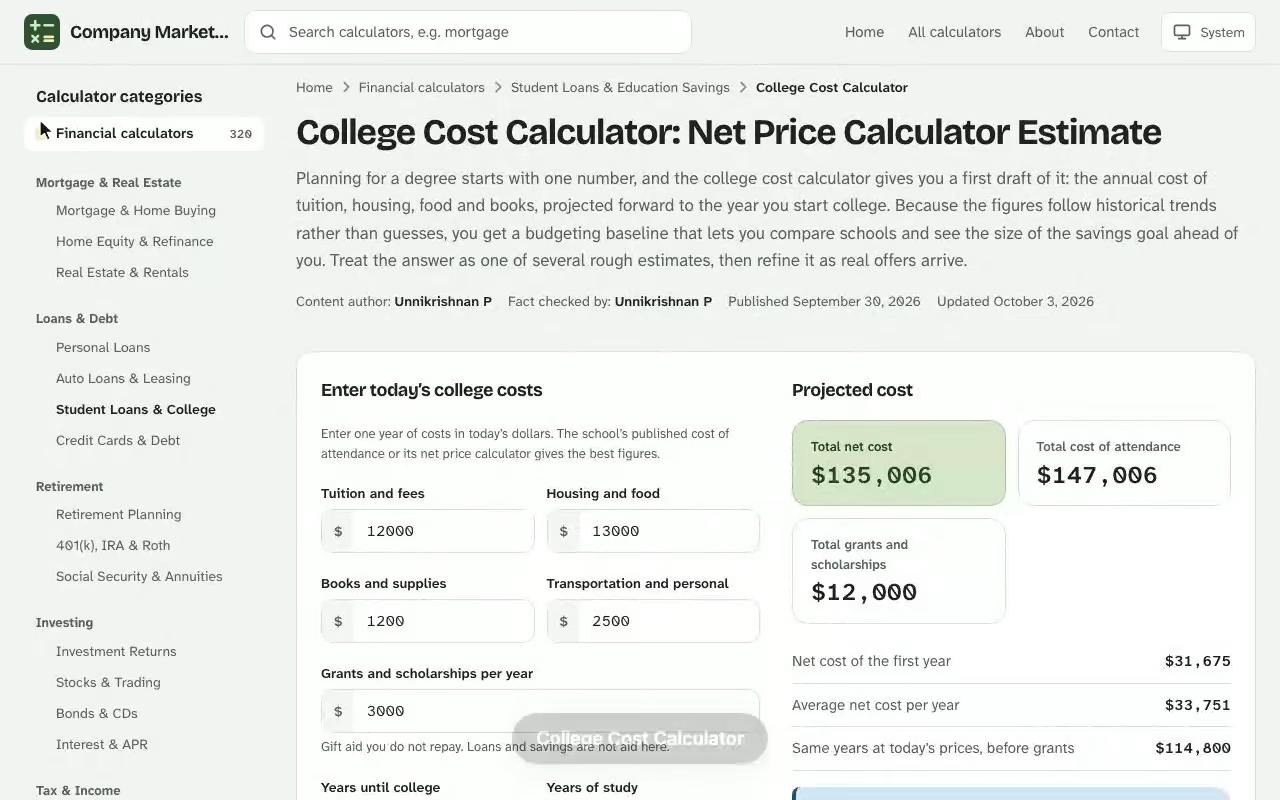
College Cost Calculator. Planning for a degree starts with one number, and the college cost calculator gives you a first draft of it: the annual cost of tuition, housing, food and books, projected forward to the year you start college. Because the figures follow historical trends rather than guesses, you get a budgeting baseline that lets you compare schools and see the size of the savings goal ahead of you. Treat the answer as one of several rough estimates, then refine it as real offers arrive. Pair this with the student loan calculator for a fuller picture before you make a decision.
Projected cost
Total net cost
–
Total cost of attendance
–
Total grants and scholarships
–
Net cost of the first year–
Average net cost per year–
Same years at today’s prices, before grants–
Cost increases are assumptions, not forecasts. Try a few rates to see a range. To plan how much to save, use the college savings calculator.
Cost by school year
Each year’s costs grow from today’s figures by the increase rates you entered.
School year
Tuition and fees
Housing and other
Cost of attendance
Grants
Net cost
Results are estimates for educational purposes and are not financial, tax or legal advice.
How Much Does College Cost? The Main Expense Categories
Before you estimate your college cost, it helps to know what the number contains. The cost of attendance at most schools combines four groups of expenses, and each one behaves differently from year to year. The first group is billed directly by the school, while the rest are choices you partly control. Try the student budget calculator online to run your own numbers — everything is calculated in your browser and nothing you enter is stored or sent anywhere.
Tuition and fees: the price of instruction, which differs by program, number of credit hours and residency.
Room and board: housing plus meal plans, or an off-campus living cost if you rent nearby.
Textbooks and school supplies: course materials, software and equipment, which you can reduce by renting or buying used.
Transportation and personal expenses: gas, transit passes, entertainment and everyday spending.
Tuition and Fees by School Type
College tuition is the largest line for most families, and it depends heavily on residency. Public colleges charge residents far less than visitors, so an in-state student pays a fraction of the sticker price an out-of-state student faces. Private colleges usually publish one price for everyone. A two-year program leading to an associate's degree costs much less per year than a four-year bachelor's degree, though the aid picture differs too. Some schools quote comprehensive fees that bundle tuition, fees and housing into a single bill, so check what the figure covers before comparing.
Room, Board and Living Costs
Colleges offer many living options, from dorms with meal plans to an apartment shared with roommates. Staying home removes housing and food from the bill, although some schools require first-year students to live on campus. Add transportation and entertainment, because they are real money even when they never appear on a bursar statement.
College Cost Calculator Formula and Worked Example
The projection behind any college cost projector is compound growth. You take today's average annual price, grow it by an inflation rate for each year until enrollment, and then keep growing it through each year of study. Many projectors assume a 3% increase each year, but you can change the rate to match what you see locally. If you want to see how the figures change, the free student loan consolidation calculator gives you an instant result you can adjust as you go.
Here \(r\) is the yearly growth rate, \(n\) is the number of years until you start college, and \(k\) is the study year (1 to 4). The total cost is the sum of the four yearly results.
A Four-Year In-State Example
Suppose you are budgeting for a public four-year school that starts in 8 years. Today the yearly bill is $11,850 for tuition and fees, $12,900 for room and board, $1,150 for textbooks and $2,300 for transportation and personal costs, a total of $28,200. With a growth rate of 4.5%, the first year grows by a factor of 1.0458, or about 1.4221, and each later year adds one more year of growth.
Study year
Tuition and fees
Room and board
Books
Other
Total cost
Year 1
$16,852
$18,345
$1,635
$3,271
$40,103
Year 2
$17,610
$19,171
$1,709
$3,418
$41,908
Year 3
$18,403
$20,033
$1,786
$3,572
$43,794
Year 4
$19,231
$20,935
$1,866
$3,732
$45,764
Four-year total
$72,096
$78,484
$6,996
$13,993
$171,569
The four-year total of $171,569 is about 52% more than the $112,800 you would get by multiplying today's bill by four, which shows how much compounding matters over a long horizon.
Projected yearly college cost for the four-year in-state example, split by expense category.
Net Price: What You Pay After Financial Aid
The sticker price is not what most families pay. The net price is the cost of attendance minus grants and scholarships, and it is the figure that should drive your decision. Subtracting aid from the projection turns a scary total into a payable one: with $7,500 of grant aid in each of the four years, the example above falls from $171,569 to a net cost of $141,569, or about $35,392 per year.
How $30,000 in grants turns the sticker price into the net price.
How a Net Price Calculator Works
Every school must post its own net price calculator, and the Department of Education collects them in one place. Each of these net price calculators asks about your household and returns what students like you paid last year after aid. The tools use data for a first-time, full-time student, so they suit a freshman better than a transfer. Use the projection above for the long view and the school-specific tool for the next year, and you have covered both ends.
Financial Aid: Grants, Scholarships, Loans and Work-Study
Grants and scholarships are the inputs that turn the sticker price into the net price, so they deserve a closer look. Financial aid comes in four basic forms, and a typical financial aid package mixes them. Grants and scholarships do not need repayment; together, scholarships and grants are the money that lowers your net price. Pell grants go to undergraduate students with financial need, while a merit-based scholarship rewards achievement and a need-based award reflects demonstrated financial need. Work-study jobs pay you for campus hours.
See how the College Cost Calculator works: change the inputs and the total net cost updates instantly. Enter your own numbers in the calculator above.
A student loan is the last piece, because it must be repaid. A direct subsidized loan covers students with financial need and pauses interest while you study; compared with other subsidized loans, unsubsidized loans accrue interest from the start. Federal student loans carry fixed interest rates and a grace period after graduation, but repayment eventually begins. The school builds the offer from your expected family contribution, the amount your family is judged able to pay, and the FAFSA is the application that produces it. The full name is the Free Application for Federal Student Aid.
Testing a Private School's Cost of Attendance Against an In-State Option
Marcus Bellamy has a daughter, Tessa, who is two years from graduating high school and wants a private university whose posted cost is $57,310 a year today. He has $48,000 in a 529 account and a ceiling of about $30,000 a year from income, so he opens the projection to see whether the plan holds.
He enters 2 years until enrollment, the $57,310 current cost and a 4% yearly growth rate. The first year comes back at $61,986, and the four-year total at $263,223. That is the sticker price, so he goes to the school's own net price calculator, which estimates $21,000 a year in grants for a student with Tessa's profile. Subtracting it leaves $40,986 for year one and $179,223 over four years.
Now he checks the number against hard limits. Even after the 529 balance, his $30,000 ceiling leaves a gap of roughly $11,000 in year one. Federal loans will not close it, because a dependent first-year undergraduate can borrow at most $5,500 a year, only $3,500 of it subsidized.
So Marcus reruns the projection for the in-state flagship, entering $26,480 with the same inputs. Year one comes to $28,641 and the four-year total to $121,622, inside his ceiling before any aid. The difference between the two schools is $57,601 over four years even after the private school's grants. His decision is to apply to both and wait for the actual offers, then rerun the numbers with the real grant figure.
Saving for Future College Costs from Your Estimate
Once the college cost projector gives you a four-year total, treat it as the savings target and work backward to a monthly amount. Starting early and making consistent contributions matters more than a large final deposit, because growth compounds over the years. Two kinds of 529 account are built for this job.
529 Savings Plan
A 529 savings plan invests your contributions in mutual funds, usually with an age-based asset allocation that becomes more conservative as enrollment approaches. Earnings are tax-free when spent on qualified education expenses, and some states add a state income tax deduction, which are the main tax advantages. Qualified expenses include tuition, fees, books, computers and room and board for students enrolled at least half time. Because the account is tax-advantaged, it works a bit like a Roth IRA for school. Parental assets held in the plan are assessed lightly in the aid formula. Those qualified categories mirror the calculator's own expense groups, so the plan can fund most of the projected total.
529 Prepaid Plan
A 529 prepaid plan works differently: you buy tuition credits today through a lump-sum or monthly payments, and they are redeemed later at participating schools. A prepaid plan is a way to hedge against inflation in tuition, but it usually covers tuition only and often limits you to in-state public colleges. Because it locks in tuition today, it protects you from the very growth rate the projection assumes. Compare it with the savings plan before choosing.
Using Your Estimate to Compare Colleges
An estimate is only useful if it leads to a decision. Use the output to sort your list, then confirm the details with official tools. The Department of Education's College Navigator lets you filter schools and build side-by-side comparisons, while the College Scorecard adds salary and debt data for graduates. When your financial aid offers arrive, line them up in a single table and calculate each school's true net price.
Enter the same growth rate for every school so the comparison stays fair.
Look for ways to cut costs, such as in-state options, renting books or a community college start.
Rerun the projection after each offer, because small changes in grants shift the total cost by thousands of dollars.
Averages from the College Board are a good way to sanity-check the current-cost inputs you feed the calculator, since higher education pricing shifts every year. Rerun the projection each fall with updated numbers so your savings plan keeps pace with the estimate.
Weighing Your Net Cost Against Budget and Earnings
Start from the net cost your estimate produces, because the cost of college is only half of the picture. A university or any other institution that looks expensive may still make sense when its popular majors lead to strong salaries, and the College Scorecard shows typical earnings by field. Bring that projected net cost to your parents or other contributors before applications go out: agree on a yearly budget, decide how much each person pays from income, and name the limit you will not borrow past.
Treat the savings target the calculator produces as one investment among several. Money sent to a 529 account is money not sent to retirement, so compare the monthly amount your projection requires with what you can spare after capturing any employer match. Parents who stretch too far for a tuition bill can leave themselves short later, and a lower-cost school that fits the projection is often the stronger financial move.
College Cost Calculator questions
How much does college cost per year?
It depends on the school type. Public in-state, public out-of-state, private and two-year schools all price differently, and the total also includes room and board, books and living costs. Pick an average in the calculator or enter your own figure.
What does the college cost calculator include?
It covers tuition, fees, housing, food and other annual costs you enter in one total, then grows that figure by a yearly increase rate until you start and through each year of study.
What cost increase rate should I use?
Use the rate that matches the trend for your target schools. A common planning range is a few percent a year; test a higher and a lower value to see how sensitive your total is.
What is the difference between sticker price and net price?
The sticker price is the full published cost. The net price subtracts grants and scholarships, so use each school's own net price calculator to estimate it.
Should I enter a tax rate on my college savings?
Enter the tax rate on your investment return for a taxable account. Use 0% for a 529 plan when withdrawals go to qualified education expenses.
Does this replace a school's net price calculator?
No. This tool projects the future total cost, while a school's net price calculator estimates what students like you paid after financial aid. Use them together.
How do I find the monthly savings I need?
Set the percent of costs you plan to pay from savings, your current balance, the return rate and the years until college starts. The calculator shows the monthly amount that closes the gap.