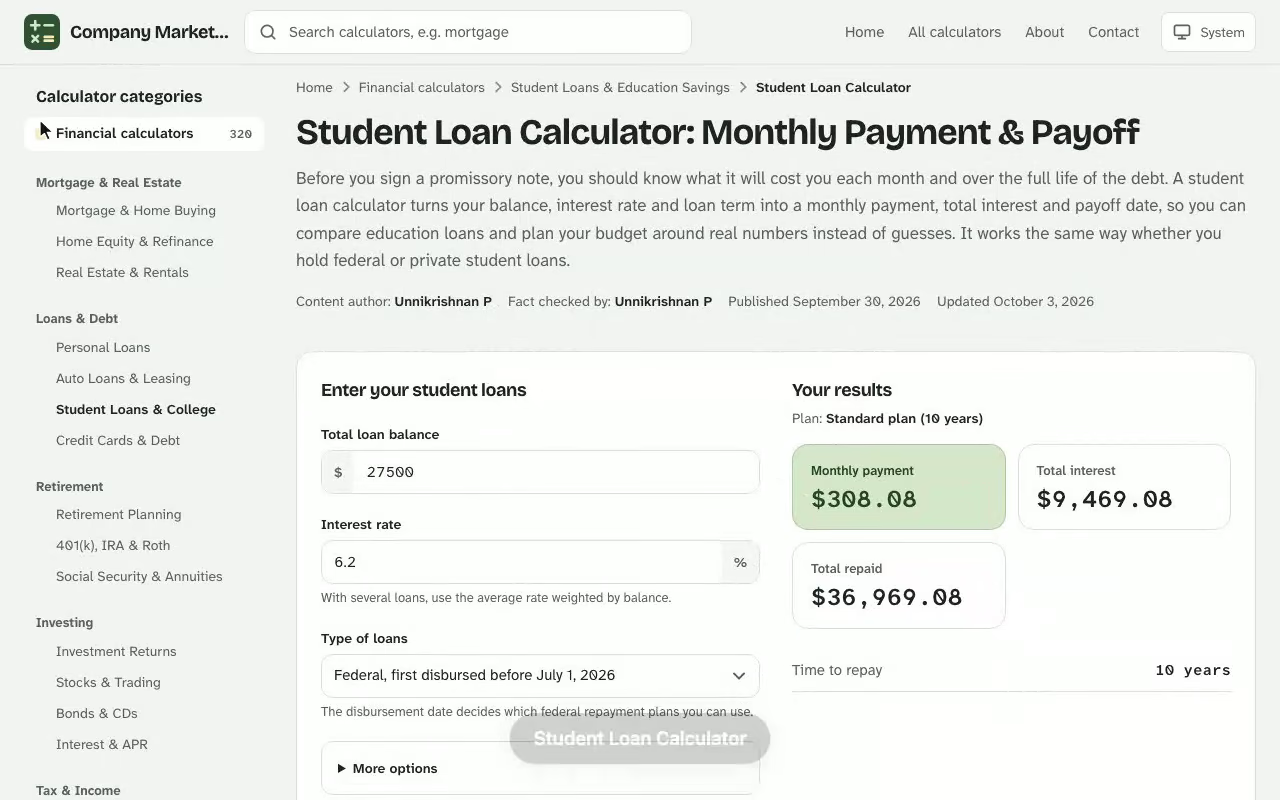
Student Loan Calculator. Before you sign a promissory note, you should know what it will cost you each month and over the full life of the debt. A student loan calculator turns your balance, interest rate and loan term into a monthly payment, total interest and payoff date, so you can compare education loans and plan your budget around real numbers instead of guesses. It works the same way whether you hold federal or private student loans. Next, open the free loan calculator and enter your own details to see an estimate in seconds.
Your results
Plan: –
Monthly payment
–
Total interest
–
Total repaid
–
Time to repay–
With your extra payments
Paid off in–
Sooner by–
Interest saved–
Federal fixed-payment plans compared
Repayment plans whose payments don’t depend on your income, under the 2026 rules. Graduated payments rise every two years; the figures are our estimate, because your servicer sets the exact steps.
Plan
Monthly payment
Time to repay
Total interest
Total repaid
Not covered here
Income-driven plans, including the Repayment Assistance Plan, base the payment on your income and family size, so they are not estimated here. Extended plans need more than $30,000 in Direct Loans, all disbursed before July 1, 2026.
Year-by-year schedule
Your main plan, including any extra monthly payment.
Year
Paid
Principal
Interest
Ending balance
Results are estimates for educational purposes and are not financial, tax or legal advice.
How a Student Loan Calculator Works Out Your Monthly Payment
Most student loans are repaid in equal monthly installments through amortization. Each payment covers that month's interest first, and whatever is left reduces the principal. Because the loan balance shrinks every month, the interest portion falls and the principal portion grows, even though the payment itself never changes. That is the reason early payments feel like they barely touch the debt. The free debt to income ratio calculator is free to use with no sign-up, and works on desktop and mobile.
The standard formula behind every loan payment calculator uses three inputs: the loan balance \(P\), the monthly interest rate \(r\) (the annual rate divided by 12), and the number of monthly payments \(n\):
$$M = P \times \frac{r\,(1+r)^{n}}{(1+r)^{n} - 1}$$
Here is a worked example with numbers you can follow. Suppose you borrow $32,740 at a 6.52% fixed interest rate and choose a 10-year repayment term, so \(r = 0.0652 \div 12 = 0.005433\) and \(n = 120\). The formula gives a monthly payment of $372.09. Your total payments across the 120 months come to about $44,651, which means total interest of about $11,911, or roughly 36 cents of interest for every dollar you borrowed.
Each year's payments split into principal and interest on the $32,740 loan at 6.52%.
Term and rate change the monthly student loan payment
The table below holds the same $32,740 balance fixed and shows how the monthly student loan payment moves when only the rate or the term changes. A longer term lowers the payment but raises the total interest, so the cheapest monthly bill is rarely the cheapest loan.
See how the Student Loan Calculator works: change the inputs and the monthly payment updates instantly. Enter your own numbers in the calculator above.Monthly payment for the same $32,740 balance at 4.52%, 6.52% and 8.07% over 10, 15 and 20 years.
Loan type and rate
10 years
15 years
20 years
Lower interest loan, 4.52%
$339.63
$250.79
$207.48
Undergraduate federal loan, 6.52%
$372.09
$285.56
$244.49
Graduate federal loan, 8.07%
$398.44
$314.20
$275.28
Inputs a Student Loan Repayment Calculator Needs
A student loan repayment calculator is only as accurate as what you type into it. Your loan servicer's monthly statement for your student loans lists the balance and the remaining term, so pull the latest bill before you start. Pair this with the payment calculator online for a fuller picture before you make a decision.
Loan balance and interest rate
Enter the current loan balance, not the amount you originally borrowed, because unpaid interest may have been added since. The interest rate is the yearly percentage the lender charges on that balance. Federal loans carry a fixed interest rate set by Congress each year, while a private lender may offer a variable rate that can change your payment later. This calculator assumes the rate stays constant, so a variable-rate loan needs a fresh calculation whenever the rate resets.
Loan term and repayment plan
The loan term is how many years you have left to pay. The standard repayment plan for federal borrowers runs 10 years, and extended or graduated options stretch or reshape that schedule. Results from a simple amortization model do not apply to income-driven plans, because those payments depend on what you earn rather than on a fixed schedule.
Origination fee and grace period
Federal loans carry an origination fee, a small percentage deducted at disbursement: 1.057% on Direct Subsidized and Direct Unsubsidized loans and 4.228% on Direct PLUS loans. Since loan fees are added to the balance you repay, include them in your starting figure. The grace period is the window after you leave school, typically six months, before payments begin. Interest on unsubsidized loans keeps accruing during it, so your balance after graduation can be higher than the amount you borrowed.
Simple Student Loan Calculator for Federal and Private Loans
A basic calculator treats every loan the same way, but the loans themselves do not. Knowing which type you hold tells you what to enter and what protections come with it. The student budget calculator online is free to use with no sign-up, and works on desktop and mobile.
Federal student loan types
A federal student loan is funded by the government and usually comes with the lowest rates and the most flexible repayment terms. Direct Subsidized Loans are need-based, and the government pays the interest while you are enrolled at least half-time. Direct Unsubsidized Loans are open to any student regardless of need, but interest starts building on day one. Older student loans may still be called Stafford loans. Direct PLUS Loans go to graduate students and to parents of dependent undergraduates, and Parent PLUS loans carry the highest rate and fee of the federal group. A Direct Consolidation Loan combines several federal loans into one.
State and private student loan options
A private student loan comes from a bank, credit union or online lender, and the rate usually depends on your credit score and whether you add a co-signer. Comparing prequalified rates from several lenders does not affect your credit, and it shows what each one would charge before you commit. A state student loan is offered by a state agency or nonprofit, and terms vary widely from one state to the next. Private lenders are not required to offer the forgiveness and hardship protections federal borrowers receive, so enter the exact rate and term from your offer letter.
Student Loan Payoff Calculator: What Extra Payments Save You
A student loan payoff calculator answers a different question than the payment formula: how much sooner you would be free of the debt if you added a fixed amount to every bill. Since interest on student loans is charged on the remaining balance, any extra dollar sent to principal stops generating interest for the rest of the loan. The payoff date moves up, and the interest you skip is pure savings.
Using the $32,740 example at 6.52% over 10 years, here is what three levels of extra payment do:
Extra each month
New monthly payment
Time to pay off
Total interest
Interest saved
$0
$372.09
10 years
$11,911
$0
$40
$412.09
8 years 9 months
$10,233
$1,678
$85
$457.09
7 years 7 months
$8,842
$3,068
$120
$492.09
6 years 11 months
$8,002
$3,909
The $85 row stands out: for less than a streaming-and-takeout budget, you finish 29 months early and keep about $3,068. Before you send anything extra, ask your servicer to apply it to the principal of your highest-rate loan, and check whether your minimum payment already covers the interest. Many servicers apply an overpayment to the next due date by default, which saves you nothing.
Months to pay off the $32,740 loan with and without extra monthly payments.
Student loan projection for borrowers still in school
A student loan projection calculator looks forward instead of back. If you are still enrolled, it estimates how much your debt will have grown by graduation, how much more it will grow during the grace period, and the payment you will owe when repayment begins. It lets you see the cost of borrowing another semester before you accept the money.
Running a Loan Payment Calculator on a Remaining $18,462 Balance
Dana, a nurse eight months into a new job, opens her servicer's March statement and sees $18,462.37 still owed on a graduate loan at 7.05%, with 96 monthly payments left. Her bill is $252.17, and she wants to know whether it is worth tightening her budget to finish early.
She enters the balance, the rate and the 96 months into the calculator. The payment comes back at $252.17, matching the statement, which confirms she typed the right inputs. The interest line reads $5,746, so by the last payment she will have paid 31 cents of interest on every dollar she still owes.
Next she compares her rate with the current federal fixed rate for new undergraduate loans, 6.52%. Her loan sits 0.53 points above it, but a lender's refinance would end her access to income-driven plans and federal forgiveness, so she rules that out before comparing any offers.
That leaves extra payments. She adds $60 a month in the extra payment field and reruns the numbers:
New monthly payment: $312.17
Payoff time: 73 months instead of 96, which is 23 months sooner
Total interest: $4,287, a saving of about $1,459
The $312.17 payment still leaves her $140 of margin after rent, so she sets up the bigger automatic transfer and writes a note to her servicer asking that every overpayment go to principal rather than the next due date. Her next step is to rerun the calculator in January with her raise included, to see whether $75 extra, which ends the loan in 69 months, is within reach.
Repayment Options and Income-Driven Repayment Plans
Federal loans give you several repayment options, and the right one depends on whether your priority is the lowest total cost or the lowest monthly bill.
Standard repayment, graduated repayment and extended terms
Standard repayment is a fixed amount for up to 10 years and costs the least interest. Graduated repayment starts lower and rises every two years, so you pay more interest overall. Extended repayment lengthens the term for larger balances. These plans follow the amortization math used above, so any calculator built on that formula applies to them.
Income-driven repayment plans
Income-driven repayment ties the bill to what you earn. Your payment is a percentage of discretionary income, which is your adjusted gross income minus a share of the federal poverty guideline for your household size. Any remaining balance may be forgiven after 20 to 25 years, and public service loan forgiveness can cancel what is left after qualifying payments while you work for a government or nonprofit employer. The table summarizes the main plans.
Plan
Share of discretionary income
Typical forgiveness timeline
Income-Based Repayment (IBR), older borrowers
15% of discretionary income
25 years
IBR for new borrowers and Pay As You Earn
10% of discretionary income
20 years
Income-Contingent Repayment (ICR)
20% of discretionary income
25 years
Eligibility depends on when you borrowed and which loan type you hold, and a borrower who cannot afford the standard payment may qualify through a partial financial hardship test. Because your income changes each year, these plans need a recertification, and a straight amortization calculator cannot predict the result. If unpaid interest builds because your payment is lower than the monthly interest, the balance can grow, even though you make every payment on time.
Lowering the Student Debt You Enter Into the Calculator
The cheapest dollar of student debt is the one you never borrow, because student loans accrue interest from the day they are disbursed. Work through these sources before accepting the full amount offered:
Scholarships and grants, which never need to be repaid.
Work-study jobs for students who show financial need.
Financial aid reviews that reduce the cost of attendance after the first year.
Savings put toward tuition at the college so the borrowed principal is smaller.
Every dollar you avoid borrowing is a dollar the calculator no longer charges interest on. Need-based aid has long been tied to the expected family contribution, so a lower figure can mean a smaller balance to enter. Borrowing only the difference between your cost of attendance and the aid you receive keeps the loan balance, the monthly payment and the lifetime interest down.
Loan consolidation and your credit card debt
Loan consolidation merges several federal loans into one payment with one servicer, so you may consolidate when separate bills become hard to track. The new fixed interest rate is a weighted average of the old ones, so enter that rate and the longer term in the calculator to see the cost before you decide. If you also carry credit card balances at a higher interest rate, the payment savings the longer term creates can go to the highest-rate balance first, then roll into the next one as a debt payoff order. Losing federal benefits such as loan cancellation or income-driven options is the main tradeoff to weigh before consolidating.
Choosing the right student loans for your situation
Borrow federal first, since those education loans carry fixed rates, a grace period and forgiveness paths. Turn to private lenders only after you have used the federal limit, and compare at least three offers on rate, fees and whether a co-signer can be released later. Run each offer through the calculator at the same term so you compare equal monthly installments. Whichever loan you pick, a graduate with a steady salary can use the payoff table above to decide how much extra to send each month.
Student Loan Calculator questions
How does a student loan calculator work out my monthly payment?
It spreads your balance over the number of months in your loan term using the amortization formula, which combines the monthly interest rate and the term into one fixed payment that covers interest first and principal second.
Does the calculator work for federal and private student loans?
Yes, for any loan repaid in equal monthly installments at a fixed rate. Income-driven and graduated federal plans change the payment over time, so the result will not match those plans.
How much can extra payments save me?
Anything added to the payment goes straight to principal once interest is covered, so it shortens the payoff date and cuts total interest. Use the payoff option to enter monthly, yearly or one-time extras and compare against your original schedule.
What is the grace period and does it add to my balance?
It is the stretch after graduation, often six months, before repayment must begin. On loans where interest keeps accruing, the unpaid interest is added to your balance, so you owe more than you borrowed.
Should I include the origination fee?
Yes. Federal loan fees are deducted from each disbursement but you repay the full amount, so entering the fee percentage raises the starting balance to what you actually owe.
Should I consolidate my student loans to lower the payment?
Consolidation can cut the monthly bill by stretching the term, but a longer term usually means more total interest, and you may lose benefits tied to the original loans. Run both terms through the calculator to compare.
Why does my result differ from my servicer's statement?
Statements reflect actual payment dates, capitalized interest and any fees, while the calculator assumes a fixed rate and on-time payments each month. Enter the balance and rate printed on your latest statement for the closest match.