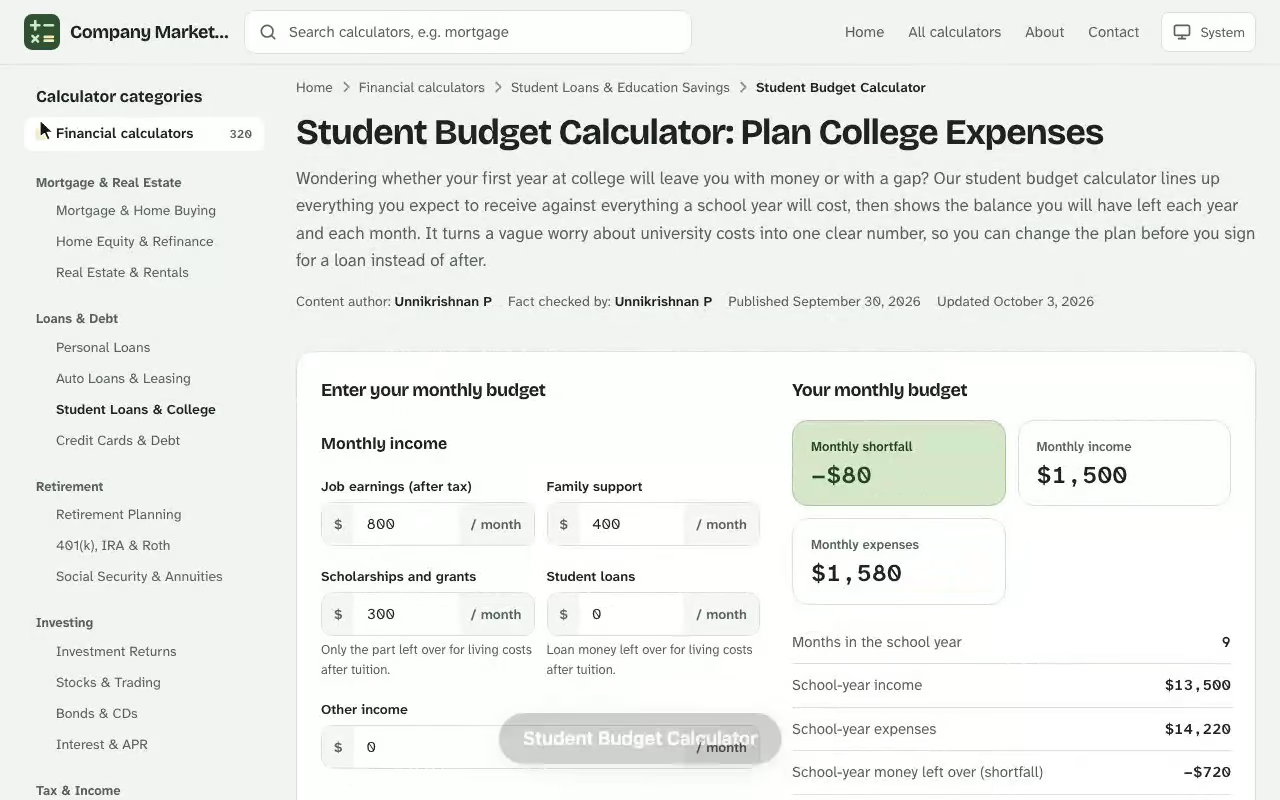
Student Budget Calculator. Wondering whether your first year at college will leave you with money or with a gap? Our student budget calculator lines up everything you expect to receive against everything a school year will cost, then shows the balance you will have left each year and each month. It turns a vague worry about university costs into one clear number, so you can change the plan before you sign for a loan instead of after. The student loan calculator is free to use with no sign-up, and works on desktop and mobile.
Your monthly budget
Monthly money left over
–
Monthly income
–
Monthly expenses
–
Months in the school year–
School-year income–
School-year expenses–
School-year money left over (shortfall)–
Share of income spent–
Where your money goes
Your expenses from largest to smallest, per month and for the school year, with each one’s share of total spending.
Expense
Per month
School year
Share
Results are estimates for educational purposes and are not financial, tax or legal advice.
What a Student Budget Calculator Measures
The tool compares two lists: the money coming in and the money going out over one school year. The first list holds your income and other funding sources, such as family help, wages, grants and savings. The second holds the full cost of attendance: tuition, housing, food, books, getting around and everyday spending. Subtract one from the other and the balance tells you whether the plan works. Pair this with the free loan prequalification calculator for a fuller picture before you make a decision.
Because most students pay in installments, the result is more useful when it is broken down by month. Dividing the yearly balance by the number of months you are enrolled gives a realistic picture of how much you can spend before the money runs out.
$$\text{Monthly shortfall or surplus} = \frac{\text{Balance}}{\text{Months in the school year}}$$
A positive balance means you could receive a refund or build up savings, while a negative one is the amount you still need to cover.
Expenses and Income: What Goes in Each Column
List every figure for the whole year, not just the fall term, so the two columns describe the same stretch of time. A complete entry looks like this:
Income: family contributions, part-time wages, scholarships, grants and any savings you plan to draw on.
Fixed expenses: tuition, campus housing or rent, and a meal plan, because the school bills these whether you spend them or not.
Flexible expenses: groceries, your cell phone bill, laundry, eating out and social activities, which are the lines you can actually trim.
Worked Example: Using a College Budget Calculator
Take a sophomore at a public university who lives in state. Over a nine-month school year this student expects the following income and funding sources. If you want to see how the figures change, the free college cost calculator gives you an instant result you can adjust as you go.
Income source
Per year
Family contribution
$3,600
Part-time wages (10 hours a week, 36 weeks, $16.00 an hour)
$5,760
Merit scholarship
$4,850
Federal grant
$2,150
Savings drawdown
$1,400
Total income
$17,760
The same student faces these yearly costs for the school year:
Expense
Per year
Share of total
Tuition and fees
$9,380
38.6%
Room and board
$10,870
44.8%
Books and supplies
$1,085
4.5%
Transportation
$740
3.0%
Personal expenses
$2,215
9.1%
Total expenses
$24,290
100%
Subtracting gives $17,760 − $24,290 = −$6,530. Spread over nine months, that is a gap of about $725.56 a month. Income averages $1,973.33 a month while expenses average $2,698.89, so the plan is short before the first lecture.
Which Costs Move the Result Most
Housing and tuition together account for 83.4% of the total, which means a small change in either one outweighs a big change in everything else. Cutting transportation by half saves $370, while a 10% saving on room and board saves $1,087.
Closing the Gap Step by Step
With a $6,530 shortfall, the student works through the cheapest fixes first. Switching to the smallest meal plan saves $1,150 over the year. Renting two of the heaviest textbooks instead of buying cuts the books line by $470, from $1,085 to $615. Eating out less, a drop of about $87 a month across nine months, frees another $780. Those three changes recover $2,400 and leave a shortfall of $4,130.
Three savings trim the example student's yearly expenses by $2,400.
The remaining gap is where borrowing enters. A $3,500 subsidized loan covers most of it and leaves $630 uncovered, roughly $70 a month, which a few extra shifts at the job would handle. The order matters: every dollar saved before borrowing is a dollar that never collects interest.
Savings and a subsidized loan shrink the $6,530 shortfall to $630.
Cost of Attendance: The Core Categories Explained
Every school publishes its own estimate, and the lines below are the ones worth checking against your financial aid award letter.
See how the Student Budget Calculator works: change the inputs and the monthly shortfall updates instantly. Enter your own numbers in the calculator above.
Tuition and Fees
Tuition is billed by credit, and it changes with your degree, your course load and where you live. The same course load costs far less when you are in state than when you are out of state, and a public school usually charges less than a private school because it receives state funding. A community college is cheaper again, and shorter vocational programs cost less than a full undergraduate degree.
Room and Board, Including the Meal Plan
Room and board is normally the largest line in the cost of college. It covers a dorm or off-campus housing and, for most students, a meal plan. Compare the dorm rate with off-campus accommodation after adding utilities and rent, and check how many meals per week each plan includes.
Books and Supplies
Course materials can swing from one semester to the next. Expect to buy textbooks, lab supplies and possibly a computer or software.
Transportation and Parking
If you drive, add a parking permit and gas. If you rely on public transportation, enter the monthly pass price. Trips home belong here too.
Personal Expenses and Living Costs
This is where your lifestyle shows up: groceries, your cell phone bill, laundry, eating out, credit card payments and social activities. Track your real student spending for two or three months and use the average, because guessing nearly always undershoots. Local living costs vary a lot between cities, so an estimate from a friend at another school may not apply.
Budgeting a Spring Move Off Campus: A Junior's Lease Decision
A junior has until Friday to sign a lease on a shared two-bedroom, $587.50 a month for their room, and wants to know whether the monthly budget survives it, so every figure below goes into the calculator. The paycheck from the library job is $683.40 a month (12 hours a week at $13.40, 4.25 weeks), a parent sends $325, and a department scholarship pays out $540 a month. That is $1,548.40 of income.
On the expense side, the entries are the room, a $64.20 share of utilities, $236.80 for groceries, a $48.00 transit pass, a $29.99 phone plan, $71.30 a month for next term's books, and $118.00 of personal spending. Everything adds up to $1,155.79.
The calculator reports a monthly balance, here a surplus of $392.61 a month. Before celebrating, the junior checks it against the 50/30/20 guideline, which caps needs near 50% of income. Rent, utilities, groceries, transit and the phone plan come to $966.49, or 62.4% of income, so the calculator's balance line says the lease works on cash flow while the guideline says it is tight, and the surplus is the only cushion.
That cushion decides the next step. Exam month is coming, and dropping to 9 hours a week lowers the paycheck to $512.55. Rerunning the calculator with the lower hours gives income of $1,377.55 and a surplus of $221.76, still positive, with needs now at 70.2% of income. The junior signs the lease, then moves $200 of every paycheck into a savings account so the thin months are covered before they arrive.
Reading Your Monthly Budget and Balance
Once the totals are in, the monthly budget shows how much room you have. A red, negative balance means you will owe the school or need outside money at the end of the term. A green, positive balance means you may receive a refund, depending on how the school treats unused grant and scholarship dollars, so ask the financial aid office before you count on it.
The grid below shows how the example student's yearly balance shifts if weekly work hours and the room and board price change. The $10,870 column with 10 hours a week is the base case.
Four extra weekly work hours improve the balance by $2,304 a year.
What-If Testing Across Two Inputs
Rerun the calculator while changing one input at a time, such as work hours or the room and board price, to see which one moves the balance most. Working four more hours a week adds $2,304 over 36 weeks, which is worth more than most of the small savings tips combined. Moving to cheaper housing helps just as much, since the housing line is the biggest one.
Student Finance Options When the Balance Is Negative
A shortfall does not mean you cannot afford the school. It means you need to decide which sources to add. Work through them in order of cost, cheapest first.
Reduce flexible costs first, before you borrow anything.
Apply for more scholarships and grants, even after you are enrolled.
Check work study eligibility, because the money does not need to be repaid.
Ask whether an employer offers tuition reimbursement.
Only then, add federal student loans.
Federal Student Loans and Student Loan Debt
Not every loan costs the same. Subsidized loans do not charge interest while you are in school, whereas unsubsidized loans start accruing it from the day the money is paid out. If you need only part of what is offered, ask the school to reduce the unsubsidized amount first. Borrow what you need, because every dollar adds to your eventual student loan debt.
Student Budget Planning Tips to Cut Living Costs
Small, repeated savings add up across a nine-month year. Several approaches work for most students:
Eat at home or pack lunches, and pick the smallest meal plan the school offers.
Rent your textbooks or buy used editions after confirming the ISBN.
Show your card for student discounts on software, transit, gyms and movies.
Open a student checking account with no monthly fees and a separate savings account for emergencies.
Test out of courses where you can, and look at transfer credit from a two-year school.
Consider becoming a residential advisor, a role that often covers your dorm room.
The result of these changes shows how powerful modest edits are when you put them back through the college budget calculator.
Budget Planning Mistakes That Skew Your Calculator Balance
Most errors come from leaving something out, not from bad arithmetic. Watch for these when you fill in the calculator's form, because each one shifts the balance it reports:
Using a single semester against a full year. Enter both columns for the same period, or the balance will look twice as good or twice as bad as it really is.
Counting aid that must be repaid as income. A loan fills a gap, but it is not free money, so enter it last and mark it separately.
Forgetting one-time costs such as a laptop, a deposit on an apartment, a lab kit or flights home at the holidays.
Treating the first term's bill as typical. Fall often includes orientation fees, a parking permit and a full set of books, so spring can look lighter.
Ignoring small recurring charges like streaming, app subscriptions and delivery fees, which can reach a few hundred dollars across a school year.
Run the calculator with a pessimistic case as well as the expected one. If the plan only works when everything goes right, treat the shortfall as real and prepare for it.
Keeping Your College Budget Calculator Plan Current
A plan is only as good as its last update. Re-enter your numbers each semester, and again whenever your housing, hours or aid change. Treat the first month as a test: compare what you actually spent with the plan, correct the lines that were wrong, and keep budgeting as a routine rather than a one-time exercise. Good budget planning in your first year makes every later year easier, and the same habit carries into education decisions long after graduation.
Add a buffer line to the calculator's expenses, even $20 a month, and let your savings grow beside it. The monthly balance then shows a surprise bill as a planned cost instead of debt on a credit card, and money you do not spend this year is money you do not repay with interest later.
Student Budget Calculator questions
How does a student budget calculator work?
It adds up every source of money you expect for the school year, adds up every cost, and subtracts expenses from income. A positive balance means the plan is covered; a negative one is the gap you still need to fill.
What should I include in my student budget?
Include income and funding such as family help, wages, scholarships, grants and savings, plus tuition and fees, housing, meals, books and supplies, transportation and personal spending.
Why does the calculator show a balance per month?
Dividing the yearly balance by the months you are enrolled shows how much you can spend or must find each month, which is easier to manage than one yearly figure.
Should I count student loans as income?
Treat loans separately. They fill a gap but must be repaid with interest, so the calculator shows your balance before federal loans and then the balance after you add them.
What is the difference between subsidized and unsubsidized loans?
With subsidized loans the government pays the interest while you are in school. Unsubsidized loans start accruing interest right away, so borrow them last and only what you need.
How can I reduce a negative balance?
Start with flexible costs: a smaller meal plan, rented or used textbooks, student discounts and cheaper housing. Then look at more scholarships, work study, or more work hours before you borrow.
How many months should I enter?
Enter the number of months you will be enrolled and spending, such as 8 for September through April or 9 for a full academic year. Housing and tuition are entered as yearly totals.