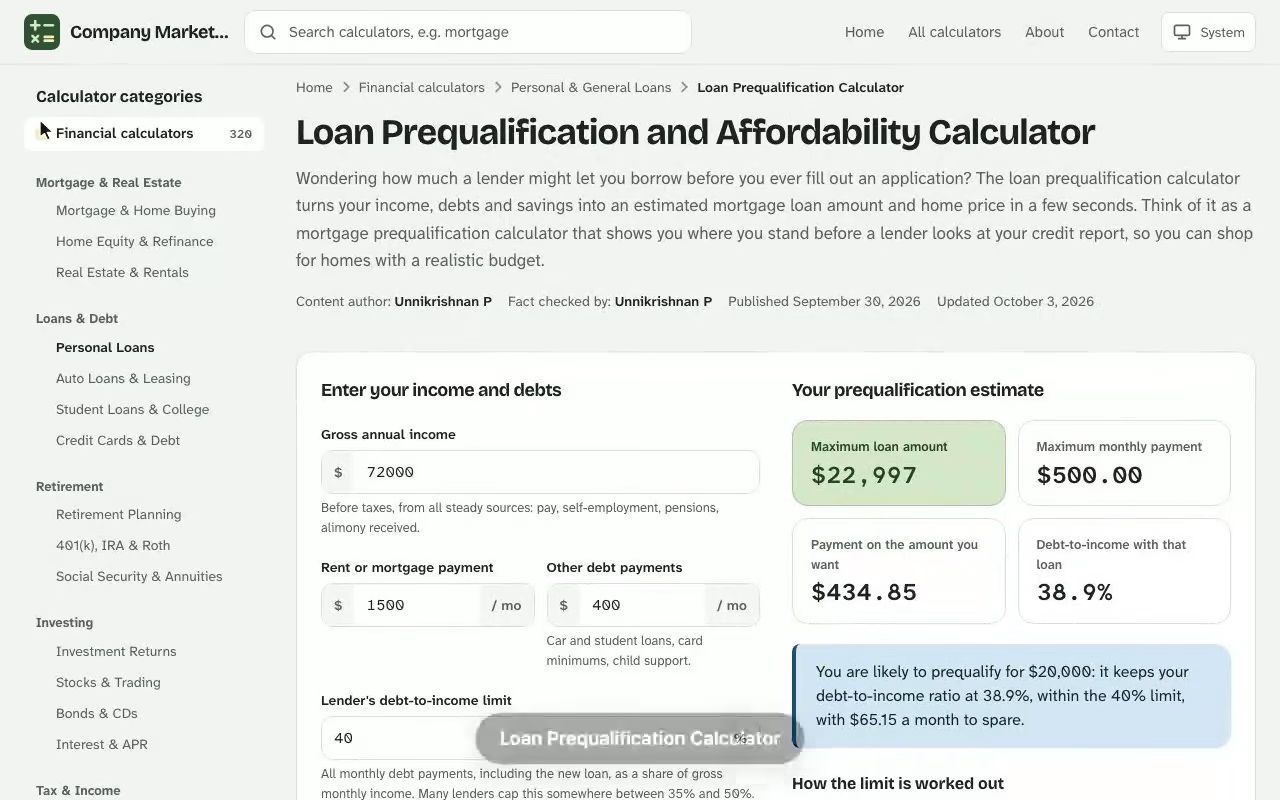
Loan Prequalification Calculator. Wondering how much a lender might let you borrow before you ever fill out an application? The loan prequalification calculator turns your income, debts and savings into an estimated mortgage loan amount and home price in a few seconds. Think of it as a mortgage prequalification calculator that shows you where you stand before a lender looks at your credit report, so you can shop for homes with a realistic budget. The free payment calculator is free to use with no sign-up, and works on desktop and mobile.
Your prequalification estimate
Maximum loan amount
–
Maximum monthly payment
–
Payment on the amount you want
–
Debt-to-income with that loan
–
–
How the limit is worked out
Gross monthly income–
Debt limit–
Less current debt payments–
Left for the new loan payment–
Debt-to-income today–
An estimate, not an offer. Lenders also weigh your credit score, job history and any collateral.
Maximum loan by debt limit and term
The most you could borrow at your interest rate under different lender limits. A longer term lowers the payment, so the same budget supports a bigger loan.
Debt-to-income limit
36 months
60 months
84 months
Results are estimates for educational purposes and are not financial, tax or legal advice.
Loan Prequalification Calculator Inputs and What Each One Means
A prequalification estimate is only as good as the numbers you feed it. Lenders judge your borrowing power from a short list of facts, and each field in a mortgage qualification calculator maps to one of them. Gather these figures first and your result will land much closer to what a lender says later. The alternative payment frequencies calculator online uses the same plain-English approach, so you can compare results side by side.
See how the Loan Prequalification Calculator works: change the inputs and the maximum loan amount updates instantly. Enter your own numbers in the calculator above.
Annual Income and Monthly Debt Payments
Enter your pretax annual income, meaning what you earn before taxes are withheld, because lenders measure your gross monthly income, not your take-home pay. Then add up your monthly debt payments: the minimum on each credit card, plus auto loans, student loans, personal loans and child support. Rent, utilities and groceries are not debts here. Every recurring debt you list reduces the share of income left for a mortgage payment, which is why this one field moves your answer as much as income does.
Down Payment, Interest Rate and Loan Term
Your down payment is the cash you put toward the purchase, and it is added to the loan amount to give a home price. Use a mortgage interest rate, not an APR, and pick the loan term in years. A fixed-rate loan keeps the same rate for the full term, while an adjustable-rate mortgage starts lower and can change later, so model the rate you would actually be offered. A 20% down payment also lets you skip private mortgage insurance, which lowers your monthly cost.
Property Tax, Homeowners Insurance and HOA Dues
These housing costs ride along with every payment. Add the annual property tax and annual homeowners insurance for the area you want, plus any monthly HOA fee. Your real estate agent or a listing page usually has all three. Leaving them at zero overstates what you can borrow, because lenders count them inside your housing payment.
How to Use the Mortgage Prequalification Calculator Step by Step
If you keep asking yourself, "how much house can I afford?", this walkthrough answers it in four moves. Buying a home is a big financial commitment, and a clear budget is the first piece of homeownership you can settle from your couch. Next, open the free student budget calculator and enter your own details to see an estimate in seconds.
Enter your annual income, monthly debt payments and down payment.
Choose a loan term and type the interest rate you expect to receive.
Add property tax, insurance and HOA fees so the house costs are complete.
Click the Calculate button and read both results.
The output shows your total loan amount, the monthly mortgage payment for principal and interest, and the total monthly payment once taxes, insurance and dues are added. It also reports your maximum monthly payment, the top figure your DTI limit allows, and the total interest you would pay across the loan. If you want to know whether you can qualify for a bigger home, change one input at a time and recalculate. Because the tool never touches your credit file, you can run it as often as you like, whether your credit scores are strong or still being rebuilt, and you will be better prepared the day you are formally prequalified.
How the Mortgage Prequalification Estimate Calculator Math Works
Behind the screen, a prequalification estimate calculator uses one idea: your debt-to-income ratio, or DTI, caps the total you can spend on debt each month. The calculator converts the room that cap leaves for principal and interest into a loan amount.
Then it converts that payment into the largest loan the rate and term allow, where \(r\) is the monthly rate and \(n\) is the number of monthly payments:
Add your down payment to the result and you have an estimated home price.
Front-End DTI Versus Back-End DTI
Front-end DTI is your future housing payment, including principal and interest, taxes, insurance and HOA, divided by gross monthly income. Back-end DTI adds all your other monthly debt on top. Most lenders lean on back-end DTI for conventional mortgage approval because it shows the whole picture of what you owe each month.
Why the 36% and 43% Limits Produce Two Results
A conventional loan lender generally prefers a back-end DTI of 36% or less, while some programs, including FHA loans, tolerate up to 43% or more. Seeing both results side by side tells you the comfortable amount and the stretch amount. Borrowing the stretch figure leaves very little room for a job loss or a surprise medical bill, so treat the higher number as a ceiling rather than a target.
Prequalification Estimate Calculator Worked Example
Here is a full run with numbers chosen for illustration. Suppose you earn $74,500 a year, which is $6,208.33 per month, and you carry $620 in monthly debt payments. You plan to put down $18,000 on a 30-year loan at a 6.85% interest rate. Your property tax is $3,240 a year ($270 a month), your homeowners insurance is $1,380 a year ($115 a month), and your HOA dues are $85 a month.
At a 36% DTI limit, total debt can reach $2,235.00 a month. Subtract your $620 in debts, $270 in tax, $115 in insurance and $85 in HOA dues and $1,145.00 is left for principal and interest. That payment supports a loan amount of $174,740, and with your $18,000 down payment the estimated home price is $192,740. At a 43% limit the numbers climb, as the table shows.
With $74,500 of income, a 36% DTI limit leaves $1,145 a month for principal and interest.
Result
36% DTI limit
43% DTI limit
Maximum total monthly debt
$2,235.00
$2,669.58
Left for principal and interest
$1,145.00
$1,579.58
Estimated loan amount
$174,740
$241,062
Estimated home price
$192,740
$259,062
Total interest paid over the life of the loan
$237,460
$327,588
Notice that the 43% result is about $66,000 larger, yet it would add roughly $90,000 in interest. A bigger approval is not the same as a better deal.
The 43% limit raises the estimated loan amount by $49,000 to $66,000 depending on the term.
Checking a $300,000 Target with the Mortgage Affordability Calculator
A buyer in Columbus has two open-house weekends coming up and a listing at $299,000 bookmarked. Before touring, the buyer opens the prequalification estimate with the numbers from the last pay stub and a lease renewal: $91,860 in annual income, $538 a month in debts (a $214 car payment plus $324 on student loans), and $24,500 saved for a down payment.
The lender's quoted rate is 6.62% on a 30-year loan. Property tax on the listing is $3,870 a year, insurance is $1,620 a year, and there are no HOA dues.
At the 36% limit, the mortgage affordability calculator returns a $275,055 loan and a home price of $299,555, built on a $1,760.30 monthly payment for principal and interest. At the 43% limit the figure jumps to $358,784, but 43% is the ceiling some FHA loans tolerate, not the 36% back-end DTI most conventional lenders prefer, so the buyer plans around the lower number. The $299,000 listing fits with $555 to spare, which is thin once closing costs are added.
The buyer then changes one input and reruns it: the car loan ends in eleven months, so removing the $214 payment lifts the 36% result to a $308,494 loan and a price near $332,994. That gives a specific next step. The buyer will keep touring homes at $299,000 now, then ask the loan officer for a preapproval letter after the final car payment clears, when the larger figure is real rather than hypothetical.
Prequalification Versus Preapproval: What Changes
People use the two words as if they were the same step, but a lender treats them very differently. Knowing which one you are asking for keeps expectations realistic.
What Prequalification Tells You
To prequalify, you share self-reported information about your income, debts and assets, and the lender gives a rough idea of what you may be able to borrow. It is optional and fast, and it helps you narrow your search to homes that fit your budget.
What Preapproval Requires
Preapproval is the formal step. You provide proof of income such as pay stubs, plus bank statements, tax returns and other documentation, and the lender verifies it. The result is a preapproval letter that states a maximum loan amount, and most letters stay valid for 30 to 90 days. In a competitive housing market, a seller will usually take a preapproved offer more seriously than one backed by a calculator estimate.
Prequalification does not guarantee preapproval. If your documents do not support the figures you reported, the lender can still turn you down.
Does Prequalification Affect Your Credit Score?
Usually not. Many lenders prequalify you from the details you provide, and some run a soft inquiry or soft credit check, which shows on your credit report but does not change your score. A calculator like this one runs no credit check at all. Preapproval is different: it typically involves a hard inquiry, or hard credit check, that can cause a small, temporary dip. If you compare lenders, complete your applications within a two-week window so scoring models count the hard inquiry only once.
Factors That Change Your Mortgage Affordability Calculator Result
Affordability depends on seven inputs, yet lenders also weigh things a calculator cannot see. These are the factors that matter most when you prequalify.
Credit Score and Creditworthiness
Your credit score is a quick read on your creditworthiness. Conventional mortgages generally ask for a score of at least 620, while other programs accept lower scores. Better credit scores can also unlock a lower rate, and your interest rate has a direct effect on the loan you can carry. A bankruptcy or foreclosures on your credit history can limit the options available.
Interest Rate and Loan Term
Shorter terms raise the monthly payment, so a 15-year loan prequalifies for less than a 30-year loan even at the same rate. Lower mortgage rates work the other way and raise what you can borrow. The next grid shows how much both levers matter at a 36% DTI limit.
Rate and term together shape how much you can prequalify for at a 36% DTI limit.
Employment History and Cash Reserves
Steady employment gives a lender confidence that payments will keep coming. A recent new job, frequent changes or self-employed income can make prequalification harder, because the lender needs a longer record to trust your earnings. Cash reserves left after your down payment also count, since they show you can handle the mortgage payment through a rough patch.
How to Increase Your Prequalified Amount
If the result is lower than you hoped, you have real levers. Each one improves a number a lender looks at.
Pay down monthly debt. Lowering your recurring debt frees up room under the DTI limit. Retiring $350 of monthly payments in the example lifts the 36% result by roughly $53,000.
Raise your credit score. Correct errors, pay bills on time, and use less of your credit limit on each card.
Consolidate high-interest balances so the combined payment shrinks.
Save a larger down payment or look into down payment assistance for eligible first-time homebuyers and military members.
Increase your income through a raise or a second job, since a bigger gross income improves your DTI.
Home Affordability Calculator Results Versus the 28/36 Rule
Many buyers pair a home affordability calculator with the 28/36 rule, which says housing costs should stay under 28% of gross monthly income and total debt under 36%. In the example, 28% of $6,208.33 is $1,738.33, while the 36% back-end result leaves a housing payment of $1,615.00 including tax, insurance and HOA. The back-end rule is the tighter limit here, so it controls the answer. Your result can fall on either side depending on how heavy your other debt is.
Whatever the figure, remember that the maximum loan amount is the most a lender will approve, not the amount that fits your budget. The loan amount and home price this calculator returns cover only principal, interest, tax, insurance and HOA, so budget closing costs, moving costs and repairs separately from the result.
Next Steps After You Prequalify
Once you have a number, put it to work with a short plan:
Set a comfortable price range using the 36% result, not the 43% one.
Check current mortgage rates and rerun the numbers with the rate you could actually get.
Gather pay stubs, bank statements and tax returns so a lender can start preapproval quickly.
Ask your real estate agent to filter listings to your budget, and talk to a loan officer when you are ready to refinance a plan into an offer.
Compare the estimated total monthly payment with your savings goals, your emergency fund and other financial priorities before you commit. A payment that leaves breathing room is worth more than the largest mortgage a lender will extend, because the result is a ceiling for your financial plan, not a target to hit.
This estimate is for general education only. It is not a lender decision, and your actual approval depends on underwriting, your credit report and the lender's own rules.
Loan Prequalification Calculator questions
What is a loan prequalification calculator?
It is a quick estimate of the loan amount and home price a lender might approve, based on your income, monthly debts, down payment, interest rate and loan term. It does not check your credit and is not a lender decision.
What is the difference between prequalification and preapproval?
Prequalification uses information you report yourself and gives a rough range. Preapproval requires documents such as pay stubs, bank statements and tax returns, usually involves a hard credit inquiry, and produces a preapproval letter.
Does prequalification affect my credit score?
Usually not. Many lenders prequalify you from the details you provide or with a soft inquiry, which does not change your score. A hard inquiry normally happens at preapproval.
Why does the calculator show 36% and 43% results?
Conventional lenders generally prefer a back-end debt-to-income ratio of 36% or less, while some programs, such as FHA loans, allow up to 43% or more. The 36% figure is the more comfortable budget; 43% is a ceiling.
How can I increase the amount I prequalify for?
Pay down monthly debt, raise your credit score, consolidate high-interest balances, save a larger down payment or increase your income. Each lowers your debt-to-income ratio or the loan you need.
Which costs are included in the monthly payment?
The total monthly payment adds property tax, homeowners insurance and any HOA dues to the principal-and-interest payment. Closing costs, moving costs and repairs are not included.
Is the estimate a guarantee that I will be approved?
No. A lender also reviews your credit report, employment history, assets and documentation, so the final approval can differ from the calculator result.