Roth vs. Traditional 401(k) and Your Paycheck Calculator
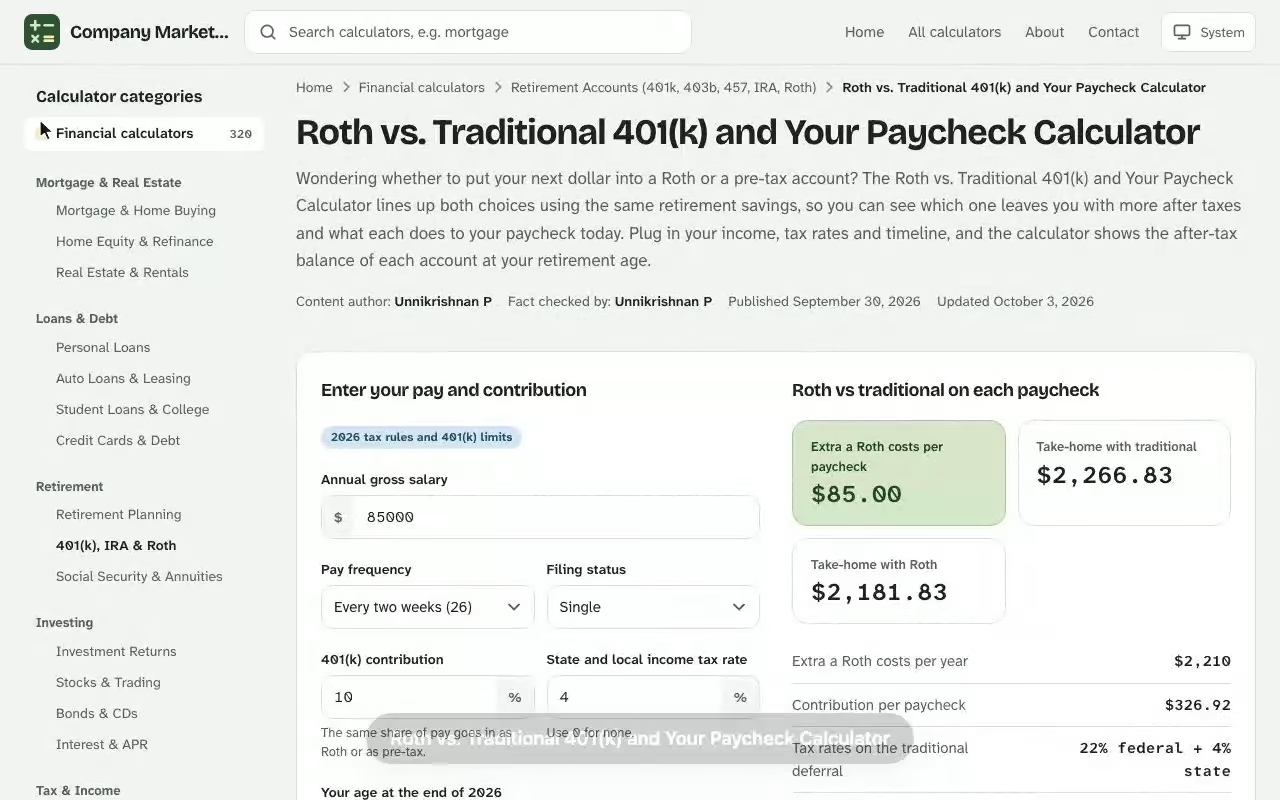
Roth vs. Traditional 401(k) and Your Paycheck Calculator. Wondering whether to put your next dollar into a Roth or a pre-tax account? The Roth vs. Traditional 401(k) and Your Paycheck Calculator lines up both choices using the same retirement savings, so you can see which one leaves you with more after taxes and what each does to your paycheck today. Plug in your income, tax rates and timeline, and the calculator shows the after-tax balance of each account at your retirement age. If you want to see how the figures change, the free roth ira calculator gives you an instant result you can adjust as you go.
Roth vs traditional on each paycheck
Extra a Roth costs per paycheck
–
Take-home with traditional
–
Take-home with Roth
–
Extra a Roth costs per year–
Contribution per paycheck–
Tax rates on the traditional deferral–
Roth contribution with the same take-home as traditional–
Roth catch-up rule applies–
Paycheck side by side
Per paycheck, for the same contribution. The difference column is the Roth paycheck minus the traditional paycheck.
Item
Traditional
Roth
Difference
The Roth premium at other contribution rates
How much more of each paycheck a Roth contribution takes than a pre-tax one, at rates from 2% to 20% of pay. That extra is income tax paid now instead of in retirement.
Contribution rate
Contribution per paycheck
Take-home, traditional
Take-home, Roth
Roth costs extra per paycheck
Per year
Results are estimates for educational purposes and are not financial, tax or legal advice.
Roth vs. Traditional 401(k) and Your Paycheck Calculator Explained
Traditional 401(k)s take contributions out of your pay on a pre-tax basis. You skip income tax now, your money enjoys tax-deferred growth, and every dollar you pull out later is taxed as ordinary income. Roth 401(k)s flip that order: contributions go in on an after-tax basis, so you pay tax up front, and qualified withdrawals come out clean. Both kinds of 401(k)s are workplace plans funded through payroll deductions, and many employers offer both side by side. The roth 401k conversion calculator uses the same plain-English approach, so you can compare results side by side.
The calculator answers one question: given the tax rate you pay today and the one you expect in retirement, which bucket ends up bigger once the IRS has taken its share? It also shows how each option changes the check that lands in your bank account, which is where most people feel the difference first.
Roth 401(k) and Traditional 401(k) Contribution Type
The contribution type setting tells the calculator which account you are funding now. Choose Roth and it increases the traditional side so that both options cost you the same net take home pay. Choose traditional and it shrinks the Roth side to match. That adjustment is what makes the comparison fair: you are not comparing a $10,000 Roth deposit with a $10,000 traditional deposit, because the second one costs you far less out of pocket.
Why Equal Net Take Home Pay Matters
Imagine two coworkers who each give up the same amount of spendable pay every month. The traditional saver sends more dollars into the plan because those dollars were never reduced by income tax. The Roth saver sends fewer dollars, but all of them are already taxed. Holding net take home pay constant is how the calculator avoids crediting the traditional account for money you would otherwise have spent.
Inputs That Drive Any Retirement Savings Calculator Result
Every field in this tool feeds the final comparison, and a few of them move the answer far more than the rest. Work through them in order and use realistic numbers rather than best-case ones. The roth 401k vs traditional 401k calculator is free to use with no sign-up, and works on desktop and mobile.
Current age and retirement age set how many years your contributions have to compound.
Current income is your gross yearly pay before any tax or deferral, used to size each paycheck.
Current tax rate is the marginal rate on your next dollar of earnings today.
Retirement tax rate is the marginal rate you expect on withdrawals later.
Hypothetical rate of return is the yearly growth you assume, applied to both accounts equally.
Annual contribution is how much you plan to defer each year.
Pay frequency converts yearly figures into the amount per paycheck.
Current Tax Rate and Retirement Tax Rate
These two numbers decide the winner. Use your marginal tax rate from your federal income tax bracket, which depends on your filing status and taxable income, not your average rate. Federal income tax is progressive, so the rate on your last dollar is higher than the rate on your first. State taxes can also tilt the result, since the calculator may only model the federal piece. If you plan to retire in a state with no income tax, your real retirement tax rate may be lower than the federal figure suggests.
Rate of Return and Pay Frequency
Because the same rate of return is applied to both accounts, it rarely changes which option wins. It does change how large the gap is. A higher growth assumption magnifies whichever account holds more dollars before tax, so be cautious with an optimistic guess. Pay frequency matters for your paycheck view: weekly, biweekly, semi-monthly and monthly schedules divide the same yearly contribution into different pay-period amounts. A 26-paycheck year spreads your deferral thinner than a 12-paycheck year.
Roth 401k vs Traditional 401k: A Worked Example
Here is a case with fresh numbers. You are 34, earn $128,000 a year, and plan to retire at 65, giving your money 31 years to grow. Your current tax rate is 24 percent, you expect an 18 percent retirement tax rate, and you assume a 6.5 percent hypothetical rate of return. You are comfortable giving up $11,400 of yearly take-home pay to save.
Because the Roth deposit comes from after-tax dollars, the full $11,400 goes in. The traditional deposit gets the tax break, so the same $11,400 of lost take-home pay supports a larger contribution:
See how the Roth vs. Traditional 401(k) and Your Paycheck Calculator works: change the inputs and the extra a roth costs per paycheck updates instantly. Enter your own numbers in the calculator above.
Both streams grow with the future value of an annuity:
$$FV = C \times \frac{(1 + r)^{n} - 1}{r} = C \times \frac{(1.065)^{31} - 1}{0.065} \approx C \times 92.989$$
The Roth balance is $1,060,077, and since qualified withdrawals are tax-free, that is also what you keep. The traditional balance before tax is $1,394,838. After an 18 percent retirement tax rate, you keep $1,143,768, which is $83,690 more than the Roth account. In this case the traditional account wins because your tax rate is expected to fall.
Balances at Retirement by Retirement Tax Rate
The table below holds every other input from the example fixed and changes only the retirement tax rate, showing how the winner flips.
Retirement tax rate
Traditional after tax
Roth balance
Traditional minus Roth
12 percent
$1,227,458
$1,060,077
+$167,381
18 percent
$1,143,768
$1,060,077
+$83,690
24 percent
$1,060,077
$1,060,077
$0
28 percent
$1,004,284
$1,060,077
-$55,794
32 percent
$948,490
$1,060,077
-$111,587
The two accounts tie when your retirement tax rate equals your current tax rate. Below that line the traditional account comes out ahead, and above it the Roth does. That is the core rule behind every comparison this tool runs.
Take-Home Pay Impact: Traditional 401k vs Roth 401k Calculator Results
Retirement balances get the attention, but your paycheck is where you feel the decision. Suppose you defer the same $15,000 a year into either account and are paid biweekly. A traditional deferral lowers your taxable income, so income tax falls and your check shrinks by only $438.46. A Roth deferral gives no tax break, so your check shrinks by the full $576.92.
Same $15,000 yearly deferral
Per paycheck
Per year
Traditional reduction in net pay
$438.46
$11,400
Roth reduction in net pay
$576.92
$15,000
Extra cost of choosing Roth
$138.46
$3,600
That $3,600 yearly gap is the tax savings you give up today in return for tax-free withdrawals later. Treat it as the price of the Roth, then ask whether your future tax rate is likely to be high enough to justify it.
Pre-Tax vs Post-Tax Effects on Your Paycheck
Pre-tax deferrals reduce the wages used to figure income tax, which delivers immediate tax benefits on every paycheck.
After-tax contributions to a Roth leave your taxable wages untouched, so your check drops dollar for dollar.
Payroll taxes for Social Security and Medicare apply to both types, so they do not change the comparison.
Your gross pay stays the same either way; only the net deposit differs.
Testing a Retirement Savings Calculator Result Before Changing a Payroll Election
Priya, a 41-year-old project manager earning $97,350, has until Friday to change her payroll election from traditional to Roth. She wants to know whether the switch is worth it, so she runs a Roth versus traditional 401(k) comparison rather than guessing.
She enters current age 41, retirement age 67, current income $97,350, a current tax rate of 22 percent and a 6 percent rate of return. For the retirement tax rate she types 24 percent, because her pension estimate plus Social Security and later RMDs should total about $125,000 a year, and a single filer's 24 percent bracket starts at $105,700. The yearly contribution is $7,800, which is $300 off each of her 26 paychecks.
The calculator sets the traditional side at $10,000 so both choices cost her the same $300 in net pay. Across 26 years the Roth balance reaches $461,420. The traditional balance is $591,564 before tax and $449,589 after a 24 percent retirement rate, which leaves the Roth ahead by $11,831.
Retirement tax rate
Traditional after tax
Roth balance
Winner
20 percent
$473,251
$461,420
Traditional by $11,831
24 percent
$449,589
$461,420
Roth by $11,831
Priya then changes only the retirement tax rate to 20 percent. The result flips, with the traditional account ahead by the same $11,831, so she knows the whole decision rests on whether her retirement income crosses that $105,700 line. Her pension statement shows a $38,400 annual benefit, which keeps her total estimate above it, so she submits the Roth election for the next pay period and plans to revisit the comparison each January.
When Roth 401k vs Traditional 401k Flips: Tax Bracket Rules
Once you know the mechanics, picking a side comes down to where you expect to stand in the tax bracket ladder when you start taking money out. These rules of thumb hold up well.
Expect a lower tax bracket in retirement, as when you stop earning a paycheck; the traditional account usually wins.
Expect a higher tax bracket, or worry that rates will rise? The Roth usually wins.
Younger investors with decades ahead and rising pay often lean Roth, since their bracket has room to climb.
Unsure? Split contributions between both for tax diversification, so you can choose which bucket to draw from each year.
Tax-Free Withdrawals and Qualified Distribution Rules
Roth tax-free withdrawals are not automatic. A qualified distribution requires that your first Roth contribution happened at least five tax years ago and that you are 59 and a half or older, or you have a disability or have died. Meet both and you pay no taxes on the earnings. Because those qualifying distributions never touch your taxable income, they also keep you away from the thresholds that trigger higher Medicare premiums. Take an early distribution and the earnings portion can be taxed and penalized.
Required Minimum Distributions and Withdrawals
Traditional balances come with required minimum distributions, or RMDs, which force withdrawals starting at age 73 whether you need the cash or not. Each traditional withdrawal is taxed as ordinary income, and those mandatory withdrawals add to your taxable income and can nudge you into a higher bracket. Roth 401(k) accounts no longer require lifetime RMDs, which gives you more control over timing and lets your money keep growing tax-free for longer. If you plan to leave money to heirs, that flexibility is a real advantage.
Contribution Limits, Catch-Up Contributions and Employer Matching
The contribution limits are shared between the two account types, so you cannot double your retirement savings room by splitting. Your savings pace is capped either way. For 2026, the employee deferral limit is $24,500 for each person. Workers aged 50 and older can add catch-up contributions of $8,000 if their plan allows it, and the SECURE 2.0 Act raised the catch-up amount for ages 60 to 63 to $11,250. Higher earners may be required to make their catch-up contributions to a Roth. Check your plan's rules, since plans can set tighter limits than the IRS.
Employer Matching and Pre-Tax Dollars
A company match is usually deposited on a pre-tax basis even when you choose Roth for your own deferrals, so it is taxed at your retirement tax rate. The calculator's annual contribution field covers only your own deferrals, which means any match you receive builds a traditional balance on top of the result you see. Contribute enough to earn the full match before deciding how to split the rest of your savings.
Tax-Advantaged Growth and Dollar-Cost Averaging
Both accounts are tax-advantaged, and the calculator applies the same rate of return to each, so growth alone never decides the winner. Traditional accounts enjoy tax-deferred growth with the bill coming at withdrawal, while Roth accounts offer tax-free growth permanently. Investing from every paycheck also brings dollar-cost averaging, whichever mutual funds or other investment you choose.
Roth vs. Traditional 401(k) and Your Paycheck Calculator Limits and Next Steps
No model captures everything. The calculator assumes a steady rate of return, a flat retirement tax rate and constant current income, while real careers bring raises, market drops, tax law changes and inflation that erodes purchasing power. It also leaves out state taxes unless you fold them into your tax rates, and it does not model how Social Security benefits or other income push up your bracket in retirement. Use the output as a directional guide, rerun it with a couple of different assumptions, and talk to a financial advisor if your situation involves a large salary change, a business sale or a big account rollover.
The same bracket logic applies to a traditional IRA and a Roth IRA, but this calculator models only your 401(k) deferrals through your retirement plan, not any other IRA or retirement account. A conversion from pre-tax to Roth would add to your tax bill in the year you convert, so run that scenario separately.
Roth vs. Traditional 401(k) and Your Paycheck Calculator questions
What is the difference between a Roth 401(k) and a traditional 401(k)?
A traditional 401(k) takes contributions before income tax, so your taxable income falls now and withdrawals are taxed later. A Roth 401(k) takes contributions after tax, so there is no break today but qualified withdrawals are tax-free.
How does this calculator keep the comparison fair?
It adjusts the option you did not choose so both reduce your net take-home pay by the same amount. The traditional contribution is the Roth contribution divided by one minus your current tax rate.
Which is better if I expect my tax rate to fall in retirement?
A traditional 401(k) usually comes out ahead when your retirement tax rate is lower than your current rate. If your retirement rate is higher, the Roth usually wins, and if the two rates are equal the balances tie.
What are the 401(k) contribution limits for 2026?
The employee deferral limit is $24,500. Workers age 50 and over can add an $8,000 catch-up contribution, and ages 60 to 63 can add $11,250 under SECURE 2.0, if the plan allows it. Roth and traditional deferrals share the same limit.
When can I take tax-free withdrawals from a Roth 401(k)?
A qualified distribution must happen at least five tax years after your first Roth contribution and on or after age 59 and a half, or upon disability or death.
When can I withdraw from a traditional 401(k)?
Withdrawals are generally penalty-free from age 59 and a half and are taxed as ordinary income. Required minimum distributions start at age 73.
Does the calculator include state taxes or employer matching?
No. It uses the tax rates you enter, so fold in state taxes yourself, and it models only your own contributions, not employer matching.