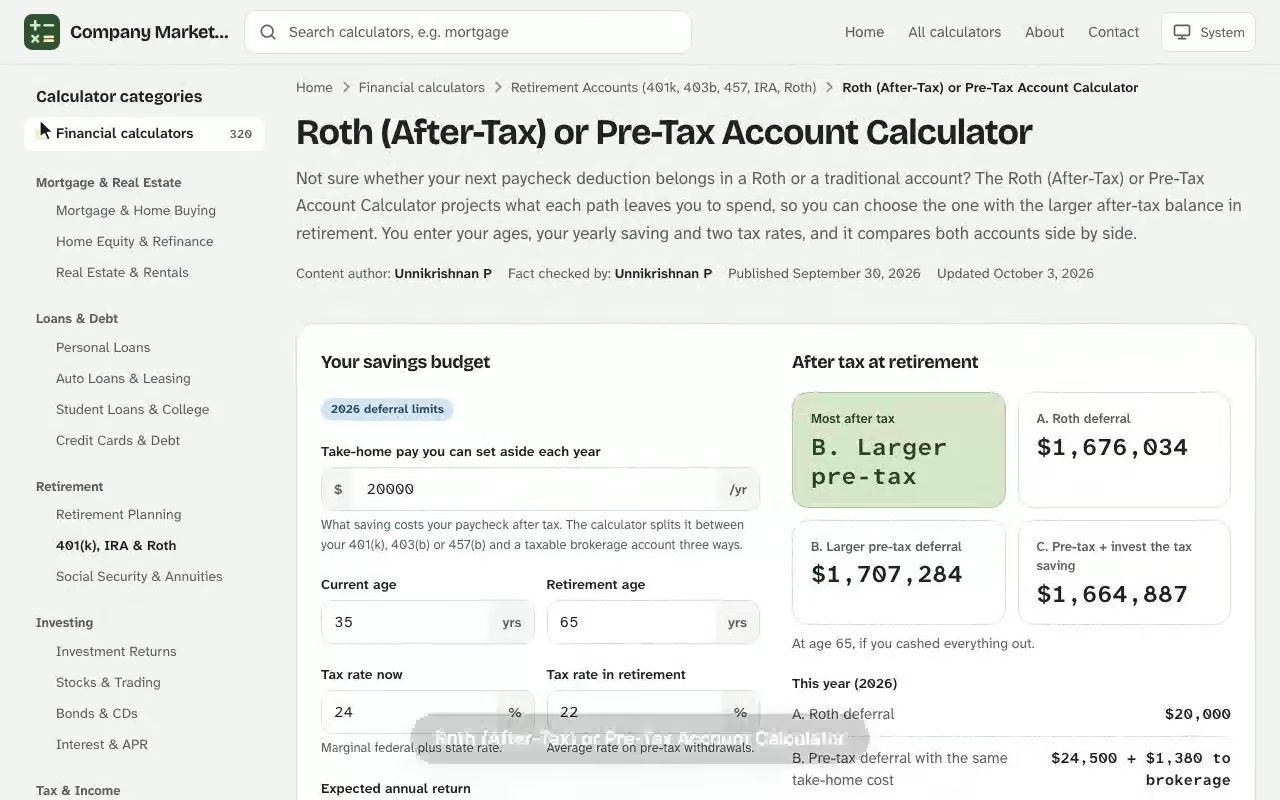
Roth (After-Tax) or Pre-Tax Account Calculator. Not sure whether your next paycheck deduction belongs in a Roth or a traditional account? The Roth (After-Tax) or Pre-Tax Account Calculator projects what each path leaves you to spend, so you can choose the one with the larger after-tax balance in retirement. You enter your ages, your yearly saving and two tax rates, and it compares both accounts side by side. The roth ira calculator online is free to use with no sign-up, and works on desktop and mobile.
After tax at retirement
Most after tax
–
A. Roth deferral
–
B. Larger pre-tax deferral
–
C. Pre-tax + invest the tax saving
–
This year (2026)
A. Roth deferral–
B. Pre-tax deferral with the same take-home cost–
C. Pre-tax deferral, tax saving to brokerage–
Your plan limit–
Where the money ends up
A. Roth account / brokerage–
B. Pre-tax account / brokerage–
C. Pre-tax account / brokerage–
Roth beats option B above a retirement rate of–
Pre-tax balances are shown before tax; the totals above take off tax at your retirement rate. Brokerage balances are after the tax on unrealized gains. The limit counts dollars, not tax, so a Roth deferral shelters more once you reach it.
Year-by-year after-tax value
What each option would leave after tax if you cashed out at the end of that year. Limits use 2026 amounts every year.
Age
Limit
Roth deferral (A)
Pre-tax deferral (B)
A after tax
B after tax
C after tax
Results are estimates for educational purposes and are not financial, tax or legal advice.
Roth (After-Tax) or Pre-Tax Account Calculator Inputs
Every result depends on a handful of numbers you already know or can estimate in a minute. Gather them before you start, and treat the tax figures as your best forecast rather than a promise. Next, open the ira calculator online and enter your own details to see an estimate in seconds.
Your current age and retirement age
Your current age and your planned retirement age set the number of years the money compounds. More years magnify the balance of both accounts, but the gap between them depends only on the tax rates you pick, which is why the next input matters so much.
Yearly contributions and expected tax rates
Enter the yearly pre-tax contribution you plan to defer. The tool converts it into the smaller after-tax contribution that costs you the same take-home pay. Then add today's marginal rate and the rate you expect on withdrawals later. Use your marginal rate, not your average rate, because the next dollar is taxed at the top rate you reach.
Annual return: a steady growth rate, such as 6.5%, applied to both accounts.
Current rate: what you save on each pre-tax dollar today.
Retirement rate: what you will pay on each dollar you pull out.
Roth vs. Traditional: How Each Account Is Taxed
Both accounts shelter growth, yet they tax you at opposite ends. One is funded on a pre-tax basis and the other on an after-tax basis. A traditional account gives you a deduction now and bills you for taxes later. A Roth does the reverse, so you pay taxes up front. Seeing that timing difference clearly makes the calculator's output easy to read. Try the roth ira conversion calculator online to run your own numbers — everything is calculated in your browser and nothing you enter is stored or sent anywhere.
Traditional pre-tax and tax-deferred growth
With a traditional pre-tax deposit, the money leaves your paycheck before income tax, which lowers your taxable income this year. The balance enjoys tax-deferred compounding, and every withdrawal counts as ordinary income. You get immediate tax benefits, but you owe the bill when you spend the money, and your investment growth is part of what gets taxed.
Roth after-tax and tax-free withdrawals
A Roth after-tax deposit uses after-tax dollars, so your paycheck shrinks by the full amount. In exchange, qualifying distributions come out with tax-free withdrawals, and the tax-free growth inside the account is never taxed. Most plans expect you to be at least age 59½ and to have held the account for five years before a payout qualifies; otherwise a penalty and tax on earnings can apply.
The Formula Behind the Roth vs. Traditional IRA Calculator
The same arithmetic powers the Roth (After-Tax) or Pre-Tax Account Calculator whether your account is a workplace plan or an individual one. First, the future balance of a level yearly deposit \(C\) earning rate \(r\) for \(n\) years:
$$FV = C \times \frac{(1+r)^{n}-1}{r}$$
Next, what each account is actually worth after tax, where \(t_{now}\) is today's rate and \(t_{ret}\) is the rate in retirement:
Because both balances grow by the same factor, the winner comes down to one ratio: (1 − current rate) ÷ (1 − retirement rate). If that ratio is above 1, the Roth is ahead; below 1, the pre-tax account wins. Return and years change the size of the gap, never its direction.
Traditional 401k vs Roth 401k Calculator Example
Here is one full run you can reproduce. You are saving for 28 years at a 6.5% yearly return, and you can afford $9,400 of pre-tax saving per year. You pay a 22% rate now and expect 26% on retirement withdrawals.
Step
Traditional pre-tax
Roth after-tax
Yearly deposit
$9,400
$7,332
Balance after 28 years
$698,726
$545,006
Tax due on withdrawals at 26%
$181,669
$0
Spendable amount
$517,057
$545,006
See how the Roth (After-Tax) or Pre-Tax Account Calculator works: change the inputs and the most after tax updates instantly. Enter your own numbers in the calculator above.A 26% retirement tax rate takes $181,669 from the $698,726 traditional balance.
The Roth finishes $27,949 ahead because your rate rises from 22% to 26%. Move the retirement rate to 16% and the traditional account wins by $41,924, so the answer flips with your forecast, not with the account type.
Retirement tax rate
Traditional spendable
Roth spendable
Better choice
16%
$586,930
$545,006
Traditional by $41,924
22%
$545,006
$545,006
Tie
26%
$517,057
$545,006
Roth by $27,949
30%
$489,108
$545,006
Roth by $55,898
The better account flips at the point where your retirement rate equals today's 22%.
Comparing Roth vs. Traditional Savings Scenarios
A single projection is a starting point. Rerun the tool with a few savings scenarios and watch how the future values shift, so you see which input your decision is most sensitive to.
When the Roth option tends to win
The Roth wins when you expect a higher tax bracket later than today. That often fits younger investors early in their careers, people whose pay is likely to grow, and anyone who thinks tax rates will rise. It also helps if you want more room to leave the money invested, since a Roth 401(k)s have no RMDs during your lifetime, which is one of the quieter benefits of the account.
When pre-tax saving tends to win
Pre-tax saving wins when you expect a lower tax bracket in retirement. If you are at the peak of your earnings, the deduction is worth the most now, and the tax savings can be invested in a taxable account on top of your deferral. Living in a state with no income tax lowers the current rate you enter, so a planned move to a taxed state is worth testing as a higher retirement rate.
Choosing a Pre-Tax Contribution at 44 with the Calculator
A 44-year-old project manager, Tomasz, is about to raise the plan deferral and wants to know whether the extra money should go in pre-tax or Roth. The paycheck stub shows a 24% marginal federal rate, and a conservative retirement budget suggests 17% on withdrawals once the mortgage is gone.
Tomasz opens the calculator and enters age 44, retirement at 66, a 7% yearly return and $6,850 of yearly pre-tax saving. Current rate: 24%. Retirement rate: 17%.
Traditional balance after 22 years: $335,689; tax at 17% is $57,067, leaving $278,622.
Roth deposit of $5,206 a year grows to $255,124.
The pre-tax side finishes $23,498 ahead, which matches the ratio check: 0.76 ÷ 0.83 is 0.916, well under 1. Tomasz then reruns the comparison at 24% in retirement, where the two accounts tie exactly, and at 30%, where the Roth leads by $20,141. The tie at 24% becomes the trigger: if the retirement budget ever points to a rate above the 24% bracket, the next raise goes to the Roth side. For now, the extra $6,850 goes pre-tax, and the $1,644 tax cut it creates this year goes into a separate brokerage account.
Tax Diversification: Mixing a Roth Option with Traditional 401(k)s
You do not have to choose one account for life. Splitting deposits gives you tax diversification: some money taxed now, some taxed later, and the freedom to draw from whichever bucket keeps your taxable income lowest in a given year. Many savers send part of their contributions to a Roth account and the rest to a pre-tax one, treat both as one investment portfolio, then rerun the numbers every few years as pay and rules change.
Required minimum distributions and age 73
Required minimum distributions force pre-tax balances out of the account starting at age 73, whether you need the cash or not. A big pre-tax balance can push you into a higher bracket at that point, which is one reason to build a Roth slice early. Roth money inside the workplace plan is exempt from lifetime withdrawals, which keeps your gross income in check.
Retirement Plan Account Limits, Employer Matching and Catch-Up
Your retirement plan account comes with yearly caps, set by the IRS and adjusted over time, so check the current figure before you set a 401(k) contribution. A workplace plan can also offer employer matching, and the match itself usually lands in the pre-tax side, so even a Roth saver ends up holding both kinds of money.
Income limits: an individual Roth IRA has earned income rules and phases out at higher incomes, while a workplace Roth option does not.
Catch up: savers over 50 may add extra deposits, and those can go to either side.
Traditional IRA: an IRA deduction can shrink if you or your spouse are covered by a workplace plan.
Retirement Account Pros and Cons Checklist
Before you commit, run through the main pros and cons of each side and keep your retirement savings goals in view.
Estimate your rate now and your rate later, then compare them. Use the traditional pre-tax calculator result as your baseline.
Decide how much take-home pay you can spare today.
Count how many years the money can grow, and account for inflation.
Check whether your employer offers matching and which side it lands on.
Rerun the retirement tool after any raise, move or tax law change.
The calculator gives estimates for illustration. For tax information tailored to your return, ask a tax advisor, and bring in a financial advisor or financial planner to build a financial plan around the result.
Roth (After-Tax) or Pre-Tax Account Calculator questions
Is a Roth or a pre-tax account better for me?
It depends mostly on whether your tax rate will be higher or lower in retirement than it is today. A higher rate later favors the Roth account; a lower rate later favors pre-tax saving. If the two rates are equal, the accounts finish with the same spendable amount.
Why does the Roth deposit get smaller in the calculator?
A Roth deposit comes from money that has already been taxed. To keep your take-home pay identical, the calculator reduces the Roth deposit by your current tax rate, then compares what each account can actually spend.
Does the investment return change which account wins?
No. Both balances grow by the same factor, so return and years change the size of the gap but not who is ahead. Tax rates decide the winner.
Can I use this for a 403(b) or 457(b) plan?
Yes, if your plan offers a Roth after-tax option next to the pre-tax option, the same comparison applies. Enter the yearly amount you plan to defer and your own tax rates.
What tax rate should I enter?
Use your marginal rate, the rate on your next dollar of income, for today. For retirement, estimate the marginal rate on the withdrawals you expect to take, based on your likely taxable income.
Do required minimum distributions affect the result?
The calculator treats the whole traditional balance as taxed at one rate. Required minimum distributions can push withdrawals into a higher bracket, so test a higher retirement rate if you expect a large pre-tax balance.
Is a split between Roth and pre-tax possible?
Yes. Many savers divide deposits between both accounts for tax diversification. Run the calculator at a few retirement tax rates to see how much each side matters.