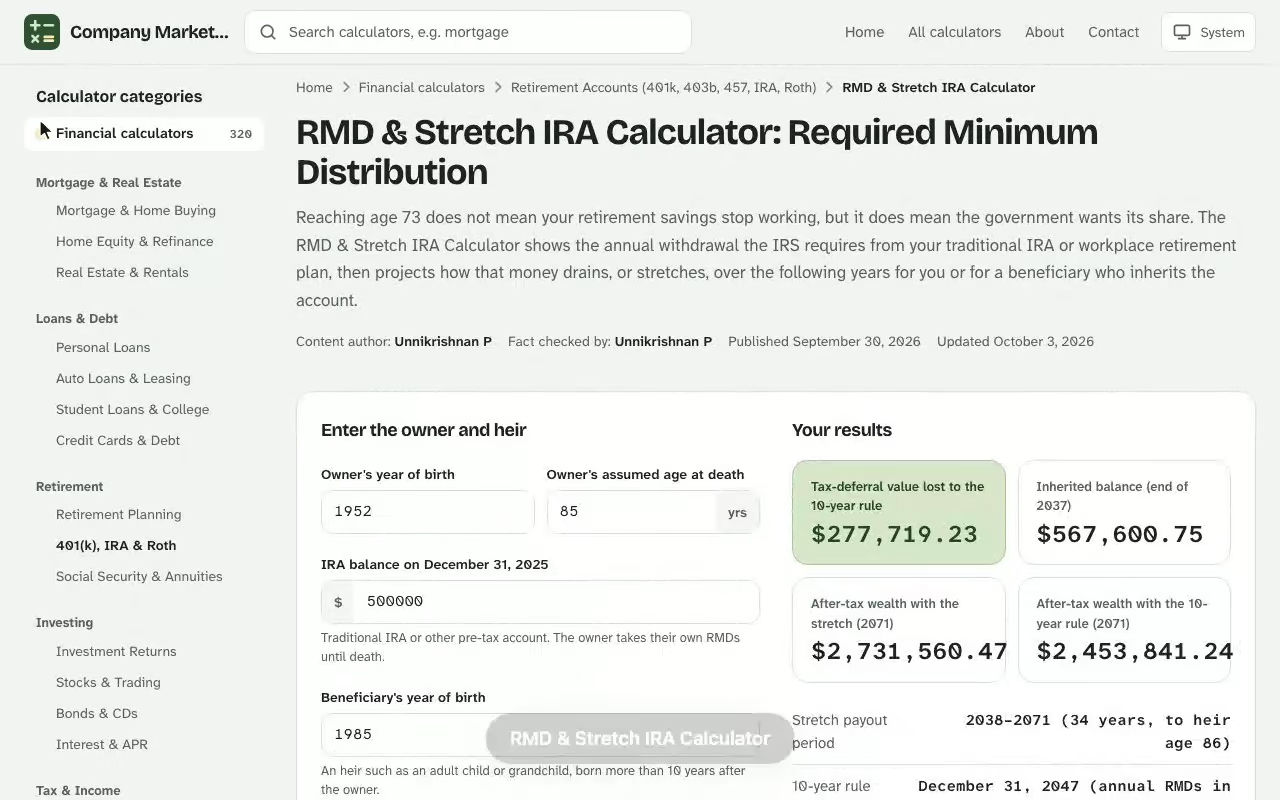
RMD & Stretch IRA Calculator. Reaching age 73 does not mean your retirement savings stop working, but it does mean the government wants its share. The RMD & Stretch IRA Calculator shows the annual withdrawal the IRS requires from your traditional IRA or workplace retirement plan, then projects how that money drains, or stretches, over the following years for you or for a beneficiary who inherits the account. The rmd calculator online uses the same plain-English approach, so you can compare results side by side.
Your results
Tax-deferral value lost to the 10-year rule
–
Inherited balance
–
After-tax wealth with the stretch
–
After-tax wealth with the 10-year rule
–
Stretch payout period–
10-year rule deadline–
Owner's lifetime RMDs–
Heir's tax: stretch / 10-year rule–
The stretch shown is the pre-2020 rule for a non-spouse heir, which still applies to eligible designated beneficiaries (spouse, minor child, disabled or chronically ill heirs, and heirs born no more than 10 years after the owner). Both use today's IRS life expectancy tables.
Heir's withdrawals: stretch vs 10-year rule
Year
Heir age
Stretch withdrawal
Stretch IRA balance
10-year withdrawal
10-year IRA balance
Owner's RMDs until death
Year
Owner age
Balance Dec 31 prior year
Divisor
RMD
Results are estimates for educational purposes and are not financial, tax or legal advice.
How the RMD & Stretch IRA Calculator Works
You enter three things: your age (or your beneficiary's age), the account balance on December 31 of last year, and the growth rate you expect on whatever stays invested. The calculator divides that balance by the IRS life expectancy factor for your age, shows the withdrawal due this year, and rolls the remaining balance forward to estimate future payouts. Everything below explains each step, so you can check the numbers yourself. The pension vs lump sum payout calculator uses the same plain-English approach, so you can compare results side by side.
A stretch projection simply repeats the same division year after year, using a new factor each time. That is why the tool is useful for two different readers: the owner planning how big the withdrawals will become, and the heir deciding how long an inherited account can keep growing tax-deferred.
Required Minimum Distribution Calculator Inputs Explained
A required minimum distribution calculator is only as accurate as what you type into it, so each field deserves a moment of attention. The future rmd projection calculator online uses the same plain-English approach, so you can compare results side by side.
Birth year or age: sets the factor and tells the tool whether your RMD age is 73 or 75, so retirement timing is handled automatically.
Prior year-end value: the statement figure for the account on December 31, not today's quote. Include only pretax money, and exclude Roth dollars held in a workplace plan.
Growth rate: a modest, conservative number works best for projections. Optimistic growth makes the future withdrawals look larger than a cautious assumption would.
Relationship and age of the spouse: only matters when your spouse is the sole heir and more than 10 years younger.
Owner type: original owner, or heir of an inherited account, which switches the calculator to the beneficiary tables.
Run the numbers once for each retirement account you hold, then add the results. If you want a second opinion, the IRS worksheet for age 73 and older owners follows the same steps by hand.
Required Minimum Distribution Rules by Age
A required minimum distribution is the smallest amount you must pull out of your tax-deferred retirement accounts each year once you reach the RMD age. Under the SECURE Act and SECURE 2.0, that age depends on when you were born.
Birth year
RMD age
First RMD due
1950 or earlier
72 or 70½ (already started)
Already in distribution
1951 to 1958
73
April 1 after the year you turn 73
1959
73 (rules for this year were clarified by final regulations)
April 1 after the year you turn 73
1960 or later
75
April 1 after the year you turn 75
Someone born in 1952, for example, reaches 73 in 2025, so the first RMD is due no later than April 1, 2026.
Required beginning date and the April 1 delay
Your required beginning date, sometimes called the required start date, is April 1 of the year after you reach RMD age. You may delay the first withdrawal until then, but the second RMD is still due by December 31 of that same year. Delay therefore stacks two taxable distributions into one tax bracket, which can push you into a higher one.
Delaying the first RMD to April 1, 2026 puts two taxable withdrawals in the same tax year.
Still working? The 5% owner exception
If you remain on the job, your current employer's plan may let you wait until you retire. That exception does not apply to a 5% owner of the sponsoring business, and it never applies to a traditional IRA, where distributions start at RMD age whether or not you are employed.
Required Minimum Distribution Formula and Life Expectancy Factor
Every required minimum distribution comes from one equation, applied separately to each account:
$$\text{RMD} = \frac{\text{December 31 balance of the prior year}}{\text{Life expectancy factor}}$$
The balance is the fair market value of the account on the prior December 31, and the divisor is a life expectancy factor from an IRS table published in Publication 590-B. Which table you use depends on your situation, and the life expectancy method built into the calculator picks the right one for you.
Uniform lifetime table
Most owners use the uniform lifetime table. It applies when your spouse is not your sole beneficiary, or when your spouse is not more than 10 years younger than you. The factor shrinks each year, so the percentage you withdraw grows with age.
Joint and last survivor table
If your only beneficiary is your spouse and your spouse is more than 10 years younger, the joint and last survivor table applies. It produces a longer divisor, so the withdrawal is smaller, a sensible reward for a longer shared horizon.
Single life expectancy table
Beneficiaries of an inherited account use the single life expectancy table instead. This is the engine behind a stretch IRA, because a younger heir's factor can span decades.
Worked Example With an IRA RMD Calculator
Suppose you are 76 and your traditional IRA held $847,300 on the prior December 31. The uniform lifetime factor for age 76 is 23.7:
$$\frac{\$847{,}300}{23.7} = \$35{,}751.05$$
That is the minimum you must withdraw this year, roughly 4.22% of the balance. If you assume the remainder grows 5% before the next December 31, you can project the following years:
See how the RMD & Stretch IRA Calculator works: change the inputs and the tax-deferral value lost to the 10-year rule updates instantly. Enter your own numbers in the calculator above.
Age
Prior Dec. 31 balance
Factor
RMD
76
$847,300.00
23.7
$35,751.05
77
$852,126.39
22.9
$37,210.76
78
$855,661.41
22.0
$38,893.70
79
$857,606.10
21.1
$40,644.84
80
$857,809.32
20.2
$42,465.81
Notice that the balance barely moves while the withdrawal climbs each year. These projected RMDs are what the tool plots, so you can see the income you will be forced to recognize long before it arrives.
The required withdrawal rises from $35,751.05 at age 76 to $42,465.81 at age 80, while most of the balance stays invested.
How the Required Minimum Distribution Changes Your Cash Flow
Because the divisor shrinks every year, the share of your retirement savings you must withdraw rises steadily. At age 76 it is about 4.2%; by age 90 the uniform factor is 12.2, which means more than 8% of the starting balance must come out. The projected RMDs in the calculator's results table show that climb year by year, so you can see each larger withdrawal, and the retirement income it adds, before it arrives.
Rerun the tool each autumn with the latest balance so the current-year figure is on your calendar well before December.
Reading the stretch IRA projection
When you read the projection, compare each year's required withdrawal with the growth on what remains. In the $847,300 example, 5% investment growth outpaces the withdrawal through age 80, so the balance holds near $857,000. Lower the growth input to 3% and the same projection bends downward sooner, which shows how sensitive the result is to your assumptions. The point of a projection is to show a range, not a promise.
Which Accounts Need a Minimum Distribution?
The rules reach most tax-deferred money. You must take a minimum distribution from:
A traditional IRA, including a rollover IRA holding pretax money
A SEP IRA or SIMPLE IRA
A 401(k) or other workplace retirement plan
A 403(b) or 457(b) plan
A Roth IRA owner never takes one during their own lifetime, and since 2024 designated Roth accounts in workplace plans work the same way. An IRA owner must calculate the amount separately for each IRA, but may withdraw the total from any one or a mix of them. The same aggregation works across 403(b) contracts, never across different account types.
One special case: pre-1987 contributions in a 403(b) can wait until age 75 if the plan tracks them separately.
Retirement Plan Rules for a 401(k), 403(b) and 457(b)
Every employer retirement plan has its own paperwork, but federal law sets the minimum, and workplace 401(k)s, 403(b)s and 457(b)s all follow it. A 401(k), 403(b) or 457(b) follows the same division formula as an IRA, with two differences worth knowing. First, you can often postpone withdrawals from your current employer's plan until the year you leave the job. Second, each plan calculates the amount for its own account, and you cannot satisfy it by taking extra money from a different type of plan or from an IRA.
One IRA means one calculation
Consolidating old retirement accounts into a single IRA before you reach RMD age replaces several required minimum calculations with one. Check with each plan administrator first, because a few restrict rollovers, and never roll over the RMD itself. The amount is a dollar figure, so you may satisfy it by selling holdings or by moving shares out in kind.
Annuities and the December 31 value
When you enter the December 31 value into the calculator, include the current value of any annuity contract held inside your retirement accounts. A lifetime income annuity can satisfy the requirement through its payments, and the insurer usually reports the amount separately.
Inherited IRA RMD Calculator Basics
When an owner dies, the beneficiary's category decides the schedule, which is why an inherited IRA RMD calculator asks for the date of death and the heir's relationship to the original owner. Two groups exist under current law.
Eligible designated beneficiary
An eligible designated beneficiary can stretch withdrawals over life expectancy. The group includes a surviving spouse, a minor child (until reaching majority), a disabled or chronically ill person, and anyone no more than 10 years younger than the owner, such as a sibling.
Designated beneficiary and the 10-year rule
Everyone else is a designated beneficiary. They must empty the account by the end of the tenth year after death under the 10-year rule. If the owner had already begun required withdrawals, the heir must also take annual amounts inside that decade; if not, the heir may wait until year ten.
Stretch IRA Projection for an Eligible Beneficiary
Take an inherited balance of $412,600 and a 52-year-old eligible heir. The single life factor for age 52 is 34.3, and it drops by one each following year:
Year
Start balance
Factor
Required withdrawal
1
$412,600.00
34.3
$12,029.15
2
$420,599.39
33.3
$12,630.61
3
$428,367.21
32.3
$13,262.14
4
$435,860.33
31.3
$13,925.25
5
$443,031.83
30.3
$14,621.51
With 5% growth, the account is larger after five years than on day one. Compare that with a non-eligible heir, who faces the 10-year rule: an even draw would be $41,260 a year, more than three times the stretch withdrawal. That gap is the whole appeal of the stretch strategy.
A 52-year-old eligible heir withdraws $12,029.15 in year 1, against $41,260 under an even 10-year draw.
A Retiree Plans Her Withdrawal With the RMD Calculator
Marguerite is 84, widowed, and keeps one traditional IRA. Her December 31 statement shows $1,126,482.37, and she wants to know the required minimum distribution calculator's answer before her tax preparer's January appointment, because she is also deciding how much to give to her church.
She enters her age, 84, and the prior year-end value. Her husband is gone, so no joint table applies; the calculator selects the uniform lifetime factor of 16.8. The RMD this tool produces is $1,126,482.37 ÷ 16.8 = $67,052.52, about 5.95% of the balance.
Next she tests a decision. She changes one input, adding a $20,000 qualified charitable distribution paid directly to the church. The requirement is still $67,052.52, but the amount that reaches her taxable income drops to $47,052.52, because the transferred dollars count toward the RMD without being reported as income.
She also checks the downside. Missing the deadline would trigger the 25% excise tax, which on her figure is $16,763.13, so she asks the custodian to send the church gift in February and the remaining $47,052.52 in two payments, one in June and one in November, both ahead of December 31. A quick rerun with a 2% growth assumption shows next year's divisor of 16.0 would require about $70,405 if the balance stays flat, so she budgets for the increase now.
The result gives Marguerite three specific actions: the charitable transfer amount, the payment dates, and the figure to hand her tax preparer.
Penalty for a Missed Required Minimum Distribution
Skip a withdrawal, or take too little, and a 25% excise tax applies to the shortfall. SECURE 2.0 lowered the old 50% charge, and the excise tax falls to 10% if you correct the miss within the allowed window, generally two years. On the $35,751.05 example, the penalty would be $8,937.76, or $3,575.11 if corrected in time. Because the penalty is that steep, many owners schedule the withdrawal in January rather than risk the deadline.
Taxes on Required Minimum Distribution Withdrawals
Withdrawals count as ordinary income and are added to your taxable income for the year, except any portion that is basis (after-tax money) or that is otherwise tax-free. State taxes may also apply. Larger RMDs can lift your tax bracket, raise Medicare premiums and make more of your Social Security taxable, which is why projecting them early matters.
Qualified charitable distribution
If you give to charity anyway, a qualified charitable distribution sends money straight from an IRA to the organization. It counts toward the requirement but is not included in your taxable income, subject to annual IRS limits.
What to Do With Your Withdrawal: Strategy Ideas
Once the calculator gives your annual amount, a withdrawal strategy decides where that RMD goes. It cannot be rolled into another IRA or reinvested in a tax-favored plan, but you can move it elsewhere. Weigh these options:
Spend it to cover living costs and leave other savings untouched.
Invest it in a taxable brokerage account for future goals.
Give it to a charity through a qualified distribution.
Use part of it to buy an annuity that adds guaranteed lifetime income.
Fewer accounts also mean fewer RMD calculations to run and track. Ask a tax advisor how the result fits your overall income picture.
Common Mistakes When Using an RMD Calculator
Most errors come from inputs, not arithmetic. Check these before trusting any result:
Entering today's balance instead of the December 31 figure from last year
Using the wrong table, especially when a spouse is far younger
Forgetting that a surviving spouse, minor child or disabled heir has special rules
Ignoring a year-end rollover or conversion that changes the valuation
Assuming withdrawals above the minimum satisfy next year's requirement; they do not
The IRS also publishes worksheets for owners who want to confirm the math by hand, and Publication 590-B lists every table.
RMD & Stretch IRA Calculator questions
What is a required minimum distribution?
It is the smallest amount you must withdraw each year from a traditional IRA or workplace retirement plan once you reach RMD age. The amount is the prior December 31 balance divided by an IRS life expectancy factor.
At what age do I have to start taking RMDs?
Age 73 if you were born from 1951 through 1958, and age 75 if you were born in 1960 or later. Your first RMD can wait until April 1 of the following year.
What happens if I delay my first RMD until April 1?
You must also take the second RMD by December 31 of that same year, so two taxable withdrawals land in one tax year, which can push you into a higher bracket.
Do Roth IRAs have required minimum distributions?
Not while the original owner is alive. Beneficiaries who inherit a Roth IRA are subject to RMD rules, and the same goes for inherited traditional IRAs.
What is the penalty for missing an RMD?
A 25% excise tax applies to the amount you failed to withdraw. It falls to 10% if you correct the shortfall within the allowed window.
Which IRS table does the calculator use?
The Uniform Lifetime Table. If your only beneficiary is a spouse more than 10 years younger, choose that option; the Joint and Last Survivor Table in IRS Publication 590-B applies instead.
Can I take my RMD from just one IRA?
You calculate the RMD separately for each IRA, but you may withdraw the combined total from one or more of them. This does not extend across different account types, such as an IRA and a 401(k).
Can I roll my RMD into another retirement account?
No. An RMD cannot be rolled over or reinvested in an IRA or 401(k). You can put it in a taxable brokerage account, save it, or donate it to charity.