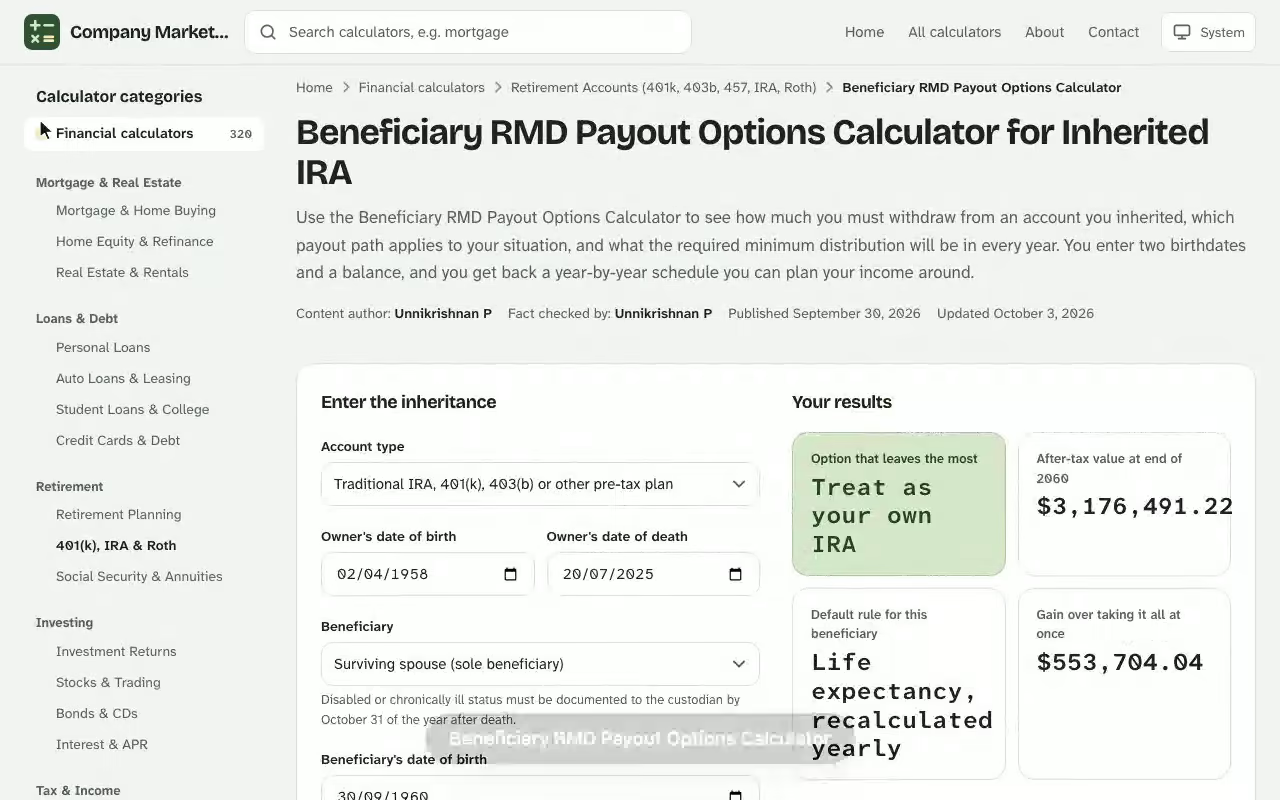
Beneficiary RMD Payout Options Calculator. Use the Beneficiary RMD Payout Options Calculator to see how much you must withdraw from an account you inherited, which payout path applies to your situation, and what the required minimum distribution will be in every year. You enter two birthdates and a balance, and you get back a year-by-year schedule you can plan your income around. Pair this with the rmd calculator for a fuller picture before you make a decision.
Your results
Option that leaves the most
–
After-tax value of that option
–
Default rule for this beneficiary
–
Gain over taking it all at once
–
Uses one flat tax rate for every withdrawal. A lump sum or a large final-year withdrawal is often taxed at a higher bracket than smaller yearly amounts, so the real gap between options is usually bigger than shown.
Payout options side by side
Each option starts from the same balance and return. After-tax value = money taken out (after tax, then invested) plus whatever is still in the account, less the tax due on it.
Option
Withdrawal years
Total withdrawn
Tax on withdrawals
After-tax value
Withdrawals by year for each option
Results are estimates for educational purposes and are not financial, tax or legal advice.
How a Beneficiary RMD Payout Options Calculator Works
Every payout path starts from the same three facts: who owned the account, when that person was born and died, and how you are related to them. The calculator turns those facts into a first-year amount, then repeats the arithmetic for every later year until the account has to be empty. That is why a good RMD calculator asks for dates before it asks for dollars. The free rmd start date calculator is free to use with no sign-up, and works on desktop and mobile.
The same logic sits behind every inherited IRA RMD calculator you will find from a brokerage or an insurer, and it is the logic this beneficiary RMD payout options calculator follows: the owner's status decides the deadline, and your own status decides the divisor.
Owner's Birthdate and Age at Death
The owner's birthdate fixes the starting age for required withdrawals under the SECURE Act and SECURE 2.0: 72 for owners born from mid-1949 through 1950, 73 for those born from 1951 through 1959, and 75 for anyone born in 1960 or later. Whether the owner had reached that age before dying decides if you owe a payment every year or only a final emptying date.
Beneficiary Birthdate and Plan Type
Your own beneficiary birthdate sets your divisor, because your remaining life expectancy comes from the IRS Single Life Table. The plan type matters as well. A 401k, a 403b, a traditional account and a Roth IRA all follow the same timelines for heirs, but only the pre-funded kinds produce a bill when you take the money out.
Inherited Retirement Account Distribution Rules by Heir Type
The distribution rules that apply to an inherited retirement account depend on who you are. The table below sorts the common cases, and the subsections explain how each one plays out. The free fixed annuity calculator uses the same plain-English approach, so you can compare results side by side.
Who you are
Payout path
Account must be empty by
Yearly withdrawal required?
Surviving spouse
Roll over, treat as your own, or use a lifespan-based payout
Based on your own age, if you roll over
Once you reach your own required age
Eligible designated beneficiary
Lifespan-based payout
The end of your lifespan factor
Yes, every year
Adult son, daughter or other designated heir
Ten-year rule
December 31 of the tenth year after death
Yes in years 1 to 9 if the owner had started withdrawals
Estate or charity
Five-year rule or owner's remaining lifespan factor
Five years, or the owner's remaining span
Depends on the owner's status at death
Spouse as Sole Beneficiary
A spouse has the most freedom. As the sole beneficiary, a surviving spouse can leave the money where it is, or the account rolls over into the spouse's own IRA. After rolling over, the spouse follows the Uniform Lifetime Table once the spouse reaches that point. Anything the owner had not taken in the year of death cannot move, so that shortfall has to come out of the old account first. No other heir gets that choice.
Eligible Designated Beneficiaries and Life Expectancy
Eligible designated beneficiaries are a short list: the owner's minor child, a disabled or chronically ill heir, and anyone not more than ten years younger than the owner. These heirs can stretch withdrawals across their own lifespan, which means the smallest yearly amounts of any path. A minor gets this treatment only until reaching the age of majority, after which the ten-year countdown begins.
The 10 Years Rule for Everyone Else
Adult children, siblings, nieces and friends fall under the 10 years rule. When the owner had already begun required withdrawals, you must take a yearly annual distributions amount in each of the first nine years and clear the remainder in year ten. When the owner died earlier, the only deadline is that final December 31, and the amount in between is yours to choose.
Required Minimum Distribution Worked Example
Take a daughter born in 1972 who inherits a traditional account from her father, who died at 79 after he had already begun his withdrawals. On December 31 of the year before her first withdrawal, the balance is $418,750. She is 53 in the first year, and the IRS Single Life Table gives a factor of 33.4 for that age (check the current table in IRS Publication 590-B before relying on it). The calculator uses this formula:
$$\text{RMD} = \frac{\text{Prior year-end balance}}{\text{Single Life Table factor}}$$
Her first-year figure is \(\$418{,}750 \div 33.4 = \$12{,}537\). Each following year the factor drops by 1, and the calculator applies a hypothetical rate of return of 5% to whatever is left after each withdrawal.
The ten-year clock for a $418,750 inherited account: nine yearly minimums, then the account must be empty.
Year
Factor
Opening balance
Withdrawal
1
33.4
$418,750
$12,537
2
32.4
$426,523
$13,164
3
31.4
$434,027
$13,823
4
30.4
$441,215
$14,514
5
29.4
$448,036
$15,239
6
28.4
$454,436
$16,001
7
27.4
$460,357
$16,801
8
26.4
$465,733
$17,641
9
25.4
$470,497
$18,523
10
Empty the account
$474,572
$474,572
The pattern is the point. Nine small withdrawals add up to $138,243 and then one balloon payout in year ten brings in the rest, so the schedule that looks gentle at first ends in the largest annual bill. Splitting the same sum evenly over the decade would instead start at $41,875 and finish at $64,962.
See how the Beneficiary RMD Payout Options Calculator works: change the inputs and the option that leaves the most updates instantly. Enter your own numbers in the calculator above.The minimum schedule keeps early withdrawals low but pushes $474,572 into year 10.
Stretch IRA Calculator Logic Versus Taking It All at Once
A stretch IRA calculator models the oldest idea in estate planning: take the least the law allows, as late as it allows, so the account keeps growing. The strategy still works for spouses and eligible heirs, but for most others a decade-long payout window has replaced it.
Taxes and the Lump Sum
You can always withdraw all funds immediately. Doing so pays the bill at once, usually in the highest bracket you will ever see, while the slower paths let you defer taxes and spread income across several returns. If you want a single bottom-line comparison, a tax advisor or CPA can run your tax situation through each schedule.
Choosing the Minimum Amount Versus a Smoother Plan
Taking only the minimum amount each year keeps early income low. Smoothing the withdrawals keeps the last year from landing on top of your salary. When the owner died before the starting age, you choose, so test both schedules in the calculator before you commit.
Working Out Required Minimum Distributions for an Aunt's Account
A 46-year-old engineer inherits a traditional account holding $287,340.18 from an aunt who died at 70, in 2026, before her own starting age of 73. Before choosing a payout, the heir opens the beneficiary RMD calculator and enters the aunt's birthdate, the date of death and the account's December 31 balance.
The result is not a yearly figure at all. Because the aunt had not begun withdrawals, the schedule shows no annual minimum, only a deadline: the account must be empty by December 31, 2036, the tenth year after the year of death. That is the required minimum distribution answer for this heir, and it means the timing is a choice.
To see the cost of each choice, the heir tests an even split. At a 4% hypothetical return, taking the balance divided by the years left starts at $28,734 and climbs to $40,897 in the final year, $344,984 in total. Rerunning with 6% lifts the last payout to $48,546 and the total to $378,737.
Year 1 withdrawal at either rate: $28,734, since the return has not been applied yet.
Year 10 withdrawal: $40,897 at 4%, $48,546 at 6%.
The decision follows from those numbers. The heir schedules $28,734 for December 2027, keeps the 6% run as the planning case, and re-enters the balance every January so the next figure uses real values rather than the assumed return.
Penalties, Waivers and Rule Changes
The yearly amount this tool produces is the minimum the law expects from you, so any shortfall against it is what a penalty is measured on: the excise charge is a percentage of the difference between what the schedule requires and what you actually took out. Missing a required withdrawal is costly, and you generally have to file a form to ask for relief. To avoid penalties, take at least the scheduled amount by December 31 every year. The CARES Act granted a one-time waiver for 2020, which is why older schedules show a blank for that year. The SECURE Act rewrote the payout window the schedule is built on, and later rounds of law changed when withdrawals begin, not the way your divisor is figured.
Inherited IRA Distributions Calculator Assumptions and Limits
Any tool of this kind rests on calculator assumptions: a steady rate of return, a balance on December 31, and no mid-year surprises. Treat the output as estimates only. Real markets swing, inflation erodes purchasing power over a decade, and a fixed investment return is a convenience rather than a forecast. Confirm the final figure with a financial professional or financial planner before moving any money.
Retirement Accounts and Required Minimum Distributions You Can Inherit
The calculator covers retirement accounts of every common kind: a traditional or Roth IRA, SEP IRAs, SIMPLE IRAs, and workplace plans. Each one has its own plan information sheet, yet the required minimum distributions an heir faces follow one framework, so the same inputs work across all of them.
Beneficiary Options Beyond the Account Itself
Your beneficiary options narrow when the money sits in annuities bought inside the account, because the contract's own payout schedule can override the usual choices. A pension that pays a survivor benefit follows plan rules instead. Life insurance proceeds are not part of the retirement assets at all, and ordinary savings outside the account never carry a withdrawal deadline.
Distribution Requirement Definitions and the Report
Read the definitions before you trust a result. An account owner is the person who held the money, and an IRA owner is the same idea for IRAs, so a mislabeled entry changes the answer. When the report prints, check the beneficiary information section: an IRA beneficiary who is entered with the wrong status gets the wrong divisor. Each distribution requirement changes between heir types, the lifetime tables apply only to some of them, and the distribution requirements for an account owner who died early differ again. The withdrawal rules are strict about timing, and a qualifiedtax professional can confirm which row of the table is yours. If you simply want to stretch out payments as long as the law permits, enter the smallest allowed amount each time.
How do I calculate a beneficiary's required minimum distribution?
Divide the account balance on December 31 of the previous year by the life expectancy factor that applies to your beneficiary type. The factor comes from the IRS Single Life Table and drops by one each year for most heirs.
What is the 10-year rule for an inherited IRA?
Most non-spouse heirs who are not eligible designated beneficiaries must empty the account by December 31 of the tenth year after the owner's death. If the owner had already begun required withdrawals, you must also take a yearly amount in years one through nine.
Who is an eligible designated beneficiary?
A surviving spouse, the owner's minor child, a disabled or chronically ill individual, and a person not more than 10 years younger than the owner generally qualify and can use a life expectancy payout.
Does it matter whether the owner died before or after the required beginning date?
Yes. If the owner died on or after the required beginning date, a 10-year heir owes yearly withdrawals as well as the final emptying. If the owner died earlier, there is usually only the final deadline.
What can a surviving spouse do differently?
A spouse can leave the money in an inherited account and use a life expectancy that is recalculated each year, or roll it into their own IRA and follow the lifetime table once their own starting age arrives.
What happens if I miss a required withdrawal?
The shortfall is subject to an excise charge, which you generally ask the IRS to waive by filing a form with a short explanation. Withdraw at least the scheduled amount by December 31 each year to avoid it.
Do estates and charities follow the same rules?
No. Without a person as beneficiary, the account is emptied within five years if the owner died before the required beginning date, or paid over the owner's remaining life expectancy if after it.
How accurate is this calculator?
It gives estimates based on the inputs you enter and a steady rate of return. Confirm results with a tax professional or your plan administrator before you take a withdrawal.