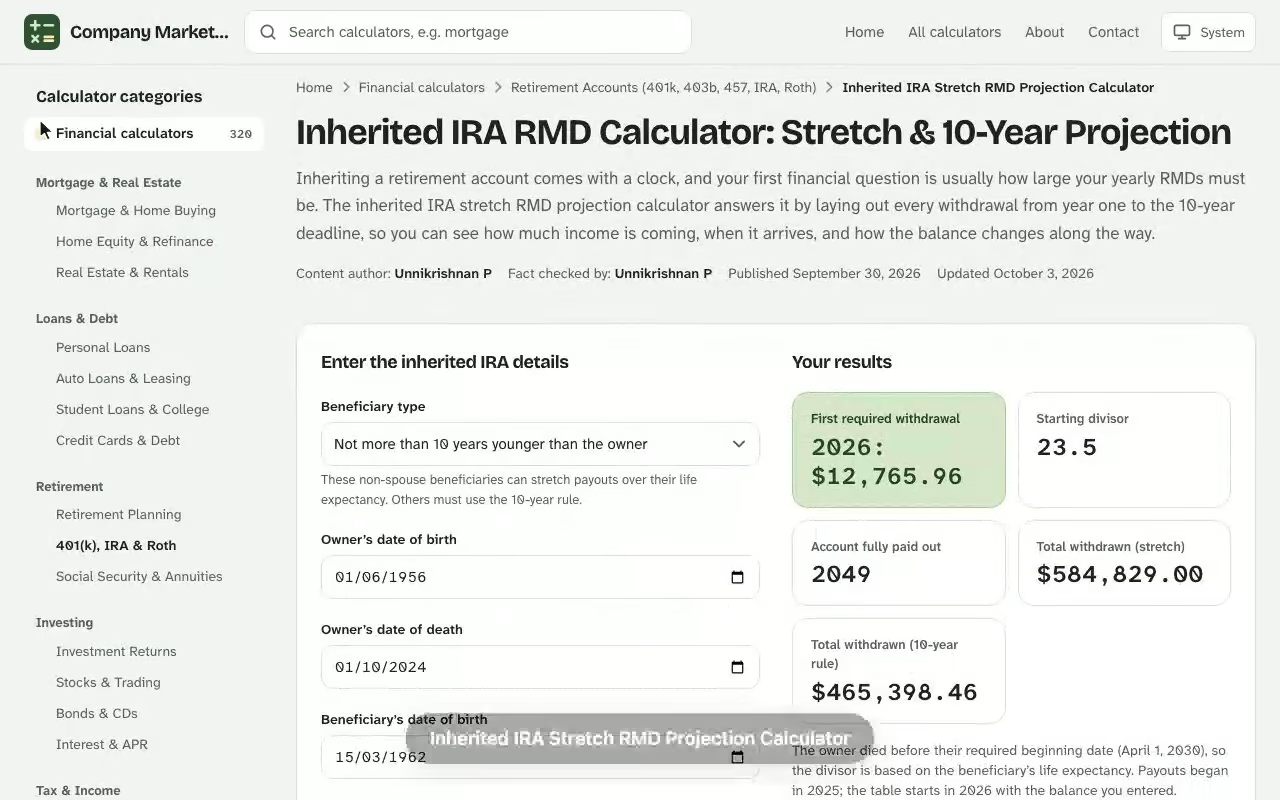
Inherited IRA Stretch RMD Projection Calculator. Inheriting a retirement account comes with a clock, and your first financial question is usually how large your yearly RMDs must be. The inherited IRA stretch RMD projection calculator answers it by laying out every withdrawal from year one to the 10-year deadline, so you can see how much income is coming, when it arrives, and how the balance changes along the way. Next, open the free rmd calculator and enter your own details to see an estimate in seconds.
Your results
First required withdrawal
–
Starting divisor
–
Account fully paid out
–
Total withdrawn (stretch)
–
Total withdrawn (10-year rule)
–
For a surviving spouse, use the spouse inherited IRA calculator: spouses get extra options, such as treating the IRA as their own.
Year-by-year stretch payouts
Required withdrawals if the beneficiary takes only the minimum each year, with the 10-year rule shown alongside for comparison.
Year
Beneficiary age
Balance Dec 31 prior year
Divisor
Required withdrawal
Balance at year-end
10-year rule withdrawal
Results are estimates for educational purposes and are not financial, tax or legal advice.
How the Inherited IRA RMD Calculator Works
An inherited IRA RMD calculator takes a handful of facts about the account and the person who received it, then runs the same arithmetic the IRS expects. Each year, your required minimum distribution equals the account balance on December 31 of the prior year divided by a life expectancy factor. The factor comes from the IRS Single Life Expectancy Table, and it shrinks by one every year, which is why the percentage you must withdraw rises over time. If you want to see how the figures change, the free current year rmd calculator gives you an instant result you can adjust as you go.
The projection adds one more layer: a hypothetical rate of return applied to whatever stays invested. That turns a single answer into a schedule of annual distributions you can plan around.
First-year required withdrawal for three balances and five beneficiary ages; the worked example is outlined.
What you enter
Account balance on December 31 of the year the owner died, which is the starting point for every later calculation.
Beneficiary birthdate, because your age on December 31 of the year after death sets the first life expectancy factor.
Owner's age at death and whether they had already begun required withdrawals, since that decides if yearly distributions apply at all.
Plan type such as a traditional IRA or Roth IRA, along with your expected investment growth for retirement planning and savings estimates.
Why beneficiary birthdate matters
Your birthdate fixes your age on December 31 of the year following the death. Take that age to the table, read the factor, and divide. Because the factor falls by exactly one each later year, a single birthdate drives the entire schedule.
Beneficiary Options and the 10-Year Distribution Rules
Which distribution rules apply to you depends on who you are relative to the original account owner. Before the SECURE Act took effect, nearly every beneficiary could stretch withdrawals across a lifetime. The law replaced that with a shorter window for most people, and SECURE 2.0 later adjusted related ages and penalties without changing how a beneficiary's RMD is calculated. The free beneficiary rmd calculator current year is free to use with no sign-up, and works on desktop and mobile.
Eligible designated beneficiaries
A small group, the eligible designated beneficiaries, keeps the lifetime stretch. It includes a surviving spouse, a minor child of the owner, a disabled or chronically ill person, and anyone not more than ten years younger than the owner. Their annual withdrawals are spread over their own life expectancy.
Everyone else: the 10 years rule
Adult children, grandchildren, siblings far younger than the owner and most other beneficiaries must empty the account by December 31 of the tenth year after death. If the original account owner had already reached the required beginning date, yearly required minimum distributions are due in years one through nine as well. If the owner died earlier, no yearly amount is required, though the account must still be empty by the end of year ten.
Key dates for the 10-year distribution window in the worked example.
Surviving spouse choices
A surviving spouse who is the sole beneficiary can usually roll the funds into their own IRA and follow the Uniform Lifetime Table (one of the IRS lifetime tables), or keep an inherited account and use the single life table. When the spouse is more than ten years younger than the owner, the joint life expectancy approach produces smaller required amounts. These beneficiary options change the schedule dramatically, so run each one separately.
Inherited IRA Stretch RMD Projection Calculator: A Worked Example
Here is a complete case you can reproduce with an inherited IRA distributions calculator. The owner died in 2025 at age 76, after required withdrawals had begun, leaving a traditional IRA worth $412,600 on December 31, 2025. The beneficiary is the owner's daughter, who turns 55 on December 31, 2026. She assumes a 5% rate of return and takes each withdrawal at year end.
Her first factor is 31.6 from the IRS table, so her first minimum amount is $412,600 ÷ 31.6 = $13,057. The remaining balance grows by 5% to $433,230 before that withdrawal, leaving $420,173. The next factor is 30.6, and the pattern repeats.
Year
Age at Dec 31
Factor
Opening account balance
Required withdrawal
Closing balance
2026
55
31.6
$412,600
$13,057
$420,173
2027
56
30.6
$420,173
$13,731
$427,451
2028
57
29.6
$427,451
$14,441
$434,382
2029
58
28.6
$434,382
$15,188
$440,913
2030
59
27.6
$440,913
$15,975
$446,984
2031
60
26.6
$446,984
$16,804
$452,529
2032
61
25.6
$452,529
$17,677
$457,478
2033
62
24.6
$457,478
$18,597
$461,756
2034
63
23.6
$461,756
$19,566
$465,278
2035
64
None (final year)
$465,278
$488,541
$0
Across the decade she withdraws $633,577 in total, which is the $412,600 she inherited plus about $220,977 of growth. The surprise is the last row. Years one through nine ask for under $20,000 each, then 2035 demands $488,541, because the whole balance must leave the account. Without planning, that single year can push you into a much higher tax bracket.
Nine required distributions under $20,000, then a $488,541 payout that empties the account in 2035.
Beneficiary's assumed age at death
Some versions of this tool also ask for the beneficiary's age at death so a successor beneficiary can be modeled. In the worked example, if the daughter died in 2029, whoever inherits from her would still have to empty the account by the end of 2035, so the 2026-2035 schedule above would stop being hers. If you only care about your own schedule, leave this setting alone.
Running Required Minimum Distribution Numbers on a Brother's IRA
Marcus Delgado's brother died in November 2025 at age 79, and the traditional IRA passed to Marcus, who will be 61 on December 31, 2026. The December 31, 2025 statement shows $287,450. His brother had been taking withdrawals since 72, so yearly distributions apply to Marcus too. He wants to know what 2026 requires and what the tenth year looks like.
He opens the projection and enters the balance, his birthdate, his brother's age at death, and a 5% growth assumption. The calculator reads the factor for age 61 from the IRS Single Life Expectancy Table, 26.2, and divides: $287,450 ÷ 26.2 = $10,971. That is the stretch IRA minimum for 2026, and it climbs to $16,500 by 2034.
The result that stops him is the last line. At the minimums, the account still holds about $298,811 after 2034, so 2035 requires a $313,751 payout. Marcus is still working, and that lump would land on top of his salary in one tax year.
He reruns the projection with an extra $25,000 withdrawn each year from 2026 through 2034.
The required amounts shrink because the balance is smaller, and the 2035 payout falls to $76,677.
He now asks his tax professional whether the extra $25,000 fits inside his current bracket, instead of discovering the lump in 2035.
The calculator did not choose for him. It turned a vague ten-year deadline into two concrete figures, $10,971 now and $313,751 later, and gave him a precise question to take to his accountant.
Stretch Strategy: Reading the Required Minimum Distribution Calculator Results
The stretch strategy means taking the smallest amount the law allows, as late as the law allows, so the rest keeps growing while you defer taxes. A required minimum distribution calculator shows the floor, and the projection shows what it does to your balance. In the example above, the inherited IRA stretch RMD projection calculator shows that withdrawing only the minimum keeps the account growing for nine years. Taking more early, say $60,000 a year, would shrink the 2035 balloon but raise your taxes sooner.
Compare the shape of the schedule against your own income picture. If you expect to retire in five years and fall into a lower bracket, leaving more of the account for the later years may cost you less. If your earnings are likely to rise, the opposite is true. The calculator gives you the numbers, and a tax professional or tax advisor helps you pick the withdrawal pattern.
Roth accounts and plan type
The plan type you enter matters. A Roth IRA owner is never subject to lifetime required withdrawals, so a beneficiary has no annual requirement, just the ten-year emptying deadline. A traditional IRA follows the rules in the worked example. Other accounts, such as a 401(k) or 403(b), usually follow similar beneficiary rules, though the plan's own terms may add restrictions.
RMD Calculator Assumptions, Risk and Penalties
Every projection is only as good as its assumptions. A steady 5% is a convenient simplification, not a forecast. Real portfolios swing, and market risk means your balance in 2030 could land far above or below the figure shown. Inflation also erodes the buying power of every future withdrawal, so a $19,566 distribution in 2034 will buy less than the same amount does today.
Estimates only: results depend on the rate of return and balance you supply, and they are not a guarantee.
IRS rules change: read the current IRS publication on distributions from IRAs before acting, since final regulations have already adjusted several details.
CARES Act waiver: the 2020 waiver of required withdrawals no longer applies to current years.
Missing a withdrawal: the excise tax is 25% of the shortfall, reduced to 10% if you correct it promptly.
The tax obligations attached to an inherited account are easy to overlook, and penalties for a missed distribution add up fast. Treat the output of this calculator as a map, then confirm the route with a financial professional.
Withdrawal Rules: Timing, Rollovers and Year of Death
The withdrawal rules for the year the owner passed away are a common trap. If the original owner had not yet taken that year's required amount, the beneficiary generally must take it by the end of that year of death, using the owner's own life expectancy. The calculator's first projected year is the following year, and the earlier shortfall is a separate item.
A direct rollover into an inherited IRA is how most non-spouse beneficiaries move assets from the original plan. Choose a trustee-to-trustee transfer so no tax is withheld and the account keeps its inherited status. If you roll over the funds into your own IRA in error, the transfer can be treated as a full distribution, and the schedule this projection produces no longer applies. When the account is retitled correctly, you can withdraw more than the distribution requirement in any year without penalty, because the minimum is a floor, not a cap.
Retirement Savings, Beneficiary RMD Planning and Investments
Use the projection's yearly figures for retirementplanning: the $13,057 to $19,566 withdrawals in the worked example are what you can budget for or send to a tax estimate each year, and the 2035 payout is what you need savings or a lower-bracket withdrawal plan to absorb. Because the money must leave the IRA, you can reinvest it in lower-turnover investments outside it to keep the tax drag small, and keeping accounts organized, with a record of every distribution, makes the tax return match the schedule.
See how the Inherited IRA Stretch RMD Projection Calculator works: change the inputs and the first required withdrawal updates instantly. Enter your own numbers in the calculator above.
The stretch IRA calculator view is also useful for the original owner. If you want your own heirs to benefit, run the projection for a few likely beneficiaries, see how large the year-ten payout becomes, and adjust your risk level or beneficiary designations before it matters. A beneficiary RMD plan made in advance is cheaper than one made in a hurry. That is the quiet advantage of an RMD & Stretch IRA calculator: it turns an abstract legal deadline into dollars you can work with.
Finally, remember that the RMD calculator results for an inherited retirement account are not the same as those for your own. If you also hold your own accounts, calculate those separately and total the yearly amounts before you budget.
Inherited IRA Stretch RMD Projection Calculator questions
How do I calculate the RMD on an inherited IRA?
Take the account balance on December 31 of the prior year and divide it by the life expectancy factor that applies to you. For most non-spouse beneficiaries the account must be emptied within 10 years, and this projection assumes an even payout over that window.
What is the 10-year rule for inherited IRAs?
Under the SECURE Act, most non-spouse beneficiaries must withdraw the entire inherited balance by December 31 of the tenth year after the owner's death. Eligible designated beneficiaries, such as a surviving spouse, can follow different rules.
Does a spouse who inherits an IRA follow the same schedule?
No. A surviving spouse who is the sole beneficiary can roll the account into their own IRA and take required distributions from their own required age. This calculator then applies the 10-year rule to the spouse's beneficiary.
Do Roth IRAs have required minimum distributions?
The original owner of a Roth IRA never has lifetime required distributions, so the projection shows none while the owner is alive. A beneficiary still has to empty the account within the 10-year window.
What happens if I miss a required distribution?
The IRS can charge an excise tax on the amount you should have taken. Correcting the shortfall promptly can reduce the penalty, and a tax professional can explain how it applies to your situation.
What rate of return should I assume?
Use a conservative, steady figure. The rate only drives projected balances, so a higher assumption raises later withdrawals. Actual returns vary and investments carry market risk.
At what age do required distributions start for the account owner?
It depends on the owner's birthdate. Under SECURE 2.0, owners born in 1951 through 1959 start at 73, and owners born in 1960 or later start at 75.