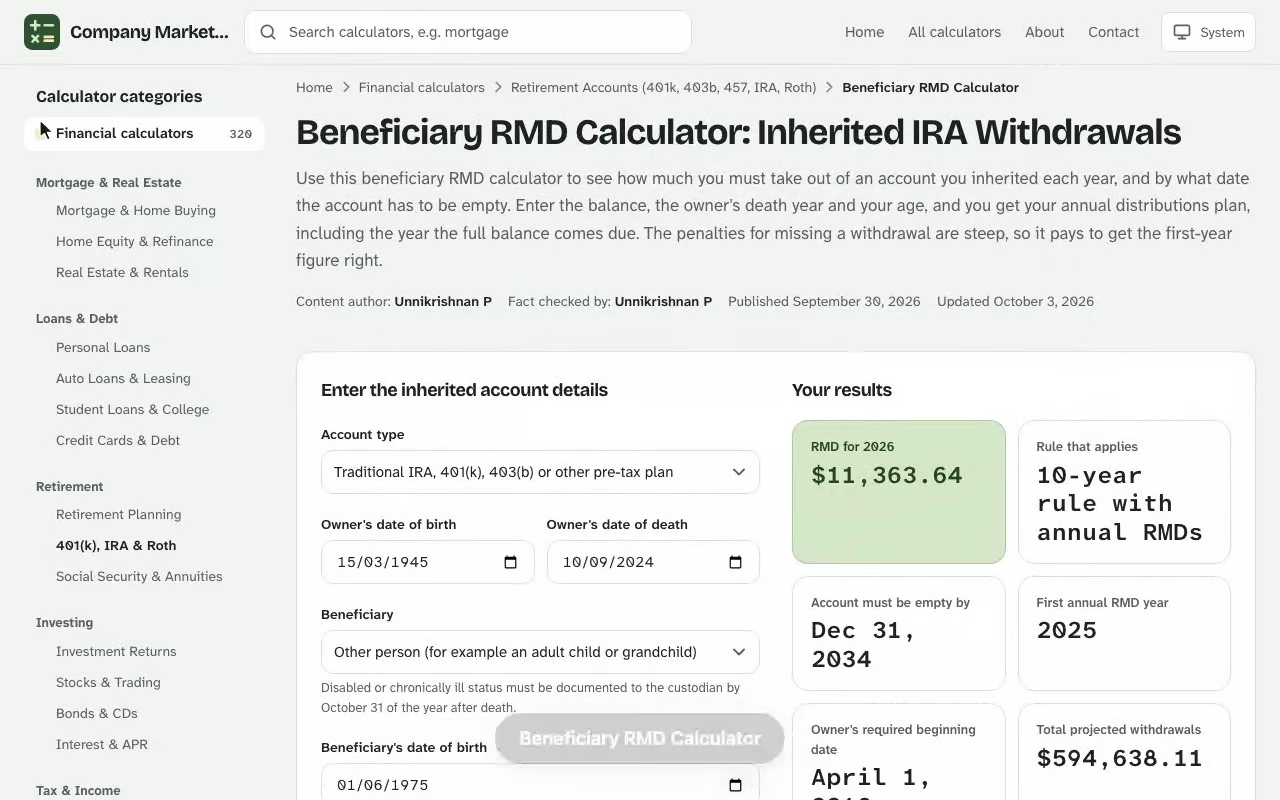
Beneficiary RMD Calculator. Use this beneficiary RMD calculator to see how much you must take out of an account you inherited each year, and by what date the account has to be empty. Enter the balance, the owner's death year and your age, and you get your annual distributions plan, including the year the full balance comes due. The penalties for missing a withdrawal are steep, so it pays to get the first-year figure right. Pair this with the rmd calculator online for a fuller picture before you make a decision.
Your results
RMD
–
Rule that applies
–
Account must be empty by
–
First annual RMD year
–
Owner's required beginning date
–
Total projected withdrawals
–
Assumes one individual beneficiary (or an estate) for the whole account and uses the IRS Single Life Table in effect from 2022. Check the IRA or plan document too: a plan can require the 10-year or 5-year rule instead of life-expectancy payments.
Year-by-year withdrawal schedule
Required withdrawals if you take only the minimum each year and the account earns the return you entered. In the final year the whole remaining balance comes out.
Year
Beneficiary age
Balance Dec 31 prior year
Divisor
Required withdrawal
Note
Results are estimates for educational purposes and are not financial, tax or legal advice.
How the Beneficiary RMD Calculator Works
Inheriting a retirement account usually means inheriting a deadline as well. If the original owner had already started taking withdrawals, the IRS expects you to keep the schedule going, and it expects the account to be fully paid out within a fixed window. The calculator turns those rules into plain numbers: a dollar amount for this year, the divisor behind it, and the final date. The pension plan retirement options calculator online is free to use with no sign-up, and works on desktop and mobile.
What you enter
You provide five facts about the account and about yourself. Each one maps to a rule in the IRS tables, so none of them is optional:
Your relationship to the original owner: spouse, non-spouse, or eligible designated beneficiary.
Year of death and whether the owner had already reached RMD age and started withdrawals.
Your age in the calendar year after the death, which sets the life expectancy factor.
The account balance on December 31 of the year before the withdrawal year.
An expected growth rate, used only for the year-by-year projection.
What you get back
The result is your required withdrawal for the selected year, the factor used to compute it, the rule that applies to your situation, and the last year by which the account must be emptied. Treat the number as an estimate built on the stated assumptions, because custodians sometimes round a balance or a factor differently.
Required Minimum Distribution Formula for Inherited Accounts
For a beneficiary who is paid out over a life expectancy, the required minimum distribution for any year is the prior year-end balance divided by a divisor taken from the IRS Single Life Expectancy Table: The free spouse inherited ira rmd calculator uses the same plain-English approach, so you can compare results side by side.
$$\text{RMD} = \frac{\text{Balance on December 31 of the prior year}}{\text{Life expectancy factor}}$$
The balance is easy to find on a year-end statement. The factor is where most mistakes happen, so it gets its own section.
Choosing the life expectancy factor
Look up your age in the calendar year following the owner's death. That table value is your factor for the first year, and it is the number the calculator looks up from the age you enter before dividing it into your balance. A 54-year-old beneficiary, for instance, starts with a factor of 32.5. The table is the same for everyone, so two beneficiaries of the same age always start from the same divisor.
First-year amounts for different balances and ages, with the worked example outlined.
Why the divisor drops by one each year
A non-spouse does not look up a new age every year. You take the first-year factor and subtract 1 for every calendar year that passes. The divisor shrinks, so the same balance produces a bigger withdrawal each year:
A spouse who keeps the account as an inherited account is treated differently, because the spouse's factor is looked up again from the table every year as the spouse ages. That is one reason the relationship input comes first.
Checking Annual Distributions on an Inherited Account Before the January Transfer
Priya Raman's father died in March 2024 after years of taking his own withdrawals, and the December 31, 2024 statement on the account she inherited shows $286,914.37. She is a non-spouse, so the 10-year window ends December 31, 2034, and because he had already started, she cannot simply wait it out. Before moving money, she wants the required withdrawal for 2025.
She keys in a death year of 2024, "started withdrawals: yes," the $286,914.37 balance, and her age in 2025, which is 47. The Single Life Table gives a factor of 39.0, and the beneficiary RMD calculator returns the division she would otherwise do by hand:
$$\frac{\$286{,}914.37}{39.0} = \$7{,}356.78$$
That is her 2025 amount. The number matters because the excise tax on a shortfall is 25% of what was missed, which would have been $1,839.19 on this figure (reduced to 10%, or $735.68, if corrected in time). So she sets a standing transfer for the first week of January and does not touch the rest.
Then she changes one input. Assuming 4% growth on the remainder, the 2026 balance becomes $290,739.89 and the factor drops to 38.0, so the 2026 requirement rises to $7,651.05. Seeing the climb, she decides to compare it against her 24% bracket before choosing whether to take extra in the lower-income years. The ten-year clock, not the yearly amount, is what limits her options, and the calculation shows exactly how much room is left.
Inherited IRA Distribution Rules Calculator: Which Rule Applies to You
Before any dollar figure matters, you need to know whether annual withdrawals are required at all. A good inherited IRA distribution rules calculator answers that question first, because the answer depends on three facts: who you are to the owner, when the owner died, and whether the owner had begun taking withdrawals. The same questions drive the amount the tool shows you.
If the owner died before 2020, the older rules apply and the choice is usually a five-year payout or life expectancy payments.
If the owner died in 2020 or later and was already taking withdrawals, most non-spouse beneficiaries must take yearly amounts in years 1 through 9 of a 10-year window.
If the owner died in 2020 or later before starting withdrawals, most non-spouse beneficiaries have no yearly requirement but must still withdraw the balance by the end of the tenth year.
From the 2025 death to the 2035 deadline, the worked example needs nine yearly amounts and one final payout.
This distribution requirement is set once, soon after you open the inherited account, and it does not change for that account. You run the rule check one time and then return to the calculator each year for the new dollar figure.
Beneficiary Options and RMD Options by Relationship
Your relationship to the owner is the single biggest driver of your beneficiary options. The three main groups below each have different RMD options, and the calculator applies the matching one automatically.
Spouse beneficiary
A surviving spouse has the widest choice. You can roll the money into your own IRA and treat it as yours, which means withdrawals start only when you reach your own required age. Or you can keep it as an inherited account in your name and take payments based on your life expectancy, typically beginning when the late spouse would have reached that age or in the year after the death.
Non-spouse beneficiary
Adult children, siblings and friends usually fall here. A non-spouse generally must move the assets into an inherited account in their own name, and for deaths in 2020 or later the 10-year window applies. Whether you owe yearly withdrawals inside that window depends on whether the owner had started their own.
Eligible designated beneficiary
Some non-spouse heirs get the longer life expectancy payout instead of the 10-year cap. The categories are:
A minor child of the original owner, until the child reaches the age of majority.
A person who is chronically ill or disabled.
Someone not more than 10 years younger than the original owner.
Trusts and estates follow their own rules, and with a trust it is best to confirm the options with a tax advisor or attorney before taking anything out.
Worked Example: Inherited IRA RMD Calculator Results Year by Year
Suppose the original owner died in 2025 after starting required withdrawals, and you are their 54-year-old child. The December 31, 2025 balance was $417,250.00. You are a non-spouse, so the 10-year window runs through 2035. Your first-year factor, for age 54, is 32.5.
Assume you take each withdrawal on January 1 and the remainder earns 5% for the year. The balance carried into each following year changes, and the factor falls by 1:
See how the Beneficiary RMD Calculator works: change the inputs and the rmd for 2100 updates instantly. Enter your own numbers in the calculator above.
Year
Prior year-end balance
Factor
Required withdrawal
2026
$417,250.00
32.5
$12,838.46
2027
$424,632.12
31.5
$13,480.38
2028
$431,709.32
30.5
$14,154.40
2029
$438,432.66
29.5
$14,862.12
2030
$444,749.06
28.5
$15,605.23
2031
$450,601.02
27.5
$16,385.49
2032
$455,926.31
26.5
$17,204.77
2033
$460,657.62
25.5
$18,065.00
2034
$464,722.24
24.5
$18,968.25
2035
$468,041.69
Final year
$468,041.69
Reading the schedule
This table is the calculator's year-by-year output, and two features stand out. The yearly amounts climb steadily, from about $12,800 to about $19,000, because the divisor keeps shrinking. And in 2035 you must withdraw the balance in full, so the last payout is more than twenty times the first. Rerunning the calculator with a different growth rate, or with extra withdrawals in earlier years, shows how beneficiaries keep a large tax bill from landing in one year.
Nine required yearly amounts, then the entire remaining balance in 2035.
Withdrawal Requirements, Penalties and Deadlines
The withdrawal requirements are firm even when the calculation is easy to get wrong. The IRS taxes each withdrawal as ordinary income, and a withdrawal that is too small, late or skipped can trigger an excise tax on the shortfall. The key dates are short enough to list:
Each yearly withdrawal is due by December 31 of that calendar year.
For a 10-year payout, the account must be emptied by December 31 of the year containing the 10th anniversary of the owner's death.
Penalties on a missed amount can reach 25%, and a prompt correction can reduce it.
Every required minimum distribution counts as taxable income in the year you receive it.
Withdrawal rules for missed years
The withdrawal rules do not pause because a penalty was waived. During 2021 through 2024 the IRS relieved certain beneficiaries from the excise tax on missed amounts, but the 10-year clock kept running, so those years still count against your withdrawal period. If you are behind, check with a tax professional about catching up before filing.
Penalties and how to avoid them
The simplest protection is to schedule the calculator's first-year figure as an automatic transfer from the inherited account early in the year. Saving the result alongside the year-end statement also gives you a record of how the number was reached.
Inherited IRA Distributions Calculator: Assumptions and Limits
Any inherited IRA distributions calculator rests on assumptions, and this one is no exception. It assumes a single beneficiary, a traditional account with a known year-end balance, and a standard life expectancy table. It does not read your custodian's records, and it cannot see an account split between several heirs.
Employer plans and annuities carry plan-specific terms that the calculator does not model, so confirm those with the plan administrator.
Beneficiary RMD Calculator questions
What is a beneficiary RMD?
It is the minimum amount you must withdraw each year from a retirement account you inherited. When you inherit the account you may also inherit the original owner's withdrawal responsibility.
How is an inherited IRA RMD calculated?
Divide the account balance on December 31 of the prior year by the life expectancy factor from the IRS Single Life Table for your age in the year after the owner's death. A non-spouse subtracts 1 from the factor each following year.
What is the 10-year rule?
Most non-spouse beneficiaries of owners who died in 2020 or later must empty the account by December 31 of the year containing the 10th anniversary of the death. If the owner had started withdrawals, yearly amounts are also due in years 1 through 9.
Do I need to take yearly withdrawals if the owner had not started their own?
For most non-spouse beneficiaries, no yearly amount is required in that case, but the full balance must still be withdrawn by the end of the 10th year.
What happens if I miss an RMD?
The IRS can charge an excise tax of up to 25% of the amount you should have withdrawn, which may be reduced to 10% if you correct the shortfall promptly.
Who is an eligible designated beneficiary?
A surviving spouse, a minor child of the owner, a chronically ill or disabled person, or someone not more than 10 years younger than the owner. These heirs may use life expectancy payments instead of the 10-year cap.
Can a surviving spouse treat the account as their own?
Yes. A spouse can roll the money into their own IRA, so withdrawals begin only at their own required age, or keep it as an inherited account and take payments based on life expectancy.
Does this calculator handle trusts and estates?
No. Trusts and estates follow different rules depending on trust type and beneficiaries, so confirm those with a tax advisor or attorney.