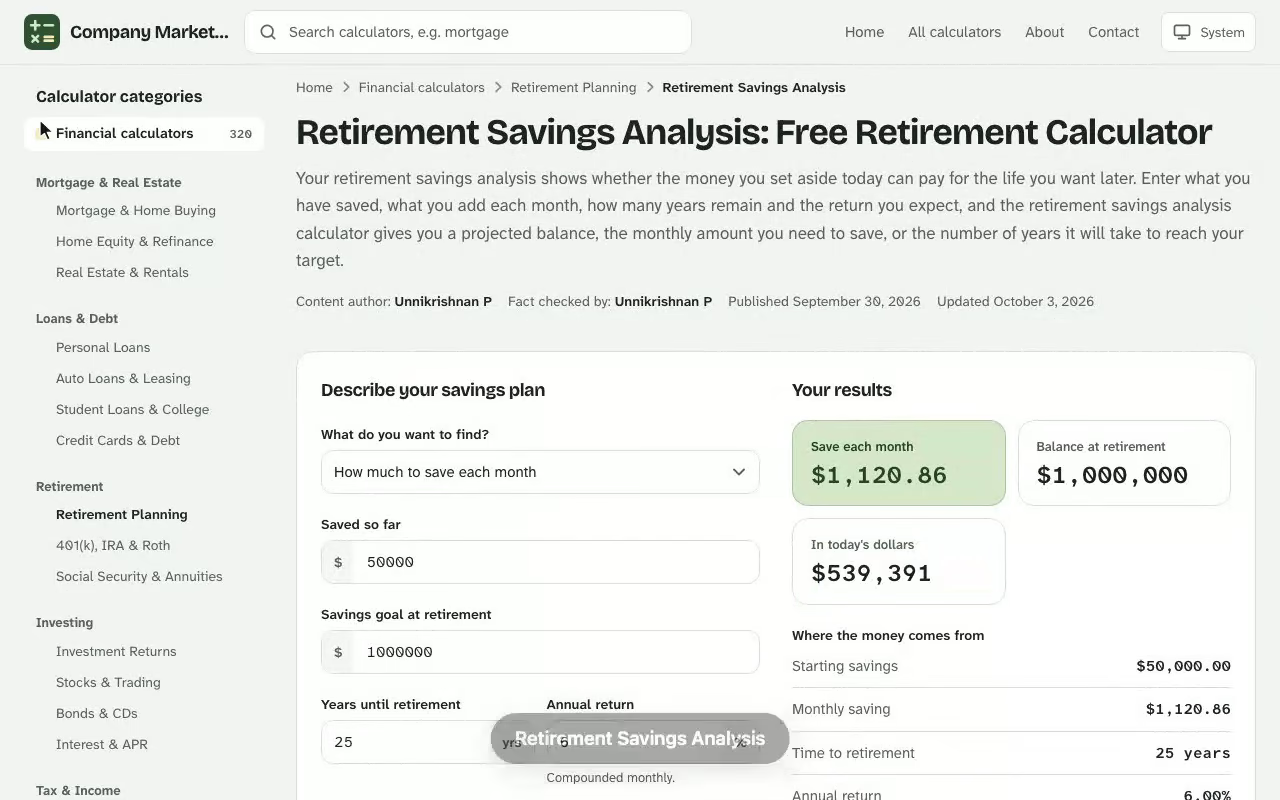
Retirement Savings Analysis. Your retirement savings analysis shows whether the money you set aside today can pay for the life you want later. Enter what you have saved, what you add each month, how many years remain and the return you expect, and the retirement savings analysis calculator gives you a projected balance, the monthly amount you need to save, or the number of years it will take to reach your target. Try the life expectancy calculator to run your own numbers — everything is calculated in your browser and nothing you enter is stored or sent anywhere.
Your results
Save each month
–
Balance at retirement
–
In today's dollars
–
Where the money comes from
Starting savings–
Monthly saving–
Time to retirement–
Annual return–
Total you put in–
Investment growth–
Year-by-year savings
How the plan above builds up, split between what you add and what it earns.
Year
Saved that year
Growth that year
Balance
Results are estimates for educational purposes and are not financial, tax or legal advice.
How a Retirement Savings Analysis Works
Every result comes from one idea: money you already have grows with compounding, and every deposit you add grows for however long it stays invested. The calculator treats your current savings balance and your stream of monthly deposits separately, then adds them together at your retirement date. Because it uses a steady rate of return, the output is a hypothetical estimate, not a promise about what markets will do. Try the net distribution calculator online to run your own numbers — everything is calculated in your browser and nothing you enter is stored or sent anywhere.
The future value formula
With monthly compounding, the balance at retirement is the growth of your starting balance plus the growth of every deposit:
See how the Retirement Savings Analysis works: change the inputs and the balance at retirement updates instantly. Enter your own numbers in the calculator above.
$$FV = PV \times (1 + r)^{n} + PMT \times \frac{(1 + r)^{n} - 1}{r}$$
Here PV is what you have saved today, PMT is your monthly deposit, r is the annual return divided by 12, and n is the number of months until you retire (years times 12). Solving the same equation for a different unknown gives the other three answers the tool offers.
The four questions you can solve
You pick one unknown and the calculator fills it in from the other inputs:
How much should I save monthly? You supply a target balance, and the tool returns the deposit that reaches it.
How much will I have at retirement? You supply the deposit, and the tool returns the projected savings.
How long should I save? You supply the deposit and target, and the tool returns the years required.
What annual return do I need? You supply everything else, and the tool returns the rate that closes the distance.
Inputs for a Retirement Planner Calculator
A good retirement planner calculator asks for only a handful of numbers, and each one has a clear job. Use the most accurate figures you have, then refine them later as your situation changes. Try the retirement shortfall calculator online to run your own numbers — everything is calculated in your browser and nothing you enter is stored or sent anywhere.
Current age and retirement age
Your current age and planned retirement age set the number of years your money can compound. A longer runway matters more than almost any other input, because the final years of growth are the largest in dollar terms.
Annual contributions and savings rate
Enter what you deposit each month, or your annual contributions divided by 12. Many people think of this as a savings rate, a percentage of annual income, and convert it to dollars before running the numbers. Include any employer matching money from your 401(k) in the total, since it compounds exactly like your own deposits.
Rate of return and investment style
Your investment style drives the rate of return you can reasonably assume. A conservative mix weighted toward bonds historically grows more slowly, while an aggressive mix weighted toward stocks aims higher at the cost of larger swings. A diversified portfolio of mutual funds often lands somewhere between the two, so choose a figure that matches your own risk tolerance rather than the highest number you have seen.
Worked Example: Running the Retirement Calculator
Suppose you are 38, have $42,500 in a retirement account, and add $750 every month. You plan to retire in 27 years and assume a 6.5% annual return. Plugging those inputs into the retirement calculator gives these results:
Input or result
Value
Starting savings balance
$42,500
Monthly deposit
$750
Years until retirement
27
Annual return
6.5%
Total deposits you make
$243,000
Growth on your starting balance
$244,635
Projected balance at retirement
$903,175
Reading the projected savings
Notice that you personally contribute only $285,500 in cumulative savings (your starting balance plus deposits), yet the total savings figure reaches $903,175. The remaining $617,675 comes from compounding. Looking at the schedule year by year shows how that growth accelerates:
Years from now
You have contributed
Projected balance
5
$87,500
$111,775
10
$132,500
$207,570
15
$177,500
$340,037
20
$222,500
$523,215
27
$285,500
$903,175
Closing the gap to a $1,000,000 savings goal
If your savings goal is $1,000,000, the projection above leaves a gap of $96,825. Switching the calculator to solve for the deposit shows you would need to save about $860 per month, which is roughly $110 more than today. Solving for time instead shows that $750 per month reaches the goal after 28 years and 5 months, and solving for the return shows you would need about 7.0% a year. These are the savings needed under three different levers, and you can pick whichever is easiest to pull.
A 51-Year-Old Tests a $1,400,000 Target in a Retirement Savings Calculator
Marcus is 51, works for a logistics firm, and wants to stop at 67, the full benefit age for anyone born in 1960 or later. His spreadsheet says he needs a $1,400,000 balance to draw a steady paycheck beside his Social Security, so he opens the calculator to run a full projection of his savings and see whether his current path reaches it.
He enters what his latest statement shows: $318,400 already invested, $1,425 a month going in, 16 years to go, and a 5.8% annual return that matches his balanced fund mix. The calculator, set to solve for the balance at retirement, returns $1,252,834.
That is $147,166 below his $1,400,000 target, so this savings projection has done its main job: it has shown him a shortfall while he still has 16 years to act. He does not change the return, since pushing it to 7% would only hide the problem. Instead he switches the calculator to solve for the monthly deposit and leaves every other field alone.
Required deposit: $1,892 a month
Increase over today: $467 a month
Test deposit of $1,700: $1,339,533, still $60,467 short
The $467 increase is more than he can add in one step, so his next move is specific. He asks payroll to raise his 401(k) deferral by $240 a month right away, plans a second $227 increase for his next raise, and reruns the calculator at $1,665 to confirm that the first step alone lifts his projection to roughly $1,330,000.
Using a Retirement Income Calculator to Plan Withdrawals
Reaching a balance is only half of the job. A retirement income calculator turns that balance into a monthly paycheck and tests whether it can cover your costs for the rest of your life. This kind of retirement income analysis starts with how much you expect to spend and subtracts every guaranteed source.
Monthly spending: the amount you need each month for housing, food, travel and insurance.
Social security: the monthly benefit you expect, which rises if you delay claiming.
Pension: any fixed payment from a former employer.
Other income: rental, part-time or annuity payments not counted above.
Withdrawals: what your savings must cover after those sources are subtracted.
Estimating retirement spending as a percentage of your final salary is a common shortcut, but listing real retirement expenses line by line is more reliable. The difference between your expected retirement income and that spending is the amount your portfolio has to supply, and it tells you whether your retirement outlook looks comfortable or tight.
Retirement Planning Factors That Move Your Results
Good retirement planning goes beyond the headline balance, because several forces quietly change what that balance can buy. A strong analysis keeps each of them in view.
Inflation and purchasing power
Inflation raises the cost of living every year, so a dollar in your golden years buys less than a dollar today. Even a modest 3% rate cuts purchasing power by about half over 24 years, which is why many planners run the numbers with a return that is already adjusted for inflation.
Taxes on withdrawals
The account type controls how your money is taxed. Pre-tax money in a 401(k) or traditional IRA is taxed as ordinary income tax when you withdraw it, using your marginal tax rate. Qualified withdrawals from a Roth IRA are tax-free. Because taxes can take a meaningful bite, a withdrawal plan should be built from after-tax spending needs, not pre-tax balances.
Healthcare costs and long-term care
Healthcare costs tend to rise faster than general prices. Medicare covers much of the basic bill after age 65 but not everything, and long-term care can be a large unplanned expense. Contributing to a health savings account while you work builds a tax-advantaged reserve for those bills and supports your long-run financial security. Add those expected costs to your planned retirement spending so your projection reflects them.
Retirement Savings Calculator Scenarios to Compare
One projection is a starting point, while several scenarios show how sensitive your plan is. Change one input at a time so you can see exactly what moved. Using the same example, here is how the projected savings respond to the rate of return and to the retirement date:
Scenario
Change
Projected balance
Lower return
5.0% annual return
$675,873
Baseline
6.5% annual return
$903,175
Higher return
8.0% annual return
$1,221,927
Retire earlier
22 years instead of 27
$614,810
Working longer
32 years instead of 27
$1,301,932
Five more years of working longer adds about $398,757, far more than the $250,000 you would add in deposits alone, because those extra years also let the existing pile compound.
Retirement Planner Moves That Close a Savings Gap
When the numbers fall short, you have more choices than simply saving harder. Raise your deposit by any amount you can afford with each pay raise, claim your full employer matching contribution first, and diversify across asset classes so a single bad year does less harm. You can also delay social security to lock in a larger check, or take on part-time work early in retirement to reduce withdrawals from your brokerage and retirement accounts.
Treat the calculator as a planning tool, not a verdict. Attending a retirement workshop or meeting with a financial advisor can turn your estimate into a complete financial plan with tax strategy, withdrawal order and extra savings targets tailored to you. Revisit your retirement goals and rerun the numbers at least once a year, or after any big change in income, family or health.
Retirement Savings Analysis questions
How much should I save for retirement each month?
It depends on your target balance, how many years you have and the return you expect. Choose the monthly option, enter your target, current savings, years and return rate, and the calculator shows the deposit needed. Many advisors suggest saving at least 15% of gross income as a starting point.
What annual return rate should I use?
Use a figure that matches your investment mix and risk tolerance. A conservative portfolio of bonds tends to grow more slowly than one weighted toward stocks, and returns are never guaranteed. Running a lower, middle and higher rate shows how sensitive your plan is.
Does the calculator account for inflation?
No. Results are in nominal dollars. To see them in today's purchasing power, enter a return rate that has inflation already subtracted, for example 6.5% growth with 3% inflation is about 3.4%.
How long will it take me to reach my retirement goal?
Select the option for how long you should save, then enter your target, current savings, monthly deposit and return rate. The tool returns the number of years needed to reach the target.
Are the results a guarantee?
No. The calculator assumes a steady return and regular monthly deposits, which real markets do not deliver. Treat the output as a hypothetical estimate and revisit it at least once a year.
Does it include Social Security, pension or employer match?
Social Security and pension payments are not part of the savings projection. Employer matching contributions can be included by adding them to your monthly saved amount.
What is the year-by-year schedule?
It lists the deposits made, growth earned and ending balance for each year until you retire, so you can see how compounding accelerates over time.