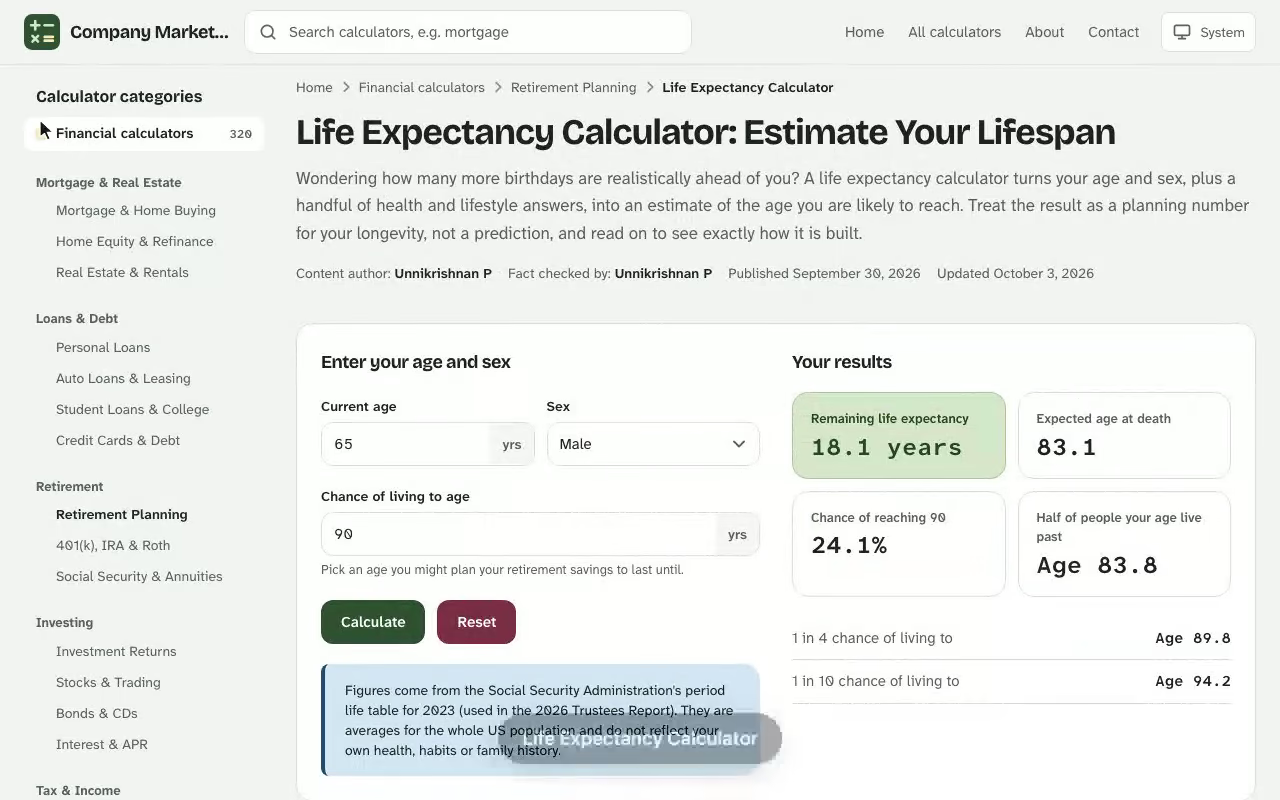
Life Expectancy Calculator. Wondering how many more birthdays are realistically ahead of you? A life expectancy calculator turns your age and sex, plus a handful of health and lifestyle answers, into an estimate of the age you are likely to reach. Treat the result as a planning number for your longevity, not a prediction, and read on to see exactly how it is built. Next, open the retirement calculator and enter your own details to see an estimate in seconds.
Your results
Remaining life expectancy
–
Expected age at death
–
Chance of reaching 90
–
Half of people your age live past
–
1 in 4 chance of living to–
1 in 10 chance of living to–
Chance of reaching each age
Your chance of being alive at each age, starting from your current age, for both sexes.
Age
Years from now
Male (you)
Female
Results are estimates for educational purposes and are not financial, tax or legal advice.
How a Life Expectancy Calculator Estimates Your Lifespan
Every tool of this kind starts from the same place: published mortality data describing how many people of a given age and sex died in a given year. From those counts, actuaries build a life table, and the life table tells you the average number of years a person of your age has left. Your personal answers then nudge that average up or down. Your lifespan estimate is therefore a baseline from population statistics plus a set of adjustments for the things that research links to longer or shorter lives. Next, open the free annuity calculator and enter your own details to see an estimate in seconds.
Life expectancy at birth versus remaining years
Life expectancy at birth is the number most headlines quote, and it is pulled down by deaths in infancy and early adulthood. Once you have reached your fifties or sixties, you have already survived those risks, so your own remaining years are measured from your current age and your expected final age is higher than the birth figure. This is why a 52-year-old is not expected to die at the age quoted for a newborn.
Cohort life expectancy and period life tables
A period life table freezes one year's death rates and applies them to everyone. Cohort life expectancy instead follows people born in the same year and assumes future mortality improvements, meaning death rates keep falling as medicine and working conditions get better. Cohort figures are usually a little higher than period figures for the same person, so check which type your calculator uses before comparing two results.
Why life expectancy calculators return a range, not a date
No honest tool can tell you the day you will die. The better ones return a probability range, such as the chance of surviving to 85 or to 95, rather than one fixed age. Half of people of your age and sex will outlive the median and half will not, so the single number on screen is only the centre of a spread. Keep that spread in mind whenever you plan around a longevity estimate.
Life Expectancy Calculator Inputs That Move Your Result
The more of your profile a calculator asks about, the more individual the answer becomes. A two-field tool only knows your demographic group; a detailed questionnaire also sees your habits. The inputs below are the ones that matter most, listed roughly in order of how much each can change the final number. Try the rmd calculator to run your own numbers — everything is calculated in your browser and nothing you enter is stored or sent anywhere.
What a life expectancy calculator asks first: date of birth and sex
Your date of birth fixes your age and, for cohort tables, the year group you belong to. Age and sex are the only inputs a basic public tool needs because women, on average, outlive men at every age. Gender differences narrow somewhat for people who reach their eighties, but they never disappear in the tables.
See how the Life Expectancy Calculator works: change the inputs and the remaining life expectancy updates instantly. Enter your own numbers in the calculator above.
Lifestyle: smoking, alcohol, diet and physical activity
Your lifestyle carries the largest adjustable share of the result. Smoking is the heaviest single penalty, and quitting recovers part of it. Heavy alcohol use shortens a life, while a sensible diet and regular physical activity lengthen it. These habits are also the only inputs you can change tomorrow, which is why many calculators show them as a ranked list of risk factors.
Smoking: never, former or current smoker
Alcohol: none or moderate versus heavy
Diet: poor, average or mostly whole foods
Exercise: sedentary, some, or 150 minutes a week or more
Expected age across smoking and exercise, with the worked example outlined.
Family history, genetics and medical conditions
If your parents and grandparents reached their late eighties, that family history counts in your favour, because family genetics and shared environment both play a part. Your own medical history matters just as much: diagnosed medical conditions such as diabetes or heart disease lower the figure, and so does uncontrolled blood pressure. Your weight belongs here too, since body mass index is a standard input.
Air pollution, sleep and stress
Some tools go further and ask about air pollution in your neighbourhood, sleep and stress. Fine-particle pollution is linked to heart and lung disease, so a high local reading can take a measurable number of days or months off a long-term estimate. These factors usually move the answer less than smoking does, but they show how broad the research behind a modern longevity calculator has become. When you answer one of these questions, the tool converts it into a small adjustment, often a few months, added to or taken off your projected age.
Life Expectancy Formula and a Worked Example
Under the hood, a simple life expectancy calculator adds your adjustments to the life-table baseline for your age and sex. The structure is the same whether the tool asks four questions or forty: The retirement income calculator online is free to use with no sign-up, and works on desktop and mobile.
Here \(R_{\text{base}}\) is the baseline remaining years from the life table, and each \(a_i\) is an adjustment in years for one factor, positive when it helps and negative when it hurts. The weights in this example are illustrative planning values, not clinical coefficients.
Step-by-step example for a 52-year-old woman
Take a 52-year-old woman whose life table gives 31.2 remaining years. She has never smoked, exercises more than 150 minutes a week, eats mostly whole foods, is slightly overweight, has long-lived grandparents and takes medication for controlled high blood pressure. Her adjustments add up as follows:
Factor
Her answer
Adjustment (years)
Baseline from life table
Female, age 52
+31.2
Smoking
Never smoked
0.0
Physical activity
150+ minutes a week
+1.5
Diet
Mostly whole foods
+1.0
Weight
Overweight
-0.8
Family history
Grandparents lived long
+0.6
Medical conditions
Controlled high blood pressure
-0.9
Total remaining years
32.6
Her expected age is \(52 + 32.6 = \mathbf{84.6}\) years. Because the answer is a centre point, she would plan for a range around 84.6 rather than that exact birthday.
Each adjustment moves the 52-year-old woman's remaining years above her life table baseline.
Your health age compared with your calendar age
Some tools also report a health age: the age at which an average person has the same remaining years as you. In the example, the woman has 1.4 more years than the baseline, so her health age comes out slightly under 52. A health age below your real age means your profile looks better than average for your group; above it means the reverse.
Average Life Expectancy and Population Data
The baseline in any calculator comes from national statistics, so it helps to know where those come from. The average life expectancy of a country is published by statistical agencies and health bodies such as the CDC, and it changes from year to year. Women outlive men by a few years in nearly every wealthy country, and the pandemic briefly reversed years of gains before they resumed. A published average like this is only the starting point: the calculator takes it as your baseline and then adjusts it for your own profile.
Social Security actuarial tables
In the United States, the Social Security Administration publishes an actuarial life table every year, and its Trustees Report projects future improvements. Many free calculators lean on that table for their baseline. It reports a purely demographic estimate, so it ignores your habits and health, and it is the right comparison point for the lifestyle adjustments described above.
Mortality data and mortality improvements
The raw material is mortality counts: how many deaths occurred at each age within a population. Researchers publishing in a long-running study or a national survey refine those counts with research on specific risks. Education and income are also correlated with longer lives in this data, although a typical consumer calculator will not ask for them.
Reading Life Expectancy Calculators Before Claiming Social Security
Dev, 61, is deciding whether to claim Social Security at his full retirement age of 67 or hold out until 70. His benefit statement shows the monthly figure at each age, but the choice hinges on how long he will collect, so he runs a life expectancy estimate first.
He enters what he knows: male, age 61, a former smoker who quit eleven years ago, walking about 90 minutes a week, an average diet, a body mass index of 27.8, no blood pressure medication, and a father who died at 71. The life table baseline for his age and sex is 21.9 remaining years. The adjustments are -1.5 for the former smoking, -0.8 for being overweight and 0.0 for everything else, so the total is 19.6 years, or an expected age of 80.6.
Scenario
Remaining years
Expected age
Current habits
19.6
80.6
With 150+ minutes of exercise a week
21.1
82.1
He compares 80.6 with the age of about 82 where waiting until 70 usually overtakes claiming at 67. At 80.6 the two choices look nearly even, so the estimate alone does not justify the wait. He changes one input, exercise to 150 minutes or more, and the expected age moves to 82.1, just past that threshold.
The next step is concrete: Dev books a physician visit to confirm he can sustain the higher activity, and decides to claim at 67 unless his own exercise log shows he is holding the new routine by 65. The calculator did not make the decision, but it showed him which input was worth acting on and what the habit was worth in years.
Longevity Calculator Types: Quiz, Scientific and Medical
Not every longevity calculator works the same way, and the right one depends on what you want to learn.
Demographic tools need only your age and sex and return a table-based average.
A longevity quiz asks about habits and gives personalized feedback for each answer, helping you see what to work on.
A scientific life expectancy calculator built on a long-running centenarian project, such as the Living to 100 questionnaire, links family patterns and health signals to healthy aging.
A healthy life expectancy calculator estimates years in good health rather than total years, which is useful for care planning.
Medical calculators focus on one diagnosis and are designed for use with a physician.
Retirement-oriented tools may also model joint-life probabilities, the odds that at least one member of a couple survives to a given age. A joint estimate reports the odds for two people at once, which is why couples get a later planning age than either partner alone; see accuracy and limits for how far to trust it.
Using a Lifespan Calculator for Retirement Planning
Most people underestimate how long their money has to last. Using a lifespan calculator alongside your budget helps turn a vague worry into a concrete horizon for retirementplanning.
Longevity risk and retirement income
Longevity risk is the chance that you outlive your savings. If your estimate says 84.6 but there is a meaningful probability of reaching the mid-nineties, a plan that stops at 85 leaves you exposed. Many people therefore plan their retirement income to a later age than the central estimate, and some add guaranteed income so that a long life is not a financial emergency.
Retirement planning timeline built around the expected age from the worked example.
Retirement planning, couples and Social Security claiming
For couples, the relevant question is the second death, not the first, and that is usually later than either partner's individual estimate. Your result can also inform when to claim Social Security: a longer expected survival favours delaying, because each year of delay raises the monthly payment you collect for life. Add healthcare costs to the plan: the later your projected age, the more years of those rising costs you need to budget for.
Accuracy and Limits of Life Expectancy Calculators
The accuracy of any estimate is bounded by two things: the quality of the statistics behind it and how honestly you answer. A tool, even one as detailed as Living to 100, cannot see your lab results, and a longer questionnaire cannot remove the random risk that exists between any two otherwise identical people. Treat the output as the likelihood of a typical outcome for people like you, never as a verdict.
How to read a life expectancy calculator result responsibly
Run the calculation, then change one input at a time to see which risk factors carry the most weight for you. Re-run it after a major change in your health or habits, and compare the result with the average for your age and sex rather than with a friend's number. Remember that the inputs interact, so improving one habit rarely adds the full amount a simple table suggests.
Medical advice and talking to your physician
These estimates are educational and are not medical advice. If a result worries you, or if you have a serious diagnosis, bring it to your physician and ask what a realistic range looks like for your medical history. A doctor can also tell you which of your risk factors are worth tackling first, using information no online form can collect.
Life Expectancy Calculator questions
How does a life expectancy calculator work?
It starts from a life table that gives the average remaining years for your age and sex, then adds or subtracts years for habits and health such as smoking, exercise, diet and weight. The result is an estimate for people like you, not a prediction.
How accurate is a life expectancy calculator?
It is an educational estimate. Accuracy depends on the statistics behind it and on how honestly you answer, and no calculator can account for every medical detail or for chance. Use it as a planning range.
What factors affect life expectancy the most?
Smoking, physical activity, diet, body weight, alcohol use and existing medical conditions usually move the result most, followed by family history, income, education and air quality.
What is health age?
Health age is the age at which an average person has the same remaining years as you. If it is below your real age, your profile looks healthier than average for your group.
Is life expectancy the same as how long I will live?
No. It is an average, and half of people of your age and sex live longer than the median. That is why the tool also shows the chance of reaching a target age.
Can I use the result for retirement planning?
Yes, as one input. Many people plan income to a later age than the expected age to cover longevity risk, and use the estimate when deciding when to claim Social Security.
Is this calculator medical advice?
No. It is for education only. Talk with your physician about your own health and what a realistic range looks like for you.