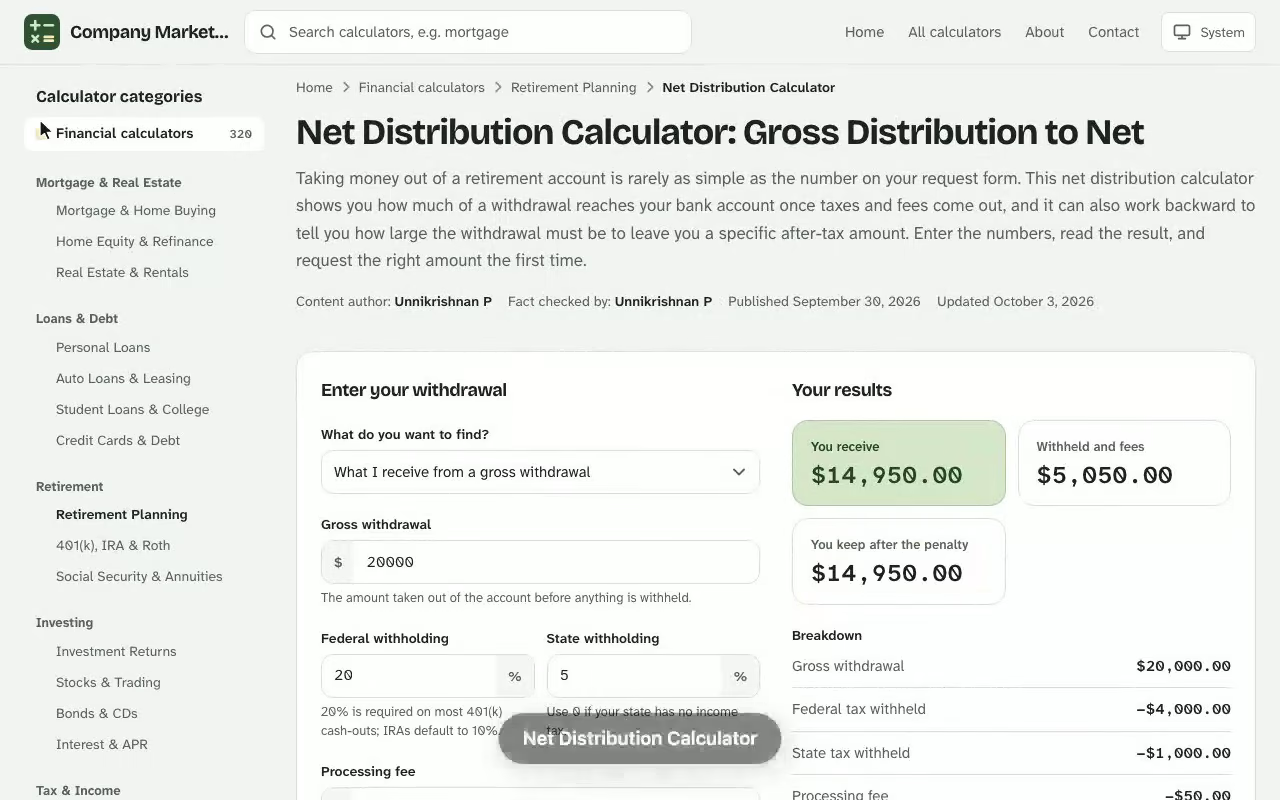
Net Distribution Calculator. Taking money out of a retirement account is rarely as simple as the number on your request form. This net distribution calculator shows you how much of a withdrawal reaches your bank account once taxes and fees come out, and it can also work backward to tell you how large the withdrawal must be to leave you a specific after-tax amount. Enter the numbers, read the result, and request the right amount the first time. If you want to see how the figures change, the free life expectancy calculator gives you an instant result you can adjust as you go.
Your results
You receive
–
Withheld and fees
–
You keep after the penalty
–
Breakdown
Gross withdrawal–
Federal tax withheld–
State tax withheld–
Processing fee–
Payment you receive–
10% penalty due at tax time–
Share of the withdrawal you keep–
Withholding is a prepayment, not your final tax. Depending on your bracket you may owe more or get some back when you file, and a fee is assumed to come out of the payment.
Results are estimates for educational purposes and are not financial, tax or legal advice.
How the Net Distribution Calculator Works
Every retirement withdrawal has two sides: the amount your plan sends out and the amount you actually keep. The tool connects those two sides using a handful of inputs you already know or can look up in a minute: the gross amount, your federal and state rates, and any flat fee your custodian charges. You can start from the gross amount and read what is left, or start from the cash you need and let the calculator find the withdrawal that delivers it. The retirement planner with retirement earnings calculator is free to use with no sign-up, and works on desktop and mobile.
Gross amount, tax withheld and net proceeds
The gross amount is the full distribution amount before anything is taken out. The tax withheld is the slice your custodian sends to the IRS and your state on your behalf, and the net proceeds are what remain after that slice and any fee. Think of it as three lines on a pay stub: what was paid, what was held back, and what lands with you.
Total tax, fee and what you keep
The total tax line adds your federal and state withholding into one figure, and the fee line is subtracted separately because it is a flat dollar charge rather than a percentage. The result is the net amount you can plan around, the same number that appears as the net to you on a custodian's confirmation.
Total withholding rate and effective withholding rate
Your total withholding rate is the federal percentage plus the state percentage, written as a combined figure. The effective withholding rate goes one step further and divides everything that left the account, fee included, by the gross amount. Because a flat fee takes a bigger bite out of a small withdrawal, the effective figure is always at or above the combined percentage.
Calculator field
What you enter or read
Why it matters
Gross amount
The full withdrawal before deductions
Starting point for the gross-to-net direction
Federal withholding (%)
The percentage you elect on your withdrawal form
Largest piece of the total tax
State withholding (%)
Your state's percentage, or zero
Added to the federal figure
Fee ($)
A flat charge from the custodian
Subtracted after tax is withheld
Net distribution
What reaches your account
The answer you plan your budget around
Net-to-Gross Calculator Formula: Finding the Gross Amount You Need
Going from gross to net is plain subtraction. Going the other way trips people up, because the tax is taken from the larger gross amount and not from the cash you want. The formula below handles both directions. Convert each percentage to a decimal first (24% becomes 0.24), add the federal and state decimals into one rate \(r\), and keep the fee \(F\) in dollars. Try the retirement savings analysis to run your own numbers — everything is calculated in your browser and nothing you enter is stored or sent anywhere.
$$\text{Net} = \text{Gross} \times (1 - r) - F$$
$$\text{Gross} = \frac{\text{Net} + F}{1 - r}$$
The second line is what any net-to-gross calculator solves. You add the fee to your target, then divide by the share of each dollar you keep, \(1 - r\). The answer is the required gross distribution you should ask your custodian to send. Rounding up to the next whole dollar protects your target against cent-level rounding. Used as an IRA net-to-gross calculator, the same formula tells a retiree exactly how much to withdraw from a traditional IRA, and the calculator on this page does the arithmetic for you in one click.
Worked Example: IRA Distribution Calculator with Federal and State Withholding
Here is a complete pass through an IRA distribution calculator, using one set of numbers in both directions. The inputs are deliberately specific so you can follow every step.
From gross amount to net after withholding
You request a $14,500.00 withdrawal from a traditional IRA. You elect 22% federal withholding and your state takes 4.25%, so your combined rate is 26.25%. Your custodian also charges a $25.00 fee.
Line
Calculation
Amount
Gross amount
Entered
$14,500.00
Federal withholding
$14,500.00 × 0.22
$3,190.00
State withholding
$14,500.00 × 0.0425
$616.25
Total tax
$3,190.00 + $616.25
$3,806.25
Fee
Flat charge
$25.00
Net after withholding
$14,500.00 − $3,806.25 − $25.00
$10,668.75
The effective withholding rate is ($3,806.25 + $25.00) ÷ $14,500.00, or 26.42%, a little above the 26.25% you entered because of the fee.
How a $14,500 IRA withdrawal becomes a $10,668.75 net distribution.
From the desired net amount back to the gross
Now flip the question. You need exactly $9,275.00 to land in your account, your combined rate is 29% (24% federal plus 5% state) and the fee is $30.00. Using the formula, \(\text{Gross} = \frac{9{,}275 + 30}{1 - 0.29} = \frac{9{,}305}{0.71}\), the calculator returns $13,105.63. The tax withheld is $3,800.63, and $13,105.63 − $3,800.63 − $30.00 leaves $9,275.00, which proves the answer.
Gross Distribution Calculator: Why Adding Tax on Top of Your Target Fails
The most common mistake is to take the desired net, multiply by the rate and add the result back on. With the numbers above that gives ($9,275 + $30) × 1.29 = $12,003.45. When 29% is withheld from that request and the fee is paid, only $8,492.45 reaches you, which is $782.55 short of the target. The shortfall exists because the percentage applies to the whole gross amount, including the part that covers the tax itself. Dividing by \(1 - r\) is the only version that closes the gap, and it is why a gross distribution calculator is worth opening before you call your custodian.
Adding tax on top leaves you $782.55 short of your target net amount.
Method
Gross requested
Net you receive
Result
Add tax on top
$12,003.45
$8,492.45
Short by $782.55
Divide by (1 − rate)
$13,105.63
$9,275.00
Exact
Using the Calculator Step by Step: Inputs, Results and Checks
The calculator is built so you can reach an answer in under a minute, and each step below tells you what the calculator expects and what it hands back. Keep your latest statement and your withdrawal form nearby, because the calculator is only as accurate as the percentages and balances you give it.
Choose the direction. Pick gross-to-net if you know the withdrawal, or net-to-gross if you know the cash you need, since the calculator solves either one.
Enter the amount. The calculator takes a single dollar figure, so use the withdrawal in the first case and the target in the second.
Type the federal and state percentages. The calculator adds them into one combined rate and shows that rate beside the result.
Add the fee. Leave it at zero if your custodian charges nothing, and the calculator will skip that line.
Click the Calculate button and read the results, which the calculator lists as gross amount, total tax and net.
Change one input and calculate again. Comparing two runs of the calculator shows how much a single percentage point or fee is worth.
If the result looks wrong, check the usual causes before you trust the calculator or doubt it. A percentage typed as 0.22 instead of 22 will make the calculator show almost no tax, while a rate above 50% usually means the federal and state figures were entered twice. A good habit is to run the calculator with the numbers from your last real withdrawal and confirm it matches what actually arrived. When it does, you can rely on the calculator for planning, and when you spot a gap, the gap is normally a fee or a state rule you had not entered.
See how the Net Distribution Calculator works: change the inputs and the withdraw this gross amount updates instantly. Enter your own numbers in the calculator above.
The calculator also settles whether one large withdrawal beats two smaller ones: split the amount across two tax years, run the calculator for each, and compare the net totals. Run it for an investment account and an IRA alike, and your investment withdrawals sit on one comparable scale, so the calculator results are easy to review with a tax professional.
Federal Withholding, State Withholding and Your Tax Rate
The calculator only asks for percentages, but choosing them well is the part that keeps you from a surprise bill in April. A withdrawal is added to your income for the year, so the right percentages come from your own situation and not from a default.
Net distribution by gross amount and combined withholding rate, with the worked example outlined.
Federal withholding and federal tax rate
For a non-periodic IRA withdrawal, federal withholding defaults to 10% unless you elect another percentage on the withdrawal form. Your actual federal tax rate on that money depends on where it lands among your other income, so a 10% default can fall well short if you are in a higher bracket. Eligible rollover payments from an employer plan such as a 401(k) that are paid to you carry a mandatory 20% federal withholding instead.
Marginal tax rate and tax bracket
Your marginal tax rate is the rate on the last dollar you earn, and the tax bracket that contains it is set by your taxable income and your filing status. A large distribution can push part of your income into the next bracket, so entering the marginal rate rather than your average rate usually gives a more honest net figure.
State tax rate and state tax
Your state tax rate varies widely. Some states take nothing on retirement income, some require mandatory state tax withholding, and some leave the choice to you. Enter zero if your state does not tax the withdrawal, and the calculator treats the federal figure as the whole withholding.
Filing status
Your filing status decides which brackets apply and what your standard deduction is, which is why an accurate rate starts here. Your marital situation on the last day of the tax year determines the choice, and the filing status you pick sets your bracket, which in turn sets the federal percentage you type into the calculator.
Filing status
Who it generally fits
Single
Unmarried, with no other status that applies
Married filing jointly
Married couples filing one combined return
Married filing separately
Married people who each file their own return
Head of household
Unmarried people who pay most of the cost of a home for a qualifying dependent
Qualified surviving spouse
A spouse whose partner died in the prior tax year and who supports a dependent child
Adjusted gross income and deductions
Your adjusted gross income is your total income for the tax year after adjustments such as contributions to a 401(k) or IRA. The standard deduction and other deductions then reduce it further. When you estimate your rate, include the distribution itself in your adjusted gross income, because it is part of what the IRS will tax, then read your marginal rate for that total and enter it as the federal percentage in the calculator.
Effective tax rate versus the rate you enter
Your effective tax rate is the share of all your income that ends up as tax, and it is normally lower than your marginal rate. Withholding is only a prepayment. If the percentage you elect is higher than your final liability, the difference returns as a refund, and if it is lower, you owe the balance when you file.
A $6,840 Roof Repair: Finding the Gross Amount for Your Desired Net Amount
A 63-year-old retiree has a contractor's quote of exactly $6,840.00 for a roof repair and wants that sum in her checking account by Friday. The money will come from a traditional IRA, and she is below the age where early withdrawals trigger the 10% penalty, so the only question is how much to ask for.
Her last return put her in the 12% federal bracket, so she plans to elect 12% federal withholding, and her state takes 3.15%. Her custodian charges a $15.00 wire fee. She opens the net distribution calculator, switches to the net-to-gross direction and enters the target of $6,840.00, a 15.15% combined rate and the $15.00 fee.
Result line
Amount
Gross amount to request
$8,078.96
Tax withheld (15.15%)
$1,223.96
Fee
$15.00
Net after withholding
$6,840.00
Before she submits the form, she reruns the calculator with the custodian's 10% federal default for non-periodic IRA withdrawals. At 13.15% combined the required gross falls to $7,892.92, which looks cheaper, but it withholds only 10% against a 12% bracket. She would owe the 2-point gap, about $157.86, when she files, so the lower request just postpones part of the tax.
Her decision is concrete: she elects 12% federal withholding on the form and requests $8,079.00, rounded up from $8,078.96 so cent-level rounding cannot leave her under $6,840.00. The calculator also tells her the effective withholding rate is 15.34% once the fee is included, which is the figure she writes in her notes next to the quote.
IRA Tax Withholding Calculator Rules: Early Withdrawals, Periodic Payments and Penalties
An IRA tax withholding calculator is only as good as the rules behind the percentages you feed it. Three situations change the picture, so check which one applies before you request the money.
Early withdrawal penalty
Taking money before age 59½ usually adds a 10% early withdrawal penalty on top of ordinary income tax, unless an exception applies. The penalty is not part of withholding, so a calculator that only shows the tax withheld will understate what you could owe. Add it to your budget separately, or raise the percentage you elect to cover it, because early withdrawals without a plan for that charge are the most common source of an unexpected tax bill.
Periodic payments and non-periodic distributions
Regular periodic payments, such as a monthly draw, are withheld as though they were wages unless you elect otherwise. A lump sum is one of the non-periodic distributions, and it follows the flat default percentage described above. If you take both kinds in the same year, run the calculator once for each so each line gets its own rate.
Qualified distributions and tax-free withdrawals
A Roth withdrawal that meets the five-year rule after age 59½ is a qualified distribution, and it is tax-free. In that case your withholding rate is zero and the net equals the gross minus any fee. Only the earnings in a non-qualified Roth withdrawal are taxable.
After-Tax Results by Account: Traditional IRA, Roth IRA, 401(k) and Pension
The same arithmetic applies to all of your retirement accounts that pay out taxable money, which is why one tool covers so many cases. What changes from account to account is the tax treatment and the withholding default.
Traditional IRA: contributions were usually deducted, so nearly every dollar you take out is taxable income.
Roth IRA: qualified withdrawals come out tax-free, so enter 0% for each rate and the net equals the gross minus any fee.
401(k): paid-to-you rollovers face the mandatory 20% federal withholding, so enter 20% as the federal rate; direct rollovers have none.
Pension: payments are normally fully taxable, and you can usually choose the percentage withheld from each check.
Retirees who also owe required minimum distributions should remember that those amounts are taxed the same way, so the same calculation shows what an RMD will leave in your account after tax. Add every source together before you pick a rate, since your combined income decides the bracket.
Tips for Using a Distribution Calculator Before You Withdraw
A few habits keep the numbers trustworthy and keep your retirement savings working for as long as possible.
Confirm the rate on your custodian's form, since each custodian sets its own defaults and state rules.
Round the gross request up to the next dollar so rounding never leaves you under your target.
If withholding looks too low for your bracket, schedule estimated tax payments instead of raising it, or do both.
Rerun the numbers whenever your income, deductions or dependent situation changes during the year.
Treat the calculator result as a planning estimate, since the calculator is an illustration and not tax advice, and no calculator knows your full return.
A calculator cannot replace judgment, but a calculator used well makes every conversation with your custodian shorter, and each calculator run leaves you with firmer numbers. Before you act on a large withdrawal, talk to a tax professional who can see your whole return, and consider asking for personal financial advice on how the withdrawal fits your wider investment plan. The calculator gives you the dollar math, and a professional can confirm the tax rules behind it.
Keeping the calculator results on file
Save the calculator inputs, the date and the net figure, then compare them with your custodian's confirmation. If the two differ, the calculator tells you which input to question first, and a yearly calculator note makes the next investment withdrawal faster to plan in retirement, when you may revisit the same withdrawal every year.
Planning around the net result
If your retirement savings sit in several accounts, run the calculator for each one and add the net results, so your retirement budget uses the dollars that will actually arrive after taxes. Include any investment account you draw on in retirement, since every investment withdrawal is taxed on its own terms, and keep one retirement line per account in your notes.
Net Distribution Calculator questions
What is a net distribution?
A net distribution is the amount that reaches your bank account after federal, state and local tax withholding and any custodian fee are taken out of a gross retirement withdrawal.
How do I work out the gross amount I need for a specific net amount?
Add any flat fee to your target net, then divide by one minus your combined withholding rate written as a decimal. At 29% withholding and a $30 fee, a $9,275 target needs a gross of about $13,105.63.
Why does adding the tax on top of my target leave me short?
Withholding is a percentage of the whole gross amount, including the part that covers the tax itself, so multiplying your target by the rate understates the tax. Dividing by one minus the rate fixes this.
What federal withholding rate should I enter for an IRA withdrawal?
Many custodians default to 10% on non-periodic IRA withdrawals unless you elect another percentage. Your real liability depends on your bracket, so a higher election or estimated tax payments may be safer.
Does withholding include the early withdrawal penalty?
No. The 10% additional tax on most withdrawals before age 59½ is not part of withholding, so budget for it separately or raise the percentage you elect.
Is a Roth IRA withdrawal taxed?
A qualified Roth withdrawal, after the five-year rule is met and you are 59½ or older, is tax-free, so you can enter zero for each withholding rate. Earnings in a non-qualified withdrawal can be taxable.
Does withholding equal the tax I will owe?
Not necessarily. Withholding is a prepayment. If it is lower than your final liability you owe the difference when you file, and if it is higher you get a refund.