Retirement Planner with Retirement Earnings Calculator
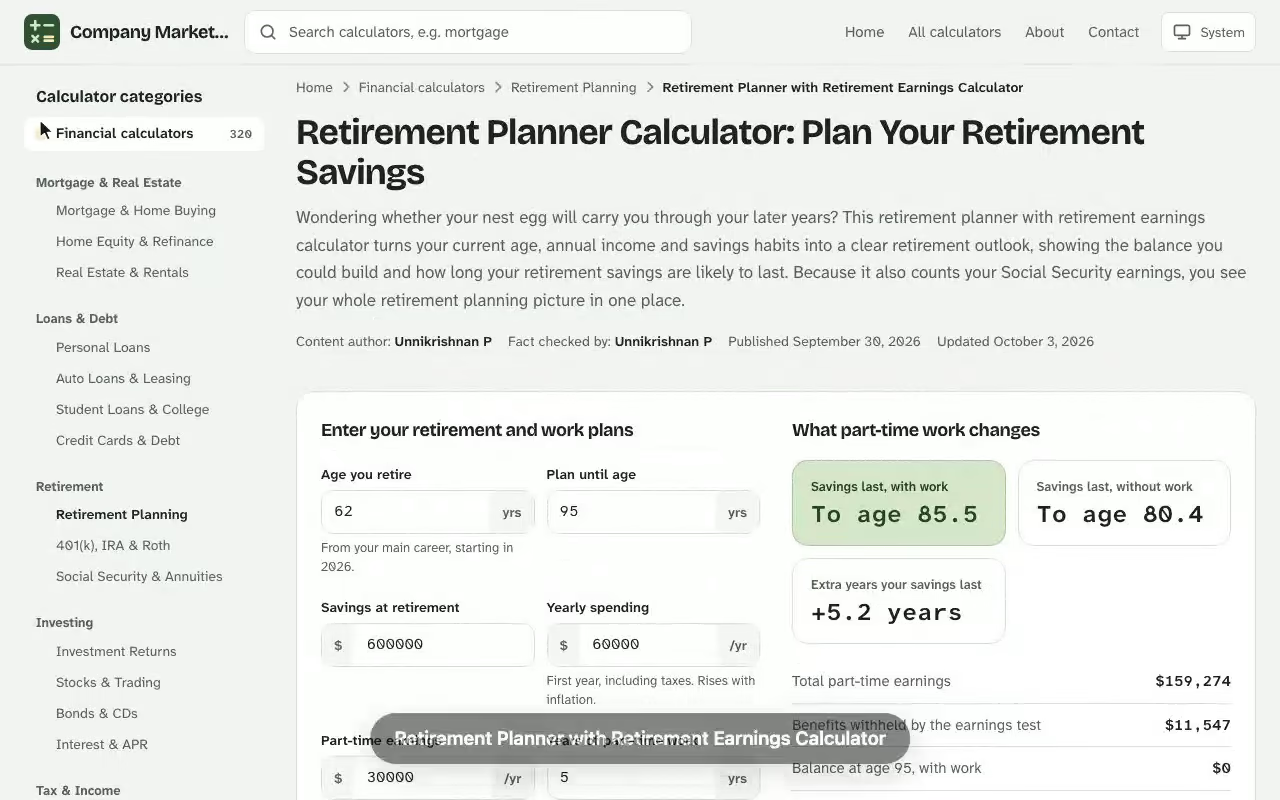
Retirement Planner with Retirement Earnings Calculator. Wondering whether your nest egg will carry you through your later years? This retirement planner with retirement earnings calculator turns your current age, annual income and savings habits into a clear retirement outlook, showing the balance you could build and how long your retirement savings are likely to last. Because it also counts your Social Security earnings, you see your whole retirement planning picture in one place. Next, open the life expectancy calculator and enter your own details to see an estimate in seconds.
What part-time work changes
Savings last, with work
–
Savings last, without work
–
Extra savings at plan age
–
Total part-time earnings–
Benefits withheld by the earnings test–
Balance at plan age, with work–
Balance at plan age, without work–
First-year withdrawal, with / without work–
2026 earnings test limits: $24,480 a year ($1 withheld per $2 above it) and $65,160 in the year you reach full retirement age ($1 per $3), raised with inflation in later years. Withheld benefits are not lost: SSA raises your monthly benefit at full retirement age to credit those months, which this estimate leaves out. Income tax is not modeled separately.
Year-by-year: working in retirement vs not working
Each year's spending is covered first by part-time pay and Social Security; savings cover the rest at the start of the year. A negative draw means pay and benefits exceeded spending and the extra was saved.
Age
Part-time pay
Social Security paid
Withheld
Spending
Drawn from savings
Balance with work
Balance without work
Results are estimates for educational purposes and are not financial, tax or legal advice.
How a Retirement Planner Calculator Works
A retirement planner calculator runs two projections back to back. First it grows your cumulative savings from today until the day you stop working, adding your yearly contributions along the way. Then it spends that balance down, year by year, to cover whatever your guaranteed income does not. The result is a savings summary: the balance you reach at your chosen retirement age, the savings needed to fund your goals, and any extra savings or shortfall left over. Try the retirement plan withdrawal calculator to run your own numbers — everything is calculated in your browser and nothing you enter is stored or sent anywhere.
Think of it as a planning tool, not a crystal ball. Every figure it returns is hypothetical and built on the assumptions you type in, which is why the most valuable habit is to test different scenarios rather than trust a single answer. Results are not guarantees; they are a way to see which levers matter most for your retirement plan.
The Growth Phase Formula
While you are still working, your balance compounds each year and your annual contributions are added on top. In its simplest form the growth phase looks like this:
$$B_{t+1} = B_t \times (1 + r) + C_t$$
Here \(B_t\) is your balance, \(r\) is your expected rate of return, and \(C_t\) is that year's contribution, which usually rises as your pay does.
The Withdrawal Phase Formula
Once you stop working, the retirement spending you need is reduced by your guaranteed retirement income, and only the difference comes out of your portfolio:
$$W_t = (S - SS) \times (1 + i)^{t}$$
In this formula \(S\) is yearly spending, \(SS\) is yearly Social Security, and \(i\) is the rate of inflation. The gap \(W_t\) grows every year, so a plan that looks comfortable today can feel tight a decade into retirement.
Inputs for a Retirement Savings Calculator
Every retirement savings calculator asks for roughly the same information. The more honest your numbers, the more useful the output. Use the table below as a checklist before you start. Try the free net distribution calculator to run your own numbers — everything is calculated in your browser and nothing you enter is stored or sent anywhere.
Input
What to enter
Example value
Current age
Your age today
43
Retirement age
The age you plan to stop working
65
Current balance
All retirement account savings combined
$187,350
Annual contributions
What you add each year, plus employer match
$13,900
Rate of return
Expected yearly growth before and after you retire
6.25% then 4.75%
Monthly spending
Expected costs in today's dollars
$5,400
Monthly Social Security
Estimated benefit in today's dollars
$2,480
Inflation
Expected yearly rise in prices
2.7%
Retirement Age and Current Age
Your current age sets how many years of growth you have left, and your retirement age sets how many years you must fund. Moving the second number by even two or three years often changes the outcome more than any investment choice, because it adds contributions and compounding while it removes withdrawals.
Investment Style and Rate of Return
Your investment style drives the growth assumption you type into the calculator. A conservative mix may justify entering 4.75% after you stop working, while a moderately aggressive mix before then supports a figure like 6.25%, the pair used in the worked example below. Match each number to your own risk tolerance, then diversify investments so one bad stretch in a single holding does not decide your outcome. Every investment carries risk, and the projected balance moves directly with this input, so treat a higher assumed return with caution.
Retirement Earnings and Social Security Benefits
The earnings side of the calculation matters as much as the savings side. Your social security check is based on your average indexed monthly earnings, so the benefit you enter should come from an official benefit estimate. If you hold a personal my Social Security account, it links your earnings record directly and gives a better figure than a guess. Anyone with a pension from work not covered by Social Security should also read about the windfall elimination provision and the government pension offset, since either can reduce what you receive.
Timing counts too. Claiming before your full retirement age permanently trims the check, while waiting raises it. When you enter your monthly social security amount, make sure it matches the age you actually plan to claim.
A Social Security benefits calculator may quote results in today's dollars or in future dollars, sometimes called inflated dollars. Mixing the two is a common mistake, so keep every number in the same basis. If you also receive a monthly pension or have other income such as rent or part-time work, add those to the guaranteed side of the ledger as well.
Using the Retirement Planner with Retirement Earnings Calculator Step by Step
Follow these steps to get a reliable reading from the tool:
Enter your current age and the retirement age you realistically expect.
Add your total cumulative savings and your yearly contributions, including any match.
Choose your growth rates and an inflation figure of about 2% to 4%.
Enter your expected monthly spending and your Social Security estimate.
Press the calculate button and read the projected savings and the year your balance would run out, if it does.
Change one input at a time and run it again.
See how the Retirement Planner with Retirement Earnings Calculator works: change the inputs and the savings last, with work updates instantly. Enter your own numbers in the calculator above.
Keep your expected retirement expenses honest. Housing, food and travel are easy to estimate; healthcare costs are not. Consider Medicare premiums, a health savings account, and whether long-term care insurance belongs in your budget.
A Worked Example: Retirement Planning at 43
Suppose you are 43, with $187,350 saved, and you add $13,900 a year, rising 3% annually. You expect 6.25% growth until you retire at 65 and 4.75% afterward. You want $5,400 a month in today's dollars, and your estimate says Social Security will pay $2,480 a month. Inflation is assumed at 2.7%.
Projected balance at age 65: $1,514,717
Prices rise by a factor of about 1.80 over 22 years, so your first-year gap after Social Security is $62,967
That first withdrawal is about 4.16% of the balance
Balance remaining at age 92: $539,997
The plan holds up. Now test a bolder choice: stop at 62 and the same retirement account only reaches $1,196,093 and runs dry at 88. That single change is the sort of comparison a good retirement planner exists to reveal.
Stress-Testing Retirement Income at 58 with the Calculator
Marisol is 58 and wants to leave her job at 63, four years before her Social Security full retirement age of 67. She has $642,880 across her workplace plan and an IRA, and she is adding $21,500 a year, catch-up contributions included. She opens the calculator and enters 58, 63, a 5.5% return before retirement and 4.5% after, 2.5% inflation, $4,150 of monthly spending in today's dollars, and the $2,915 a month her Social Security statement projects at 67.
The calculator reports a balance of $960,212 at 63. The number that catches her eye is the first-year gap: with no Social Security until 67, the account must cover $56,344, which is 5.87% of the balance and well above the 4% first-year withdrawal guideline planners often cite. Her balance still reaches age 95 with $1,681,046 remaining, because the check from Social Security arrives in year five and shrinks every later withdrawal.
She does not stop there. Dropping the post-retirement return to 2.5% and rerunning the retirement income calculation leaves $561,503 at 95, so the plan survives a weak market. She decides to keep 63 as her date, and she sets a rule for herself: if her balance at 63 comes in below $900,000, she reruns the figures with a 64th year of work.
Retirement Income, Taxes and Withdrawal Rates in the Calculator
The balance the calculator projects is a pre-tax figure, so your gross balance is not your spendable balance. Enter your spending as a pre-tax amount, or trim the projected balance by your expected tax rate. Understanding taxes on withdrawals keeps the plan honest. A traditional IRA or 401(k) holds pre-tax dollars, so withdrawals are taxed as ordinary income. A Roth IRA holds after-tax money, and qualified withdrawals are free of tax. Your marginal tax rate and your gross income in retirement decide how much of each withdrawal you keep.
Pay attention to withdrawal rates as well. Drawing around 4% in the first year is a common rule of thumb, though it is a guide rather than a promise. Compare the first-year gap the calculator reports with that guideline: the 43-year-old's 4.16% sits close to it, while the 58-year-old's 5.87% is only workable because Social Security starts four years later. A higher rate in the early years raises the chance your balance is gone sooner.
Protecting Purchasing Power from Inflation
Inflation quietly erodes purchasing power. At 2.7% a year, $5,400 of monthly spending today needs to become roughly $9,700 in 22 years to buy the same things. That is why every serious retirement income calculator asks for an inflation input, and why a tool that ignores it flatters your results.
Ways to Make Savings Last Longer
If the result is short, you have options before you panic. To make your savings last longer, you can:
Raise your yearly contributions, even by a small amount
Delay claiming Social Security to boost the monthly benefit
Work a few more years, or take on part-time work early in retirement
Lower spending in the first decade, when withdrawals hurt the most
Review your portfolio mix at least once a year
A retirement workshop or a licensed financial advisor can help you turn the output into a real financial plan and a durable retirement strategy. A good advisor will also stress-test your retirement goals against poor market years.
Retirement Calculator Limits to Remember
No retirement calculator can predict markets, tax law or your health. Treat the output as an online calculator estimate, revisit it each year, and update your earnings, balance and goals as they change. Reviewing your retirement planning annually keeps small errors from compounding into big ones.
Retirement Planner with Retirement Earnings Calculator questions
How does a retirement planner calculator work?
It grows your current savings and yearly contributions to your retirement age, then withdraws what your spending needs beyond Social Security, pension and other income each year until the money runs out or reaches age 95.
How much do I need to retire?
The Savings Needed result is the balance required at your retirement age to fund every projected year of spending after guaranteed income, adjusted for inflation and taxes. Compare it with your projected savings to see any extra savings or shortfall.
Should I enter Social Security in today's dollars or future dollars?
Use the same basis for everything. Statements are often in today's dollars; if your figure is in inflated future dollars, switch the selector and the calculator converts it.
What rate of return should I use?
Pick the investment style that matches your risk tolerance and a lower return for retirement, when portfolios usually turn more conservative. Test a weaker return to see how sensitive the plan is.
Why does inflation matter so much?
Inflation raises your spending every year, so the gap your savings must cover grows over time even if your lifestyle does not change.
What can I do if my savings fall short?
Raise annual contributions, retire later, delay Social Security, trim spending or add part-time income, then rerun the calculator one change at a time.
Are the results guaranteed?
No. The numbers are hypothetical estimates based on the assumptions you enter, so review them yearly and speak with a financial advisor for personal advice.