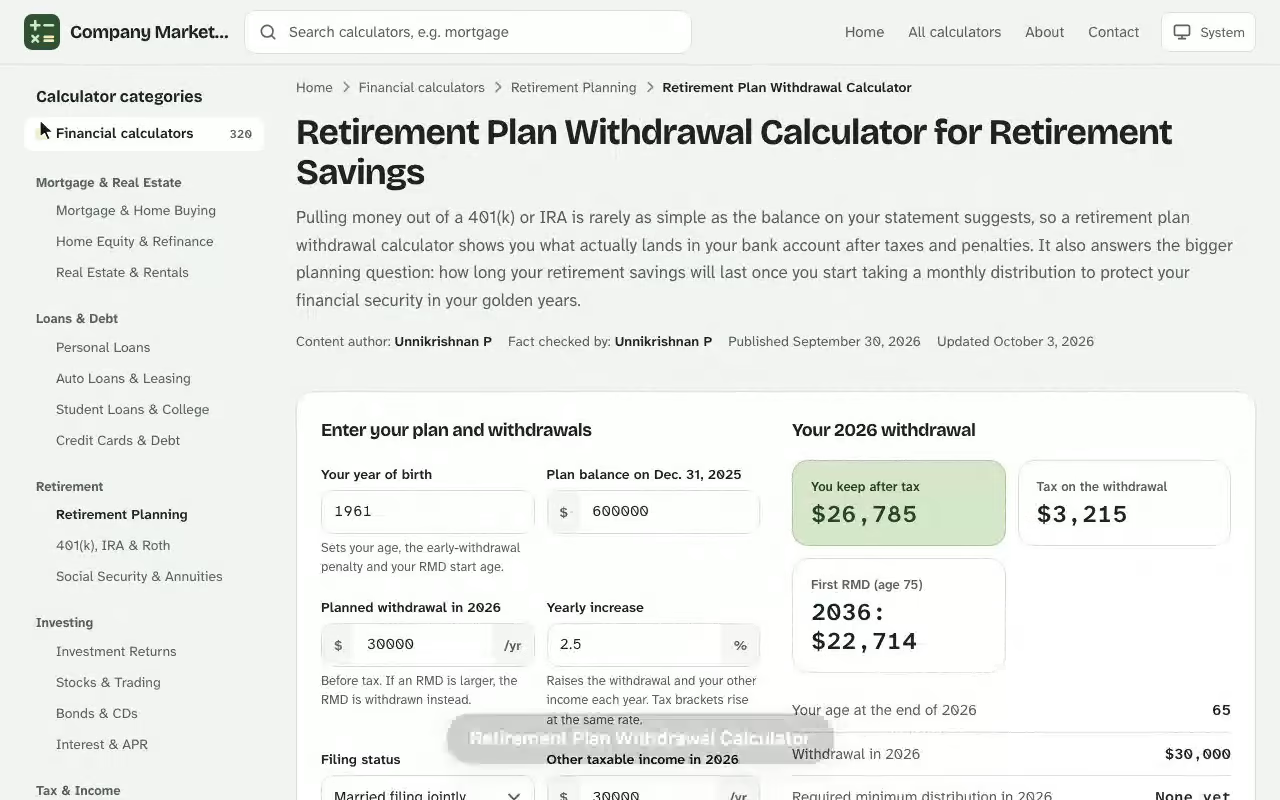
Retirement Plan Withdrawal Calculator. Pulling money out of a 401(k) or IRA is rarely as simple as the balance on your statement suggests, so a retirement plan withdrawal calculator shows you what actually lands in your bank account after taxes and penalties. It also answers the bigger planning question: how long your retirement savings will last once you start taking a monthly distribution to protect your financial security in your golden years. If you want to see how the figures change, the life expectancy calculator online gives you an instant result you can adjust as you go.
Your 2026 withdrawal
You keep after tax
–
Tax on the withdrawal
–
First RMD
–
Your age at the end of 2026–
Withdrawal in 2026–
Required minimum distribution in 2026–
Federal income tax on it–
State income tax on it–
10% early-withdrawal penalty–
Federal bracket with the withdrawal–
Total withdrawn / total tax–
2026 federal brackets and deductions, indexed by your yearly increase in later years. RMDs use the IRS Uniform Lifetime Table; a spouse more than 10 years younger who is your sole beneficiary would lower them.
Year-by-year withdrawals, RMDs and tax
Each year's RMD is the prior year-end balance divided by the IRS distribution period. The withdrawal is the larger of your plan and the RMD, and the rest earns your return.
Year
Age
Start balance
RMD
Withdrawal
Federal tax
State tax and penalty
You keep
End balance
Results are estimates for educational purposes and are not financial, tax or legal advice.
How the Retirement Plan Withdrawal Calculator Works
This retirement calculator handles two jobs that people usually search for separately. The first is a one-time net withdrawal: you enter the amount you want to take out, your age and your tax rates, and it subtracts income tax and any early withdrawal penalty. The second is a retirement income calculator view that runs your balance forward month by month against your spending, so you can see the month your account would reach zero. Next, open the savings distribution calculator and enter your own details to see an estimate in seconds.
Inputs a Withdrawal Calculator Needs
Have these figures ready before you start. Each one changes the result, and the more precise you are, the more useful the estimate becomes.
Cumulative savings: the balance in the account you plan to draw from today.
Monthly spending: everything you expect to pay each month for living expenses.
Social Security: the monthly benefit you expect, based on your earnings record.
Monthly pension: any guaranteed payment from an employer plan.
Other income: rental income, part-time pay or anything not listed above.
Rate of return: the yearly growth you assume on your investments.
Rate of inflation: how quickly your costs are expected to rise.
Marginal tax rate: the rate that applies to your next dollar of withdrawals.
Retirement age: your current age decides whether the early penalty applies.
Reading Your Results
The calculator reports your net withdrawal, the tax and penalty it removed, and the number of months or years your retirement money is projected to last. Try changing one input at a time. Raising your investment style from conservative to growth-focused, for example, shows how much of your outcome depends on the rate of return you assume rather than on how much you spend.
What a Retirement Savings Calculator Cannot See
Any retirement savings calculator works from the assumptions you type in, so treat its net withdrawal and months-remaining figures as estimates rather than promises. This tool applies one flat tax rate and cannot see your plan's own withholding rules, a state with unusual tax treatment or a market drop in your first year. It also leaves out account fees and product restrictions. Rerun the numbers each year with your current balance, and compare several outcomes, because a single result hides the range of financial situations you might actually face. If your own situation is complicated, a licensed professional can fill the gaps that the estimate leaves open.
Retirement Distribution Calculator Formulas
A retirement distribution calculator is only trustworthy if you can check the arithmetic yourself. Both calculations use short formulas that you can reproduce on paper. The retirement planner with retirement earnings calculator is free to use with no sign-up, and works on desktop and mobile.
Net Withdrawal After Taxes and Penalties
Your net withdrawal is the gross amount minus federal tax, state tax and the penalty, each charged as a share of the amount withdrawn:
$$\text{Net withdrawal} = W - (W \times t_f) - (W \times t_s) - (W \times p)$$
Here \(W\) is the gross withdrawal, \(t_f\) the federal marginal rate, \(t_s\) the state rate and \(p\) the penalty rate, which is 10% before age 59 1/2 and zero afterward.
How Long Your Retirement Savings Last
To estimate how long your retirement savings last, the balance grows each month and then pays out the gross amount needed to cover your spending gap:
\(B\) is your balance, \(r\) the annual return, \(S\) monthly spending, \(I\) your monthly Social Security, pension and other income, and \(t\) your tax rate. The spending gap is raised once a year by your inflation rate, and the first month in which \(B\) drops below zero is the month your money runs out.
Worked Example: A Pension Withdrawal at Age 54
Say you are 54 and need $18,500 from a traditional 401(k) to cover a roof repair. You are in the 22% federal bracket and pay 4.5% state tax. Because you are younger than 59 1/2, the 10% early withdrawal penalty applies as well.
Line item
Rate
Amount
Gross withdrawal
—
$18,500.00
Federal income tax
22%
−$4,070.00
State income tax
4.5%
−$832.50
Early withdrawal penalty
10%
−$1,850.00
Net withdrawal
36.5% total
$11,747.50
Waiting until you are past 59 1/2 removes the penalty, which lifts the same withdrawal to $13,597.50. A Roth IRA withdrawal limited to your own contributions would keep the full $18,500, which is why the account type matters so much.
You can also rerun the calculator with the amount split across two calendar years. Each portion can stay inside a lower bracket, while one lump sum may push part of it into a higher one, so comparing both net payouts before you request the money can save real tax.
How Long Does Money Last in Retirement?
Now run the second calculation. You retire with a balance of $612,000, spend $4,850 a month, receive $1,920 a month from Social Security, expect a 5.5% return, 2.8% inflation and a 12% tax rate. The projection shows your retirement funds lasting about 244 months, or roughly 20 years. The table shows how sensitive that answer is to a single assumption.
See how the Retirement Plan Withdrawal Calculator works: change the inputs and the you keep after tax updates instantly. Enter your own numbers in the calculator above.
What changes
Assumption
Money lasts
Rate of return
4.0%
17.3 years
Rate of return (base case)
5.5%
20.3 years
Rate of return
7.0%
25.4 years
Monthly spending
$4,000
33.4 years
Monthly spending
$5,500
15.7 years
Cutting your monthly spending by $850 stretches the same balance by thirteen years, which is a far bigger lever than any reasonable shift in returns.
Early Withdrawal Penalty and the 59 1/2 Rule
Taking a distribution before age 59 1/2 usually triggers an early withdrawal penalty of 10% on top of ordinary income tax. The taxes and penalties combined can consume more than a third of the money, as the example above showed. The penalty applies to the taxable part of the distribution, so the calculator asks for your age before it estimates anything.
72(t) and Substantially Equal Periodic Payments
If you must start drawing before 59 1/2, the 72(t) rule lets you avoid the penalty by taking substantially equal periodic payments for five years or until you reach 59 1/2, whichever is longer. The schedule is rigid, so use a dedicated 72(t) tool before committing to it.
Other Early Withdrawal Exceptions
Certain situations waive the penalty, including disability and some medical expenses, though the withdrawal is still taxed as income. Check the rules for your plan type, because an early withdrawal from a 401(k) is not always treated like one from an IRA.
Checking a Retirement Distribution Plan at Age 63
You are 63, just retired, and holding a rollover IRA worth $487,300. Your only guaranteed income is a $640 monthly pension, and Social Security is not yet claimed. Before you set up automatic transfers, you want to know whether the account can carry you.
You open the retirement withdrawal calculator and enter your balance, $4,260 in monthly spending, the $640 pension, a 4.8% return, 3.1% inflation and a 15% tax rate. The result reads 128 months, about 10 years and 8 months, which would empty the IRA around age 74.
The number is easy to check against a named benchmark. Your first-year gross withdrawal works out to $51,106, which is 10.5% of the balance, more than double the 4% guideline that planners commonly use as a sustainable starting rate. The calculator is telling you the plan is too aggressive, and the arithmetic backs it up.
So you change one input at a time. Lowering monthly spending to $3,700, the amount your fixed bills and groceries actually require, moves the result to 154 months, or 12 years and 10 months. That helps, but it still isn’t enough. Then you enter the $1,780 monthly Social Security benefit on your statement as other income, keeping spending at $4,260, and the projection jumps to 279 months, about 23 years and 3 months, carrying the account past age 86.
That figure settles the decision. Claiming Social Security now keeps the IRA withdrawal rate near a sustainable level, so you file the application this week and set the IRA transfer to the lower gap amount instead of the full $4,260.
Taxes on Retirement Plan Withdrawals by Account Type
The tax obligation on a distribution depends on how the account was funded. A traditional IRA or 401(k) holds pre-tax dollars, so withdrawals count as ordinary income at your tax bracket. A Roth account holds after-tax dollars, so qualified withdrawals are tax-free.
Account
Funded with
Withdrawal after 59 1/2
Traditional IRA
Pre-tax dollars
Taxed as ordinary income
401(k) and 403(b)
Pre-tax dollars
Taxed as ordinary income
Roth IRA
After-tax dollars
Tax-free if qualified
Roth 401(k)
After-tax dollars
Tax-free if qualified
IRA and 401(k) Withdrawal Differences
An IRA gives you control over when and how much you take, while an employer plan may restrict distributions or add withholding. A Roth conversion shifts money into a Roth, which changes the tax rate you enter later, and tax deferral in a pre-tax account does the opposite, so match the rate to the account you are drawing from.
Required Minimum Distribution Rules
Once you reach the age set by law, a required minimum distribution forces you to take money from pre-tax accounts each year. An RMD calculator uses your balance and a life-expectancy factor, and ignoring it triggers a steep penalty. Once RMDs begin, the required amount becomes the minimum you enter as the gross withdrawal, so run it through the calculator to see the net payout and plan your budget for the year.
Retirement Income Sources Beyond Your Accounts
Your withdrawals rarely have to carry the whole load. Guaranteed retirement income shrinks the amount you pull from savings and lowers the tax you owe each year.
Social Security: delaying your claim raises the monthly check and the lifetime benefits you receive.
Pension: a fixed payment from an employer that reduces your required withdrawals.
Annuity: converts part of your balance into fixed income for life; enter the payment as other income so the calculator draws less from savings.
Part-time work: earnings entered as other income, which let your portfolio keep growing a few more years.
Healthcare Costs, Medicare and HSA Planning
Medical bills belong inside the monthly spending you enter. Healthcare costs before Medicare begins can be especially heavy, so raise that input accordingly. A health savings account (HSA) can pay them with tax-advantaged money, and long-term care coverage keeps one extended stay from changing your projected months.
How Inflation and Risk Change Your Retirement Savings Results
Inflation quietly erodes your purchasing power, because the cost of living keeps rising throughout a long retirement. Your lifestyle stays the same only if your income keeps pace, so the calculator inflates your spending gap every year.
Your risk tolerance shapes the rate of return you can reasonably enter. Stocks, bonds and mutual funds in a diversified portfolio may earn more than a savings account, but their volatility means a bad early year cuts your months-remaining result more than a bad late one. Moving gradually toward conservative investments lowers the return you assume while steadying the outcome. Testing several scenarios with the calculator shows the range of results rather than a single guess.
Ways to Make Your Retirement Funds Last Longer
If the projection falls short of your retirement goals, adjust the inputs that you control before changing anything else.
Review your budget every year and trim the living expenses that no longer serve you.
Monitor your withdrawal rates and avoid pulling more than your plan assumes.
Diversify your holdings so a single downturn does not drain the balance.
Delay Social Security if you can comfortably cover the gap from savings.
Speak with a financial advisor before large or irreversible moves.
Good retirement planning treats the calculator as the start of an income strategy, not the finish. Rerun it with your updated balance, spending and income inputs, then compare your projected savings, your total savings and the savings needed to cover your retirement spending. Update the numbers whenever your annual contributions or plans change, and you will see right away whether your plan still lasts.
Retirement Plan Withdrawal Calculator questions
How does a retirement plan withdrawal calculator work?
It combines your savings balance, monthly spending, guaranteed income, expected return, inflation and tax rate to project how many months your account can fund withdrawals. It also subtracts income tax and any early withdrawal penalty from a one-time withdrawal to give your net amount.
What is the early withdrawal penalty on retirement accounts?
Withdrawals from qualified plans such as a traditional IRA, 401(k) or 403(b) before age 59 1/2 are generally hit with a 10% penalty on top of ordinary income tax, unless an exception such as 72(t) payments applies.
How much tax will I pay on a retirement withdrawal?
Pre-tax accounts are taxed as ordinary income at your marginal rate. Qualified Roth withdrawals are tax-free because the money was taxed before it went in. Enter your marginal rate to see the dollar effect.
How long will my retirement savings last?
It depends mainly on your spending gap, your rate of return and inflation. The calculator subtracts Social Security, pension and other income from spending, grosses up the gap for taxes and tracks the balance month by month.
Does the calculator include inflation?
Yes. The spending gap is increased once each year by the inflation rate you enter, so purchasing power stays the same across a long retirement.
Can I avoid the early withdrawal penalty?
Some exceptions exist, including substantially equal periodic payments under 72(t), certain medical expenses and disability. Check the rules for your specific plan before relying on one.
What withdrawal rate is considered sustainable?
Many planners use about 4% of the starting balance as a common guideline. The calculator shows your first-year withdrawal rate so you can compare your plan with that benchmark.