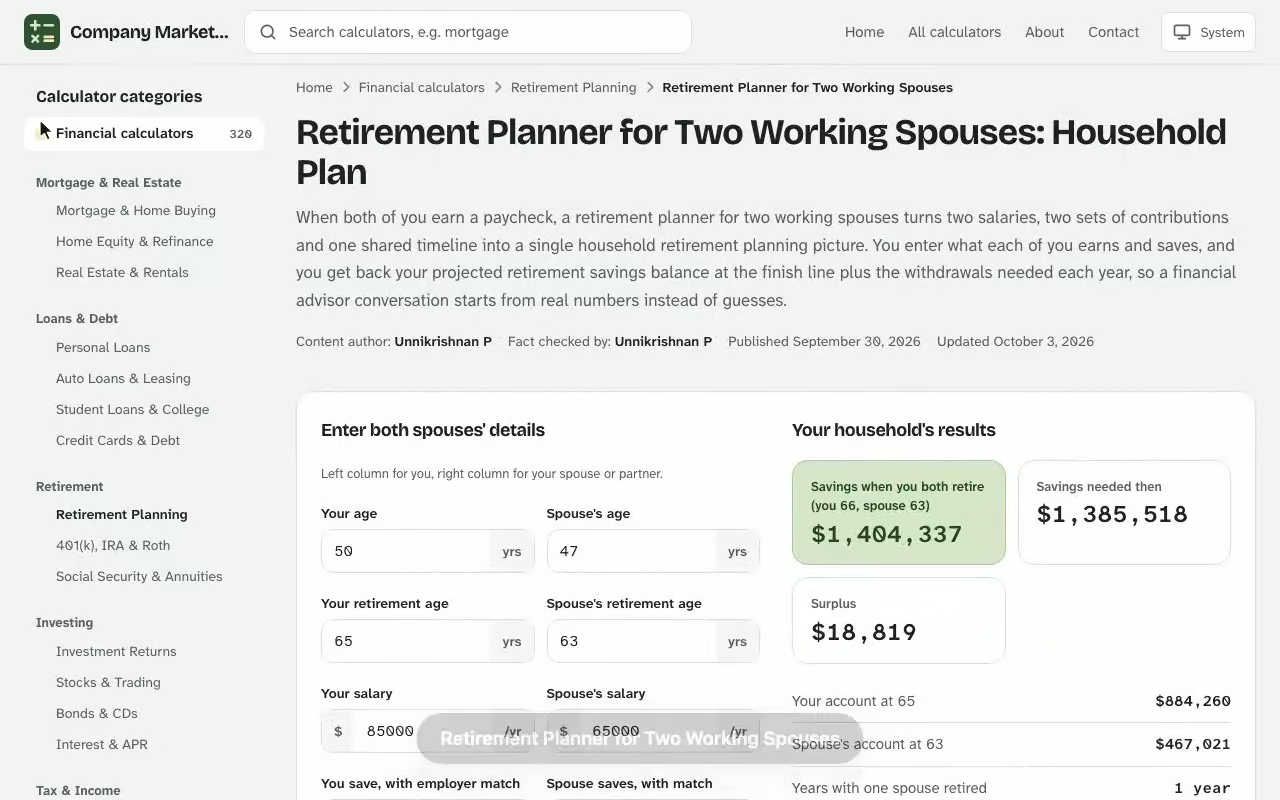
Retirement Planner for Two Working Spouses. When both of you earn a paycheck, a retirement planner for two working spouses turns two salaries, two sets of contributions and one shared timeline into a single household retirement planning picture. You enter what each of you earns and saves, and you get back your projected retirement savings balance at the finish line plus the withdrawals needed each year, so a financial advisor conversation starts from real numbers instead of guesses. The life expectancy calculator is free to use with no sign-up, and works on desktop and mobile.
Your household's results
Savings when you both retire
–
Savings needed then
–
Shortfall
–
Your account when you retire–
Spouse's account when they retire–
Years with one spouse retired–
First full-retirement year: spending–
Social Security that year–
Withdrawal from savings (before tax)–
Savings last until–
While one spouse still works, the household is assumed to live on that salary and any benefits already claimed, without drawing on savings. Spousal and survivor benefits are not modeled.
Year-by-year plan for both accounts
Contributions stop when each spouse retires. Once you have both retired, withdrawals come from the two accounts in proportion to their balances.
Your age
Spouse's age
Contributions
Social Security
Withdrawals
Your account
Spouse's account
Combined
Results are estimates for educational purposes and are not financial, tax or legal advice.
How a Retirement Planner for Two Working Spouses Works
The same logic that powers the long-form retirement planner for two working spouses with different retirements sits behind every tool of this kind: grow today's savings and each year's contributions until the day you stop working, then pay your lifestyle out of that nest egg, Social Security and any pension for as many years as you expect to live. Because there are two incomes, the planner has to blend two sets of ages, salaries and benefits into one cash-flow stream, which is why a single-person retirement calculator tends to under- or overstate what a couple needs. The retirement account contribution accelerator online is free to use with no sign-up, and works on desktop and mobile.
Household status and why it changes the math
Your household status tells the planner whose earnings feed which benefit. A married couple where both partners work receives two separate Social Security checks, though the lower earner may switch to a spousal Social Security benefit when it is larger than their own. An unmarried couple sharing expenses also keeps two separate benefits, but neither one qualifies for a spousal amount. Pick the status that matches reality before anything else, because it quietly changes every later result.
Annual earned income for each partner/spouse
Enter each person's annual earned income as gross earned income, the pay figure Social Security is built on. Leave out interest, dividends and rental income here; those belong in the miscellaneous income field covered below. In our running example you earn $87,300 and your partner earns $64,900, so the household brings in $152,200 a year before taxes.
Employer retirement contribution
An employer retirement contribution is the percentage of salary your employer adds to a 401(k), a 403(b) or a similar workplace account. It is free money that compounds beside your own deposits, so leaving a match unclaimed is the costliest mistake a two-income household can make. Here your employer adds 4% and your partner's employer adds 3%.
Employee retirement contribution
The employee retirement contribution is what you personally defer from each paycheck. You put in 9% and your partner puts in 6%. Together with the employer share, the household's first-year deposits come to $17,190, and extra savings outside payroll add another $4,200 for $21,390 in total.
How your household's year-one retirement contributions add up to $21,390.
Retirement Planner Calculator Inputs for Savings and Timing
Beyond pay and contributions, a good retirement planner calculator asks how long you will save, how long you will spend and what the markets and prices may do in between. These assumptions carry as much weight as your deposits, so treat them as dials you will revisit rather than answers you set once. The free savings distribution calculator is free to use with no sign-up, and works on desktop and mobile.
Years until retirement and years in retirement
Enter years until retirement as the gap between today and the day withdrawals begin; enter zero if you have already stopped working. Then set your years in retirement long enough to cover the younger or longer-lived partner. Our example uses 14 years of saving, with you retiring at 67 and your partner at 64, followed by 28 years of spending.
Rate of return and compounded growth
Your rate of return is the average yearly gain you expect before taxes. Historically, the S&P 500 has delivered a compounded rate of return near 10% over very long stretches, but a mixed portfolio of stocks, bonds and cash earns less, and the swings between years are real. A common approach is a higher assumption while you are saving and a lower one afterward, since you shift toward safer investments as withdrawals begin. We use 6.5% before retirement and 4.5% during it.
Inflation rate
The inflation rate raises both your expenses and your paychecks over time. The Consumer Price Index (CPI), the usual yardstick, has averaged roughly 3% over the last century, so we use 2.8%. This planner inflates both spouses' pay and your first-year withdrawal at that rate, so the income target in your results grows with it; ignoring inflation would show a comfortable balance that buys far less than it appears to.
Annual surplus and retirement work income
An annual surplus appears in any year when your Social Security, pension and other income exceeds your spending. A good planner lets you reinvest that surplus rather than spend it. If you expect part-time retirement work income, enter it with the number of work years you will keep earning it; it reduces how much you pull from savings in those years.
Retirement Savings Calculator Formula and Withdrawals
Behind the screen, the retirement savings projection is a simple recurrence. Each year the prior balance grows by the pre-retirement rate of return, and that year's contributions are added:
$$B_{t} = B_{t-1} \times (1 + r) + C_{t}$$
Here \(B_{t}\) is the balance at the end of year \(t\), \(r\) is the rate of return and \(C_{t}\) is the household's combined contributions, which rise with pay. Once retirement starts, the sign flips and each year's withdrawal comes out before growth:
Most planners ask what percentage of your last working year's pay you will need. Many couples land between 70% and 85%, because commuting, payroll tax and saving costs fall away, while health care costs rise. We chose 70%. Because your savings are mostly tax-deferred, treat the percentage as an after-tax figure if you keep money in a Roth IRA, and as a pre-tax figure if you do not.
Retirement income from pensions, rental income and other sources
Enter any pension (including a ministerial church pension board plan), annuities and rental income as annual amounts under retirement income. These streams are usually not adjusted for inflation, so a pension that looks generous today can lose real value across 28 years. Reducing the withdrawal need by these sources is exactly how a couple with a modest nest egg can still retire comfortably.
Social Security for Two Working Spouses
For most households, Social Security is the largest guaranteed income stream, and with two earners it is also the most timing-sensitive decision in the plan. Each spouse claims on their own record, and the claiming age matters a great deal.
Age you begin taking Social Security
You can claim at age 62, but the monthly benefit is up to 30 percent lower than at full retirement age, which is 67 for anyone born in 1960 or later. Each year you wait beyond that, your payment grows about 8 percent until age 70. A planner lets each partner enter a different claiming age, so you can test whether the higher earner waiting while the lower earner starts early improves the household total.
See how the Retirement Planner for Two Working Spouses works: change the inputs and the savings when you both retire (you 85, spouse 119) updates instantly. Enter your own numbers in the calculator above.
Spousal Social Security benefit
A spousal Social Security benefit pays up to half of the other spouse's full benefit and only matters when one partner's own record is much smaller. When both of you have solid earnings histories, the spousal amount is often zero, which is why the planner compares the two options automatically.
Item
You
Your partner
Household
Current age
53
50
Two spouses
Annual income
$87,300
$64,900
$152,200
Employee contribution
9%
6%
$11,751 first year
Employer contribution
4%
3%
$5,439 first year
Retirement age
67
64
14 years from now
Social Security (today's dollars)
$3,120 per month
$2,280 per month
$5,400 per month
Your Results: What the Planner Shows for This Couple
With these inputs, the planner produces the following projection. Your current retirement savings start at $212,000, plus $350 a month of extra deposits, and the numbers below are in the dollars of the year they occur.
Combined retirement contributions grow from $21,390 in year one to $30,628 in year 14 as pay rises with inflation.
The balance at retirement reaches $1,074,760.
Household pay in the final working year is $224,036, so 70% of it means you need $156,825 of retirement income that year.
Social Security covers $95,385 of that, leaving a first-year withdrawal of $61,441, or 5.72% of the balance.
Because withdrawals rise with inflation, the money lasts until year 21 of the 28 planned years.
A 5.72% opening withdrawal rate is above the 4% to 5% range planners usually treat as sustainable, which is why the balance runs dry about seven years early. Raising extra monthly deposits from $350 to $900 lifts the balance to $1,248,417, lowers the opening rate to 4.92% and stretches the money to year 25.
Key dates in the couple's retirement timeline, from today to the year savings run out.
Testing a Contribution Gap with a Retirement Planner Calculator
Marcus, 58, and Elena, 56, sit down on a Sunday evening with last year's pay stubs because Marcus wants to know whether retiring in eight years is realistic. He earns $118,400 and defers 10% with a 5% employer match; Elena earns $93,750, defers 8% and receives 4%. Their combined current retirement savings stand at $486,300, Elena's employer pension will pay $18,000 a year, and their Social Security statements add up to $6,900 a month in today's dollars.
They choose 65% of final pay as the income goal, 6% growth until retirement, 4% afterward, 2.5% inflation and 27 years in retirement, since Elena's grandmother lived to 94. The planner returns a projected balance of $1,095,614 at retirement, a final-year household income of $258,484 and a spending need of $168,015. Social Security covers $100,884 of it, the pension covers $18,000, and the first withdrawal is $49,131, or 4.48% of the balance, which is inside the 4% to 5% band financial planners often cite.
The year-by-year table is where the problem shows up. With withdrawals rising 2.5% annually, the balance goes negative in year 27, short by about $27,900, because the pension never rises with prices. The two know exactly which lever to test, so Marcus raises his own deferral from 10% to 14% and reruns the tool. The projected balance rises to $1,147,942, the opening rate eases to 4.28%, and $123,006 remains at the end of year 27. Marcus asks his payroll department to change the percentage before the next pay period, instead of postponing his retirement date.
Retirement Needs, Taxes and Budget Checks
The planner's balance and withdrawal figures are pre-tax and assume a smooth average return, so check them against these rules before you rely on the years-funded result.
Taxes and early withdrawals
You owe income taxes on withdrawals from a traditional 401(k) or IRA, and most states tax them too. Touching a tax-deferred account before age 59½ usually triggers a 10 percent penalty on top. If your combined rate is 30 percent, a $1,000 withdrawal leaves you $700 after taxes, which is why the net amount you actually spend is lower than the gross figure in a planner.
Health care, Medicare and retirement expenses
Health costs are the budget line most likely to surprise you. Medicare generally starts at 65, so a spouse who retires at 64 needs a year of private coverage in the plan. Add premiums and out-of-pocket costs to your retirement expenses rather than assuming they match your working-year budget.
Risk, volatility and protecting principal
The planner applies one fixed average return, 6.5% before retirement and 4.5% after, so it never shows a bad early run. Markets do not behave that way, and a deep decline in the first years of withdrawals hurts most because you sell investments at low prices to cover living costs. With our couple's 5.72% opening withdrawal rate and staggered retirement ages of 67 and 64, that risk is real. Lower the retirement-phase return, rerun the tool, and consider holding a few years of cash and bonds so volatility does not force a sale.
Ways to Improve Your Retirement Plan
When a result falls short, treat your retirement savings plan as adjustable and change one lever at a time and rerun the tool, so you can see which move matters most for your wealth and your finances.
How the opening withdrawal rate changes with extra deposits and your income goal.
Raise the employee retirement contribution until each employer match is fully captured.
Delay Social Security for the higher earner to age 70 where health and savings allow.
Use catch-up deposits to a Roth IRA once you are over 50, and keep investing consistently.
Trim the desired income percentage by a few points and check how many more years the money lasts.
Postpone retirement by two years: more contributions, a larger balance and fewer years to fund.
Use this calculator once a year, update your financial goals and monthly retirement contributions, and compare the new balance with the last. Because it is only an estimate based on your assumptions, share the results with a financial advisor before you change your savings, benefits or investments. For a quick sense of scale, use any retirement calculator, but remember that a tool built for one earner cannot capture how two careers, two sets of benefits and one shared budget interact.
Retirement Planner for Two Working Spouses questions
How does a retirement planner for two working spouses differ from a single-person calculator?
It blends two salaries, two sets of contributions, two ages and two Social Security claiming ages into one household cash flow, and it can apply a spousal benefit when one partner's own benefit is much smaller.
Do both spouses have to retire in the same year?
This planner assumes both retire when the years-until-retirement count reaches zero. If your retirement dates differ, run it once with each date and compare, or use the earlier date for a conservative estimate.
What rate of return should I enter?
Use the average yearly gain you expect before taxes. A mix of stocks, bonds and cash historically earns less than stocks alone, and many couples assume a lower rate after retirement. Test a few values because returns vary widely from year to year.
How much of my pre-retirement income will I need?
Many households plan on 70% to 85% of their final working year's income. Use a lower figure only if your mortgage is paid off and you expect modest health costs, and treat it as an after-tax figure if most savings sit outside tax-deferred accounts.
Should we claim Social Security at the same age?
Not necessarily. Letting the higher earner wait until 70 raises that spouse's check and the survivor benefit, while the lower earner may claim earlier. Enter a different age for each spouse and compare the results.
Are pensions and rental income adjusted for inflation?
The miscellaneous income field is treated as a fixed annual amount, so its buying power falls over a long retirement. Retirement work income is adjusted for inflation.
What does the annual surplus option do?
If pensions, Social Security and other income exceed your spending need in a year, the extra can be reinvested instead of spent, which increases the balance for later years.
Is this result financial advice?
No. It is an estimate based on the assumptions you enter, with Social Security approximated from your income. Review the numbers with a financial advisor before changing your savings or claiming plans.