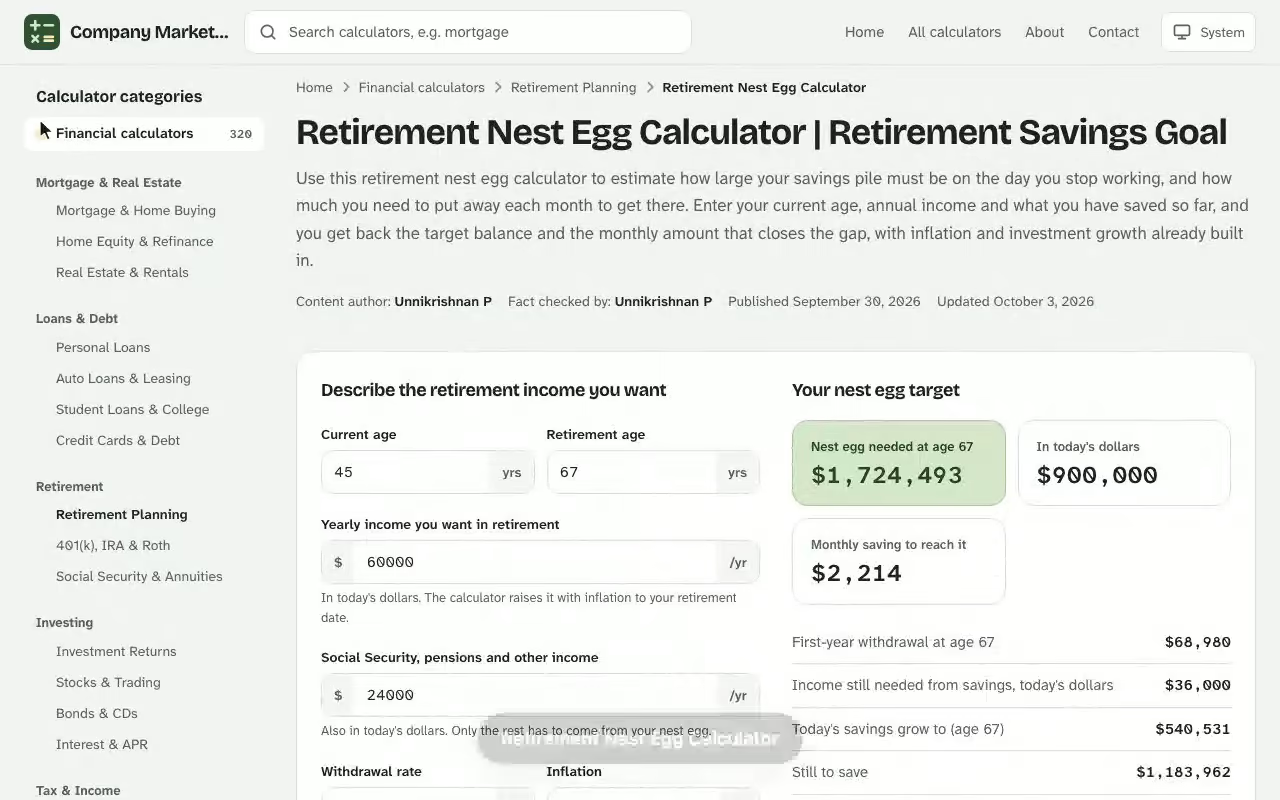
Retirement Nest Egg Calculator. Use this retirement nest egg calculator to estimate how large your savings pile must be on the day you stop working, and how much you need to put away each month to get there. Enter your current age, annual income and what you have saved so far, and you get back the target balance and the monthly amount that closes the gap, with inflation and investment growth already built in. The free life expectancy calculator uses the same plain-English approach, so you can compare results side by side.
Your nest egg target
Nest egg needed
–
In today's dollars
–
Monthly saving to reach it
–
First-year withdrawal–
Income still needed from savings, today's dollars–
Today's savings grow to–
Still to save–
At this rate, savings last about–
Nest egg needed at other withdrawal rates
A lower withdrawal rate needs a bigger nest egg but is more likely to last. The last column shows how long the money would last if each first-year withdrawal then rises with inflation and the rest earns your return during retirement.
Withdrawal rate
Nest egg needed
In today's dollars
Monthly saving needed
Lasts about
Results are estimates for educational purposes and are not financial, tax or legal advice.
Retirement Nest Egg Calculator: How the Number Is Built
A nest egg is the pool of money, or other assets, that you invest with one purpose in mind: paying for life after your paycheck ends. The calculation works in two halves. First it prices the nest egg you need on your retirement date. Then it asks how much of that amount your current balance will cover on its own and how much of the rest you still have to save. Try the retirement shortfall calculator to run your own numbers — everything is calculated in your browser and nothing you enter is stored or sent anywhere.
The calculator follows five steps, and every one of them uses an input you control:
Grow your annual income to retirement age using your expected income increase.
Multiply that final salary by the share of pre-retirement income you want to replace.
Find the lump sum that can pay that growing income for every year of retirement, given your rate of return during retirement and the inflation rate.
Grow your current balance forward at the pre-retirement return.
Spread the remaining shortfall over the years you have left to save.
The nest egg formula
The target balance is the present value of a stream of withdrawals that rises with inflation. With \(P\) as the first year's retirement income, \(r\) as the return during retirement, \(i\) as the inflation rate and \(N\) as the number of retirement years:
The monthly amount comes from the future value of an annuity of equal yearly deposits. With \(S\) as the shortfall, \(g\) as the pre-retirement return and \(n\) as the years until you retire:
$$\text{Yearly savings} = S \times \frac{g}{(1 + g)^{n} - 1}$$
Divide the yearly figure by 12 for your monthly contributions. Both formulas assume that deposits and withdrawals land at the end of each year, which is a slightly cautious convention.
Why compound interest does most of the work
Compound interest means your growth earns growth of its own. That is why the calculator is so sensitive to how many years you have left: a dollar saved at 41 has 25 years to multiply, while a dollar saved at 60 has six. The worked example below makes that gap visible.
Retirement Savings Calculator Inputs You Need to Enter
The retirement calculator asks for a short list of numbers. Most are facts about your life today; a few are assumptions about the future, and those deserve the most thought. Next, open the different retirement dates planner and enter your own details to see an estimate in seconds.
Current age and retirement age
Your current age and planned retirement age set the number of years you can save. The calculator assumes your last deposit is made the year before you retire, so a 66th-birthday retirement means your final contribution happens at 65.
Household income and income increase
Enter your total household income before taxes. If you are married, include your spouse's pay. The income increase field captures annual raises; because your final salary sets the retirement target, a 2.5% raise compounds into a noticeably larger goal than a flat salary would.
Current retirement savings
Add up every account earmarked for later: 401(k) balances, an IRA, a 403(b) or 457(b) plan, annuities and any other investments you are treating as retirement money. Use today's balances, not projected ones.
Pre-retirement income you want to replace
Most people aim to replace between 70% and 85% of their pre-retirement income, on the theory that commuting costs, payroll deductions and saving itself stop once you retire. If you expect to travel heavily, or carry a mortgage into your later years, pick a higher percentage. Think of this field as your retirement budget expressed as a share of your salary.
Years of retirement and life expectancy
Your life expectancy decides how many years of retirement the nest egg has to last. Planning to 93 is more prudent than planning to 85, because the cost of running out is far higher than the cost of leaving a surplus.
Rate of return before and during retirement
Your rate of return is the yearly growth you expect from your portfolio. Use a lower figure after you stop working: once you begin withdrawals you will usually hold more bonds and cash and fewer stocks. The S&P 500 has averaged roughly 11% a year since 1970, but a plan built on that history alone is aggressive. A conservative rate of return keeps the plan honest.
Inflation rate
The inflation rate is how fast prices rise. At 3% a year, inflation cuts purchasing power roughly in half over 24 years, which is why the calculator raises your retirement income every year instead of holding it flat.
Social Security and married filers
Tick the Social Security option if you want expected benefits to reduce the amount you must fund yourself, and tick the married option if a spouse will also draw benefits. Leaving it unticked is the safer way to see how much you would need if benefits fell short. A pension or other passive income works the same way: every dollar of guaranteed income lowers the nest egg required.
Worked Example: A Retirement Savings Goal at Age 41
Suppose you are 41, earn $87,500 a year and have $138,400 saved. You plan to retire at 66 and want to replace 78% of your final salary for 27 years. You expect a 2.5% raise each year, a 6.5% return before retirement, a 5.0% return during retirement and 2.8% inflation. Social Security is left out.
Step
Calculation
Result
Years to save
66 − 41
25 years
Final salary
$87,500 × 1.02525
$162,220
First-year retirement income
$162,220 × 78%
$126,532
Target nest egg at 66
Formula above, 27 years of inflation-adjusted withdrawals
$2,574,585
Current balance grown to 66
$138,400 × 1.06525
$668,154
Shortfall to fund
$2,574,585 − $668,154
$1,906,431
Yearly savings needed
$1,906,431 × 0.065 ÷ (1.06525 − 1)
$32,374
Monthly savings needed
$32,374 ÷ 12
$2,698
Read the table from top to bottom and the logic is easy to audit: a rising salary produces a larger income target, the target is converted into a lump sum, and your existing balance is credited for the head start it already has. Nothing in the process is hidden, so you can swap in your own figures and follow the same path.
Your answer is a $2,574,585 nest egg and a monthly deposit of $2,698, about 37% of your gross pay. That is a steep ask, and the next sections show which levers shrink it fastest.
How the balance grows year by year
Saving $32,374 a year, your balance reaches $373,946 at age 46, $696,665 at 51, $1,138,817 at 56 and $1,744,604 at 61 before landing on the $2,574,585 target at 66. Growth, not deposits, supplies most of the late-stage gains, which is the practical lesson of compounding.
Of the $2,574,585 target, about $947,751 is money you put in and $1,626,834 is investment growth.
Changing Your Retirement Needs With Different Assumptions
Because the result depends on assumptions rather than certainties, the most valuable habit is to rerun the numbers under different ones. The table below holds everything from the worked example fixed and changes one input at a time.
Change
Monthly savings needed
Return before retirement of 5.5%
$3,334
Return before retirement of 6.5% (base case)
$2,698
Return before retirement of 7.5%
$2,121
Retire at 62
$3,568
Retire at 66 (base case)
$2,698
Retire at 70
$2,061
Retirement age is the strongest lever
Working four more years cuts the required deposit by $637 a month, while retiring four years sooner adds $870. Extra working years do three things at once: they add contributions, give existing money longer to grow and, in real life, shorten the years of retirement you must fund.
Monthly savings needed from age 41 across three returns and five retirement ages; the outlined cell is the $2,698 base case.See how the Retirement Nest Egg Calculator works: change the inputs and the nest egg needed at age 67 updates instantly. Enter your own numbers in the calculator above.
Rate of return is the riskiest assumption
A single percentage point of return moves the answer by roughly $600 a month. Because nobody can predict markets, pick a rate of return you could live with if the next decade were disappointing, and treat anything above it as a bonus rather than a plan.
Inflation rate and spending power
Raise the inflation rate by half a point and the target nest egg rises even though your spending plan has not changed. The reverse is also true, so test a range instead of trusting a single guess.
Retirement Savings Check at 52: Testing a Later Retirement Age
You are a 52-year-old school administrator, and your 403(b) statement just arrived showing $612,900. Before deciding whether to keep your current deposit of $1,150 a month, you open the calculator and type in what you know: current age 52, retirement age 67, household income $104,300, raises of 2% a year, and a goal of replacing 70% of your final salary. You choose a 6.0% return before retirement, 4.5% during retirement, 2.8% inflation and 25 years of retirement, and you leave Social Security out on purpose.
The result appears within a moment. Your final salary grows to $140,374, so 70% of it is $98,262 in the first year of retirement. The calculator prices the target nest egg at $1,998,743, while your current balance grows to $1,468,851 by 67 on its own. That leaves a shortfall of $529,893, which works out to $22,766 a year, or $1,897 a month.
Set against what you save now, the gap is $747 a month. Your deposit equals 13.2% of pay, and the figure the calculator wants is 21.8%. That is a long way above the common 10% to 15% guideline, so you stop treating the retirement age as fixed and change one input.
Retirement age
Monthly savings needed
Gap versus $1,150
67
$1,897
$747
68
$1,564
$414
69
$1,267
$117
At 69, the required deposit is only $117 above your current one, and 67 is also the age at which people born in 1960 or later reach full Social Security benefits, so working two extra years lines up with a milestone you would track anyway. The decision follows from the table: you keep the $1,150 deposit, raise it by $117 at your next open enrollment, and plan on a 69th-birthday retirement unless the balance runs well ahead of the projection.
Retirement Planning Accounts That Hold Your Nest Egg
Where you keep the money affects how much of it you actually get to spend. Retirement planning usually involves several kinds of accounts, each with different tax treatment.
401(k), 403(b) and 457(b) plans
These employer plans pull contributions straight from your paycheck. A 401(k) is offered by private companies, a 403(b) by schools and nonprofits, and a 457(b) by governments. Many include an employer match, which is a guaranteed return you should capture before putting money anywhere else.
Traditional and Roth accounts
The two main tax treatments are:
Traditional: you contribute pretax dollars, which lowers your taxable income now, and you pay taxes when you take the money out.
Roth: you contribute after-tax dollars, and qualified withdrawals come out tax-free.
Both a traditional and a Roth version exist for the IRA as well. A tax-deferred or tax-advantaged account lets growth build without yearly tax drag, so use an after-tax rate of return in the calculator if most of your money sits in an ordinary brokerage account.
IRA, HSA and contribution limits
Each account type has contribution limits that change over time and depend on age and income. An HSA paired with a high-deductible health plan is also a quiet retirement tool, because medical bills are among the largest expenses of later life. If you are behind schedule and over 50, catch up contributions let you deposit extra each year.
Investing your contributions for the long run
The calculator tells you how much to deposit; what you buy with those deposits decides whether the return you typed in shows up. Steady investing through a payroll 401(k) in low-cost funds supports a defensible pre-retirement rate of return, and fees come straight off it: a fund charging 1% a year means you should enter a return one point lower than its gross figure. Review your investments once a year and update the return field if your mix has changed, because the projected balance is only as realistic as that single input.
Retirement Income Calculator Results and Risk
A single number looks more certain than it is, and every plan carries risk from markets, longevity and policy changes. Treat the output of this retirement income calculator as a planning target, then ask what could push it off course.
Asset allocation and diversification
Your asset allocation is the split between stocks, bonds and cash. Diversification across mutual funds, real estate and other holdings reduces the risk that one bad year wrecks the plan. More stocks mean higher expected growth and more volatility; more bonds mean the opposite. In the calculator, that mix is what you reflect in the two return fields: a stock-heavy portfolio before retirement supports a higher figure, while the lower during-retirement return shrinks the nest egg you can draw from, so the same savings buy less income.
Why the numbers are hypothetical
Every projection here is hypothetical. Real returns arrive unevenly, and a market drop just before you retire does far more damage than the same drop in your thirties. Rerun the calculator each year and adjust your default assumptions as markets and your own life change.
Getting professional advice
Bring the calculator's two headline figures, the target balance and the monthly deposit, to a fee-only financial advisor. Together you can stress-test them against taxes, healthcare costs and the order in which you draw down accounts, which a single-rate projection cannot do on its own.
Closing the Retirement Savings Gap Before Your Retirement Age
If the monthly figure looks out of reach, each lever maps to an input you can change and rerun. In the worked example, moving the retirement age from 66 to 70 cuts the required deposit from $2,698 to $2,061, a higher pre-retirement return of 7.5% brings it to $2,121, and trimming the share of income you replace lowers the $2,574,585 target itself. Raising your deposit by 1% of pay each year does the same job gradually, and redirecting raises into savings makes it painless.
Consistent investing matters as much as the target itself, and a yearly check against your wider financial picture keeps the plan honest. Rerun the calculator every year with your real balance. Because a small, early change compounds for decades, it is worth far more than a large catch-up late in your career, and the updated number shows exactly how far you are from the goal.
Retirement Nest Egg Calculator questions
What is a retirement nest egg?
A nest egg is the money and other assets you save and invest specifically to pay for life after your paycheck ends, such as 401(k), IRA and brokerage balances.
How much do I need to retire?
It depends on the income you want, how many years the money must last, inflation and your investment returns. A common starting rule is to replace about 70% of your final salary, then use the calculator to price that into a lump sum.
What rate of return should I use?
Use a conservative figure you could live with if markets disappoint. Many planners assume a lower return after retirement than before, because portfolios usually shift toward bonds and cash.
How does inflation change my target?
Prices rise every year, so the income you need on retirement day is larger than today's budget. The calculator raises your target with the inflation rate and also lifts withdrawals every year of retirement.
Should I include Social Security?
Including it lowers the savings you must build yourself, but benefits can change. Run the calculator both with and without it to see how much you depend on it.
What if I am behind on retirement savings?
Try working a few years longer, raising your monthly contribution each year, using catch-up contributions if you are 50 or older, or lowering the share of income you plan to replace, then rerun the numbers.
Are the results guaranteed?
No. The results are hypothetical projections based on the rates you enter, and actual returns, inflation and spending will differ.