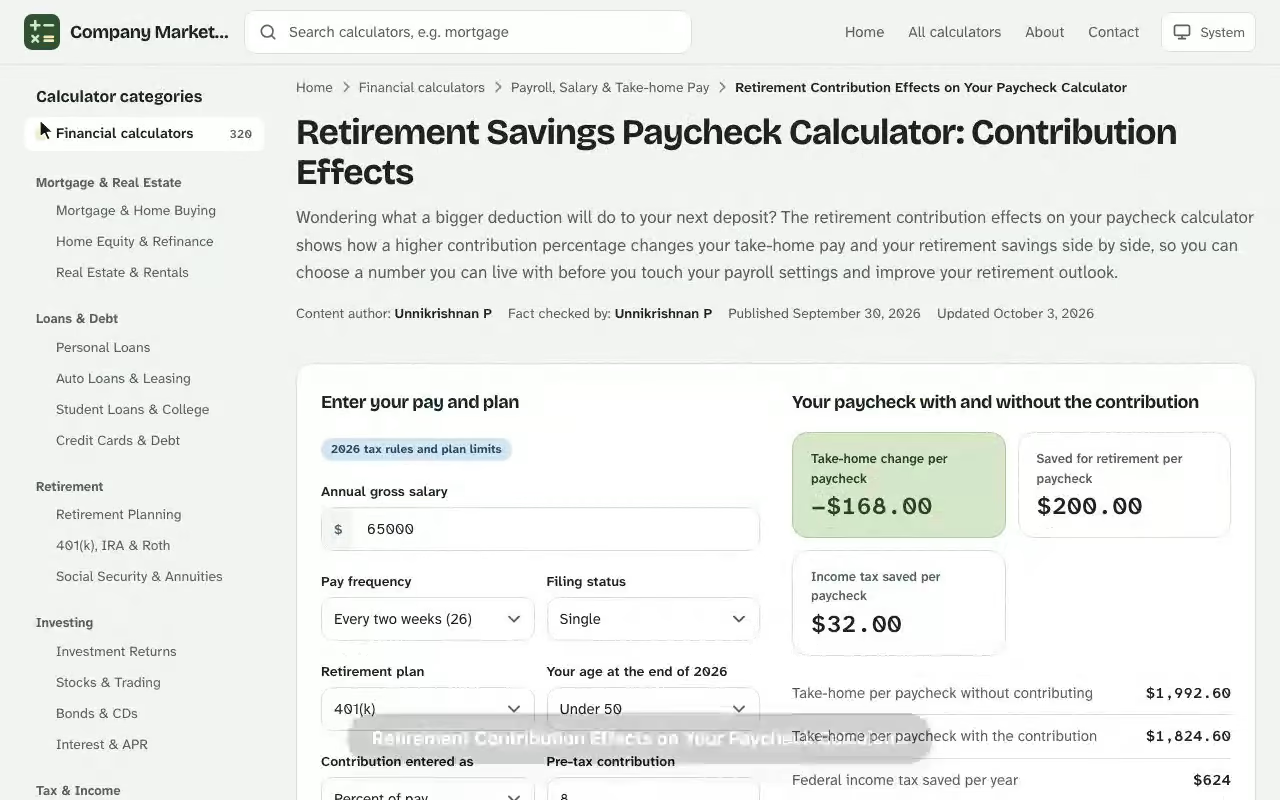
Retirement Contribution Effects on Your Paycheck Calculator
Retirement Contribution Effects on Your Paycheck Calculator. Wondering what a bigger deduction will do to your next deposit? The retirement contribution effects on your paycheck calculator shows how a higher contribution percentage changes your take-home pay and your retirement savings side by side, so you can choose a number you can live with before you touch your payroll settings and improve your retirement outlook. The salary increase calculator is free to use with no sign-up, and works on desktop and mobile.
Your paycheck with and without the contribution
Take-home change per paycheck
–
Saved for retirement per paycheck
–
Income tax saved per paycheck
–
Take-home per paycheck without contributing–
Take-home per paycheck with the contribution–
Federal income tax saved per year–
State and local tax saved per year–
Take-home cost of each $1 saved–
Your 2026 limit for this plan–
Share of pay needed to reach the limit–
Per-paycheck amount to reach the limit–
Paycheck with and without contributing
Per paycheck. Social Security and Medicare do not change: pre-tax retirement deferrals are still wages for those taxes.
Item
Without
With
Difference
Maxing out each type of plan at your age
What contributing the full 2026 limit for your age would do to each paycheck, by plan type. A 401(k) or 403(b) and a 457(b) have separate limits, so with both you can defer the two limits combined.
Plan
2026 limit
Contribution per paycheck
Take-home per paycheck
Take-home change
Cost per $1 saved
Results are estimates for educational purposes and are not financial, tax or legal advice.
How the Retirement Contribution Effects on Your Paycheck Calculator Works
Every run starts with your gross pay for one pay period. The tool subtracts the contribution you choose, treats the rest as your taxable income, applies taxes to that smaller amount, and reports what lands in your bank account. Because a traditional 401(k) takes pre-tax dollars, a $1 contribution rarely lowers your paycheck by a full $1. Income tax shrinks along with your taxable income, while Social Security and Medicare still apply to your full gross pay. Pair this with the free commission calculator for a fuller picture before you make a decision.
Two short equations drive the whole page. The first measures the change in your paycheck, where \(\Delta C\) is the extra contribution in dollars, \(t_{fed}\) is your marginal federal rate and \(t_{state}\) is your marginal state rate:
The second measures what the change adds to your account, combining your extra deferral with any extra employer match:
$$\text{Added to Account} = \Delta C + \Delta \text{Match}$$
Dividing the second result by the first tells you how many dollars reach your account for every dollar your paycheck gives up.
Gross pay and pay frequency
Your gross pay for one check is your annual salary divided by the number of times you are paid. The calculator needs your pay frequency so it can spread contributions across the right number of checks:
Weekly: 52 pay periods a year
Biweekly: 26 pay periods a year
Semi-monthly: 24 pay periods a year
Monthly: 12 pay periods a year
Pre-tax deductions and taxable income
Other pre-tax deductions such as health insurance premiums or a flexible spending account also reduce your taxable income before withholding is figured. Enter them so the result matches your real pay statement. Many calculators then draw a bar graph comparing your current check with the new one, which makes the trade-off easy to see at a glance.
Inputs a 401(k) Contribution Calculator Asks For
Keep your most recent pay statement beside you. The tool works best when its fields mirror the deductions your 401(k) plan already reports on that statement, so gather these details first: Pair this with the free payroll net to gross calculator for a fuller picture before you make a decision.
Your gross pay amount for one pay period
Your state of employment, which sets the state tax rates
The check date, because tax rules and limits change from year to year
Your current and proposed contribution percentage
Your employer match formula, if your plan has one
Other pre-tax deductions from your paycheck
Your filing status, dependents and any additional withholding
Filing status, dependents and head of household
Your filing status changes the bracket widths used to estimate income tax. Someone who qualifies as head of household generally keeps more income in lower brackets than a single filer with the same salary, so the same contribution can cost less take-home pay. Dependents lower the withholding amount further, which is why the tool asks for them.
How 401(k) Contributions Affect Your Paycheck: Taxes and Withholding
Your employer does not guess at taxes. It follows the IRS withholding schedules, which turn your wages, filing information and pre-tax deductions into a per-check withholding amount. A calculator mirrors that process, so each extra percentage point of contribution reduces taxable income at your marginal rate.
Federal withholding and your W-4
Federal withholding depends on what you reported on your W-4. Since the redesign, the new Form W-4 replaces allowances with dollar amounts for dependents and other income, and Step 4(c) lets you request additional withholding on every check. If you filled out an older form, your result may differ slightly from a calculator built around the new layout.
State withholding and FICA taxes
State withholding varies widely: a few states levy no wage tax at all, while others apply flat or graduated rates. FICA taxes, meaning Social Security and Medicare, are different. Deferrals into a 401(k) do not reduce them, so your payroll tax bill stays the same even as income tax falls. That is why the formula above uses only the income-tax rates.
Take-Home Pay Worked Example: Moving from 4% to 9%
Suppose you earn a $68,400 salary paid biweekly, contribute 4% today, and want to try 9%. Your employer matches 50% of what you defer, up to 6% of pay. For the estimate, assume a 12% federal rate and a 4.5% state rate, so a combined 16.5% of each extra dollar is spared from income tax.
See how the Retirement Contribution Effects on Your Paycheck Calculator works: change the inputs and the take-home change per paycheck updates instantly. Enter your own numbers in the calculator above.
Line item
Per paycheck
Gross pay ($68,400 ÷ 26)
$2,630.77
Current contribution at 4%
$105.23
New contribution at 9%
$236.77
Added contribution
$131.54
Income tax saved at 16.5%
$21.70
Drop in take-home pay
$109.84
Added employer match (3% minus 2% of pay)
$26.31
Total added to your account
$157.85
In plain terms, your paycheck falls by $109.84, yet your account grows by $157.85 every pay period, about $1.44 saved for each $1 of take-home you give up. Over 26 checks that is $4,104.00 a year going in, and if it earned a 6% rate of return for 20 years, the added balance would reach roughly $150,968. Treat that last figure as an illustration, not a promise, because markets and inflation will move it.
Think of the trade as a swap between two kinds of savings. Your paycheck funds today's spending, while the account is a long-term investment that your future self draws on. Seeing both columns at once makes it easier to decide how much savings capacity you really have. Many people discover that the real cost of the extra deferral is far smaller than the headline contribution, since tax savings absorb part of it, and that the investment benefit is larger than the contribution itself once the match is counted. If the take-home drop still feels too steep, try a smaller step, such as 7%, and compare the two results before deciding.
Testing a Jump in Retirement Savings Contributions Before the Payroll Cutoff
Dana, a 38-year-old project coordinator, has until Friday to change her deferral election. She earns $84,250, is paid semi-monthly, and currently contributes 5%. Her plan matches 100% of the first 4%, so she already collects the full match, and she wants to know whether doubling to 10% is affordable.
She opens the calculator and enters her gross pay of $3,510.42 per check, 24 pay periods, a current rate of 5%, a new rate of 10%, and a combined marginal rate of 27% (22% federal plus 5% state). The result appears instantly:
Extra contribution: $175.52 per check (5% of $3,510.42)
Income tax saved: $47.39, so the paycheck drops by only $128.13
Extra employer match: $0.00, because the 4% cap was already reached
The yearly contribution would be $8,425, comfortably under the $24,500 IRS limit for 2026, so the limit is not the constraint. The constraint is her budget: a $128.13 drop twice a month lands right on her car payment, and with no extra match, the added dollars come only from her own pay and tax savings.
Instead of committing, she reruns the tool with one input changed, 8%. The extra contribution becomes $105.31, the tax saved is $28.43, and her take-home falls by $76.88 per check, while $6,740 a year goes into her account. She submits 8% on Thursday and sets a reminder to re-test 10% after her next review.
Federal 401k Calculator Results: Employer Match and Tax-Deferred Growth
An employer match is the one part of your plan that works like a raise. Matching contributions only arrive when you contribute, so a tool that ignores them understates the benefit of saving more. In the example above, the match rises only until you reach 6% of pay; deferring beyond that earns no extra match but still gets the tax break.
Money inside the account enjoys tax-deferred growth: you owe no tax on earnings until you withdraw the money. Regular payroll deductions also bring dollar-cost averaging, since the same dollar amount buys more investment shares when prices fall and fewer when they rise. Over decades, those earnings compound on a bigger base, which is why the savings column often outgrows the paycheck column in the results.
Contribution Limits Your 401k Calculator Should Respect
The IRS caps how much of your wages you can defer into an account each year, and the contribution limits usually rise with inflation. For 2026 the elective deferral cap is $24,500, so a calculator should warn you if your chosen percentage times your salary would exceed it.
Annual limit and catch up contribution
The annual limit covers your own deferrals, not your employer match. If you are 50 or older, a catch up contribution adds a further amount on top, which lets you raise your contribution percentage faster late in your career. Check the current IRS figures before you set a very high percentage, since a calculator tied to an older check date may use outdated numbers.
Traditional vs Roth: Retirement Savings Account Results
With a traditional 401(k), your contribution lowers taxable income now, so your paycheck falls by less than the contribution, and you pay income tax when you withdraw in retirement. A Roth-style deferral reverses this: your paycheck falls by the full contribution, but qualified withdrawals are tax-free. Individuals comparing options often also look at a Roth IRA, which has its own limits and is funded outside payroll.
Low and moderate earners may also qualify for the Saver's Credit, a tax credit on retirement contributions, which can soften the paycheck effect of saving more. Plans for public-sector and nonprofit employees, such as a 403(b) or 457 plan, follow the same payroll logic, so the paycheck impact works the same way. An IRA is a separate account; its deposits do not appear on your pay statement.
Choosing a Contribution Percentage with a Contribution Calculator
Start with what you can afford today, then use planning as a way to move up in steps instead of one big jump. A few habits keep the number sustainable:
Contribute at least enough to capture the full match from your employer
Raise your percentage by one or two points each year, ideally on the day a raise lands
Re-run the calculator whenever your salary, benefits or deductions change
Compare your new take-home against your fixed monthly bills before you commit
Remember that an employee who saves early benefits most from long compounding
Treat the output as an estimate. Your payroll department's own figures, based on your exact earnings and deductions, are the final word, and a tax professional can advise on your specific situation.
Retirement Contribution Effects on Your Paycheck Calculator questions
How much will my 401(k) contribution reduce my paycheck?
Less than the contribution itself. A traditional 401(k) deduction is taken before income tax, so each extra dollar you defer lowers your take-home pay by roughly one dollar minus your marginal federal and state tax rate. Social Security and Medicare are still charged on your full pay.
Do 401(k) contributions reduce FICA taxes?
No. Deferrals reduce the wages used for federal and state income tax, but Social Security and Medicare taxes are still figured on your gross pay. Only certain other pre-tax benefits, such as health premiums, can reduce FICA wages.
Is there a limit on how much I can contribute?
Yes. The IRS sets an annual elective deferral limit, $24,500 for 2026, with a higher limit for catch-up contributions if you are 50 or older. Your employer match does not count against your own deferral limit.
How does my employer match change the result?
The match adds to your account but not to your paycheck. This calculator applies your match rate up to your match limit, so raising your contribution only earns more match until you reach that limit.
Why does my filing status matter?
Filing status sets the standard deduction and tax bracket widths used to estimate federal withholding. A head of household filer or a married couple filing jointly can have more income taxed at lower rates than a single filer.
What is the W-4 and how does it affect these numbers?
Your W-4 tells your employer how much federal income tax to withhold. Dependents reduce withholding, and an additional amount in Step 4(c) increases it. Enter the same values you gave your payroll department for the closest match.
How much of my paycheck should I put into a 401(k)?
Start by contributing enough to receive your full employer match, then raise your percentage gradually as your budget allows. Use the calculator to compare take-home pay at several percentages before you choose.
Are the results exact?
No. They are estimates based on annualized federal brackets, a flat state rate and standard FICA rates. Your payroll department's calculation, based on your exact earnings and deductions, is the final word.