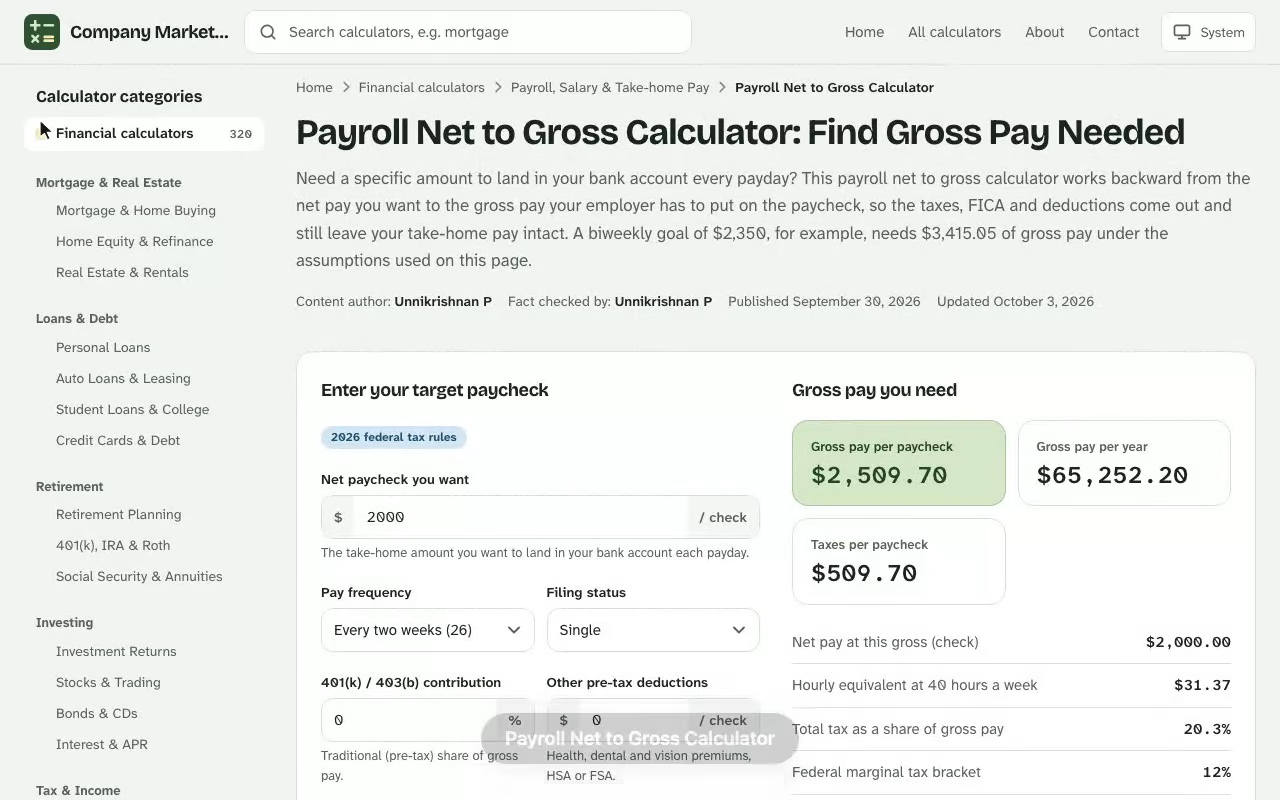
Payroll Net to Gross Calculator. Need a specific amount to land in your bank account every payday? This payroll net to gross calculator works backward from the net pay you want to the gross pay your employer has to put on the paycheck, so the taxes, FICA and deductions come out and still leave your take-home pay intact. A biweekly goal of $2,350, for example, needs $3,415.05 of gross pay under the assumptions used on this page. Try the salary increase calculator to run your own numbers — everything is calculated in your browser and nothing you enter is stored or sent anywhere.
Gross pay you need
Gross pay per paycheck
–
Gross pay per year
–
Taxes per paycheck
–
Net pay at this gross (check)–
Hourly equivalent at 40 hours a week–
Total tax as a share of gross pay–
Federal marginal tax bracket–
Paycheck breakdown
How the gross pay splits into taxes, deductions and your target net pay. Federal tax is the estimated 2026 annual liability spread evenly over the year, so your employer’s withholding may differ slightly.
Item
Per paycheck
Per year
Results are estimates for educational purposes and are not financial, tax or legal advice.
Gross Pay vs Net Pay on Your Paycheck
Gross pay is everything an employee earns in a pay period before a single tax or deduction is removed. Net pay is what is left after the employer applies tax withholding, benefit deductions and any court-ordered amounts, which is why a paycheck always arrives smaller than the salary stated in an offer letter. Net income is the same idea viewed from the employee's side: the money you can actually spend or save. Pair this with the retirement paycheck calculator for a fuller picture before you make a decision.
See how the Payroll Net to Gross Calculator works: change the inputs and the gross pay per paycheck updates instantly. Enter your own numbers in the calculator above.
A standard gross-to-net calculation moves forward, from earnings to take-home pay. The reverse direction is the gross-up: you start with the net amount you need and solve for the gross amount that produces it. Because income tax rates climb as pay rises, the answer is never a simple percentage markup, and that is what makes a dedicated calculator useful.
Why the reverse calculation matters
Employers use a gross-up when they promise a net wage, such as a relocation payment or a one-time bonus that must arrive after tax. Employees use the same math to test a job offer or to see what raise would be required to bring home a fixed monthly budget, and new employees often use it to check how much take home pay an offer really delivers. In both cases the earnings figure on the pay stub has to be larger than the targeted net pay, and the extra is the tax amount plus every deduction that comes out before the deposit.
Payroll Net to Gross Calculator Formula
Every net-to-gross result rests on one identity: net pay equals gross pay minus every deduction and tax, and each of those items depends on the gross figure itself. The relationship looks like this: If you want to see how the figures change, the payroll deductions comparison calculator online gives you an instant result you can adjust as you go.
Since the tax terms grow with gross pay, the calculator solves for the gross amount by repeated guessing until the net result matches your target. Two helpful shortcuts follow from the same logic. The first converts an annual salary into a per-period figure, and the second shows how much of each dollar of earnings you keep:
$$\text{Gross per period} = \frac{\text{Annual salary}}{\text{Pay periods per year}}$$
A flat percentage tax is the one case where the reverse is easy: dividing the net amount by one minus the rate gives the gross amount directly. Real payroll taxes are layered, so the repeated-guess method is the dependable approach.
Gross Up Payroll Calculator Inputs You Need
A gross up payroll calculator only needs a handful of facts, and each one changes the answer. Gather these before you begin:
Desired net pay per pay period, the number you want to see deposited.
Pay frequency, meaning weekly, bi-weekly, semi-monthly or monthly.
Filing status from your W-4: single, married filing jointly or head of household.
State income tax rate, plus any local taxes that apply where you work.
Pre-tax deductions such as 401(k) contributions and health insurance premiums.
Post-tax deductions such as union dues, wage garnishments or Roth contributions.
Hourly workers can first turn their wage into a per-period figure by multiplying the hourly rate by scheduled hours, then treat the result the way a salaried person treats a regular paycheck.
Taxes and Withholding in a Gross Pay Estimate
Federal taxes, state taxes and local taxes are all withheld from the same earnings, but each follows its own rules. The employer reads your W-4 to learn your filing status and dependents, then applies the current tax brackets to your annualized wages. Any pre-tax deduction lowers the base before the federal income tax is figured, which is why a 401(k) contribution reduces your tax bill while leaving the paycheck smaller by less than the contribution.
Federal income tax and tax brackets
The IRS taxes income in layers. For a single filer in 2026, the first $12,400 of taxable income is taxed at 10%, the next slice up to $50,400 at 12%, and the slice up to $105,700 at 22%. A standard deduction of $16,100 comes off before the bracket math starts. Because each extra dollar of gross pay lands in a higher layer, a bigger net target needs proportionally more gross. The tax bracket that applies to your last dollar is your marginal rate, and the effective tax rate across the whole paycheck is always lower than it.
State income tax and local taxes
Some states charge no wage tax, others use a flat rate, and others use brackets of their own. Local taxes, including city levies, are added on top in certain areas. Entering the right state income tax rate is one of the largest levers on the answer, as the heat map below shows.
Gross pay required per biweekly period for four take-home targets under three state income tax rates, with the $2,350 worked example highlighted.
FICA: Social Security and Medicare Taxes
FICA is a two-part payroll tax. Social Security takes 6.2% of wages up to a wage base limit of $184,500 for 2026, after which the tax stops for the rest of the year. Medicare takes 1.45% of every dollar with no cap, and an additional Medicare tax of 0.9% applies to earnings above $200,000. The employee pays that surtax alone, while the employer matches the regular 7.65%.
Employer-side payroll taxes, such as SUTA and FUTA unemployment tax, do not come out of your check, so they are left out of the gross-up itself and sit on top of whatever gross figure the calculator returns.
Pre-Tax Deductions and Post-Tax Deductions
The order of deductions changes the math. Pre-tax deductions come out before income tax is calculated, so they shrink your taxable earnings. Post-tax deductions come out afterward and have no tax benefit. Typical examples include:
Pre-tax: health insurance, a health savings account, a flexible spending account, retirement contributions to a 401(k), short-term disability and paid family medical leave premiums.
Post-tax: Roth contributions, union dues, charitable payroll giving and child support or other wage garnishments.
Health insurance premiums usually avoid FICA as well, while traditional 401(k) deferrals do not. Both details are built into the worked example below. Because the benefits election you made at hiring sets these deductions, and each of those benefits is a separate line on the pay stub, any change to it changes the gross pay needed for the same net pay, so employees who enroll mid-year should rerun the calculation before the next paycheck.
Worked Example: Take-Home Pay of $2,350 Biweekly
Suppose you are paid every two weeks, file as single, live in a state that withholds a flat 4.25%, contribute 6% of gross to a 401(k) and pay $145 per paycheck for health insurance. You want $2,350 in net pay each period. Solving backward gives a gross amount of $3,415.05 per period, or $88,791.20 as an annual salary across 26 pay periods.
Line item
Per pay period
Gross pay
$3,415.05
401(k) contribution (6%)
$204.90
Health insurance premium
$145.00
Federal income tax
$334.72
Social Security (6.2%)
$202.74
Medicare (1.45%)
$47.42
State income tax (4.25%)
$130.27
Net pay
$2,350.00
Deductions and taxes total $1,065.05, so you keep about 68.8% of every gross dollar. The first graphic below follows that trip from the gross amount down to the deposit.
How $3,415.05 of gross pay becomes $2,350.00 of take-home pay on a biweekly paycheck.
What changes when the target rises
Running the net to gross math at several goals shows that each extra net dollar needs a growing amount of extra gross. The share you keep falls as the target climbs. Under the same assumptions, a $2,000 net goal needs $2,851.21 gross, so 29.9% goes to deductions and taxes, while a $3,200 goal needs $4,793.24 gross and loses 33.2%. The second graphic compares the three paycheck compositions side by side.
What each gross paycheck is made of at three net pay targets.
Testing a Job Offer Against a $2,615 Net Wage Goal
Marcus Ibarra has an offer of $84,500 a year, paid semi-monthly, and his mortgage plus childcare means $2,615.00 has to land in his account twice a month. The offer letter only states gross salary, so he works backward instead of guessing.
He enters $2,615.00 as the desired net amount, picks 24 pay periods, chooses single filing status, and adds a 4% 401(k) deferral, a $118.00 health premium and his state's 3.15% flat income tax. The reverse calculation returns $3,623.31 of gross pay per paycheck, about $86,959 a year.
Item
Per paycheck
Offer, $84,500 over 24 periods
$3,520.83
Gross needed for $2,615.00 net
$3,623.31
Shortfall
$102.48
Marcus checks the output against a named line: his projected taxable income of roughly $64,549 sits in the 22% federal bracket, which starts above $50,400 for a single filer in 2026, so each extra raise dollar loses 22 cents to federal tax before FICA and state tax. That explains why the gap he must close is $2,459.52 a year, not just the $102.48 shortfall times a flat markup.
His next step is specific. He reruns the same inputs with a $87,000 salary, sees $3,625.00 per period clear his $3,623.31 requirement, and sends a counteroffer at $87,000, not $85,000, since a smaller ask would still leave his deposit short of $2,615.00.
Net Income by Pay Frequency: Weekly, Bi-Weekly, Semi-Monthly and Monthly
Pay frequency decides how an annual salary is cut into checks. Divide the yearly amount by the number of pay periods: 52 for weekly, 26 for bi-weekly, 24 for semi-monthly and 12 for monthly. Bi-weekly means every other week, so it produces 26 checks, whereas semi-monthly means twice a month on fixed dates and produces 24.
Pay frequency
Pay periods per year
Gross per period on $88,791.20
Weekly
52
$1,707.52
Bi-weekly
26
$3,415.05
Semi-monthly
24
$3,699.63
Monthly
12
$7,399.27
Switching the schedule does not change what you earn over the year, only how each paycheck looks. In a year with a third bi-weekly payday in one month, you get two extra checks without any raise, which is worth planning around when you budget.
Filing Status, Dependents and Your W-4
Your W-4 tells the employer how much federal income tax to hold back. A change in filing status moves the brackets, so the same net goal needs a different gross amount. For the $2,350 biweekly example, a single filer needs $3,415.05, a head of household filer $3,285.64, and a married filing jointly filer $3,225.68 under the same state, 401(k) and insurance assumptions. Claiming dependents or entering extra withholding adjusts the result further.
Bonus Gross-Up and Supplemental Wage Rate
A bonus is usually taxed at the flat supplemental wage rate, 22% for federal withholding on amounts under $1 million, rather than through the regular brackets. If an employer promises a $1,000 bonus after tax, it must gross the payment up so that the withholding is covered. Reimbursement of moving costs follows the same logic when the benefit is taxable. A gross-up like this also shows up in severance packages. The formula is gross = net ÷ (1 − 0.22 − 0.0765 − state rate), so a $1,000 after-tax bonus with a 4.25% state rate needs about $1,512.86 of gross, and you can enter those same rates into the calculator to confirm it.
Gross Pay and Labor Costs for Employers: Hiring and Compliance
For employers, the grossed-up figure this calculator returns is the starting point for the real cost of an employee, because matching FICA and unemployment tax sit on top and leaving them out distorts labor costs in a hiring plan. Accurate gross-to-net math also supports compliance, since underwithheld payroll taxes are a liability that the IRS expects the business to cover. Employees, for their part, benefit when the compensation package, including its benefits, is explained in terms of both gross earnings and the net result.
Net Salary vs Gross Salary: Reading a Pay Stub
A pay stub lists the pay period dates, hours, gross pay, each tax, each benefit deduction, net pay and year-to-date totals, often with a paid time off balance as well. Compare your net salary to the amount in your bank, then compare gross salary to the number in your offer. If a figure does not match your estimate, check withholding first, since small W-4 differences make the biggest gap.
Don't confuse this with price math, where a net price excludes sales tax or VAT and the gross price includes it. Payroll runs the opposite way, because tax is subtracted from gross pay rather than added to a net price.
Tips for Accurate Paycheck Calculator Results
Start from the net amount that you must have, not a rounded wish.
Enter the pre-tax and post-tax deductions from your latest pay stub.
Use the state rate for where you work, not where you live, unless local rules differ.
Treat the result as an estimate and compare it to your actual first paycheck.
Re-run the numbers after any raise, a W-4 change or a new benefits election.
If you only have a take-home goal, any payroll calculator or paycheck calculator that runs forward can be used by trial and error, but a reverse tool gets there in one step.
Payroll Net to Gross Calculator questions
What does a payroll net to gross calculator do?
It works backward from the take-home amount you want to the gross pay your employer must put on the paycheck, after federal income tax, Social Security, Medicare, state tax and your deductions are removed.
What is the difference between gross pay and net pay?
Gross pay is total earnings before any tax or deduction. Net pay, also called take-home pay, is what remains after withholding, benefit deductions and other amounts come out.
Why is the gross-up more than a simple percentage markup?
Income tax is applied in brackets, and each extra gross dollar can fall into a higher bracket. Only a flat percentage tax can be reversed with one division, so the calculator solves the layered taxes numerically.
How do pre-tax and post-tax deductions change the result?
Pre-tax deductions such as a 401(k) or health premium lower taxable wages, so they reduce income tax. Post-tax deductions such as Roth contributions or garnishments reduce net pay without any tax benefit, so you need more gross pay to cover them.
Does pay frequency change the gross pay I need?
The per-paycheck figure changes because the annual amount is split into 52, 26, 24 or 12 pay periods. Per-period deductions such as a health premium are also repeated a different number of times per year.
How is a bonus grossed up?
Bonuses are usually withheld at the flat 22% federal supplemental rate plus FICA and state tax. Use the flat percentage mode with the combined rate on the gross amount to estimate the gross bonus needed for a target after-tax payment.
Is the calculator result exact?
No. It uses a simplified annualized withholding method with 2026 federal brackets, a flat state rate and no local taxes, so treat the result as an estimate and compare it with your first real paycheck.
What is the Social Security wage base limit?
For 2026 Social Security tax of 6.2% stops once your wages reach $184,500 for the year, while Medicare tax of 1.45% has no cap and an additional 0.9% applies above $200,000.