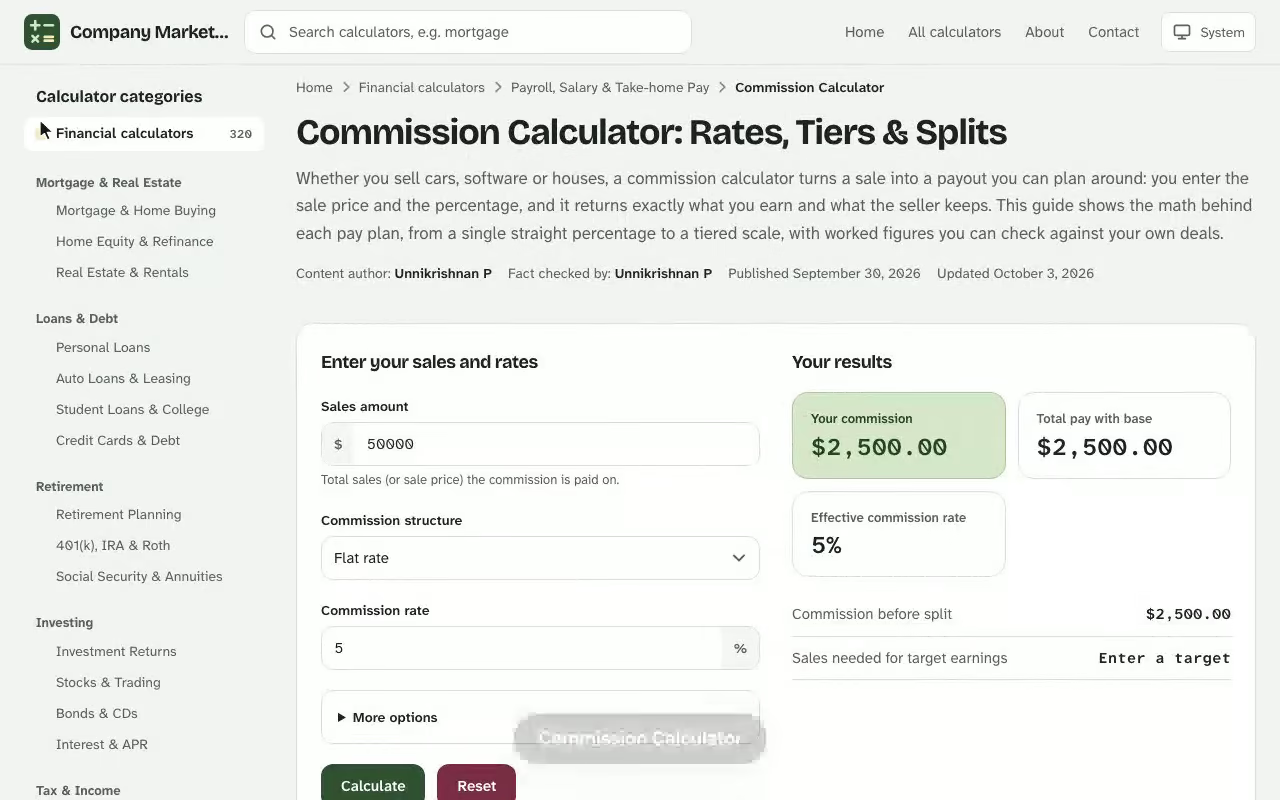
Commission Calculator. Whether you sell cars, software or houses, a commission calculator turns a sale into a payout you can plan around: you enter the sale price and the percentage, and it returns exactly what you earn and what the seller keeps. This guide shows the math behind each pay plan, from a single straight percentage to a tiered scale, with worked figures you can check against your own deals. The salary increase calculator uses the same plain-English approach, so you can compare results side by side.
Your results
Your commission
–
Total pay with base
–
Effective commission rate
–
Commission before split–
Sales needed for target earnings–
Commission by tier
How much of the sale falls in each tier and what it earns, before any split.
Tier
Sales range
Rate
Sales counted
Commission
Results are estimates for educational purposes and are not financial, tax or legal advice.
How the Commission Calculator Works
At its core, a commission is percentage-based remuneration: a share of the revenue a salesperson brings in. The tool needs only two of three values to find the third, which is why you can solve for the commission amount, the sales price or the rate. Every other plan in this article is a variation on that single relationship. Pair this with the free hourly paycheck calculator for a fuller picture before you make a decision.
The basic formula
Multiply the sale price by the commission rate and divide by 100:
$$C = P \times \frac{r}{100}$$
Here \(C\) is the commission amount, \(P\) is the sale price and \(r\) is the commission percentage. A $36,750 sale at 7.2% pays \(36{,}750 \times 0.072 = \$2{,}646\). The same equation rearranges to find the rate when you already know both dollar figures: \(r = C \div P \times 100\).
Inputs and results at a glance
Sale price: the final amount the buyer pays for the product or service.
Commission percentage: the share agreed in your pay plan, such as 2.75% or 8.5%.
Commission amount: the payout, which equals the sale price times the rate.
Seller receives: what remains of the sale after the salesperson is paid.
Commission Rate Calculator: Solving for Any Missing Value
Used as a commission rate calculator, the same three values work in any direction. If you earned $2,646 on a $36,750 sale, then \(2{,}646 \div 36{,}750 \times 100 = 7.2\%\). If you know the rate and the payout, divide the payout by the rate to recover the sales price: \(2{,}646 \div 0.072 = \$36{,}750\). Try the retirement paycheck calculator to run your own numbers — everything is calculated in your browser and nothing you enter is stored or sent anywhere.
Who pays: seller or buyer
In most deals the seller covers the cost, so the real revenue the business keeps is the sale price minus the commission. On a $18,400 item with an 8.5% commission, that is \(18{,}400 - 1{,}564 = \$16{,}836\). When the buyer covers it, the price with commission is the base plus a percentage increase: \(18{,}400 + 1{,}564 = \$19{,}964\).
Typical commission and the average commission rate
A typical commission depends on what is sold. The average commission rate is lower on high-value goods and higher on services, where overheads are smaller. Treat any published average as a starting point and rely on the commission percentage written into your own agreement. Many small businesses pay a flat rate because it is easy to explain and easy to audit, while larger teams tend to layer quotas and tiers on top once they have enough history to know where the thresholds should sit. Whichever you use, confirm in writing whether the percentage applies to the invoice total, the amount collected or the margin, because that single definition changes the payout more than any rounding rule will.
Sales Commission Calculator Plans: Salary, Quotas and Bonuses
A calculator for sales pay has to cope with more than one pay plan, because employers mix variable pay with fixed pay in different ways. Each commission structure rewards a different behavior, so choose the one that matches how you are paid.
Commission structure
How you are paid
Best suited to
Commission only
Sale price times commission rate, nothing else
Independent agents, high-margin sales
Base salary plus commission
Fixed salary plus a percentage of sales
Retail, auto and inside sales teams
Quota-based
Higher rate once revenue passes a quota
Account executives with monthly targets
Tiered commission
Rate rises as total sales cross each threshold
Teams that want to motivate stretch goals
Commission only versus base salary plus commission
Under commission only, you earn nothing without a sale, which strongly motivates effort but offers no security. With base salary plus commission, a modest fixed income arrives regardless of results. A rep with a $1,800 base salary who sells $41,250 at 3.4% earns \(1{,}800 + 41{,}250 \times 0.034 = \$3{,}202.50\). Compared with hourly pay, this variable pay swings with every month, so budget around the base.
Quota, attainment and the commission rate over quota
Many plans measure attainment, the share of a quota you have reached. Suppose your quota is $90,000, the rate is 5% up to quota, and the commission rate over quota is 8%. On $118,000 of revenue you earn \(90{,}000 \times 0.05 + 28{,}000 \times 0.08 = \$6{,}740\). Some employers add overrides for managers, a draw against future earnings, or a rate lookup table that picks the percentage from a revenue range.
Tiered Commission Calculator for Sliding Scale Plans
This kind of tool applies a different rate to each slice of your sales. This is a sliding scale: crossing a threshold lifts the rate only on the dollars above it, not on everything you sold. That detail is the most common source of overpaid estimates.
Worked tiered commission example
Assume a salesperson closes $63,400 in a month under these tiers:
The blended result of 5.69% sits well below the top 9% rate, which shows why the headline rate in a plan is never your true percentage.
Prorated deals that cross a threshold
When a single sale pushes you into the next tier, the payout is prorated: only the part of the deal above the threshold earns the higher rate. Enter your sales to date first, then the new deal, so the calculator splits it at the right point.
Real Estate Commission Calculator: From Gross Commission to Agent Net
This version adds a second layer, because the gross commission on a home sale is shared. First the listing price sets the total commission, then the brokerage and agent divide it, and finally fees come off the agent's side.
Standard commission split
Consider a house that sells for $386,500 with a 2.75% commission. The total commission is \(386{,}500 \times 0.0275 = \$10{,}628.75\). With a 65/35 commission split in the agent's favor, the figures work out as follows:
Line item
Amount
Gross commission (2.75% of $386,500)
$10,628.75
Agent share (65%)
$6,908.69
Brokerage collects (35%)
$3,720.06
Less agent fees
$245.00
Agent net
$6,663.69
See how the Commission Calculator works: change the inputs and the your commission updates instantly. Enter your own numbers in the calculator above.
These last two lines are the net payables a broker needs for payday. A commission split calculator returns both at once, so no one has to rebuild the arithmetic by hand.
Reading a real estate agent commission calculator result
The tool reports two numbers worth separating: what the office keeps and what lands in the agent's account. Compare the agent net line with your expected paycheck, since a split commission can look generous until fees come off the top.
Referral fees and franchise fees
Not every deduction is the same. Referral fees go to whoever sent you the client, and franchise fees go to the brand that licenses the office. Subtract them from the net commission before you spend the check, because the brokerage split applies to the gross figure while these charges often hit afterward.
Flat fee and team arrangements
Some agents pay a flat fee per transaction instead of a percentage cut, which favors high earners. When teams share a listing, divide by the number of agents to get the commission per agent, then apply each person's own agent commission rate. Buyer-side and seller-side agents commonly divide the total commission evenly, but always check the written agreement.
Who pays the real estate commission
In a typical real estate transaction the seller pays the total commission out of the proceeds at closing, and the listing brokerage then shares part of it with the buyer's broker. The buyer does not write a separate check, although the price they agree to already reflects that cost. Because real estate commissions are negotiable, the calculator lets a seller see what each half point is worth: on a $386,500 sale, every 0.5% moves the total commission by $1,932.50.
The split is where the calculator earns its keep for a salesperson in real estate. Run the same $386,500 sale at a 65/35 split with $245 in agent fees and the agent net is $6,663.69. Run it at a 90/10 split with a $1,500 desk fee and the agent net becomes \(9{,}565.88 - 1{,}500 = \$8{,}065.88\), but only if the higher fee fits your volume. Entering both plans lets you compare compensation in dollars rather than in percentages alone.
Tracking a Realtor Commission Calculator Payout on a $412,800 Listing
Marguerite Okafor, a listing agent, needs to know what she can spend before a four-bedroom home goes under contract at $412,800. The listing agreement sets a 2.6% commission, her brokerage keeps 30% under its standard split, and she has a $7,400 take-home target for the month to cover a car repair and her licensing renewal. As a working realtor, she opens the tool and enters the price, the percentage and the split.
The commission calculation starts with the gross figure: \(412{,}800 \times 0.026 = \$10{,}732.80\), the same number that will appear on the commission line of the Closing Disclosure. Her 70% share is \(\$7{,}512.96\), and the office's $310 transaction fee leaves an agent net of $7,202.96. Against her $7,400 target, that is $197.04 short, so the result is not a pass.
The shortfall points to one specific lever. Her seller had floated 2.8% in the earlier conversation, so she reruns the numbers with only the percentage changed. Gross commission becomes $11,558.40, her share is $8,090.88, and after the same fee she keeps $7,780.88, which clears the target by $380.88. Nothing else about the deal moved: same price, same split, same fee.
She does not promise the seller anything. Instead she prints both scenarios and brings them to the listing appointment, showing in dollars that the extra 0.2% costs the seller $825.60 at closing while changing her month. The seller picks 2.7%, which she tests in a third run: $7,491.92 after fees, still above target.
Commission Structure Comparison: Which Plan Pays More
The same sales volume pays differently under each commission structure, and the right plan depends on how much risk you can carry. Take a rep who sells $52,500 in a month. Under commission only at 6.5%, the payout is $3,412.50. Under a base salary of $2,200 plus 2.25%, the compensation is $2,200 plus $1,181.25, or $3,381.25, nearly identical but far steadier. If the same rep has a slow month at $20,000, the commission-only plan pays $1,300 while the salaried plan still pays $2,650.
That gap is the real cost of risk. A plan that leans on variable pay can lift your earnings in strong months, and a salary floor protects your income in weak ones. Employers use these differences to motivate the behavior they need: new accounts, bigger deals or repeat business. Before accepting an offer, run your own realistic and worst-case sales figures through each plan, and judge it on the lower number as much as the higher one. Where the plan pays on profit rather than on revenue, ask how profit is defined, since discounts and returns can shrink the base your percentage applies to. Compensation tied to a team result adds another layer, so check whether your share is individual or pooled.
Using an Online Commission Calculator Accurately
A calculator only returns what you give it, so a few habits protect the result. Follow these steps every time:
Confirm whether the sale price is gross or net of discounts and taxes.
Enter the commission percentage exactly as the agreement states it.
Choose the plan type: straight percentage, base plus commission, quota or tiered.
Add any fees or draw balances that reduce your payment.
Click calculate and compare the payout to your own records.
Common mistakes to avoid
The biggest error is applying a top-tier rate to every dollar. If the blended rate in the results is far below the top tier rate you typed in, the calculator is correctly paying each slice at its own rate. Another is forgetting that a commission can be reduced when discounts are granted, so enter the discounted sale price, not the list price. A third is mixing up a straight percentage of sales with a percentage of profit, because the two plans pay very differently: if your plan pays on profit, type the profit figure into the sale price field.
Reading Your Commission Calculator Results
Once you click calculate, read the results from the top down. The commission amount is your payout before any deductions. The seller receives line shows the sale price minus that payout, and the price with commission line shows the total if the buyer covers it instead. The effective rate is the commission amount divided by the sale price, so on a tiered plan it tells you how far your blended percentage sits below the top rate.
For a split, compare the agent share with the agent net: the gap is the agent fees. Divide the payout by the hours the deal took to see an effective rate against hourly pay, then change one input at a time, such as the commission percentage or a tier limit, to see how incentive compensation built as pay-for-performance responds. Treat the figure as an estimate until payroll confirms it, since clawbacks and timing can shift the final earnings.
Commission Calculator questions
How do you calculate commission?
Multiply the sale price by the commission rate and divide by 100. A $48,500 sale at 6.5% pays $3,152.50. To find the rate instead, divide the commission by the sale price and multiply by 100.
What is a typical commission?
It depends on what is sold. Physical goods usually carry lower percentages than services, and real estate commissions are usually quoted as a share of the home's sale price. Always rely on the rate written in your own pay plan.
How does a tiered commission work?
Each slice of your sales earns its own rate. Crossing a tier threshold raises the rate only on the dollars above it, not on your whole total, so your blended rate always sits below the top tier rate.
What is base salary plus commission?
It is a pay plan with a fixed base amount plus a percentage of sales. Enter the base in the base commission field and the calculator adds it to the percentage-based commission.
Who pays the commission, the seller or the buyer?
Usually the seller pays, so the seller receives the sale price minus the commission. If the buyer covers it, the price with commission is the sale price plus the commission. Both results are shown.
How is a real estate commission split between agents and brokerage?
The brokerage collects the total commission, then pays the agent an agreed share, such as 65 or 70 percent. Enter that share as the agent commission rate and any agent fees to see the agent net.
What is a commission rate over quota?
Some plans pay a higher percentage on sales above a quota. Enter the quota and the rate over quota with the flat plan, and the calculator pays the base rate up to quota and the higher rate beyond it.
Are commission rates negotiable?
Often yes, especially in real estate and high-value sales. Run the numbers at two or three rates to see what each half point is worth in dollars before you agree.