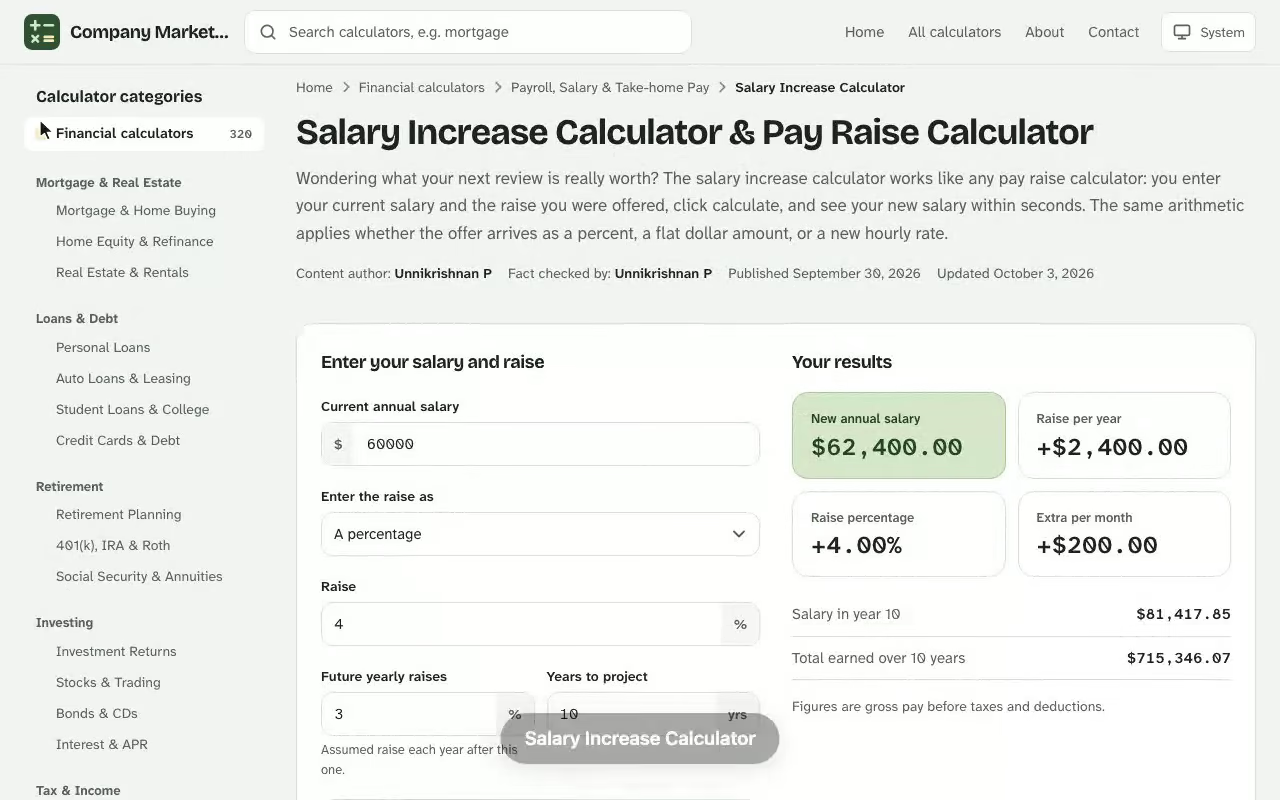
Salary Increase Calculator. Wondering what your next review is really worth? The salary increase calculator works like any pay raise calculator: you enter your current salary and the raise you were offered, click calculate, and see your new salary within seconds. The same arithmetic applies whether the offer arrives as a percent, a flat dollar amount, or a new hourly rate. Pair this with the free salary calculator for a fuller picture before you make a decision.
Your results
New annual salary
–
Raise per year
–
Raise percentage
–
Extra per month
–
Salary in the last projected year–
Total earned over the projection–
Figures are gross pay before taxes and deductions.
Pay before and after the raise
Your gross pay for each pay period, before and after the increase.
Pay period
Before
After
Change
Salary projection
Year 1 is the new salary; later years add the future yearly raise.
Year
Salary
In today’s dollars
Total earned
Results are estimates for educational purposes and are not financial, tax or legal advice.
How the Salary Increase Calculator Works
An online pay raise calculator needs very little from you. Tell it what you earn today, choose how the raise is expressed, and it fills in everything else: the extra money, the revised figure, and the percent change. Most versions also restate the result across several pay periods, so you can compare a yearly total with the amount that actually lands in your account. If you want to see how the figures change, the life insurance calculator online gives you an instant result you can adjust as you go.
Choose your pay rate type, either per hour or per year.
Enter the current salary and, if you are paid by the hour, your hours per week; 40 is the common default.
Pick the type of increase: a percent, a flat rate increase, or a target figure.
Press the button to see the increase amount and the result for each pay period.
Only know the dollar offer? Type it in as the raise value and let the tool work backward to the rate.
Salary increase percentage calculator inputs
The simplest salary increase percentage calculator asks for two items, the amount you are paid today and the rate of the raise. Everything else is derived from them. Both inputs are pre-withholding amounts, so treat the output as a pre-withholding estimate.
The Pay Raise Formula Behind Every Result
The math is one multiplication. Turn the rate into decimal form by dividing by 100, multiply the old figure by it, and add the product back. A quicker route is the multiplier: multiply once by 1 plus the rate. Pair this with the income tax calculator online for a fuller picture before you make a decision.
Because it is a ratio, a 5% change is the same whether you apply it to a per-hour figure, a week, a month, or a year. That is why the percent can be entered against whichever period you know best.
Salary increase percent calculator for two known amounts
Here a salary increase percent calculator is just the second formula. Imagine your current salary is $67,350 and a rival employer quotes $72,000. The gap is $4,650, and $4,650 ÷ $67,350 gives a percentage increase of about 6.90%. That is the number to weigh against any counter-proposal. If you would rather start from a target, a percentage calculator for salary can solve for the missing input directly.
Worked Example: A 5.5% Pay Raise on $67,350
Suppose a full-time worker earning $67,350 a year is offered a 5.5% raise. Multiply $67,350 by 0.055 and you get $3,704.25, so the yearly total becomes $71,054.25. The table restates that outcome in every period, assuming a 40-hour workweek and a standard working year. Pair this with the free civilian to military pay calculator for a fuller picture before you make a decision.
Pay period
Before the raise
Raise
After the raise
Hourly
$32.38
$1.78
$34.16
Weekly
$1,295.19
$71.24
$1,366.43
Bi-weekly
$2,590.38
$142.47
$2,732.86
Semi-monthly
$2,806.25
$154.34
$2,960.59
Monthly
$5,612.50
$308.69
$5,921.19
Quarterly
$16,837.50
$926.06
$17,763.56
Annual salary
$67,350.00
$3,704.25
$71,054.25
Key insight: the same 5.5% shows in every row, yet the dollar gain looks very different depending on the period you read it in.
The 5.5% raise adds $3,704.25 to the $67,350 starting salary.
How each result is converted
The tool derives every row by dividing the yearly total by the number of periods in a year: 2,080 time slots, 52 weeks, 26 fortnights, 24 half-months, 12 months or 4 quarters. Seeing the figure per check makes an offer feel concrete before you accept it, and it turns a vague $3,704.25 into roughly $142 more every other Friday. Your monthly salary rises from $5,612.50 to $5,921.19, which is how this pay raise appears on a monthly statement.
Choosing Pay Raise Calculator Inputs for Hourly or Annual Work
The figure you type in shapes how easy the answer is to read. If you are salaried, the yearly number is the cleanest starting point. If your shifts vary, begin with the rate per hour and add your weekly schedule; the tool will convert it into every other period for you. Whichever you pick, the results should agree once converted, because a percent change does not depend on the period.
Salaried staff: enter the annual figure and read the monthly or per-check result.
Staff paid per hour: enter the rate plus schedule, and remember that overtime is not part of the base.
Comparing offers: enter each employer's figure as the "new" amount and compare the resulting rates.
Before you press calculate, try a quick mental check: multiply the old figure by 1 plus the raise percentage (1.055 for 5.5%) and see whether your estimate lands near the tool's answer. If the two are far apart, one input is probably in the wrong period.
Common mistakes when you calculate an increase
The first slip is mixing a rate with a flat amount, for example typing 3,000 into a percent box. The second is entering take-home money where the tool expects the full figure, which understates the new pay. The third is assuming a raise and a cut of the same size cancel out: a 10% bump followed by a 10% cut leaves you 1% behind where you started, because the cut applies to a larger base.
A repeating annual raise deserves its own check. Three years of 3% do not add to 9%; they compound to about 9.27%, so enter each year's rate in the calculator separately, as a pay rise amount calculator does, to see the compounded total. The projection table later on this page shows the same effect.
Finally, an increase in salary is a gross figure in the calculator, so read the paycheck section below before adjusting your monthly budget.
See how the Salary Increase Calculator works: change the inputs and the new annual salary updates instantly. Enter your own numbers in the calculator above.
When you discuss the result with others, quote the percentage increase the calculator reports rather than the dollar gap. A 5.5% percentage increase means the same thing whatever your base, whereas a dollar difference depends on each person's starting point.
Pay Raise Calculator Example: Checking Against a Landlord's Income Rule
Marisol Quinn is renewing a lease on a $1,900 apartment, and the property manager requires verified earnings of at least three times the rent. That works out to $5,700 a month, or $68,400 a year. Her current pay is $64,180, and her manager has just offered a 4.8% raise at the next review.
She opens the salary increase calculator, types 64,180 as the current figure, selects the percentage option and enters 4.8. The result comes back at once: an increase of $3,080.64, bringing the new total to $67,260.64, or $5,605.05 a month.
That lands $1,139.36 a year short of the $68,400 line, so the offer alone will not clear the rule. Marisol reruns the tool backward, entering $68,400 as the target figure instead. It reports the rate she would need: 6.58%, a gap of $4,220 above today's pay.
Offered: 4.8%, which is $67,260.64 a year.
Required: 6.58%, which is $68,400.00 a year.
Shortfall at the offer: $1,139.36 a year, or about $94.95 a month.
With those figures in hand, her next step is specific. She asks for a 6.6% adjustment, which works out to $68,415.88, just over the threshold, and mentions the lease requirement as the reason for the number. If the company holds at 4.8%, she knows to ask the landlord about a co-signer or a larger deposit before the renewal deadline, instead of finding out at signing.
Pay Rise and Salary Raise: What Drives the Number
A pay rise in the UK and a raise in the US mean the same thing, and either may reflect a different driver. Employers usually settle on a wage increase by weighing a few signals:
Length of service: some firms adjust pay every year or every two years.
Performance: an annual review rewards results.
Merit and promotion: new skills or a bigger role.
Cost of living: pay that follows rising prices.
Minimum wage: legal changes lift the floor for everyone.
Whatever the driver, the calculator takes the offered rate as its input, and knowing which driver applies helps you judge whether that rate is typical. A cost-of-living adjustment tends to be modest and uniform, while a promotion can move pay much further.
Does the increase keep up with rising prices?
Compare the rate with price growth. If prices climb 3.2% while your earnings climb 5.5%, buying power improves by 1.055 ÷ 1.032 − 1, or roughly 2.23%. Merely holding even at 3.2% would have required only $2,155.20 more. A raise smaller than inflation is effectively a pay cut, and a salary inflation calculator makes the comparison automatic.
Salary Increase Effects on Your Paycheck
The result is gross, so the take-home paycheck grows by less. The extra amount may land in a higher bracket, and deductions such as national insurance, payroll tax and retirement contributions each take a share. To see net pay, run the new figure through a gross to net tool before making commitments that depend on it.
Raises also stack. These projected yearly totals assume a constant rate of 3.5% starting from $67,350:
Year
Salary at 3.5% a year
Gain over today
1
$69,707.25
$2,357.25
2
$72,147.00
$4,797.00
3
$74,672.15
$7,322.15
5
$79,990.67
$12,640.67
Five years of steady 3.5% raises lift the same salary by $12,640.67.
Your future salary after five years is almost $12,641 higher, which shows why the first raise matters beyond a single year. An annual rate that repeats beats one large bump followed by nothing.
Use the result for planning and negotiation
For budgeting, split the extra income into categories you already track, so the extra does not vanish into spending; sending part of it to savings is the simplest habit. Many people also fold it into financial planning, such as a debt payoff schedule or a house fund, because these financial decisions depend on knowing the exact raise amount.
For salary negotiations, bring numbers. A request framed as a precise rate, backed by results, is easier for a boss to approve than a vague hope, and a calculator gives fair compensation a concrete benchmark. You can negotiate with confidence once you know what each point is worth, and a job offer from a new job becomes a plain comparison of two outputs, plus any additional benefits it carries. An employee who earns more should still check earnings against spending, because the raise amount and rate the tool reports matter most when they support the goals behind your happiness.
Salary Increase Calculator questions
How do I calculate a salary increase?
Convert the raise percentage to a decimal, multiply it by your current salary, and add the result to the current salary. Equivalent shortcut: new salary = old salary × (1 + raise rate).
How do I find the raise percentage if I know both salaries?
Subtract the old salary from the new one, divide by the old salary and multiply by 100. Choose New Rate as the raise type and the calculator reports the percentage for you.
Is a 10% annual raise the same as a 10% monthly or hourly raise?
Yes. A percentage raise applies equally to every pay period, so the rate does not change when you convert between hourly, weekly, monthly and annual pay.
Are the results before or after tax?
They are gross figures. Taxes, national insurance and other deductions will make the increase in your take-home paycheck smaller.
What is the difference between a percentage raise and a flat rate increase?
A percentage raise scales with your current pay, while a flat rate increase adds the same amount per pay period regardless of what you earn now.
How do I know whether my raise keeps up with inflation?
Compare the raise percentage with the rate of price growth. If prices rise by 3% and your pay rises by 5%, your buying power improves by roughly 2%.
How do repeated annual raises add up?
They compound. Three yearly 3% raises equal about 9.27%, not 9%, because each raise applies to a larger base. Use the Years to Project field to see the yearly table.
When can I expect a pay raise?
Employers commonly review pay after a set length of service, after a performance review, on promotion, or when the cost of living or the minimum wage changes.