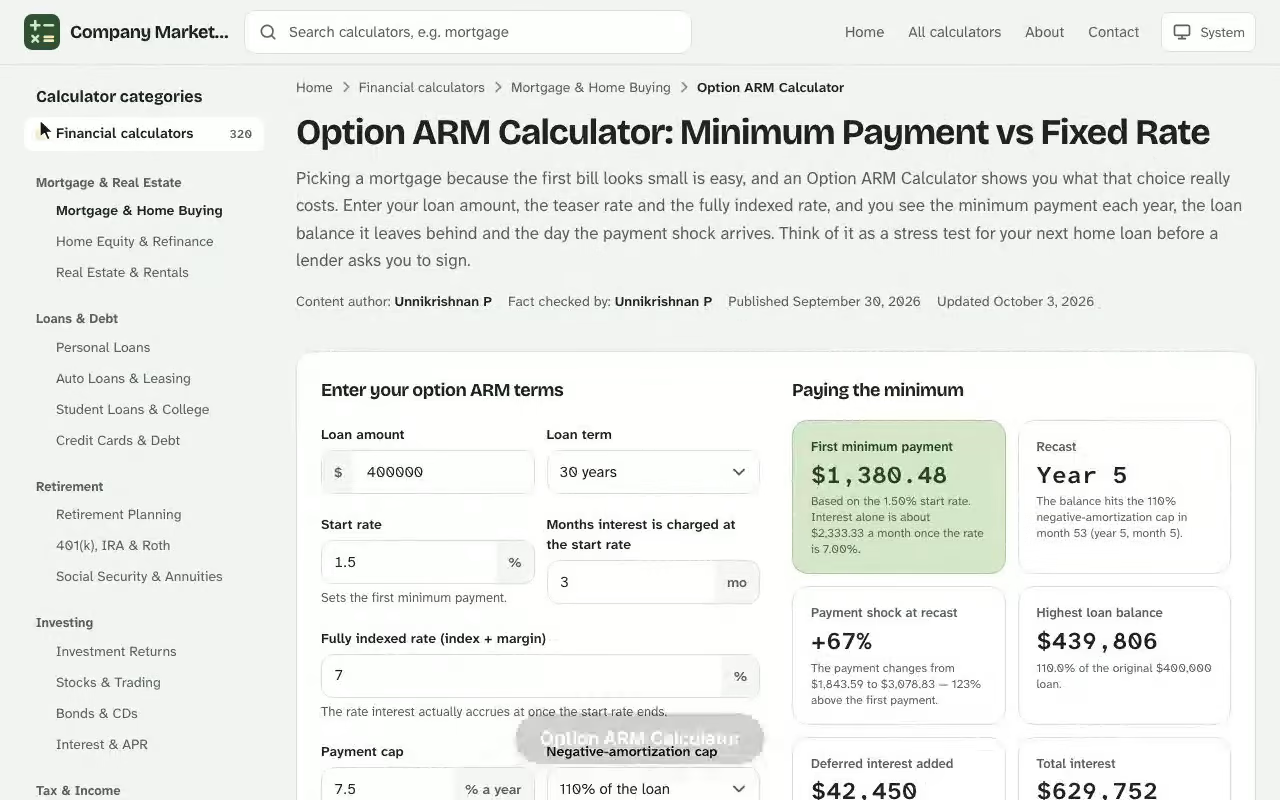
Option ARM Calculator. Picking a mortgage because the first bill looks small is easy, and an Option ARM Calculator shows you what that choice really costs. Enter your loan amount, the teaser rate and the fully indexed rate, and you see the minimum payment each year, the loan balance it leaves behind and the day the payment shock arrives. Think of it as a stress test for your next home loan before a lender asks you to sign. The free amortization calculator uses the same plain-English approach, so you can compare results side by side.
Paying the minimum
First minimum payment
–
Recast
–
Payment shock at recast
–
Highest loan balance
–
Deferred interest added
–
Total interest
–
Figures assume you always make the minimum payment.
Option ARMs are now rare
Since January 10, 2014, the ability-to-repay rule in Regulation Z (12 CFR 1026.43) bars a loan whose payments can increase the principal from being a qualified mortgage, and requires lenders to judge whether you can afford the fully amortizing payment on the largest balance negative amortization could reach, at the fully indexed rate. Few lenders still offer these loans.
Your payment choices each month
Payment option
Monthly payment
Effect on the balance
Minimum, interest-only and full payments compared
If you
First payment
Payment in year 2
Balance before recast
Highest payment
Total interest
Total paid
Year-by-year schedule paying the minimum
The balance grows while the minimum payment is below the interest, until the recast resets the payment to fully amortizing.
Year
Rate
Monthly payment
Paid in the year
Interest charged
Deferred interest
Ending balance
Balance vs loan
Results are estimates for educational purposes and are not financial, tax or legal advice.
How a Pay Option ARM Calculator Works
A pay option ARM calculator models a mortgage whose borrower chooses between several monthly payments. Unlike a standard fixed-rate mortgage, where one payment repays the loan on a set schedule, the payment here is a choice, and that choice decides whether your debt shrinks or grows. The combination mortgage calculator is free to use with no sign-up, and works on desktop and mobile.
The tool needs only a handful of inputs, and each one maps to a line in your loan agreement:
Loan amount and down payment: the money you borrow after your own cash goes in.
Teaser rate and the number of months it lasts: the low initial rate that sets your first minimum monthly payment.
Index and margin: the reference rate the lender tracks plus the lender's own markup, which together form the fully indexed rate.
Payment cap and lifetime cap: how far the payment and the interest rate may climb at each reset and over the life of the loan.
Loan term, usually a 30-year schedule, plus the negative amortization limit.
What the results show
You get the initial monthly payment, the payment in every later year, the balance after each year and a side-by-side comparison against a fully amortizing payment. Seeing all of that in one view is the point of an arm calculator: the first number on a lender's quote is the most flattering one.
Payment-Option ARM Loans: The Four Pick-a-Payment Choices
Payment-option ARM loans are usually 30-year adjustable-rate mortgage contracts that let you pick-a-payment every month. The payment-option ARM typically offers four amounts, and each one treats the principal differently. The arm vs fixed rate calculator online is free to use with no sign-up, and works on desktop and mobile.
Payment choice
What it covers
Effect on your loan balance
Minimum payment
Less than the accrued interest
The unpaid interest is added to the balance
Interest-only payment
Exactly the interest due this month
The balance stays flat
30-year fully amortizing
Interest plus principal over the full term
The balance falls on schedule
15-year fully amortizing
Interest plus principal over half the term
The balance falls fast and builds equity sooner
The cheapest of the four is tempting, and that is where the trouble starts: whenever you send less than the interest charged, the difference is added to what you owe.
Month-1 payment choices on a $338,500 option ARM loan.
Option-ARM Loan Formulas: Minimum Payment and Accrued Interest
An option-ARM loan uses ordinary amortizing math with one twist: the minimum payment is computed from the teaser rate, while interest accrues at the fully indexed rate. The payment on a loan of \(L\) dollars at a monthly rate \(i\) over \(n\) months is:
$$P = L \times \frac{i}{1-(1+i)^{-n}}$$
Each month, the interest that accrues on the current balance \(B\) at the fully indexed annual rate \(r\) is:
$$\text{Interest} = B \times \frac{r}{12}$$
Your new balance is then the old balance plus that interest minus the payment you chose. When the payment is smaller than the interest, you are in negative amortization, and the calculator tracks the growth month by month. A payment cap normally limits the yearly rise of the minimum to 7.5%, so the payment steps up each year by:
The fully indexed rate equals the index rate plus the margin. With an index of 4.15% and a margin of 2.25%, the lender charges 6.40% once the teaser expires, which is why your minimum payment and your real cost of borrowing drift apart.
Worked Example: Reading an ARM Mortgage Calculator Result
Suppose you plan to borrow $338,500 on a 30-year term. The lender quotes a teaser rate of 1.60% for the first three months, then a fully indexed rate of 6.40% that stays flat in this scenario, with the minimum payment rising 7.5% a year. An arm mortgage calculator returns these figures:
Payment option (month 1)
Amount
Minimum payment at 1.60%
$1,184.54
Interest-only payment at 6.40%
$1,805.33
30-year fully amortizing at 6.40%
$2,117.34
15-year fully amortizing at 6.40%
$2,930.12
Paying the minimum saves you $932.80 a month against the 30-year payment, which is why these loans sold so well. The cost shows up in the balance. After twelve months of minimum payments you owe $341,897.22, about $3,397 more than you borrowed, because interest accrued faster than you paid it.
Negative amortization after five years of minimum payments.
The payment climbs every year
Year
Minimum monthly payment
Balance at year end
1
$1,184.54
$341,897.22
2
$1,273.38
$348,695.14
3
$1,368.89
$354,760.85
5
$1,581.92
$364,132.85
8
$1,965.22
$368,737.89
10
$2,271.05
$363,052.08
Across the first five years you hand over $82,563 instead of the $127,040 a fixed payment would have taken, so you keep $44,477, yet you also owe $47,627 more than a borrower on the fixed schedule, whose balance would be $316,506. The balance peaks at $368,738 in year eight, 108.9% of the original loan. By year ten the minimum payment of $2,271.05 has overtaken the 30-year amortizing payment of $2,117.34.
Negative Amortization Limit, Recast, and Payment Shock
Most contracts include a negative amortization limit, commonly set between 110% and 125% of the original loan amount. Once the balance reaches that ceiling, the lender will recast the loan, which means the minimum payment is replaced by a fully amortizing payment over the remaining term. In the example above the ceiling at 115% would be $389,275, and the balance never reaches it. Many loans also force a recast every five years or so, regardless of the balance.
Payment shock in numbers
If this loan were recast at the end of year five, the new payment would be $2,435.95 against a minimum of $1,581.92 the month before, a jump of $854.03 or 54%. Recasting at the end of year ten gives $2,685.49. This sudden climb is called payment shock, and it is the main reason lenders and regulators stopped selling these loans after the housing bust. A borrower who made only the minimum payment has a bigger loan balance, almost no home equity and a bill that may be unaffordable.
The minimum payment rises 7.5% a year until it passes the fixed payment.
The worst case
The worst case for the borrower is a rising index combined with a falling home price. The lifetime cap, often around 5% above the initial rate, limits how far the interest rate can climb, but it does not protect you from owing more than the property is worth. Run your calculator at the cap before you decide whether the loan is safe.
Stress-Testing a $287,400 Payment-Option ARM Offer
Dana earns $8,150 a month before tax and carries $1,150 of car and student loan payments. Lenders commonly cap total monthly debt at 43% of gross income, which leaves $3,504.50 across all debts, so the housing budget is $2,354.50 once those loans are counted. A broker has just emailed an offer: $287,400 over 30 years at a 1.35% teaser rate, with a fully indexed rate of 6.15% (an index of 3.90% plus a 2.25% margin) and a 115% balance ceiling.
Dana types those values into the calculator, along with $410 a month for taxes and insurance. The first result reads $971.32 for the minimum payment, against $1,750.92 for a fully amortizing payment, and the monthly bill looks comfortable. The schedule tells a different story. The balance reaches $289,970 after one year, $304,359 after four, and $307,602 at the end of year five, still below the $330,510 ceiling. The minimum payment has risen with the 7.5% cap to $1,297.17 by then.
The row that matters is the recast. At month 60, a fully amortizing payment on $307,602 over the remaining 300 months is $2,010.18. Adding the $410 for taxes and insurance gives $2,420.18, which is $65.68 above the $2,354.50 budget and over the 43% line. The negative amortization that made year one cheap has made year six unaffordable.
Dana reruns the figures with one change, a loan of $277,000 after adding $10,400 to the down payment. Now the minimum starts at $936.17, the balance at month 60 is $296,471 and the recast payment is $1,937.44, or $2,347.44 with taxes and insurance, just inside the budget. Dana takes that number, not the teaser payment, back to the broker.
Option ARM vs Fixed-Rate Mortgage vs Hybrid ARM
A fixed rate mortgage gives you one payment and one annual percentage rate for the whole term, so the lender carries the risk of rising mortgage rates. The cost is a higher starting rate. A hybrid ARM, such as a 5/1 ARM, holds its rate for an introductory period of five years, then adjusts once a year, which is why it is called a hybrid.
Option ARM: the lowest start, the most flexibility and the only one where your balance can rise.
Hybrid ARM: a steady payment for the introductory period, then yearly adjustments.
Interest only variants: no principal reduction for the opening years, then a higher payment on a shorter remaining term.
Fixed-rate loan: a payment that never changes, in exchange for a higher rate on day one.
In the worked example, the fixed payment of $2,117.34 reduces your debt to $286,244 after ten years, while the option ARM leaves you at $363,052 with a higher payment. Run both scenarios through an adjustable rate mortgage calculator and compare the monthly payments against the balances, never the payments alone.
How market rates change your minimum payment
Rates move for reasons that have nothing to do with you. When the index climbs, the fully indexed rate climbs with it, and the gap between what you pay and what accrues widens, so the balance grows faster. When rates fall, the reverse happens, and some borrowers see the balance stop growing altogether. Testing a few rates in the calculator, for example 5.4%, 6.4% and 7.4%, shows how sensitive the loan is. A one-point rise on the example balance adds roughly $280 a month in interest alone, which is why a lender's quote of today's rates is only a starting point. Ask for the rates on every adjustment date, not just the first one, and compare them with the rates on a fixed alternative before you commit.
Keep the horizon in mind as well. A loan you plan to sell or refinance within three years behaves very differently from one you will hold for twenty, because the extra balance and the payment steps matter most in the later years. Enter your own holding period and the calculator will show the balance you would hand to the next owner, or to a new lender, on the day you leave.
Using an Adjustable Rate Mortgage Calculator Before You Sign
An adjustable rate mortgage calculator is only as honest as the inputs, so collect them from your lender in writing. Ask what the index is, what the margin is, how often the rate can reset, what the payment cap is and whether there is a prepayment penalty or a balloon payment. Ask for the origination fees and the annual percentage rate too, since an APR quoted on a teaser rate hides the real cost.
Questions worth asking your lender
What would my minimum payment be after one, three and five years if the index rises 2%?
Can the loan carry negative amortization, and at what balance does the recast happen?
Does the payment include property taxes and homeowners insurance?
Will the lender give me an amortization schedule for every payment choice?
Comparing against a refinance
If you already hold one of these loans, run your current balance through the calculator and compare it with a refinance into a fixed loan. Being pre-approved for the new loan before the recast date gives you leverage and removes the risk of being stuck when the payment resets.
Pay Option ARM Risks and Fees to Enter in the Calculator
These mortgages grew during the housing boom of the early 2000s, when lenders offered them to home buyers who could not qualify for a standard loan. Underwriting standards slid, low doc and no doc versions appeared, and many loans were packaged into mortgage-backed securities sold to investors who never met the borrower. When prices fell and the minimum payment stopped covering the interest, those sudden jumps turned into defaults, and the product almost disappeared. Some older loans remain outstanding, and similar structures still surface in niche lending.
See how the Option ARM Calculator works: change the inputs and the first minimum payment updates instantly. Enter your own numbers in the calculator above.
The fees belong in your calculation too. Add the origination fees and any monthly taxes and insurance so each payment reflects what you will actually send, and enter the highest rate your contract allows to see the peak balance and the new bill before you sign. Credit risk and interest rate risk are real, even when the first payment looks small, so judge any home loan by the whole path of payments and balances, not by the opening figure.
Option ARM Calculator questions
What is an option ARM?
An option ARM, also called a payment-option adjustable-rate mortgage, lets you choose each month between a minimum payment, an interest-only payment and a fully amortizing payment over 30 or 15 years. The minimum is based on a low teaser rate, so it can be less than the interest charged.
What is negative amortization?
Negative amortization happens when your payment is smaller than the interest that accrues, so the unpaid interest is added to your loan balance. With an option ARM you owe more than you borrowed until the loan recasts or you pay more than the minimum.
How does the option ARM minimum payment change?
The minimum payment usually stays fixed for the first year, then rises each year by up to a payment cap, often 7.5%. The calculator applies your cap every year until the loan recasts.
What is a recast and when does it happen?
A recast replaces the minimum payment with a fully amortizing payment over the remaining term. It happens when your balance reaches the negative amortization limit, commonly 110% to 125% of the original loan, or when the minimum payment catches up with the full payment.
Why is the teaser rate different from the fully indexed rate?
The teaser rate is a low introductory rate used to set your first minimum payment, typically for 1 to 3 months. After that, interest accrues at the fully indexed rate, which is the index plus the lender's margin.
How is an option ARM different from a regular ARM or a fixed rate mortgage?
A fixed rate mortgage keeps one payment for the whole term, and a traditional ARM resets its payment when the rate adjusts but still repays principal. An option ARM can leave your principal growing, so the balance comparison matters as much as the payment.
Can I use this calculator to compare payments after the first year?
Yes. Choose how many years to review and the calculator shows your payment, balance and total paid for the option ARM, the fixed rate mortgage and the traditional ARM at the end of that year.
Are option ARM loans still available?
They are rare today. Most were issued during the early 2000s housing boom, and lenders largely stopped offering them after the housing crisis, but some existing loans remain, and this calculator is useful for testing them.