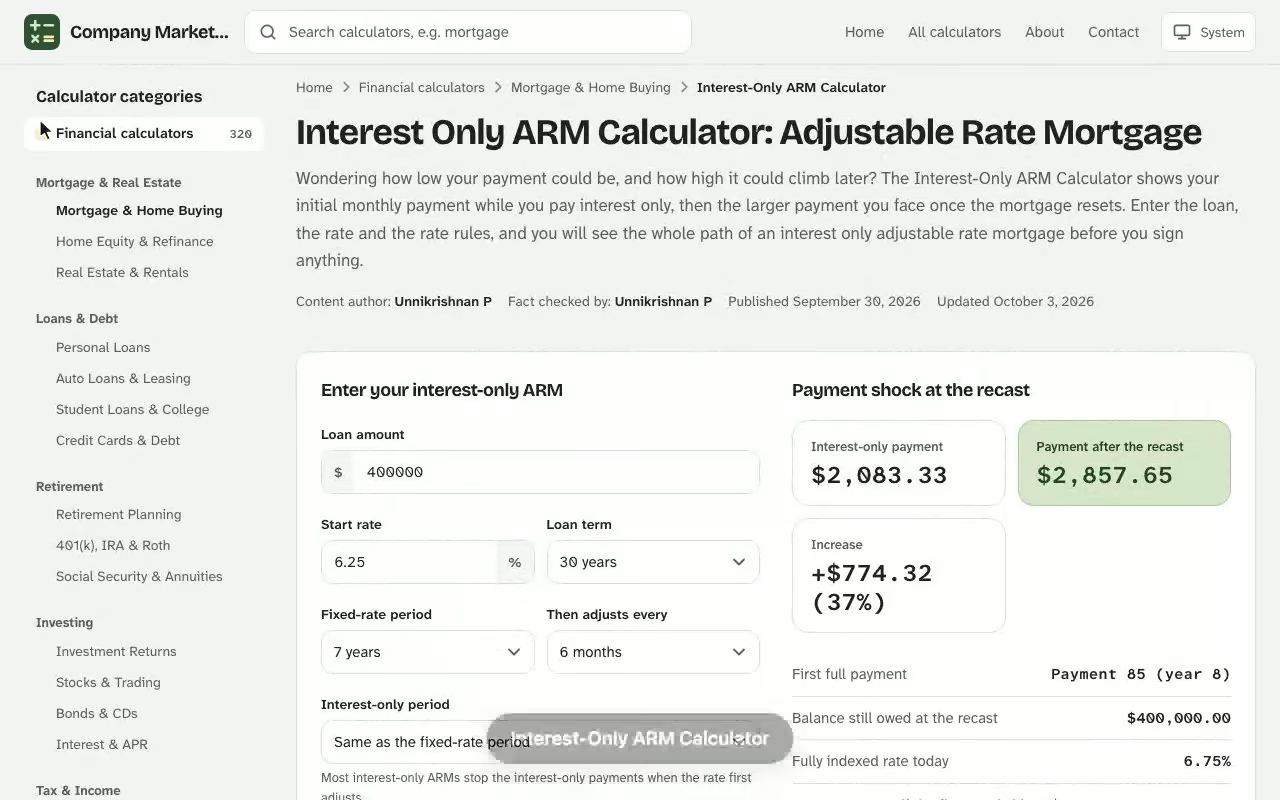
Interest-Only ARM Calculator. Wondering how low your payment could be, and how high it could climb later? The Interest-Only ARM Calculator shows your initial monthly payment while you pay interest only, then the larger payment you face once the mortgage resets. Enter the loan, the rate and the rate rules, and you will see the whole path of an interest only adjustable rate mortgage before you sign anything. Try the amortization calculator online to run your own numbers — everything is calculated in your browser and nothing you enter is stored or sent anywhere.
Payment shock at the recast
Interest-only payment
–
Payment after the recast
–
Increase
–
First full payment–
Balance still owed at the recast–
Fully indexed rate today–
Recast payment if the first cap is hit–
Increase in that case–
Highest possible payment under the caps–
Total interest, expected path–
Total interest, worst case–
Plan for the jump
–
Year-by-year schedule
Expected path: the rate and payment at the end of each year, with the payment if every adjustment hits its cap alongside.
Year
Rate
Monthly payment
Interest
Principal
Balance
Worst-case payment
Results are estimates for educational purposes and are not financial, tax or legal advice.
How the Interest-Only ARM Calculator Works
An interest only ARM is an adjustable-rate mortgage in which you pay nothing toward the principal for the first several years. Your payment covers the interest that accrues on the loan, and the balance stays exactly where it began. When the interest-only period ends, the loan is recast: the unpaid balance is spread across the remaining term, and from then on the rate can move up or down at every adjustment date. The calculator models both stages so you can compare them side by side. The free fixed vs interest-only mortgage calculator is free to use with no sign-up, and works on desktop and mobile.
Mortgage amount and starting interest rate
The mortgage amount is your original or expected loan amount, after any down payment. The starting interest rate is the annual percentage the lender quotes for the opening period. Because this opening figure is often a teaser rate set below the fully indexed level, treat it as a starting point and never as a promise.
Months rate is fixed and months between adjustments
The months rate is fixed field sets how long the fixed period lasts, and it is also the length of interest-only payments in this design. The months between adjustments field says how often the rate may change afterward; twelve months is the most common choice, so your payment changes at most once per year.
Expected adjustment and interest rate cap
The expected adjustment is the change you believe the rate will make at the first reset, added to or subtracted from your rate. The interest rate cap is the highest rate your contract allows, so the calculator never lets the projected rate rise above it. Together these two entries turn a vague worry about rising rates into a number you can plan around.
What the calculator returns
You get the starting monthly payment, the payment after the first reset, the maximum payment at the cap, the total payments across the full term and the total interest you would pay. The totals assume no prepayment of principal, so any extra money you send in will only improve them.
Interest Only Adjustable Rate Mortgage Formula
Two formulas drive every result. The first covers the interest-only stage and the second covers the stage after the loan recasts. Both use the monthly rate \(i\), which is the annual rate divided by twelve. If you want to see how the figures change, the apr calculator for adjustable rate mortgages gives you an instant result you can adjust as you go.
Payment during the interest-only period
While you pay interest only, the monthly payment is the balance multiplied by the monthly rate. No portion goes to principal, so the balance never moves.
$$\text{Payment}_{IO} = B \times \frac{r}{12}$$
Here \(B\) is the loan balance and \(r\) is the annual rate written as a decimal.
Payment after the reset point
At the reset point the payment becomes fully amortizing. The same balance must now amortize over the months that remain, using the adjusted rate:
$$\text{Payment}_{reset} = B \times \frac{i}{1-(1+i)^{-n}}$$
In this formula \(n\) is the number of months left in the loan term. Because you repay the same balance in fewer months, the principal and interest payment jumps even if the rate itself never changed. That jump explains why people who focus on the opening payment alone get surprised.
How the rate is set at each adjustment
After the introductory stage, a new rate equals a published index plus the lender's margin. The margin is fixed in your contract, while the index moves with the market. Every adjustment is then limited by the caps described below.
Worked Example: A $412,500 Interest Only ARM Mortgage
Suppose you borrow $412,500 on a 7/1 interest only ARM mortgage with a 30-year term. Your initial interest rate is 6.125%, so the interest-only payment is \(412{,}500 \times 0.06125 \div 12\), or $2,105.47 a month for the first 84 months. After 84 months you still owe the full $412,500, and you have paid $176,859.38 in interest with nothing to show against the balance.
Stage
Rate
Months
Monthly payment
Interest-only period
6.125%
84
$2,105.47
After reset, expected adjustment of +1.25%
7.375%
276
$3,108.04
After reset, rate adjusted by the full 2% first cap
8.125%
276
$3,306.43
Lifetime interest rate cap of 11.125%
11.125%
276
$4,149.18
Reading the payment shock
With a 1.25% expected adjustment the payment rises from $2,105.47 to $3,108.04, an increase of $1,002.57 or about 47.6%. If the rate climbs by the full 2% first rate cap, your payment reaches $3,306.43, and at the lifetime ceiling the maximum payment would be $4,149.18. Over the full term, the projected total payments come to $1,034,679.57, which includes $622,179.57 of total interest if the rate holds at 7.375%.
How the monthly payment builds from the interest-only start to the recast and cap payments.
Interest-Only ARM vs 30-Year Fixed Rate
The natural comparison is a 30-year fixed loan. A fixed rate locks one payment for life, while an I-O loan trades that stability for a lower start. Using the same $412,500 and a fixed-rate mortgage at 6.75%, the payment is $2,675.47.
Measure
7/1 interest-only ARM
30-year fixed-rate mortgage
Starting monthly payment
$2,105.47
$2,675.47
Balance after 84 months
$412,500.00
$374,498.33
Payment after month 84
$3,108.04 (expected)
$2,675.47
Total interest over the loan
$622,179.57
$550,668.17
Where the interest-only option wins
The ARM saves you $570.00 a month at the start, which matters if you plan to sell or refinance inside the opening window, or if your income is expected to grow. That monthly gap can be redirected into savings, a business, or extra principal.
Where the fixed option wins
A fixed loan builds equity from the first payment. After 84 months the borrower on the fixed loan owes $374,498.33, which is $38,001.67 less than the interest-only balance. It also removes the risk of rising rates altogether, and it keeps total interest lower.
After 84 months the interest-only balance is unchanged, while the fixed loan has repaid $38,001.67.
Stress-Testing a Hybrid ARM Before You Sign
A nurse practitioner earning $8,640 a month before tax is offered a 5/1 interest-only loan of $287,350 at 5.875% for a condo she plans to keep about eight years. Her lender's guideline caps housing costs at 28% of gross income, which works out to $2,419.20 a month, so she wants to know whether the loan still fits after the fixed stretch ends.
She enters the loan amount, the 5.875% starting rate, 60 months fixed, 12 months between adjustments, and an expected adjustment of +1.50%. The interest-only payment comes back at $1,406.82, or 16.3% of her income, comfortably under the guideline. Next she looks at the recast line: with 300 months left and the rate at 7.375%, the payment is $2,100.18, or 24.3% of income, still below $2,419.20.
Then she raises the adjustment to the full 3-point first cap in her loan estimate, which puts the rate at 8.875%. The interest-only ARM payment at that rate is $2,386.88, or 27.6% of income. That leaves only $32.32 of room under the guideline, so the worst case passes, but barely.
The result tells her two things. The loan is affordable on the expected path, and she should not borrow a dollar more than $287,350. Her next step is specific: she asks the lender to confirm in writing that the first adjustment cannot exceed 3 points, and she sets up a $300 monthly transfer into savings during the five fixed years, so a reset at the cap would not strain her budget.
3/1 ARM, 5/1 ARM, 7/1 ARM and 10/1 ARM Structures
Most hybrid ARM products follow the same pattern: the first number is how many years the rate stays put, and the second is how often it adjusts afterward. A longer opening stretch means a longer wait for rate adjustments, but it also leaves fewer months to repay the principal once the interest-only years end.
ARM type
Interest-only months
Remaining term in months
Payment at 7.375% on $412,500
3/1
36
324
$2,938.83
5/1
60
300
$3,014.88
7/1
84
276
$3,108.04
10/1
120
240
$3,291.61
The gap between the interest-only payment and the recast payment grows with the length of the interest-only stage.
5/1 ARM and 7/1 ARM
A 5/1 ARM is the most common choice because the honeymoon period covers the typical time people stay in a home. A 7/1 ARM adds two quiet years for a slightly higher opening rate.
3/1 ARM and 10/1 ARM
The 3/1 ARM gives you the cheapest start and the earliest reset. The 10/1 ARM behaves almost like a fixed loan for a decade, but its recast payment is the steepest, since only 240 months remain.
Rate Caps and Payment Caps on an ARM Loan
Every ARM loan carries limits on how far the rate can move. They are written as three numbers, such as 2/2/5: the first-adjustment limit, the limit on each later adjustment, and the lifetime ceiling.
Interest rate cap
The interest rate cap protects you from an unbounded climb, yet it is still a high ceiling. In the example, a 5-point lifetime cap on a 6.125% start lets the rate reach 11.125%. Plan around that figure, not the opening rate.
Payment cap and negative amortization
A payment cap limits how much the monthly bill can rise in a year instead of limiting the rate. It sounds friendly, but when the cap holds the payment below the interest owed, the unpaid interest is added to the balance. That is negative amortization, and it is the main hazard of a payment-option ARM. If you reach the maximum balance, the loan will recast and you may owe a balloon payment at the end.
Costs Beyond Principal and Interest
The calculator's results cover principal and interest only. Your real housing bill also includes property taxes, homeowner's insurance, PMI if your down payment is small, and HOA fees where they apply. Closing costs can be rolled into the loan, which raises the mortgage amount and every figure above. Request an amortization schedule from your lender after the recast date, so you can see how the balance falls.
Getting a trustworthy answer from the interest-only adjustable rate mortgage calculator depends on the fields you fill in. Copy the mortgage amount and starting rate from your loan estimate, then set the length of the opening stretch, the months between adjustments, the expected adjustment and the interest rate cap. Run it three times: once with an adjustment of zero, once with your own forecast, and once with the adjustment that reaches the cap.
Read two results each time: the starting monthly payment and the maximum payment. The first tells you what you can afford today and the second what you must still afford after the recast. Keeping the monthly payments of both stages side by side shows whether a loan only works on the flat path, in which case it is a poor choice.
Making an IO ARM Work With Extra Payments
The calculator's totals assume no prepayment, so any extra principal you send will beat them. Using the $412,500 example, sending $500 a month toward principal for the 84 interest-only months would retire $42,000 before the reset. Re-enter the lower balance as the mortgage amount and the recast payment falls in proportion, so the monthly payments you owe after the reset shrink too. The $570 monthly gap between the ARM and the fixed loan is the natural source for those extra payments, and a hybrid structure works best when the date you expect to leave lines up with the end of the fixed stretch.
Who Should Consider an I-O Loan
These interest-only adjustable rate home loans suit home buyers who have a firm exit plan, or a predictable jump in earnings.
Good fits for an interest-only ARM
Buyers who expect to sell or refinance before the introductory period ends
Borrowers with irregular or bonus-heavy income who can make large principal payments when cash arrives
Real estate investors who prefer low monthly payments to build positive cash flow
Poor fits to avoid
Take the calculator's cap-level result and hold it against your income. If that cap-level payment is unaffordable, the loan is a poor fit, because a falling home value can block a refinance when you need one. A strong credit score helps you qualify for a lower margin, and the market you buy in matters less than that worst-case number.
See how the Interest-Only ARM Calculator works: change the inputs and the payment after the recast updates instantly. Enter your own numbers in the calculator above.
Next steps before you apply
Keep the flat, expected and cap scenarios from the calculator in front of you when you talk to two lenders. Ask each for a conforming quote to compare and get pre-approved, and ask whether a 15-year or other fully amortizinghome loan fits your finance goals better than the interest-only structure.
Interest-Only ARM Calculator questions
What is an interest-only ARM?
It is an adjustable-rate mortgage where you pay only the interest for an opening period, so the principal balance does not fall. After that period the loan is recast and the rate can adjust at set intervals.
What happens when the interest-only period ends?
The unpaid balance is spread over the remaining months of the 30-year term, so the payment includes principal and usually jumps even if the rate stays the same. A rate adjustment can push it higher or lower.
How does a 5/1 or 7/1 interest-only ARM differ from a 10/1?
The first number is the years the rate is fixed and the second is how often it adjusts afterward. A longer fixed period delays the reset, but leaves fewer months to repay the principal, so the recast payment is higher.
What does the interest rate cap do?
It is the highest rate your mortgage allows, so the projected rate never rises above it. Periodic and payment caps may also limit each adjustment, so check all of them with your lender.
Is an interest-only ARM cheaper than a fixed-rate mortgage?
It is cheaper at the start because you pay no principal, but you build no equity during that time and total interest is usually higher over the full loan if rates rise.
Does the calculator include taxes, insurance and PMI?
No. Results cover principal and interest only. Property taxes, homeowner's insurance, PMI and HOA fees come on top.
Can I pay down principal during the interest-only period?
Many lenders allow it. The totals here assume no prepayment, so extra principal payments would lower the balance that gets recast and reduce later payments.